Why consider low-code for SaaS development?
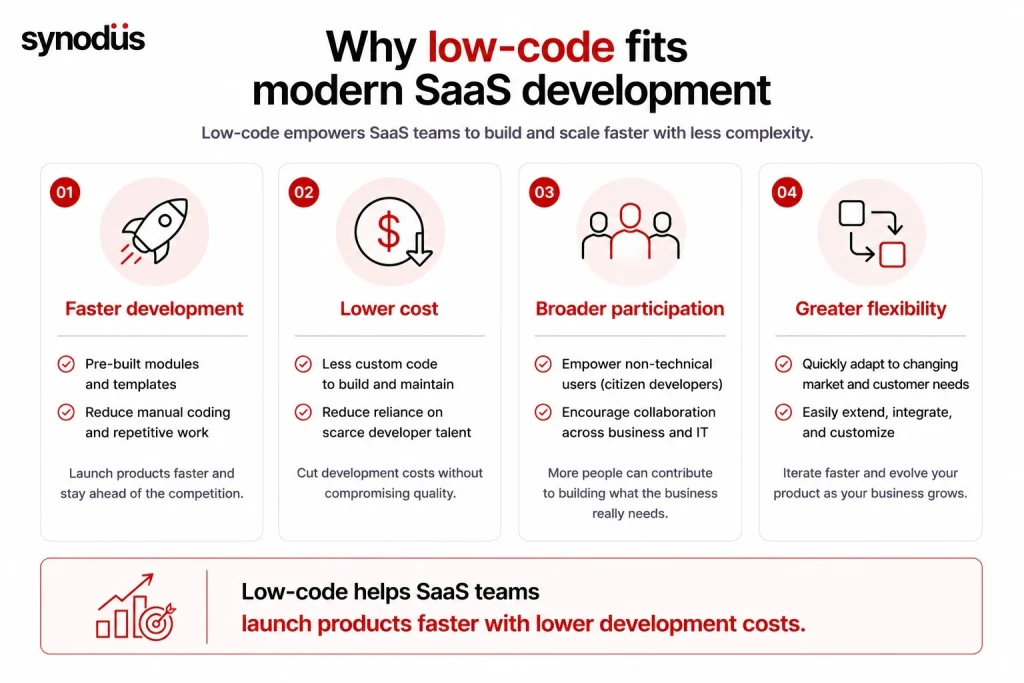
Faster development
In the digital age, time equals money. By using pre-built modules and templates, low-code lets developers skip writing code from scratch and focus on customizing existing components to fit specific needs. This shortens time to market and keeps businesses competitive in fast-moving markets.
Cost savings
Low-code reduces reliance on high-end technical resources like senior software engineers and consultants, which cuts development costs. That helps small and medium enterprises stay competitive and keep innovating on a limited budget. For the full picture, see our breakdown of low-code for enterprise.
Wider participation in building
Low-code’s user-friendly design lets non-technical users create and deploy custom applications quickly, without extensive training. This encourages more people across the organization to take part in building software, promoting shared ownership.
Greater flexibility
Traditional development can be slow to respond to changing markets and customer needs. Low-code offers more flexibility, letting you quickly modify and customize applications as business needs evolve.
The future shift: AI-native and vertical SaaS
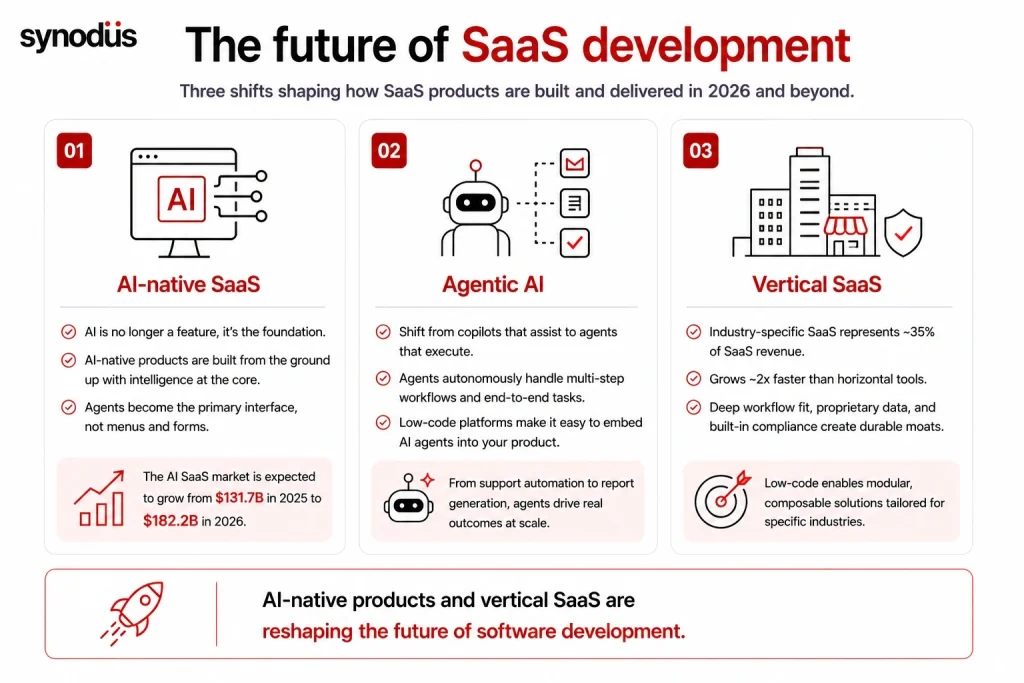
The SaaS landscape is changing fast, and if you are building a product now, three shifts matter most.
First, AI has moved from a feature to the foundation. The industry now distinguishes AI-enabled SaaS, which bolts AI onto existing products, from AI-native SaaS, built from the ground up with AI at its core, where agents are the primary interface rather than menus and forms. The AI SaaS market is expected to grow from around $131.7 billion in 2025 to $182.2 billion in 2026, and buyers now ask not whether a product has AI, but how well it uses it.
Second, agentic AI is the defining change. SaaS is shifting from copilots that assist to agents that execute multi-step workflows on their own, from resolving support tickets to generating reports. Low-code platforms are a fast way to embed these AI agents into your product without building the orchestration from scratch.
Third, vertical SaaS is winning. Industry-specific products now represent about 35% of SaaS revenue and grow roughly twice as fast as horizontal tools, because deep workflow fit, proprietary data, and built-in compliance create natural moats. Low-code makes it practical to build a vertical product on a modular, composable backbone. One more shift to plan for: pricing is moving from per-seat toward usage- and outcome-based models, since a single AI agent can do the work of several users.
A successful low-code SaaS story
Munich Re HealthTech (MRHT), the provider of SMAART, a digital solution for health insurance underwriting and pricing, struggled with a custom-built system that was costly to scale and fell short on usability. Wanting to offer SMAART as a scalable service, the team rebuilt it on a low-code platform, choosing a cloud-compatible, user-friendly technology.
The results, drawn from the company’s published case study, were notable: the new SMAART system shipped in three to four months, became a SaaS application that cut insurers’ process times from days to minutes, stayed cost-effective and low-maintenance, and handled advanced needs like data residency without writing code. Client feedback praised its security, scalability, and compatibility. It is a useful example for any business weighing a low-code SaaS build.
Steps to build a SaaS with low-code
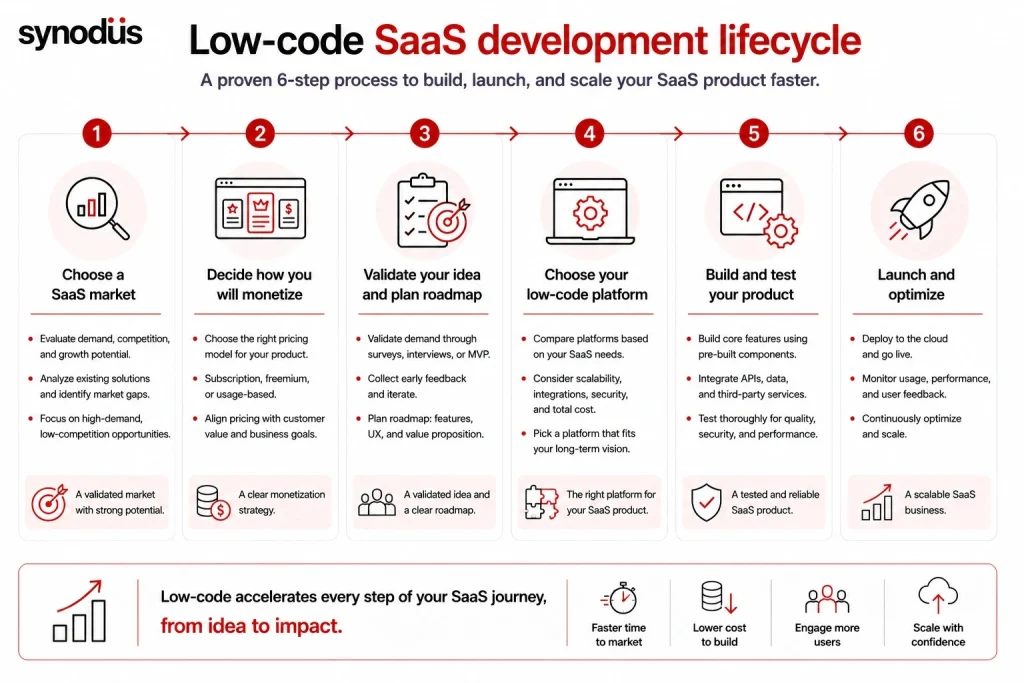
Building a SaaS product on a low-code platform can be a simplified but systematic process. Here are six essential steps.
Step 1: Choose a SaaS market
Market selection determines your features and the problems you solve. Weigh demand, competition, and growth potential, analyze existing solutions, and find gaps. The best markets usually combine high demand with low competition, and in 2026, focused verticals often beat broad horizontal plays.
Step 2: Decide how you will monetize
Determine your revenue model early, since it guides development decisions. Common SaaS models include:
- Subscription: users pay a recurring fee, monthly or yearly, for access.
- Freemium: basic features are free, with advanced features behind a premium tier.
- Usage-based: customers pay based on how much they use, which is increasingly common for AI-heavy products.
Step 3: Validate your idea and plan your roadmap
Before investing in development, validate demand through surveys, customer interviews, or a minimum viable product for early feedback. Then plan a roadmap covering core features, user experience, and your value proposition, which gives your team clear direction and realistic expectations.
Step 4: Choose your low-code tech stack
With so many platforms available, focus on the ones whose strengths match SaaS development. For example, Creatio suits sales and marketing apps, Microsoft Power Apps suits internal tools, and Salesforce suits mobile apps. Weigh every feature before deciding, and consider open-source low-code options for a cost-effective start. Our review of the top low-code platforms compares pricing, features, and best-fit use cases.
Step 5: Design, develop, and test
Design a user-friendly interface using UX best practices so it is intuitive and meets user needs. Then build your product on your chosen platform, dragging and dropping components and adding custom code where needed. Finally, run rigorous functionality, usability, performance, and security testing, and fold the feedback into the final product.
A tip for startups: low-code is the fastest, cheapest way to build an MVP for validation, pitching, and testing. As the product grows, you can migrate from low-code to a more robust custom stack of your own to scale further, so you are not locked into the platform long term.
Step 6: Launch your low-code SaaS product
Prepare a launch plan covering your marketing and sales strategy, such as a website, social media, and email campaigns, and set up customer support before you go live. Remember that launch is just the beginning: monitor feedback and usage data continuously, and keep shipping improvements, since SaaS products need ongoing development to stay competitive.
Top low-code SaaS platforms
As businesses look to move faster, these six platforms offer strong SaaS-building capabilities. Pricing changes often, so confirm current details with each vendor.
| Platform | Best for | Notable strength | Free option |
|---|---|---|---|
| Salesforce Platform | Mobile and CRM-centric apps | Deep Salesforce ecosystem, AI agents | No |
| Creatio | Sales and marketing apps | Composable apps, AI/ML models | 14-day trial |
| Oracle APEX | Data-heavy web apps | Scalable, secure, spreadsheet-to-app | Free with Oracle DB |
| Microsoft Power Apps | Internal tools and automation | 400+ connectors, Power Platform suite | Trial available |
| Mendix | Web and mobile apps | Full lifecycle, AI-assisted development | Free community edition |
| Kissflow | BPM and workflow automation | Process automation focus | No |
Salesforce Platform
The Salesforce Platform integrates seamlessly with Sales Cloud, Service Cloud, and Marketing Cloud, so you can build end-to-end solutions across Salesforce products. It follows per-user, per-month pricing and now embeds AI agents through Agentforce. See our guide to the Salesforce low-code platform.
Creatio
Started as a CRM platform, Creatio offers robust features for sales and marketing apps, and you can build mobile, on-premises, or cloud software. It supports SOAP and REST integration, a library of composable apps and widgets, and AI and machine learning models, with a 14-day free trial.
Oracle APEX
Oracle APEX is known for scalability and security across web and mobile. You can turn a spreadsheet into a SaaS web app in a few clicks, customize with JavaScript, HTML, CSS, SQL, and PL/SQL, import and export via REST web services, and host on Oracle Database Cloud.
Microsoft Power Apps
Rated a low-code leader by Gartner, Power Apps rapidly builds applications for internal use, alongside Power BI for analytics, Power Pages for web pages, and Power Automate for automation. It offers pre-built and custom API models, 400+ connectors, and strong security. See our analysis of the Power Apps low-code platform.
Mendix
Founded in 2005, Mendix is a seasoned platform for building web and mobile apps with minimal coding. It offers rapid application development, a cloud-based platform, AI-assisted development and deployment, and a free community edition alongside paid tiers.
Kissflow
Established in 2013, Kissflow focuses on business process management and workflow automation. It specializes in streamlining workflows, is used by thousands of organizations, and offers small business, corporate, and enterprise editions.
As a Microsoft Power Platform specialist, Synodus offers a custom low-code development service for everything from internal tools to SaaS products. We blend agile flexibility with waterfall predictability and work on fixed pricing, so we absorb the risk of overruns, an approach trusted by companies like BOC Aviation, KPMG, and Unilever across more than 100 projects.
What to be aware of when using low-code for SaaS
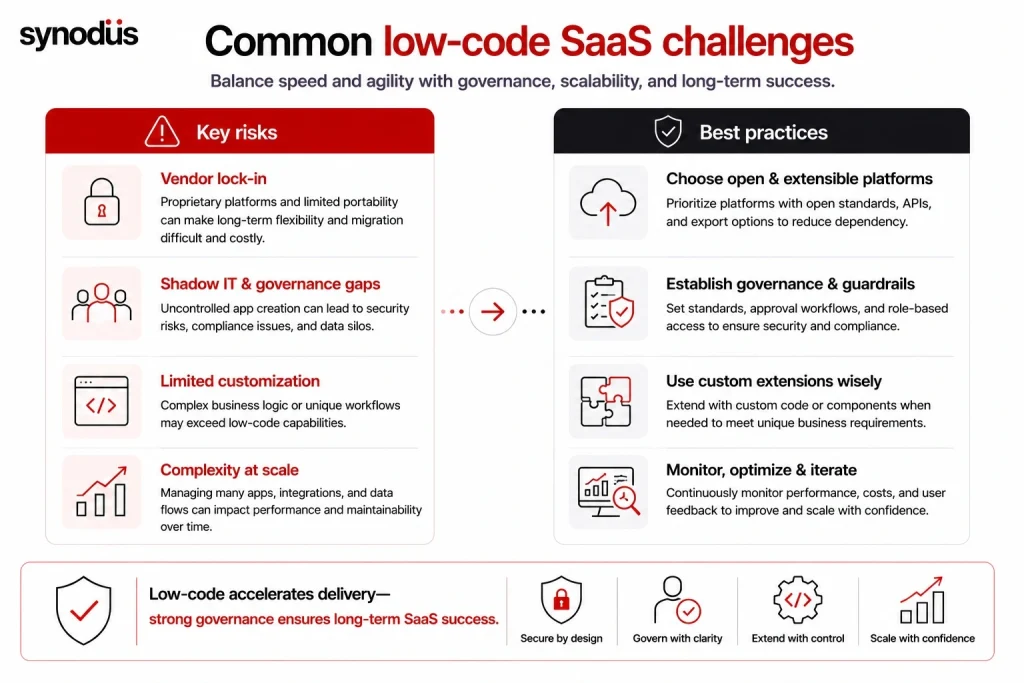
Low-code has real benefits, but plan for these challenges:
- Vendor lock-in: relying on one vendor is risky, so choose a platform that generates standardized, editable code, and review the vendor’s policy on modifying your app after you leave.
- Shadow IT: unauthorized use of low-code tools adds risk and wastes resources. Regular monitoring and low-code governance help manage it.
- Limited customization: you may hit limits that force custom coding, so confirm the platform’s customization ceiling and that your team can integrate custom code before committing.
- Underestimated complexity: low-code is simpler than hand-coding but still rewards basic coding knowledge, so do not underestimate the skills needed to use it fully. See our guide to low-code challenges.
Frequently asked questions
Yes. Low-code is well suited to building SaaS products, especially MVPs and mid-complexity applications, cutting development time and cost. Munich Re HealthTech, for example, rebuilt its SMAART underwriting product as a SaaS app on low-code in three to four months.
Very. Low-code is the fastest, cheapest way to build an MVP for validation and pitching. Many startups build on low-code first, then migrate to a custom stack as the product scales, which avoids heavy upfront cost.
AI is becoming the core of SaaS, not an add-on. In 2026, products are shifting to AI-native designs with agents that act autonomously, and low-code is a fast way to embed AI agents into a SaaS product without building the orchestration from scratch.
It depends on your product. Salesforce and Creatio suit CRM and customer-facing apps, Power Apps suits Microsoft-based tools, Oracle APEX suits data-heavy apps, and Mendix suits full web and mobile builds. Match the platform to your use case and ecosystem.
Wrapping up
Building a SaaS product with low-code streamlines development and opens it to a broader range of creators, though it still needs strategic planning and execution. Choosing the right market, monetization model, and platform, then iterating on user feedback, are the keys to success, and in 2026, planning for AI-native design and vertical focus matters more than ever.
If you would rather have experts build it for you, Synodus offers a low-code development service that turns your data into apps 10x faster and cuts development costs by half, with a delivery model that balances agile flexibility and predictable results. Book a free consultation to find the right fit for your business.