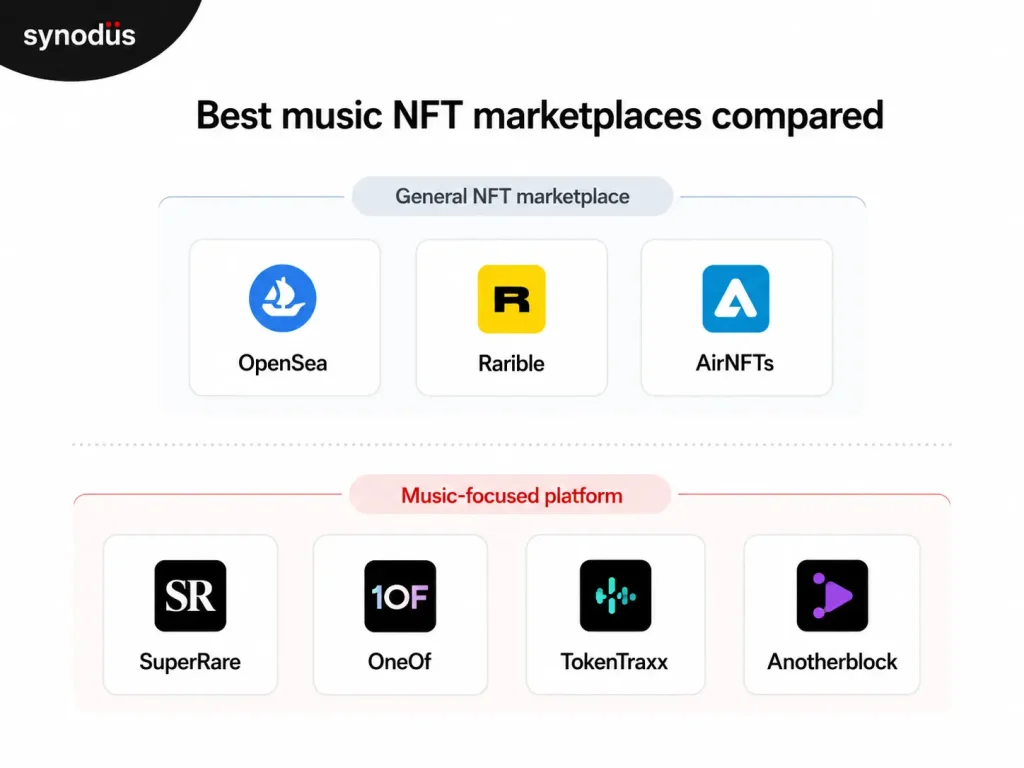
Best music NFT marketplaces compared
The platforms below are not ranked by a single metric. They were selected to represent different active models, from broad NFT marketplaces to music-specific drops and royalty-linked music assets.
| Platform | Best for | Type | Blockchain / payment model | Creator access | Key consideration |
|---|---|---|---|---|---|
| OpenSea | Broad exposure and secondary-market trading | General NFT marketplace | Multichain; crypto-based trading | Open listing for supported assets | Large NFT audience, but music discovery is not specialized |
| Rarible | Multichain creators and collectors | General NFT marketplace | Multichain marketplace | Open marketplace with collection support | Useful for general NFT reach rather than music-first discovery |
| SuperRare | Curated audiovisual and digital-art releases by musicians | Curated digital art marketplace | Ethereum; ETH/USDC and selected card checkout | Artist approval required for minting | Strong curation, but not a dedicated music marketplace |
| OneOf | Music collectibles and fan experiences with easier onboarding | Music, sports and lifestyle NFT platform | Crypto plus debit/credit card options | Verified artist storefront model | Designed for non-crypto-native fans as well as collectors |
| TokenTraxx | Music-specific drops, memberships and creator projects | Music-focused Web3 platform | Supports several chains for GetMinted projects | Membership-based creator program | Built around music releases and creator support; TRAXX token has limited liquidity |
| Anotherblock | Eligible investors exploring royalty-linked music assets | Music rights investment platform / tokenized releases | Contract-defined music rights and royalty participation | Curated rights-holder offerings; eligibility requirements apply | Rights and investor eligibility depend on each offering and agreement |
| AirNFTs | Low-friction minting on multiple lower-cost networks | General NFT marketplace with music category | BSC, Ethereum, Fantom and Polygon | Open minting via connected wallet | Accessible tooling, but lower volume and less music-specific curation than larger platforms |
Best music NFT marketplaces in detail
1. Open Sea
OpenSea remains one of the broadest places to discover and trade music-related NFTs alongside art, gaming assets, collectibles, and other categories. Its current music discovery page includes audio-visual projects and music-linked collections, making it a practical option for collectors who already use a general NFT marketplace.
For artists, the main advantage is reach rather than music-specific tooling. A release competes for attention with many other NFT categories, so OpenSea is better suited to creators who already have a collection, community, or broader Web3 strategy than to musicians looking for a dedicated music release workflow.
Main limitation: music discovery and fan engagement are less specialized than on dedicated music platforms.
2. Rarible
Rarible is a multichain NFT marketplace that supports collections across several ecosystems. Not music-specific, but musicians can use general NFT collection infrastructure to list or trade music-linked digital assets while reaching collectors who already browse multiple NFT categories.
The platform is most useful when music NFTs are part of a broader collection strategy rather than a standalone music product. Artists should confirm the current chain, media, royalty, and storefront options before choosing Rarible for a release.
Main limitation: music discovery is secondary to broader NFT collection discovery.
3. SuperRare
SuperRare is a curated Ethereum marketplace focused on digital art, but musicians and audiovisual artists have also used it for music-linked works. SuperRare has featured releases from musicians such as Don Diablo and 3LAU, and current listings continue to support audiovisual and video-based digital works.
Its positioning is closer to a curated digital-art gallery than a conventional music store, making it a better fit for limited, visually driven, collectible releases than for artists who want to mint large music catalogs or run an open self-service storefront.
Creator access is selective. SuperRare’s current help center states that only approved artists can mint, while secondary trading supports offers, auctions, and fixed-price listings.
Main limitation: selective creator access and a strong digital-art orientation.
4. OneOf
OneOf combines music, sports, lifestyle, and entertainment NFTs with a consumer-friendly purchase experience. Its platform allows users to buy with crypto or debit/credit cards and supports selling, gifting, and trading, which lowers the onboarding barrier for fans who do not already use crypto wallets.
OneOf’s artist storefront program is positioned for musicians and managers who want to mint and sell NFTs under a verified artist profile. The platform emphasizes fan utility such as VIP tickets, experiences, and signed merchandise, so it is better suited to music collectibles and fan engagement than to purely speculative trading.
Main limitation: broader entertainment platform rather than a music-only marketplace.
5. TokenTraxx
TokenTraxx is one of the clearest current examples of a music-focused NFT platform. Its GetMinted program lets members submit music for NFT projects and currently supports single-chain or multi-chain drops across Bitcoin, Ethereum, Polygon, Traxx, and Zilliqa, alongside optional custom smart contracts and multi-marketplace releases.
The platform connects NFT releases with music-specific community activity such as listening sessions, artist promotion, and live events, making it more relevant to musicians who want a guided Web3 release process than to collectors looking for broad NFT liquidity.
One caveat worth noting: the native TRAXX token has faced liquidity challenges in 2026, which affects staking rewards and token-based membership benefits. Artists interested in TokenTraxx should evaluate the platform’s current community activity independently before committing to a release.
Main limitation: membership-based creator workflow and limited TRAXX token liquidity.
6. Anotherblock
Anotherblock sits at the edge of the music NFT marketplace category. Rather than operating like a general collectibles marketplace, it focuses on music-rights investment, while its Web3 catalog includes tokenized releases tied to defined royalty participation.
The legal distinction matters. Current access and investor requirements depend on the offering, while Anotherblock ownership agreements specify the royalty share attached to a token and make clear that token ownership does not automatically transfer copyright in the recording or composition. The holder receives only the economic and usage rights explicitly stated in the agreement.
Main limitation: specialized music-rights investment model, not a standard open marketplace for artists minting collectible tracks.
7. AirNFTs
AirNFTs operates a general NFT marketplace with a dedicated music category and supports minting and trading across BSC, Ethereum, Fantom, and Polygon. Its product is designed around relatively simple wallet-based creation, listing, and auction flows rather than a curated music release process.
AirNFTs can be approachable for creators experimenting with tokenized tracks, videos, or music-related collectibles on lower-cost networks. The trade-off is that artists receive less music-specific discovery and editorial context than on platforms built primarily around music communities. Trading volume is also lower compared to major general marketplaces.
Main limitation: general marketplace positioning, lighter music-specific curation, and lower volume than major platforms.
What is a music NFT and what can it represent?
A music NFT is a blockchain token associated with music or a music-related digital asset. The token can point to audio, video, artwork, metadata, access rights, or other benefits defined by the creator or issuer.
What the buyer actually owns depends on the terms attached to that NFT. Buying the token does not automatically make the collector the copyright owner, master-rights holder, publisher, or original creator of the music.
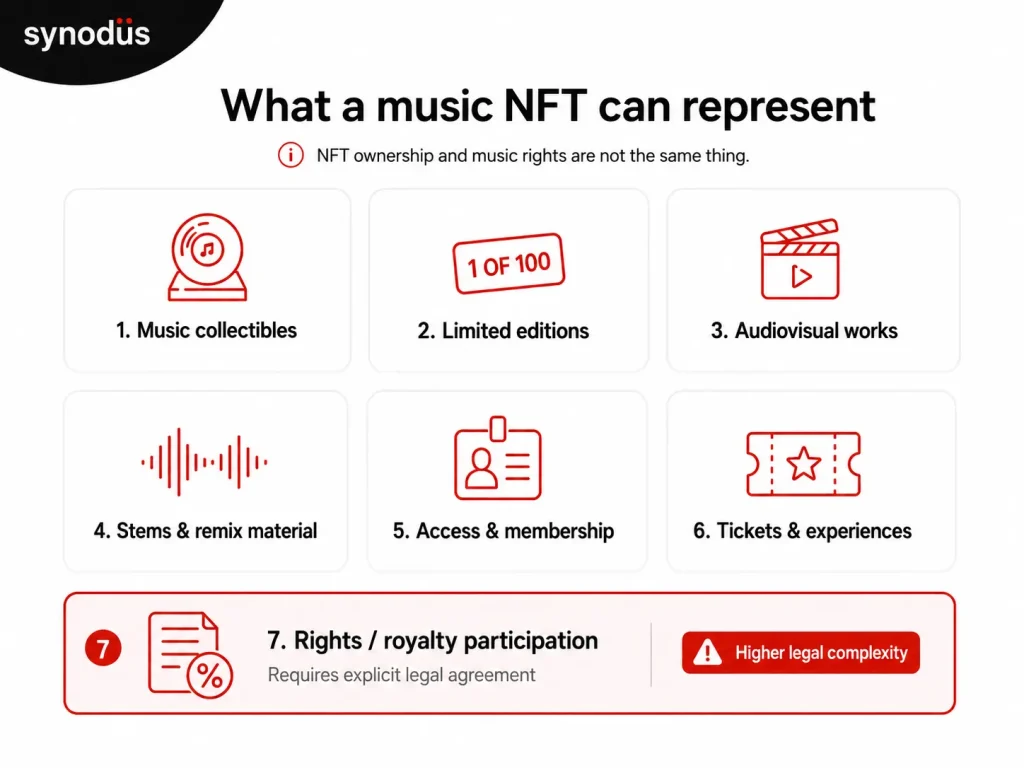
NFT ownership and music rights are not the same thing. Any copyright, commercial-use right, royalty participation, or licensing right must be explicitly granted by the issuer or a separate agreement.
Music NFTs are not limited to selling a song file. The token can be used as the ownership or access layer for several different music products, which is why the marketplace should be chosen after the release model is clear.
- Music collectibles: a token associated with a track, album, demo, or unreleased recording
- Limited editions: multiple collectible copies of the same release with a fixed supply
- Audiovisual works: music paired with animation, generative visuals, video, or digital art
- Stems and remix material: tokenized components or versions used for collecting or fan participation when the license allows it
- Access and membership: NFTs that unlock events, communities, presales, merchandise, gated content, or other benefits
- Tickets and experiences: tokens connected to concerts, meet-and-greets, listening sessions, or other fan experiences
- Rights or royalty participation: only when a contract or legal agreement explicitly grants a defined economic right
The last category requires separate evaluation. A token representing a contractual share of streaming royalties creates legal and compliance questions that do not apply to a simple collectible track or artwork.
How to choose a music NFT marketplace
The right marketplace depends on what the NFT represents and who you expect to buy it. A platform suited to a one-of-one audiovisual piece may be a poor fit for a fan membership drop or a royalty-linked music asset.
Start with what you want to release
Define the product before choosing the marketplace. A music NFT can represent a collectible track, an edition, an audiovisual artwork, access to an experience, a membership benefit, or a contractual right to a defined income stream. Those models have different requirements for media support, supply, pricing, resale, legal documentation, and fan experience.
Decide between a general and music-specific marketplace
General marketplaces such as OpenSea or Rarible can provide broader NFT reach and easier secondary-market discovery. Music-specific platforms can provide more relevant release context, fan engagement tools, or music-focused curation, but may have a smaller collector base.
| Decision factor | General NFT marketplace | Music-specific platform |
|---|---|---|
| Audience | Broader NFT collector base | More music-oriented audience or community |
| Discovery | Collection/category based | Can provide artist, track, release, or music-specific context |
| Creator tools | Generic minting and collection tools | May include release support, fan benefits, music metadata, or rights workflows |
| Liquidity | Potentially broader secondary-market reach | Can be narrower and more project-specific |
| Payments | Often wallet/crypto first, with some fiat options | Some platforms prioritize mainstream fan checkout |
| Best fit | Artists prioritizing general NFT reach and resale | Artists prioritizing music context, fan engagement, or specialized rights models |
Check creator onboarding
Some platforms allow relatively open minting, while others are curated, verified, invite-based, or membership-based. Check whether you can create a release immediately, need approval, or must work with the platform team before committing to a campaign.
Understand what rights the NFT represents
Do not assume that buying a music NFT transfers copyright, master ownership, publishing rights, or a right to streaming income. Token ownership and music rights are separate unless the issuer explicitly connects them through a license, contract, or ownership agreement. The full breakdown of what a music NFT can and cannot represent is covered in the section above.
Compare the total cost
Separate marketplace fees from blockchain gas, creator royalties, and payment-processing charges. A platform percentage is not a gas fee, and a creator royalty is not marketplace revenue. Check who pays each cost and whether different rates apply to primary and secondary sales. For a broader breakdown of how NFT marketplace fees work, see our NFT marketplace business model guide.
Evaluate wallet and payment experience
The right checkout experience depends on the audience. Crypto-native collectors may be comfortable connecting a wallet and paying network fees, while mainstream music fans may abandon a release if they need to manage a seed phrase or switch networks before buying. Platforms such as OneOf reduce that friction by supporting card payments and account-based onboarding.
Look at collector activity and secondary-market support
A marketplace can technically support music NFTs without having meaningful music collector activity. Check whether similar releases are being collected, whether buyers can make offers or resell assets, and whether the platform still maintains active marketplace infrastructure. Secondary trading is not essential for every music NFT: memberships, access passes, or fan collectibles may create value through utility rather than resale.
Fees and royalties on music NFT marketplaces
Fee comparisons become confusing when platform charges, blockchain fees, creator royalties, and rights-linked distributions are grouped together. They go to different recipients and apply at different stages of a transaction.
| Cost / payment | Usually paid to | What it means |
|---|---|---|
| Marketplace fee | Marketplace or protocol | Charge for facilitating the sale or marketplace service |
| Network / gas fee | Blockchain validators or network | Cost of executing an on-chain transaction |
| Creator royalty | Creator or designated recipient | Secondary-sale payment where supported and enforced |
| Payment-processing fee | Card / fiat payment provider | May apply when buyers pay by card or fiat |
| Rights-linked distribution | Contractual rights holder / token holder | Income participation defined by a music-rights agreement, not a normal NFT creator royalty |
SuperRare’s current fee documentation distinguishes its primary-sale split, a 10% secondary royalty to the original artist, and a separate 3% marketplace fee paid by the buyer. Gas is a separate Ethereum network cost.
Royalty-linked music products need an additional distinction. Anotherblock’s ownership agreements define the holder’s share of specific DSP royalties contractually, which differs from a marketplace creator royalty generated when an NFT is resold.
For a deeper explanation of NFT creator royalties and enforcement, see our NFT royalties guide.
Final thoughts
The best music NFT marketplace depends on the product being released, the audience expected to buy it, and the rights or utility attached to the token. A broad marketplace can provide wider NFT exposure, while a music-focused platform can offer more relevant release context, fan onboarding, or rights-specific functionality.
For artists and teams building a longer-term music Web3 product, the marketplace is only one layer. Rights management, wallet experience, payment flows, secondary trading, royalties, and fan utility should be defined before choosing whether to use an existing platform or build a dedicated marketplace.
If you are planning a custom platform, our NFT marketplace development guide explains the wider product and technical process.
Frequently asked questions on music NFT marketplaces
There is no single best platform for every artist or collector. OpenSea and Rarible suit broad NFT discovery, SuperRare suits curated audiovisual art, TokenTraxx focuses more directly on music releases, OneOf emphasizes fan-friendly onboarding, and Anotherblock represents a specialized music-rights investment model.
Yes. OpenSea currently maintains a music discovery category and supports music-related collections alongside other NFT categories. Artists should consider whether a broad NFT marketplace provides enough music-specific discovery and fan context for their release.
Not automatically. Buying an NFT usually gives the buyer ownership of the token, while copyright and other music rights remain governed by the creator’s terms, license, or separate legal agreement.
They can, but “royalties” covers different things. A creator may receive a marketplace royalty on eligible secondary sales, while a rights-linked NFT can give its holder a contractually defined share of music income. Neither should be assumed unless the platform and legal terms explicitly provide it.
Cost depends on the blockchain, marketplace or platform charges, contract design, media storage, payment model, and whether the artist is using a standard minting flow or a custom drop. For a reference on how development and operational costs are structured, see our NFT marketplace development cost guide.
Not always. Some platforms support card or fiat checkout, while others require a compatible wallet and cryptocurrency. Artists targeting mainstream fans should evaluate onboarding friction as carefully as the NFT features themselves.
Yes, but the market has consolidated. Several early music and NFT platforms have closed or pivoted, so artists should verify current operations before planning a release rather than relying on older marketplace lists.