How traditional development impedes agility
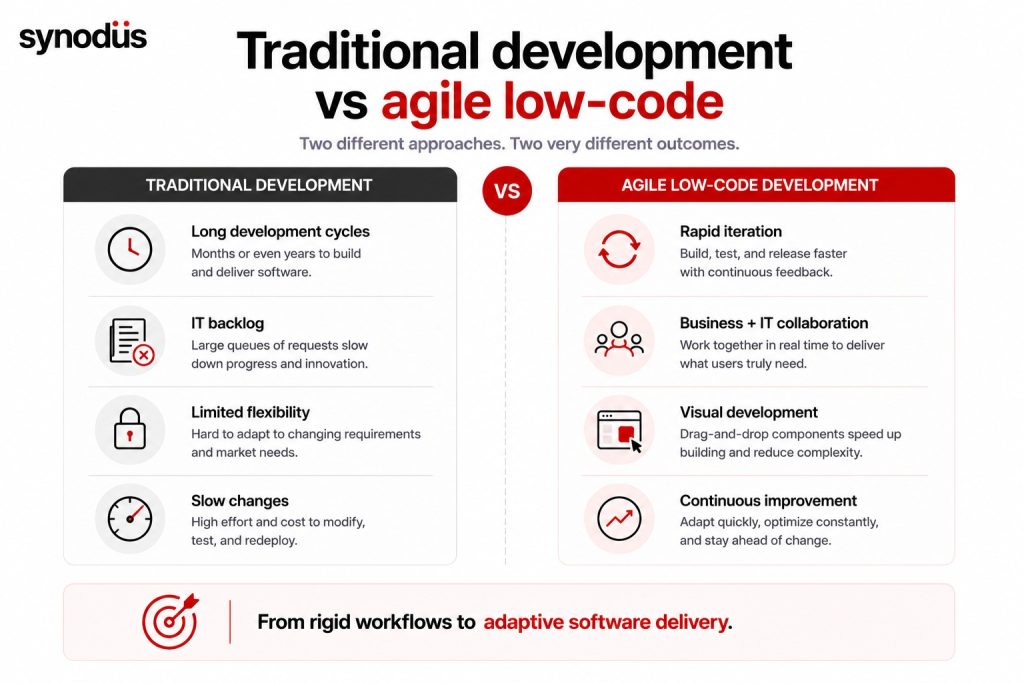
Traditional development vs agile low-code comparison for faster software delivery
In today’s fast-paced environment, agility is essential to stay competitive, yet traditional methods like the rigid waterfall approach often get in the way. The main issues include:
Rising customer expectations
Customer expectations keep climbing as new technologies reach the mainstream. Shorter product life cycles are now necessary because of agile startups, new technologies, and novel business models. Months spent hand-coding an app raise the risk that the product is outdated by the time it ships.
Business and IT work in silos
In many organizations, business and IT operate independently, often with little communication. This creates silos where the company has one agenda and IT has another, breeding an “us vs them” mentality that blocks progress, innovation, and agility.
Constraints on software design flexibility
Many IT teams still use waterfall development, which requires guessing what users will want in the future. That leaves business users hoping IT understood the big picture. IT also struggles to keep up with demand, living in a backlog of projects that take months or years, by which point the solution needs updating and the business has moved on.
Vendor lock-in
If your company buys rather than builds, it must prepare for a long-term commitment to the vendor, which raises the question of how resilient your apps will be to future change.
Costly legacy maintenance
Many companies still run old technologies that are hard to maintain and upgrade, and even when they want to modernize, they may lack the skills or resources to make the switch.
Key takeaway: traditional development can create messy workflows and a growing IT backlog, which reduces agility and slows digital transformation. Agile methodology helps, but on its own it is only as good as the tools supporting it, and this is where low-code comes in.
What is low-code?
Low-code is a development approach that emphasizes visual modeling and automation to build applications quickly. Instead of hand-coding every element, developers drag and drop pre-built components, which reduces manual coding and lets non-technical users take part. It streamlines the process so teams can build and iterate faster. To go deeper, read our guide to low-code, its types and use cases.
How low-code boosts agility
Low-code platforms are well suited to agile, letting teams iterate quickly and respond to changing requirements so they can ship faster and stay ahead. Key ways it boosts agility:
- Rapid prototyping: create, test, and refine prototypes in real time without extensive coding, which speeds time to market.
- Increased collaboration: developers and business users work closely, with business users giving input as the software is built, so it better meets real needs and reduces rework.
- Less tedious work from build to deploy: low-code eases maintenance by removing repetitive coding, and standardized, pre-tested components reduce integration problems.
- Flexibility and customization: tailor solutions to your specific needs.
- Integration with legacy systems: keep leveraging existing technology investments and avoid costly rework.
Integrating low-code and agile across the software lifecycle
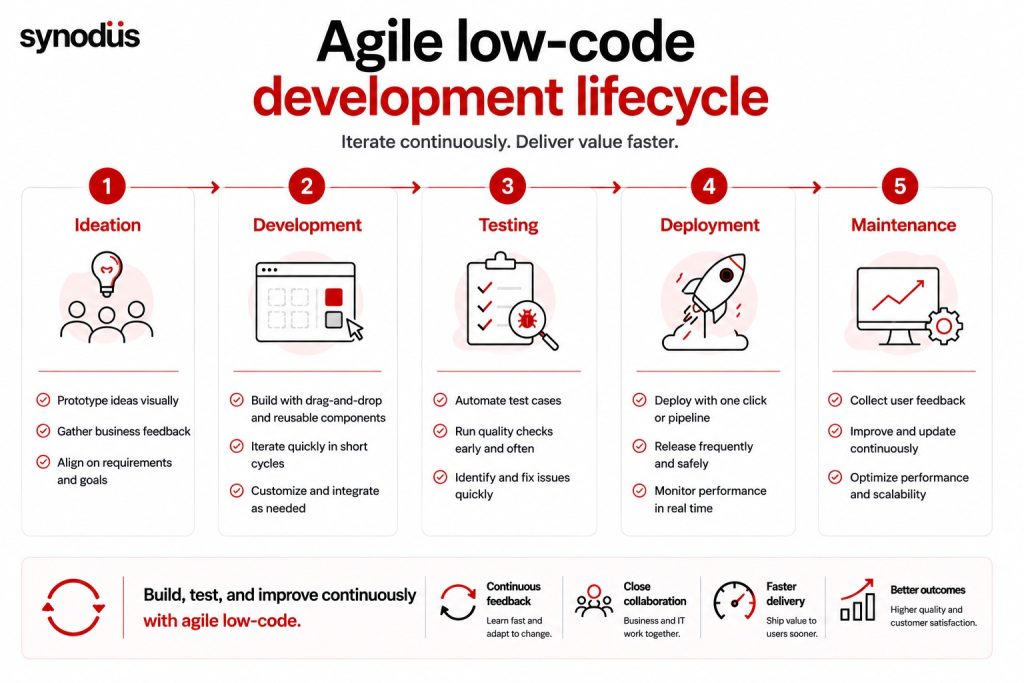
Low-code is already a strong rapid-development tool. Here is how to combine it with each stage of agile development.
1. Ideation
Ideation is where a new product or feature is conceived, and it sets the direction for everything that follows. Prioritize collaboration between business and IT here. A low-code platform helps by giving both sides a visual interface to shape the idea together: business users create a basic prototype with drag-and-drop to express their idea, then developers advise and build on it. Version control and access management let multiple people work at once, similar to Google Docs, with changes reflected in real time so the final product matches expectations.
2. Development
Agile teams break development into small pieces, build iterations, and refine each step before moving on. This can be time-consuming at scale with limited resources. Low-code with agile can accelerate and streamline development by up to 60%. It removes repetitive tasks and frees developers for higher-value work, while quick, easy code changes keep the team agile and cut the time and cost of adjustments.
3. Testing
Testing evaluates each iteration for errors, and agile teams run quality assurance to catch issues in the source code. Low-code reduces testing time with built-in troubleshooting and minimizes manual testing. You can also automate procedures like regression and performance testing, which keeps testing consistent and thorough across every iteration, improving quality and customer satisfaction. For a deeper look, see our guide to low-code test automation.
4. Deployment
An effective deployment process helps businesses streamline workflows and improve the product. With low-code, agile teams can deploy powerful applications quickly and redeploy them repeatedly to make sure the app meets requirements, which shortens the cycle and raises quality. Low-code also lets you scale applications up or down as needed and leaves room for future upgrades.
5. Maintenance
In the final stage, agile teams proactively find and fix issues, and regular maintenance helps prevent security breaches and data loss. Low-code makes this collaborative: with training and its ease of use, even business users can maintain the app without heavy IT support. As business needs change, agile low-code platforms make it easier to add new features so the application can adapt and grow.
How AI is accelerating agile low-code
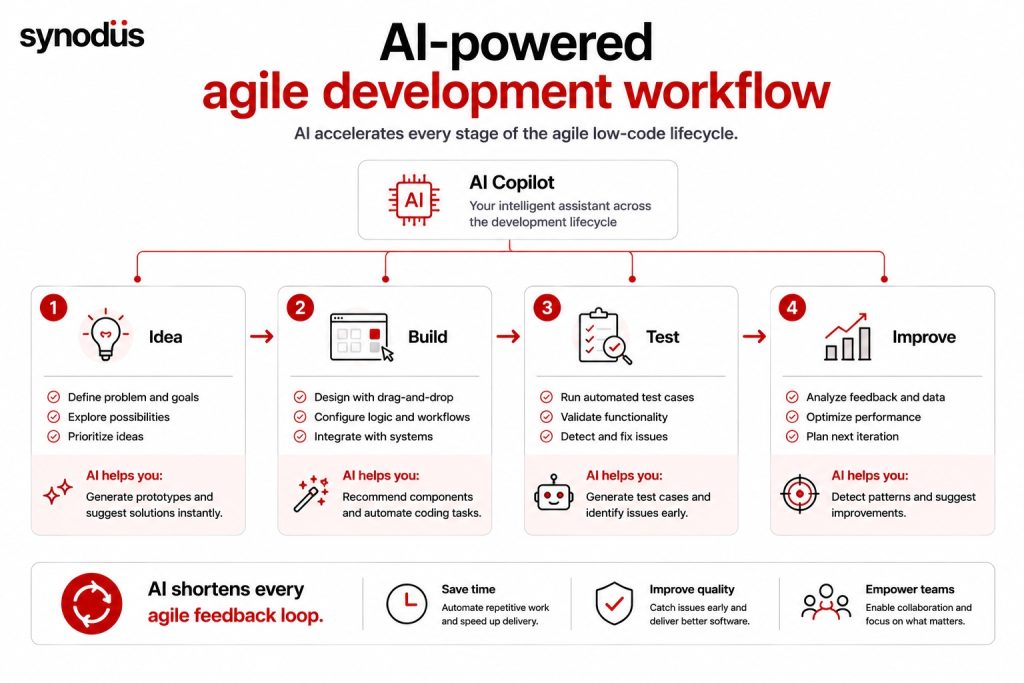
In 2026, AI is the newest force making agile low-code faster. AI copilots now speed up every stage of the lifecycle: generating a prototype from a plain-language prompt in ideation, suggesting code and components in development, generating and running test cases in testing, and flagging issues in maintenance. Used well, AI shortens each feedback loop, which is exactly what agile is built around. The caveat is governance, since AI-generated output needs review before it reaches production. To see where this is heading, read our roundup of low-code AI platforms. It is also worth noting that agile and DevOps complement each other, and low-code supports both by enabling collaboration, automation, and CI/CD across the lifecycle.
Best low-code platforms for agile development
A low-code platform that supports agile can help teams build, test, deploy, and maintain enterprise applications. Some of the best include:
- Creatio: builds business applications like CRM, BPM, and case management, with drag-and-drop, pre-built templates, and customizable components.
- Microsoft Power Apps: an enterprise-grade platform for custom business apps, with a visual designer, templates, and connectors across the Microsoft ecosystem. See our review of Power Apps as a low-code platform.
- OutSystems: an enterprise-grade platform for web and mobile apps, with a visual environment, drag-and-drop, and AI-assisted development for complex builds.
- Mendix: supports the full agile lifecycle with strong collaboration, Git version control, and a Kanban interface for team-based development.
- GeneXus: builds web and mobile apps deployable across platforms, with a visual environment, AI-assisted tools, and pre-built connectors.
How Synodus delivers agile low-code
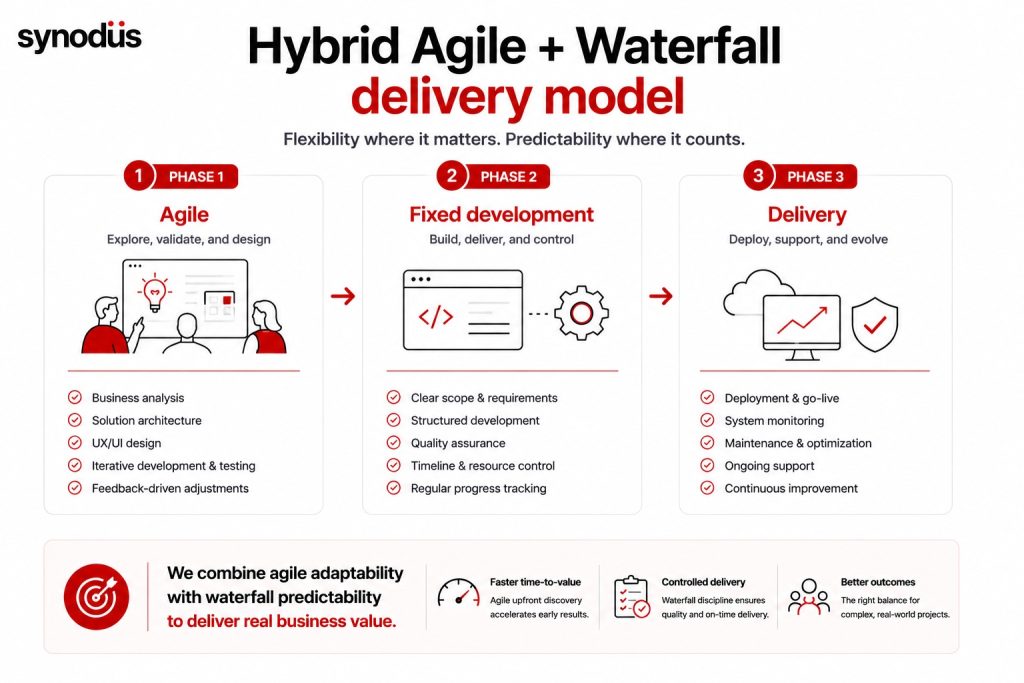
Agile is powerful, but it is not flawless. One study found that 65% of agile projects failed to deliver on time and on budget, often because pure agile skips detailed documentation, which makes accountability hard when something goes wrong. At Synodus, we learned that sticking strictly to either agile or waterfall can limit a project, so we use a hybrid approach.
We apply agile to business analysis, solution architecture, UX and UI design, and testing, where feedback loops and iteration matter most. Once requirements are defined and deadlines are set, we use waterfall for development and deployment, where predictability and control matter most. As our CTO puts it, this makes space for user feedback and iterative test cycles without compromising when mid-development changes arise. We track everything in Jira, work in sprints, and use fixed pricing, so if a project runs long or over budget, we take on that risk rather than passing it to you.
Low-code accelerates this model further, and it has earned the trust of companies like BOC Aviation, KPMG, and Unilever across more than 100 projects, with client relationships that typically last two to three years. As a Microsoft Power Platform specialist, Synodus offers a custom low-code development service that blends the flexibility of agile with the predictability your business needs.
Frequently asked questions
Low-code supports agile by enabling rapid prototyping, close collaboration between business and IT, and fast iteration across the lifecycle. It removes repetitive coding so teams can build, test, and deploy in short cycles and respond quickly to feedback.
Yes. Low-code can accelerate development by a significant margin by removing repetitive tasks and enabling quick changes, which shortens each agile feedback loop. In 2026, AI copilots speed it up further across ideation, development, and testing.
Not always. Pure agile is flexible but can under-invest in documentation and predictability, which is why many teams, including Synodus, use a hybrid of agile and waterfall to balance flexibility with control and accountability.
Yes. That is one of low-code’s biggest strengths. With training, business users can build prototypes, give real-time feedback, and even maintain applications, which improves collaboration and reduces rework.
Wrapping up
Agile low-code development helps businesses streamline and optimize how they build software, leading to faster time to market, greater efficiency, and better customer experiences. By combining the speed and flexibility of agile with the ease and automation of low-code, and increasingly with AI, teams can quickly build, test, deploy, and maintain enterprise applications, and stay ahead of the competition.
If you would rather have experts build it for you, Synodus offers a low-code development service that turns your data into apps 10x faster and cuts development costs by half, with a delivery model that balances agile flexibility and predictable results. Book a free consultation to find the right fit for your business.