Key takeaway
- The US pays the most: roughly $90,000 to $135,000+ a year, with senior Power Apps developers reaching $145,000.
- Western Europe follows: the UK and Germany run $50,000 to $90,000, the Netherlands $65,000 to $80,000.
- Asia costs a fraction: Vietnam $10,000 to $25,000 and India $7,000 to $20,000, which can cut your cost by 70% or more for comparable mid-level work.
- Platform matters: Power Apps tops the range at $115,000 to $145,000 for seniors in the US, ahead of OutSystems ($100K to $125K) and Mendix ($95K to $120K).
- Certifications pay: OutSystems certified developers earn roughly 10 to 20% more, and Microsoft PL-100 and PL-400 lift Power Apps value.
- Treat every figure as a range: aggregators disagree by $45,000 or more on the same US role, so benchmark rather than quote.
The market demand for low-code developers
The low-code market keeps expanding, with Gartner sizing low-code technologies at around $44.5 billion in 2026 and roughly 75% of new applications now built with low-code. The expanding role of business technologists and enterprise-wide hyperautomation are the primary forces behind this adoption.
Why do companies keep adopting low-code?
- To close the gap between demand for digital transformation and the shortage of tech talent, by equipping both IT and non-IT staff with low-code tools.
- To get customization that off-the-shelf software cannot provide, since packaged products often lack domain fit.
- To build specialized solutions on a limited budget, since low-code cuts development time and reduces how many professional developers a project needs.
- To support the composable enterprise model, where modular, API-first building blocks replace monolithic systems.
None of this means professional developers lose their jobs to low-code. The technology is accessible to anyone, but real coding knowledge is what unlocks its full potential, which is exactly why demand for low-code developers keeps rising. Developers have noticed: 84% say learning low-code helps them reach their career goals faster. To see where the field is going, read our guide to low-code trends.
What skills to look for in a low-code developer

Identifying the right skills helps you scope a project and benchmark what you should pay.
- Familiarity with one or more low-code and no-code platforms. This is the baseline.
- Strong programming knowledge. Despite the low-code focus, a competent developer should know languages like Java, JavaScript, HTML5, C++, .NET, and C#, which is what lets them customize apps to your requirements.
- Basic UI and UX principles.
- Database management, since they will create, maintain, and optimize the databases behind the apps they build.
- Problem-solving skills to identify and resolve issues that come up mid-development.
- Communication and teamwork, because low-code developers work constantly with non-technical business users, so they need to share ideas, gather feedback, and keep everyone aligned. Experience in cross-functional teams is a plus.
- AI literacy. In 2026 this is increasingly expected, since most platforms now ship AI copilots and agent builders, and someone has to review what the AI generates. See our roundup of low-code AI platforms.
How much do low-code developers make around the world?
In a single year, 37% of low-code developers raised their salaries by 5 to 10%, compared with 26% of traditional coders. That does not mean low-code developers out-earn everyone else, it reflects the current gap between demand and supply in a fast-growing niche.
An important caveat before the numbers: salary aggregators disagree wildly on this role. For a US Power Apps developer alone, Salary.com puts the average near $90,000, while ZipRecruiter reports about $109,000 to $125,000 and Glassdoor estimates $136,000 or more. The ranges below are approximate market bands compiled from public aggregators at time of writing, useful for budgeting and comparison, not for quoting a candidate. Always verify against current local data.
| Location | Approximate annual salary |
|---|---|
| USA | $90,000 to $135,000+ |
| United Kingdom | $50,000 to $90,000 |
| Germany | $55,000 to $90,000 |
| Netherlands | $65,000 to $80,000 |
| Canada | $40,000 to $80,000 |
| Singapore | $40,000 to $70,000 |
| Hong Kong | Around $40,000 |
| Australia | $35,000 to $70,000 |
| Belgium | $30,000 to $40,000 |
| India | $7,000 to $20,000 |
| Vietnam | $10,000 to $25,000 |
North America and Western Europe lead the chart, but this says nothing about the quality of the developers or their expertise. The gap reflects differences in living standards and currency value, which is why many companies choose offshore over onshore to stretch their budget.
If you have a region in mind, we have shortlisted the vendors in each: the best low-code development companies in the USA for enterprise projects, low-code development companies in Europe for nearshore teams with GDPR compliance, the best low-code development companies in India for offshore scale, and low-code companies across Asia for the most cost-effective builds.
Ways to hire a low-code developer
- Job boards like Indeed and LinkedIn, best for a full-time, long-term hire.
- Review sites like Clutch, G2, and Goodfirms, best for finding a development partner if you are outsourcing or lack an in-house team. Our regional roundups of low-code development companies can save you the first round of research.
- Freelance platforms like Upwork and Fiverr, best for short, simple tasks.
Which platforms pay top salaries: Power Apps, OutSystems, or Mendix?
Compensation varies by platform, experience level, and location. The bands below are approximate and change often, so use them to benchmark rather than to price an offer.
| Platform | Level | US salary (USD/year) | Global avg (USD/year) | Notes |
|---|---|---|---|---|
| Power Apps | Junior (0 to 2 yrs) | $70,000 to $90,000 | $35,000 to $50,000 | High enterprise demand, easy onboarding on the Microsoft stack |
| Power Apps | Mid (2 to 5 yrs) | $90,000 to $115,000 | $50,000 to $70,000 | Microsoft certification (PL-100, PL-400) lifts value |
| Power Apps | Senior (5+ yrs) | $115,000 to $145,000 | $70,000 to $90,000 | Often paired with Azure and Power BI skills |
| OutSystems | Junior | $65,000 to $80,000 | $30,000 to $45,000 | Portugal, Brazil, and India have strong junior pools |
| OutSystems | Mid | $80,000 to $100,000 | $45,000 to $65,000 | Certified developers earn roughly 10 to 20% more |
| OutSystems | Senior | $100,000 to $125,000 | $65,000 to $85,000 | Enterprise architecture and UX knowledge preferred |
| Mendix | Junior | $60,000 to $75,000 | $28,000 to $40,000 | Most active in Europe, especially NL, DE, and UK |
| Mendix | Mid | $75,000 to $95,000 | $45,000 to $60,000 | Java plus Mendix commands higher pay |
| Mendix | Senior | $95,000 to $120,000 | $60,000 to $80,000 | Architecture design and API integration raise salaries |
Top earners by platform and region
| Platform | Highest paying regions | Top salary range |
|---|---|---|
| Power Apps | US, UK, Australia | $115K to $145K |
| OutSystems | US, Switzerland, Germany | $100K to $125K |
| Mendix | Netherlands, Germany, US | $95K to $120K |
Career growth factors
| Factor | Power Apps | OutSystems | Mendix |
|---|---|---|---|
| Entry-level learning curve | Low | Medium | Medium |
| Enterprise demand | Very high | High | Moderate |
| Community and documentation | Very strong (Microsoft) | Good | Moderate |
| AI and cloud integration | Excellent with Azure and Copilot | Strong with DevOps | Good with Java |
Hiring tip: if budget is tight, you can find capable mid-level Power Apps or OutSystems developers in Vietnam, India, or Brazil for roughly $25,000 to $45,000 a year, while protecting quality through certifications and trial projects.
Developer tip: to raise your market value, pair platform-specific skills (PL-400 for Power Platform, OutSystems Reactive Web) with DevOps, cloud, API integration, and AI experience.
Why are offshore rates lower, and what are the trade-offs?
Why offshore costs less
- Labor cost disparity: Vietnam, India, and the Philippines have a lower cost of living, which shows up in wages. A senior low-code developer in Vietnam might earn a quarter of a US equivalent.
- A deep, competitive talent pool: many developers in these markets specialize in low-code, which keeps prices down.
- Government investment: countries like Vietnam and India have invested in IT education and outsourcing infrastructure, supporting large-scale delivery at lower prices.
- Currency advantages: exchange rates work in your favor when paying in USD or EUR.
Trade-offs to plan for
| Trade-off | Offshore challenge | How to handle it |
|---|---|---|
| Time zones | Can delay communication or approvals | Agree on overlap hours, use async tools, or go nearshore |
| Quality consistency | Not every vendor meets top standards | Vet portfolios and ask for a trial project |
| Project alignment | Cultural gaps or unclear expectations | Use clear documentation and regular check-ins |
| Legal and IP risk | Varies by country and contract clarity | Insist on strong NDAs and enforceable agreements |
Offshore low-code delivers real savings, but it needs strong project management, clear communication, and proper vendor vetting to pay off long term.
Why consider Vietnamese low-code talent?
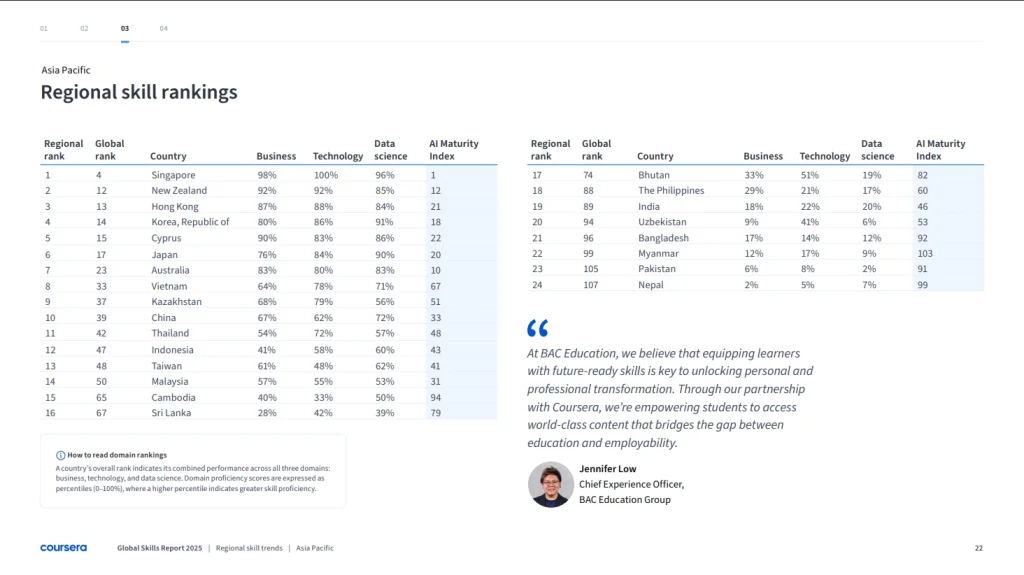
Rather than rely on generalizations, look at the data. In Coursera’s Global Skills Report 2025, Vietnam ranks 33rd globally and 8th in Asia Pacific for overall skill proficiency, ahead of markets often associated with outsourcing:
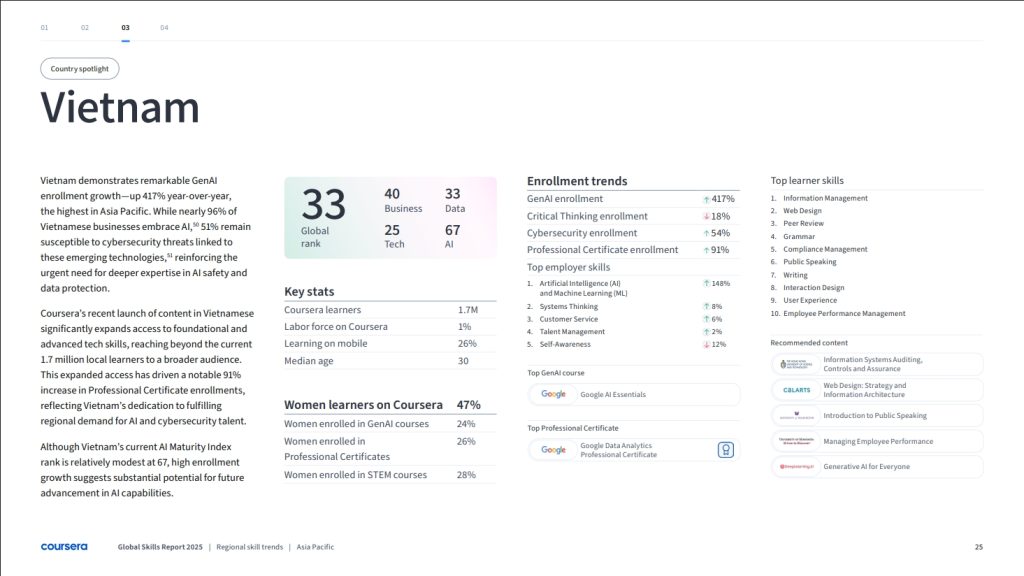
The same report shows Vietnam’s workforce upskilling fast: GenAI course enrollments grew 417% year-over-year, the highest in Asia Pacific, and Professional Certificate enrollments rose 91%, across a base of 1.7 million learners with a median age of 30. For a business hiring low-code talent, that combination matters: competitive rates, a technology skill percentile above larger outsourcing markets, and a workforce actively reskilling toward AI, which is where low-code is heading.
Two other practical points. Vietnamese rates sit below most of the region for comparable work, and political and economic stability is worth weighing for a multi-year partnership. Vietnam scores well on both.
Working with Synodus for your low-code development
As a Microsoft Power Platform specialist in APAC, Synodus offers a low-code development service with over 250 technical experts and software development experience since 2019, serving startups through enterprises. Our low-code work spans custom web and mobile app development, internal tools, process automation, cloud development, and legacy modernization.
What makes our delivery different: we blend agile for business analysis, architecture, design, and testing with waterfall for development and deployment, and we work on fixed pricing, so we absorb the risk of overruns rather than passing it to you. That approach has earned the trust of companies like BOC Aviation, KPMG, and Unilever across more than 100 projects, with client relationships that typically last two to three years.
Frequently asked questions
It depends heavily on location. In the US, aggregators put Power Apps developers anywhere from roughly $90,000 to over $135,000, while in India and Vietnam the range is a fraction of that. Platform, experience, and certifications also move the number significantly.
Power Apps tends to top the range in the US, UK, and Australia, followed by OutSystems and Mendix. Certifications and complementary skills like Azure, DevOps, and API integration raise pay across all three platforms.
Yes, usually by a wide margin, since offshore wages reflect local cost of living rather than lower capability. The trade-offs are time zones, vendor quality variance, alignment, and IP risk, all manageable with proper vetting and contracts.
The data supports it. Vietnam ranks 33rd globally and 8th in Asia Pacific for skill proficiency in Coursera’s Global Skills Report, ahead of India and the Philippines on technology skills, with rates well below Western markets and the fastest GenAI upskilling growth in the region.
Wrapping up
Demand for low-code keeps growing, and with it the need for skilled low-code developers. Salaries vary enormously by region, platform, and experience, so treat published figures as ranges to benchmark against rather than fixed prices, and weigh offshore savings against the trade-offs they bring.
If you would rather have experts build it for you, Synodus offers a custom low-code development service that turns your data into apps 10x faster and cuts development costs by half. Book a free consultation to find the right approach for your project.