Current challenges of digital transformation in insurance
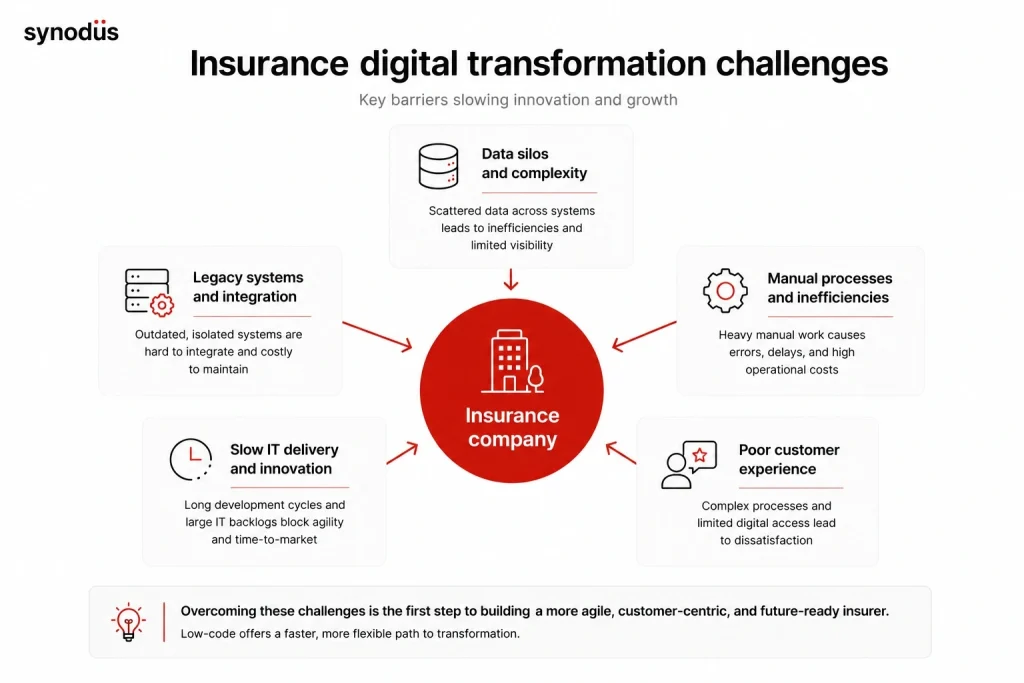
As the market grows more competitive and customer expectations rise, demand for software development increases. But it is not an easy game.
The industry relies heavily on data
The core function of an insurance system is to store and process business records: policy sales, claims, accounting, finances, customers, agents, and more. Keeping track of these records manually is error-prone, time-intensive, and carries a high risk of data loss. Insurers need a secure, scalable, advanced database, yet many options are either prone to vendor lock-in or hard to scale, while customization costs a lot of time and effort.
Insurance runs on deep collaboration
Information from across the value chain feeds insurance procedures, from claims adjusters and actuaries to accountants and underwriters. Several outside groups are also involved, including service providers and distribution partners like agents and brokers. Because the industry is heavily regulated, integration with external systems is essential.
Legacy systems are specialized and isolated
Insurers make extensive customizations to match their requirements, and in many cases each piece of software handles only a specific part, which forces businesses to run several at once. They must keep hundreds of systems running across departments and procedures while ensuring regulatory compliance, and these systems can slow the whole operation when processing raw data.
High cost and slow delivery
Updating outdated systems is hard, which creates an exceptionally long IT backlog. IT struggles just to keep up with this complexity, let alone support innovation and new products. When it takes weeks or months to make modest changes or build a new solution, a tool that speeds deployment and reduces repetitive effort becomes far more valuable.
Poor customer interactions
Employees and customers ultimately feel the effects of inefficient systems. Customers may be blocked from digital channels, forced to repeat themselves when filing a claim, or made to wait while staff work through cumbersome manual processes.
Key takeaway: buying or building software from scratch still works for digital transformation, but vendor lock-in and lengthy development can backfire as transformation needs grow, not to mention the struggle of integrating software with databases. This has pushed insurers to seek alternatives, and low-code is a promising one.
The alternative: What is low-code?
Low-code is a method of app delivery that requires less time coding and less effort in development. These platforms are an excellent way to speed up digital transition, enabling rapid development of secure, interoperable, intuitive apps built around user experience. They let citizen developers and business users influence the company in several ways: easing the burden on IT, reducing shadow IT, taking more control of business process management, and feeding business insights into new solutions.
Why use a low-code insurance platform?
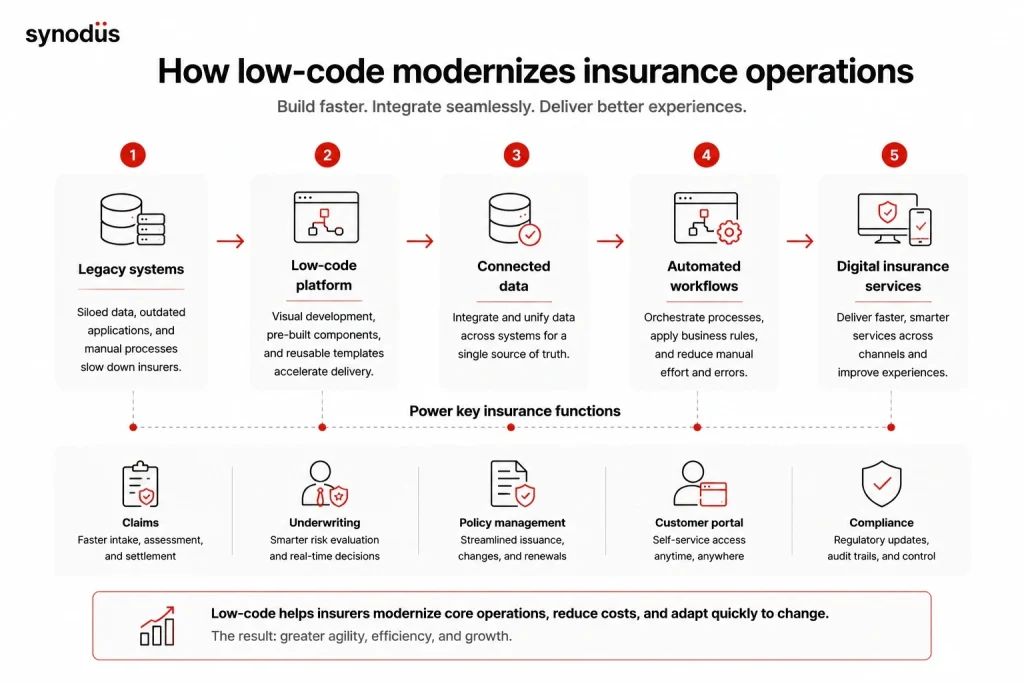
1. End repetitive tasks with automation
Insurers handle massive amounts of data, documents, and records daily, and managing them is tedious. Low-code platforms automate these repetitive tasks, so insurers can automate claims processing, policy underwriting, and more, freeing teams for critical work. Learn more in our guide to low-code workflow automation.
2. A unified data system
Low-code platforms provide a unified data system, helping insurers access and manage data efficiently instead of fighting the data silos that traditional legacy systems create. See our roundup of low-code data integration tools.
3. Lower technology cost
By reducing the need for custom development, low-code platforms let companies cut their budget and reallocate resources. Forrester’s Total Economic Impact studies on low-code report meaningful cost savings, often well into double digits, with payback in under a year.
4. Flexibility for faster adaptation
Insurers operate in an ever-changing landscape and must adapt quickly. Low-code offers the flexibility to adjust as strategy or regulations change, in hours rather than months.
5. Stronger team collaboration
Low-code gives IT, business users, and specialists a unified platform to communicate and cooperate. Industry research consistently finds that low-code initiatives are a joint effort between IT and business, which raises productivity and produces better results. For both sides of the story, read our breakdown of low-code benefits and disadvantages.
Ways to leverage low-code in an insurance company
| Use case | What you can build |
|---|---|
| Digital products | New on-demand products, broker processes, online branding |
| Underwriting | Rating, quoting, policy issuance with real-time data |
| Claims management | Automated quote, approval, and payment workflows |
| Reporting | Loss adjustment, fraud detection, audit compliance |
| Customer experience | Self-service portals, chatbots, mobile apps |
| Compliance | Fast updates to workflows, rules, and interfaces |
1. Adapt to shifts in the digital landscape
A low-code platform lets business users build processes without waiting for IT, integrating with core or legacy systems for quick rollout of new products. This includes on-demand solutions, new processes for insurers or brokers, refreshed online branding, and a better view of how customers use your services.
2. Underwriting
Rating, quoting, and policy issuance can be streamlined with low-code, lightening underwriters’ workloads and giving them better access to real-time consumer data for more precise, profile-based decisions.
3. Claims management
By automating steps like quote production, approval, and payment submission, low-code speeds up and simplifies claims. It reduces the number of people needed to handle claims and can improve long-term revenue, profit margins, and loss ratios.
4. Reporting
Insurance claims, loss adjustments, fraud detection, and audit compliance can all be automated with low-code. Automated reporting helps companies spot growth opportunities, cut operating costs, and remove bottlenecks.
5. Customer experience
A sluggish online experience means missed sales and less loyal clients. Low-code helps insurers deliver the seamless, omnichannel digital experience customers want, such as:
- A self-service portal with FAQ pages.
- A portal where customers track their insurance information.
- Low-code chatbots for instant interaction.
- AI in the call center and customer service for better support.
- A customer mobile application.
6. Compliance
Insurers must adapt to a fast-changing regulatory landscape. Low-code helps small and medium insurers meet requirements by quickly modifying workflows, business logic, rules, and interfaces in hours, freeing them to focus on clients.
The AI shift in insurance low-code
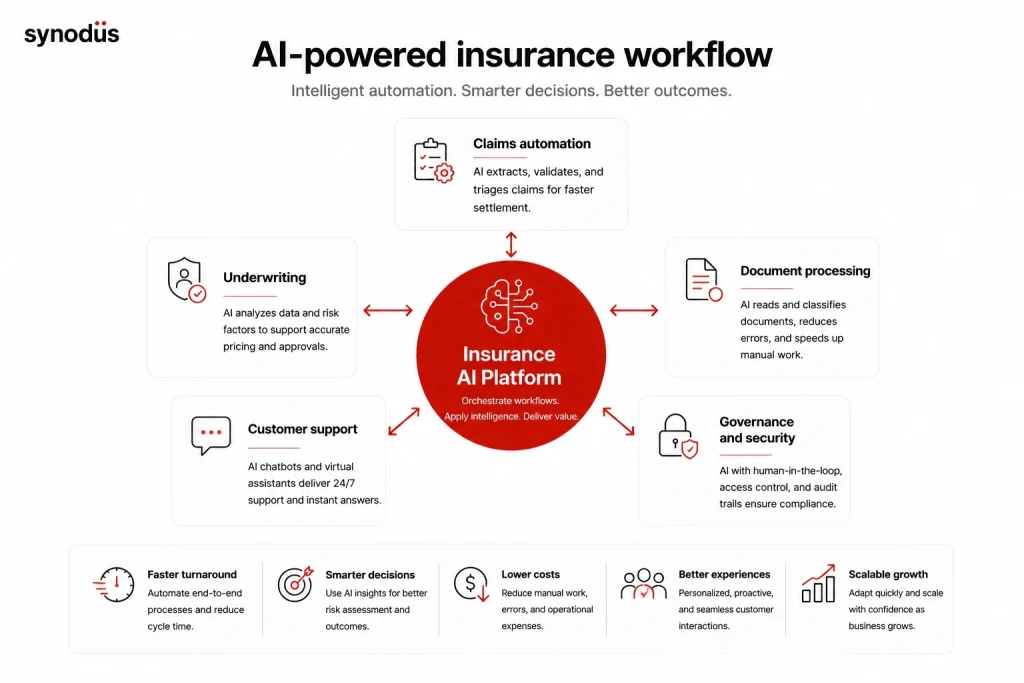
Insurance is one of the industries AI is transforming fastest, and 2026 is the tipping point. Roughly 90% of insurers are exploring generative AI, with about 55% already in active deployment across claims, underwriting, and customer experience. The shift is from chatbots that answer to AI agents that act, completing multi-step work like claims intake, document processing, and quoting end to end.
The results are striking: insurers using AI-powered claims automation are resolving claims up to 75% faster with 30 to 40% cost reductions, and underwriting timelines are collapsing from days to minutes. Allianz, for example, launched Project Nemo in 2025 to automate low-complexity claims with a human-in-the-loop model, and Travelers rolled out an agentic AI claim assistant built with OpenAI.
The catch is governance. Insurance underwriting and claims AI is classified as high-risk under the EU AI Act, and most claims professionals say AI still needs human oversight. A low-code platform helps here by letting compliance teams build the rules and guardrails themselves, with audit trails and human-in-the-loop review. When planning a build, ask where an AI agent could safely automate a workflow, while keeping explainability and oversight in place.
How one insurer succeeded with low-code
To pursue three strategic goals, customer centricity, simplicity, and innovation, Zurich Insurance, a company with a 146-year track record, turned to agile development with low-code. Part of Zurich’s DevOps team consists of engineers who used to be business analysts, giving them a strong grasp of business needs and customer insight.
Their most successful low-code application is the My Plans Portal, an online service that consolidates a client’s pension and investment data in one place, accessible with a single login. It integrates with Zurich’s Salesforce platform to provide feedback and sequence operations. By building a culture that encourages tech creation, Zurich generated significant value while ensuring solutions were implemented correctly the first time. These outcomes come from Zurich’s published case study, so treat them as point-in-time results.
Pairing low-code with an insurance core system
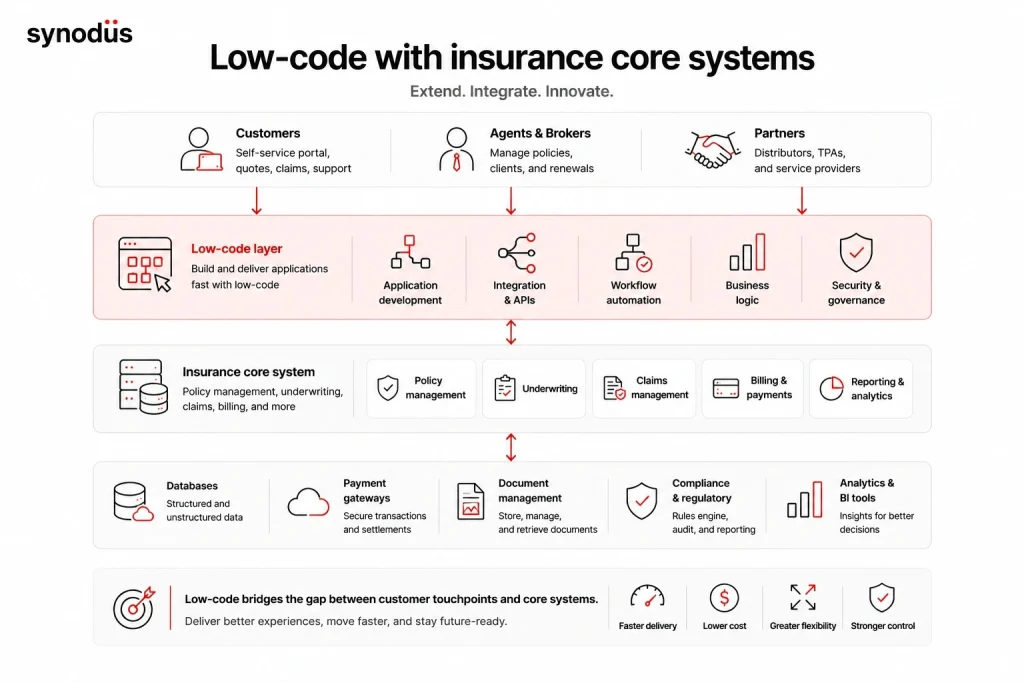
Low-code cannot fully realize an insurer’s entire vision on its own, but it excels at creating digital front-end experiences like agent portals and customer-facing websites for quotes and purchases. When a business user wants to design application logic for a niche audience and no commercial solution exists, custom development is the only way to ensure a unique experience. Low-code makes that achievable, and the app integrates easily with the deep capabilities of an insurance core platform. The result is a one-of-a-kind customer experience backed by a high-performing, centralized system for managing critical information.
Top low-code insurance platforms to use
A good low-code insurance platform should be secure, scalable, and flexible enough to handle advanced processes, large databases, and complex features. Here are strong options, and for more choices see our review of the top low-code platforms.
- Microsoft Power Apps: an enterprise-grade, highly secure and scalable platform that handles complex requirements, and integrates easily if you already use Microsoft 365.
- OutSystems: aimed at high performance, it suits business process automation, cloud apps, and customer management tools.
- Quickbase: focused on business process management and automation, good for clearing bottlenecks in workflows and operations.
- Integrate.io: one of the best for building cloud databases, analytics, data warehouses, and ETL integration for any business size.
- UI Bakery: a great choice for small and medium insurers on a tight budget, with 50+ design components and on-cloud or on-premises hosting.
- Salesforce Platform: built for scalable cloud and mobile apps with reusable components, now with built-in AI agents through Agentforce.
As a Microsoft Power Platform specialist in APAC, Synodus provides a low-code application development service with teams of experts to help you build robust insurance applications and optimized automation, with the security and compliance the sector demands.
Frequently asked questions
Insurance runs on data-heavy, document-heavy, and highly regulated processes, exactly the kind of work low-code automates well. It speeds up claims, underwriting, and compliance changes, unifies siloed data, and lets insurers adapt to new regulations in hours rather than months.
Yes. Low-code can automate quote production, approval, and payment workflows, and increasingly pairs with AI agents to process low-complexity claims end to end. Human oversight stays essential for complex or high-value claims.
It can be, when used correctly. Choose an enterprise-grade platform with strong security and compliance certifications, centralize app building under governance, and keep audit trails and human review, especially for AI-driven underwriting and claims, which regulators treat as high-risk.
Common builds include customer and agent portals, claims and underwriting automation, fraud detection and reporting tools, compliance workflows, chatbots, and mobile apps, often integrated with a core insurance system.
Wrapping up
Most insurers that adopt low-code report that it meets or exceeds their expectations. Bringing in modern technology is nothing new for insurance, and low-code helps speed up routine work like quotes, purchases, renewals, and claims paperwork, giving employees time for more impactful tasks, especially as AI agents take on more of the routine load.
If you would rather have experts build it for you, Synodus offers a low-code development service for insurance that turns your data into apps 10x faster and cuts development costs by half, with the security and governance the sector demands. Book a free consultation to find the right fit for your business.