What is a decentralized NFT marketplace?
A decentralized NFT marketplace is a marketplace or protocol where NFT ownership and trading depend primarily on blockchain wallets and smart contracts rather than a centralized intermediary.
In a more decentralized marketplace:
- Users keep NFTs in non-custodial wallets.
- Trades are executed or settled through smart contracts.
- Listing access may be permissionless.
- Marketplace infrastructure can be accessed without relying entirely on one frontend.
- Protocol rules may be governed by a DAO or token holders.
- NFT metadata may use decentralized storage such as IPFS or Arweave.
The key idea is that users do not need to transfer full control of their assets to the marketplace in order to trade. But this does not mean every component of the marketplace is decentralized. A platform can be decentralized at the transaction layer while remaining centralized at the product layer.
| Marketplace layer | More decentralized | More centralized |
|---|---|---|
| Wallet and custody | Users trade from their own wallets | Platform or custodian controls more of the asset or payment flow |
| Settlement | Trades settle through smart contracts | Transactions depend more on platform-managed systems |
| Listing access | Anyone can list supported NFTs | Listings require approval, curation, or platform permission |
| Governance | Rules may involve token holders, DAO voting, or open protocol input | Policies are decided by one company or core team |
| Metadata and storage | Metadata uses decentralized storage such as IPFS or similar systems | Metadata is hosted mainly on platform-controlled servers |
| Frontend access | Users may access the protocol through multiple interfaces | Users depend on one company-controlled website or app |
This distinction is important because non-custodial trading alone does not make an NFT marketplace fully decentralized.
For a broader overview of different marketplace models, see our NFT marketplace guide.
How does a decentralized NFT marketplace work?
A decentralized NFT marketplace usually combines blockchain wallets, smart contracts, NFT standards, marketplace interfaces, and indexing infrastructure.
A typical transaction follows this process.
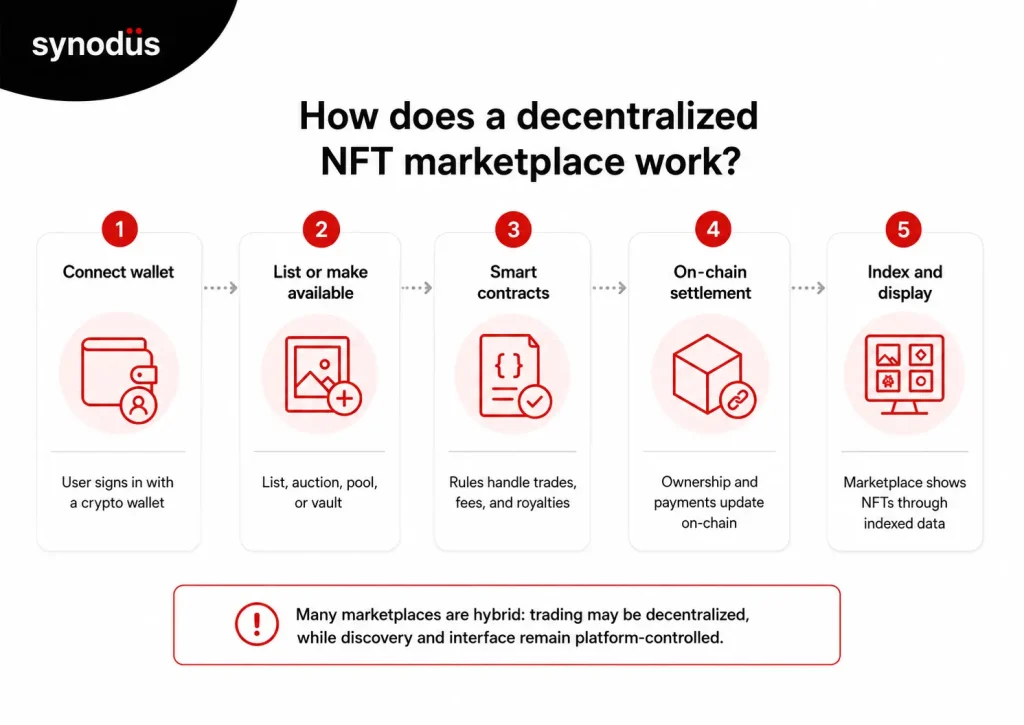
1. The user connects a wallet
Instead of creating a traditional custodial account, users typically connect a compatible blockchain wallet. The wallet allows them to:
- Prove ownership of NFTs
- Sign marketplace transactions
- Approve smart contract interactions
- Receive assets or payments
Because the wallet remains under the user’s control, the marketplace does not necessarily need to hold the NFT itself.
2. The NFT is listed or made available for trading
Depending on the marketplace architecture, the owner may:
- Create a fixed-price listing
- Start an auction
- Accept offers
- Deposit the NFT into a liquidity pool
- Interact with a collection vault
Traditional NFT marketplaces often use listing or auction models, while protocols such as sudoswap and NFTX use different liquidity mechanisms.
3. Smart contracts manage transaction rules
Smart contracts define how a trade is executed. Depending on the protocol, they may handle:
- Asset transfers
- Payment settlement
- Marketplace fees
- Royalties
- Auctions
- Bids and offers
- Liquidity pools
- Token approvals
This reduces the need for the marketplace operator to manually intermediate each transaction.
4. The transaction settles on-chain
Once the required conditions are met, the blockchain records the transfer. Ownership moves between wallets according to the smart contract logic, while payments are distributed to the relevant addresses.
The exact level of decentralization still depends on who controls those contracts, whether they can be upgraded, and whether administrative permissions exist.
5. The marketplace interface indexes and displays NFTs
NFT ownership may live on-chain, but users still need an interface to discover assets. Marketplaces often rely on:
- Blockchain indexers
- APIs
- Search infrastructure
- Metadata services
- Image storage
- Collection databases
This is one reason many NFT marketplaces are best described as hybrid. Their trading layer may be decentralized while discovery, moderation, indexing, and frontend access remain centrally operated.
Centralized vs decentralized NFT marketplaces
The main difference is not whether blockchain is used. It is where control sits.
A centralized marketplace gives one company or organization greater control over the marketplace experience. A decentralized marketplace shifts more control toward users, wallets, smart contracts, and open protocols.
| Factor | Decentralized NFT marketplace | Centralized NFT marketplace |
|---|---|---|
| Asset control | Users ususlly keep NFTs in their own wallets | Platform may control more of the asset flow |
| Settlement | Smart contracts execute or coordinate trades | Platform-managed or hybrid settlement |
| Listing access | Often more permissionless | Often curated or approval-based |
| Governance | Can involve DAO or protocol governance | Controlled mainly by the company |
| Fees | Defined by protocol or visible on-chain | Determined by the platform |
| Liquidity | Can be fragmented | Often stronger on large platforms |
| User experience | More technical and wallet-heavy | Easier onboarding and support |
| Main risk | Smart contract bugs, scams, thin liquidity | Platform dependency, censorship, fee or policy changes |
Neither model is automatically better.
A decentralized protocol can provide stronger asset control and greater openness, but may also come with more technical UX, thinner liquidity, less customer support, and greater exposure to scams or malicious contracts.
A centralized or hybrid marketplace may offer stronger discovery, liquidity, moderation, and onboarding while giving the operator more control over platform access, fees, and policies.
Quick comparison: Best decentralized NFT marketplaces
The following platforms illustrate different approaches to decentralized NFT trading.
Some are protocol-first products with relatively high decentralization. Others combine decentralized ownership and settlement with centralized interfaces and marketplace policies.
| Marketplace | Decentralization | Main model | Best for | Main limitation |
|---|---|---|---|---|
| sudoswap | High | NFT AMM protocol | Protocol-level NFT trading and liquidity | Technical UX |
| NFTX | High | NFT vault/liquidity protocol | Floor liquidity | Not a normal browse-and-buy marketplace |
| Zora | High | Creator protocol | Creators and on-chain media | Less focused on broad marketplace discovery |
| Rarible Protocol | High | Marketplace infrastructure | Custom/community marketplaces | Protocol differs from Rarible.com |
| LooksRare | Medium | Hybrid marketplace | Crypto-native NFT trading | Lower mainstream liquidity |
| OpenSea | Medium | Hybrid marketplace | Broad NFT discovery | Centralized product policies |
| Blur | Medium | Professional marketplace | Active NFT traders | Less beginner-friendly |
| Magic Eden | Medium | Multichain marketplace | Multichain discovery | Company-operated frontend |
| SuperRare | Low | Curated marketplace | Digital art | Artist access is not permissionless |
1. Rarible/ Rarible Protocol
Rarible is a non-custodial, multichain NFT marketplace, but the more interesting part from a decentralization perspective is the infrastructure underneath it. Rarible Protocol provides marketplace APIs, indexing, SDKs, and smart contract tooling that developers can use to build their own NFT experiences instead of sending every user through the Rarible frontend.
That architecture reduces dependence on a single storefront because a project can create its own discovery layer, wallet flow, collection pages, and transaction experience while using Rarible infrastructure for blockchain data and marketplace actions. The Rarible API also aggregates liquidity from external marketplaces such as OpenSea, allowing custom marketplaces to access broader listings rather than depending only on their own native inventory.
This makes Rarible particularly relevant when decentralization means open marketplace infrastructure rather than simply wallet-based trading. The important distinction is between Rarible.com, which remains an operated consumer product, and Rarible Protocol, which gives developers more freedom to build independent marketplace experiences on top of shared infrastructure.
2. Zora
Zora needs to be viewed differently in 2026 than during the earlier NFT marketplace cycle. Its original NFT contracts and ERC-1155 infrastructure still exist, but Zora now treats much of its earlier NFT documentation as legacy and has shifted its active product direction toward a creator-focused on-chain economy built around its newer protocol stack.
That makes Zora less comparable to a traditional marketplace such as OpenSea than it once was. Rather than focusing primarily on browsing NFT collections, its newer model emphasizes on-chain creation, creator economics, and tradable content, where the protocol layer matters more than a conventional marketplace storefront.
Zora remains relevant to decentralized marketplace research because it demonstrates how an NFT platform can evolve from a marketplace into broader permissionless creator infrastructure. Teams considering Zora should therefore separate its historical NFT marketplace functionality from its current product direction before deciding whether it matches a conventional NFT trading use case.
3. sudoswap
Sudoswap changes the NFT trading model itself rather than simply replacing a centralized intermediary with smart contracts. Its automated market maker (AMM) architecture allows liquidity providers to create pools containing NFTs, tokens, or both, while bonding curves determine how prices change as assets move through those pools.
This produces a very different experience from a traditional listing marketplace. Instead of waiting for another user to accept a specific listing, collections can have continuous NFT liquidity, while liquidity providers configure pricing behavior and spreads; the trade-off is that pool-based pricing often focuses more on collection-level value than the uniqueness of an individual NFT.
sudoswap also shows how marketplace rules can move from platform policy into smart contract logic. Its protocol supports mechanisms for handling royalties and pool-level trading rules on-chain, making it a strong example of decentralization happening at the transaction and liquidity layers rather than only through non-custodial wallets.
4. NFTX
NFTX approaches NFT trading through collection-level liquidity rather than conventional one-by-one listings. Its current model creates liquid collection tokens that track NFT floor value, allowing users to move between NFTs, tokens, and ETH more fluidly than on a standard storefront marketplace.
The key idea is that NFTX makes otherwise illiquid NFT collections behave more like fungible markets. Users can access floor liquidity, swap between assets in a collection, provide liquidity, or use collection tokens to gain exposure without first finding a buyer for one specific NFT.
This also creates an important trade-off. NFTX makes the most sense when users care about floor price, instant liquidity, and collection exposure, while rare NFTs whose individual traits carry large premiums may be better suited to traditional listings or auctions. In that sense, NFTX sits closer to NFT liquidity infrastructure than a normal browse-and-buy marketplace.
5. LooksRare
LooksRare has evolved beyond its early positioning as a community-first competitor to OpenSea. Its current ecosystem combines NFT trading, aggregated listings, protocol rewards, raffles, and Web3 games, making the platform broader than a conventional NFT storefront.
The aggregation layer is particularly important because users are not limited to native LooksRare inventory. LooksRare states that it pulls listings from major marketplaces, which means the interface can provide access to external marketplace liquidity rather than depending entirely on orders originating within LooksRare itself.
This does not make the full product decentralized, however. Discovery, rewards, games, APIs, and the primary frontend still depend heavily on LooksRare-operated infrastructure, so the stronger reason to use it is its crypto-native trading ecosystem and aggregated liquidity, rather than maximum decentralization across every layer.
6. OpenSea
OpenSea is one of the clearest examples of the difference between decentralized asset ownership and centralized marketplace control. Users interact through blockchain wallets and NFTs remain transferable outside OpenSea, while the platform provides the interface, discovery tools, collection pages, moderation systems, and marketplace infrastructure used to facilitate trading.
Its hybrid structure can be an advantage for mainstream users. A company-operated interface makes it easier to provide collection discovery, transaction prompts, moderation, support, and security guidance, features that purely protocol-driven marketplaces often struggle to deliver with the same level of consistency.
The trade-off is that important marketplace economics and policies remain controlled at the product level. OpenSea can determine marketplace fees and creator-earnings mechanisms even though it does not control the underlying NFT itself, showing why non-custodial ownership does not equal full marketplace decentralization.
7. Blur
Blur is designed more like professional NFT trading infrastructure than a conventional collectible storefront. Its interface emphasizes fast execution, marketplace sweeping, portfolio analytics, bidding, and collection-level trading rather than casual discovery.
This focus changes the role of the marketplace itself. For active traders, the main value is not simply access to NFTs but the ability to manage positions and execute across the market efficiently, bringing the experience closer to a crypto trading terminal than an art or collectibles gallery. Blur also promotes cross-marketplace sweeping, reinforcing its focus on execution and aggregated liquidity.
Blur also adds DAO governance through the BLUR token, allowing governance processes to influence marketplace and protocol parameters. However, governance and blockchain settlement coexist with an operated frontend and structured operational layers, making Blur another example of a marketplace that decentralizes selected components rather than the entire product.
8. Magic Eden
Magic Eden needs an important 2026 qualification. The platform announced that marketplace support for EVM chains and Bitcoin ended in March 2026, while its remaining marketplace experiences continue around Solana and Packs.
That means Magic Eden should no longer be positioned simply as a broad multichain NFT marketplace. Its current marketplace footprint is narrower, and this matters when users are selecting a venue based on chain coverage rather than only brand recognition or past marketplace activity.
Magic Eden still provides a useful example of hybrid decentralization because blockchain-based ownership can remain separate from the platform’s product strategy. Users may retain control of assets, while the centralized product layer can still change supported chains, APIs, interfaces, and marketplace services, demonstrating a form of platform dependency that non-custodial ownership alone does not remove.
9. SuperRare
SuperRare deliberately combines blockchain ownership with centralized curation. Collectors interact through Ethereum wallets, but creator access is restricted: artists need to be approved before they can mint and sell work through the marketplace.
This controlled supply is central to SuperRare’s positioning as a marketplace for curated 1/1 digital art rather than a permissionless venue for every NFT collection. SuperRare’s ecosystem also includes independent Spaces, where galleries operate within a wider curation framework connected to SuperRare DAO processes.
SuperRare therefore demonstrates why decentralization should not automatically be treated as a quality score. Wallet identity and on-chain ownership can coexist with centralized artist onboarding, and for collectors seeking curated digital art, that restriction may be part of the marketplace’s value rather than simply a limitation.
How to Choose a Decentralized NFT Marketplace
The best marketplace depends on which benefits of decentralization actually matter to you. Greater decentralization can offer more asset control, open participation, and transparency, but it often comes with trade-offs in liquidity, usability, moderation, and user support.
For a broader overview of marketplace capabilities, see our NFT marketplace features guide.
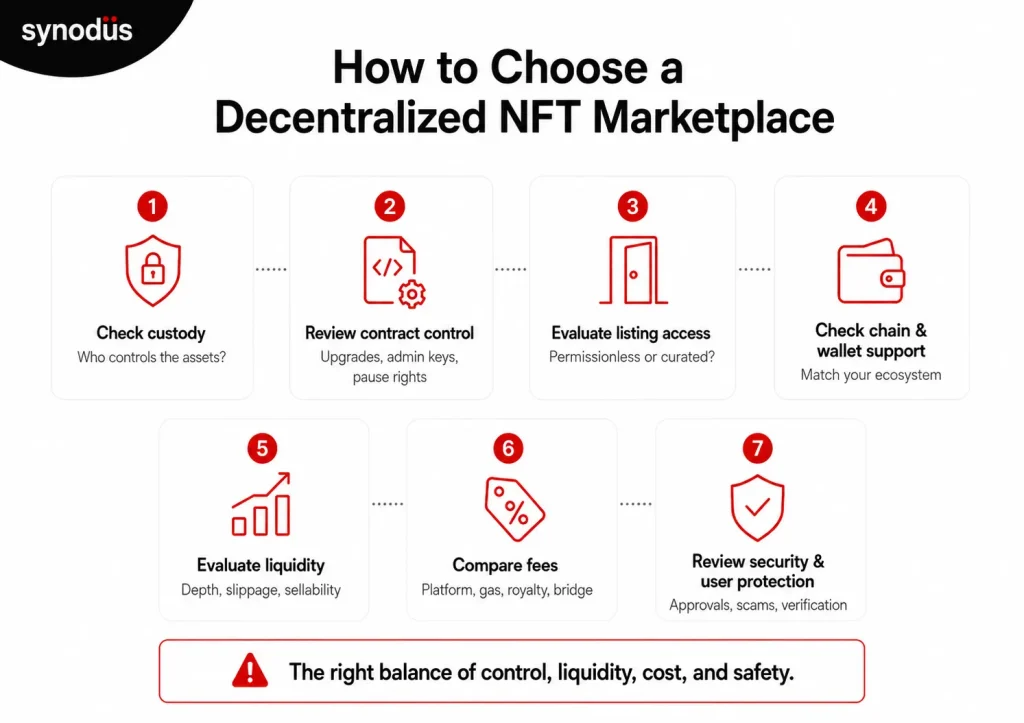
1. Check custody
Determine whether users retain control of NFTs in their own wallets.
Ask:
- Does the marketplace ever hold user NFTs or funds?
- Who controls the private keys?
- Are users required to deposit assets before trading?
- Can transactions happen directly between wallets?
Non-custodial ownership reduces dependence on the marketplace operator, but it also means users take greater responsibility for wallet security and recovery.
2. Review smart contract control
Do not only check whether the marketplace uses smart contracts. Also ask:
- Can contracts be upgraded?
- Who controls admin keys?
- Can trading be paused?
- Can fees be changed?
- Are contract permissions transparent?
Smart contract settlement can increase transparency, but poorly designed contracts can introduce vulnerabilities, malicious approvals, or upgrade risks. The presence of a smart contract does not automatically eliminate centralized control.
3. Evaluate listing access
Permissionless listing gives creators and traders more freedom. But it can also increase exposure to:
- Fake collections
- Stolen NFTs
- Malicious contracts
- Misleading metadata
Curated marketplaces trade some openness for moderation and quality control. The right model depends on whether your priority is permissionless participation or safer discovery.
4. Check blockchain and wallet support
A marketplace may be highly decentralized but irrelevant if your target community trades on another blockchain. Chain support affects:
- Liquidity
- Gas fees
- Wallet compatibility
- Transaction speed
- Available NFT collections
- User onboarding
A multichain hybrid marketplace may therefore be more useful in practice than a highly decentralized protocol with limited ecosystem coverage.
5. Evaluate liquidity
Liquidity is one of the biggest trade-offs when choosing a decentralized marketplace. Low liquidity can lead to:
- Stale listings
- Poor price discovery
- High slippage
- Difficulty selling NFTs
- Limited collection depth
This is why larger hybrid marketplaces may remain more practical for some users even if they are less decentralized. Protocols such as sudoswap and NFTX address the problem differently by using liquidity pools or vault-based models.
6. Compare fees properly
Do not compare marketplaces using only the headline marketplace fee. NFT transactions can involve several costs:
| Fee | Paid to | Purpose |
|---|---|---|
| Marketplace or protocol fee | Marketplace, protocol, or treasury | Trading or protocol usage |
| Gas fee | Blockchain network | Transaction execution |
| Creator royalty | Creator or royalty recipient | Secondary-sale compensation |
| Bridge/payment fee | Infrastructure provider | Cross-chain or payment conversion |
A marketplace with lower platform fees is not necessarily cheaper if network costs are high or liquidity is poor. For more detail, see our guides to NFT royalties and NFT marketplace business models.
7. Review security, verification, and user protection
Decentralization reduces some forms of platform dependency, but users usually take on more responsibility. Potential risks include:
- Smart contract vulnerabilities
- Malicious wallet approvals
- Fake collections
- Phishing
- Stolen NFTs
- Low-liquidity assets
Look for transparent contract addresses, clear transaction previews, wallet warnings, collection verification, reliable metadata, active protocol maintenance, and documented smart contract behavior.
A safer marketplace is not necessarily the most decentralized one. The right balance depends on how much control and responsibility the user is prepared to take on.
Best decentralized NFT marketplaces by use case
Different marketplace architectures work better for different goals.
| Use case | Better-fit option | Why |
|---|---|---|
| Protocol-level decentralized NFT trading | sudoswap | Smart contract-based AMM and liquidity pools |
| NFT floor liquidity | NFTX | Vault-based liquidity around NFT collections |
| Creator-owned drops and on-chain media | Zora | Creator-focused protocol infrastructure |
| Custom NFT marketplace infrastructure | Rarible Protocol | Developers can build marketplace experiences on top of the protocol |
| Broad NFT discovery | OpenSea, Magic Eden | Larger inventory and consumer-facing discovery |
| Professional NFT trading | Blur | Trading-focused tools and analytics |
| Crypto-native marketplace trading | LooksRare | Wallet-based trading and token-oriented ecosystem |
| Curated digital art | SuperRare | Controlled artist access and art-focused discovery |
| Gaming NFTs | Game-specific marketplaces | Better integration with gaming ecosystems |
| Cross-marketplace discovery | NFT marketplace aggregators | Combines listings or liquidity across venues |
The right marketplace therefore depends less on finding the platform with the highest decentralization score and more on matching its architecture to your actual use case.
When Should You Build a Decentralized NFT Marketplace?
Using an existing marketplace is usually enough when your priority is simply to list NFTs, reach existing buyers, or access established liquidity.
Building your own marketplace becomes more relevant when you need greater control over:
- Marketplace fees
- Listing rules
- Smart contract logic
- Token or DAO governance
- Creator permissions
- Custom user experience
- Liquidity models
- Wallet integrations
- Cross-chain support
- Compliance workflows
A custom marketplace does not necessarily require building every blockchain component from scratch. Teams can combine existing protocols, smart contract frameworks, indexing infrastructure, and custom application layers based on the required level of decentralization. The key question is how much of the marketplace needs to remain under your control and how much can depend on external infrastructure. For a deeper technical breakdown, see our guide on how to create an NFT marketplace.
Conclusion
A decentralized NFT marketplace gives users more control over assets and transactions, but decentralization can exist at different layers of the platform.
When choosing one, compare custody, smart contract control, liquidity, security, and usability rather than relying on the decentralized label alone. These factors will also determine whether an existing marketplace, an open protocol, or a custom marketplace is the better fit.
FAQ
There is no single winner. sudoswap is strong for protocol-level trading, NFTX for liquidity, Zora for creator infrastructure, and Rarible Protocol for marketplace infrastructure.
Not fully. OpenSea is better described as a hybrid marketplace because users control their NFTs, while the platform still manages the frontend, policies, fees, and moderation.
Partly. Rarible Protocol is more decentralized at the infrastructure level, while Rarible.com remains a company-operated marketplace interface.
Not necessarily. Users may still pay gas, protocol fees, royalties, bridge fees, or face higher trading costs when liquidity is low.
They reduce some custody risks but still involve smart contract, wallet, phishing, scam, and liquidity risks.
A decentralized marketplace enables NFT trading directly, while an NFT aggregator combines listings or liquidity from multiple marketplaces.