What “regulated” really means for a tokenized property deal
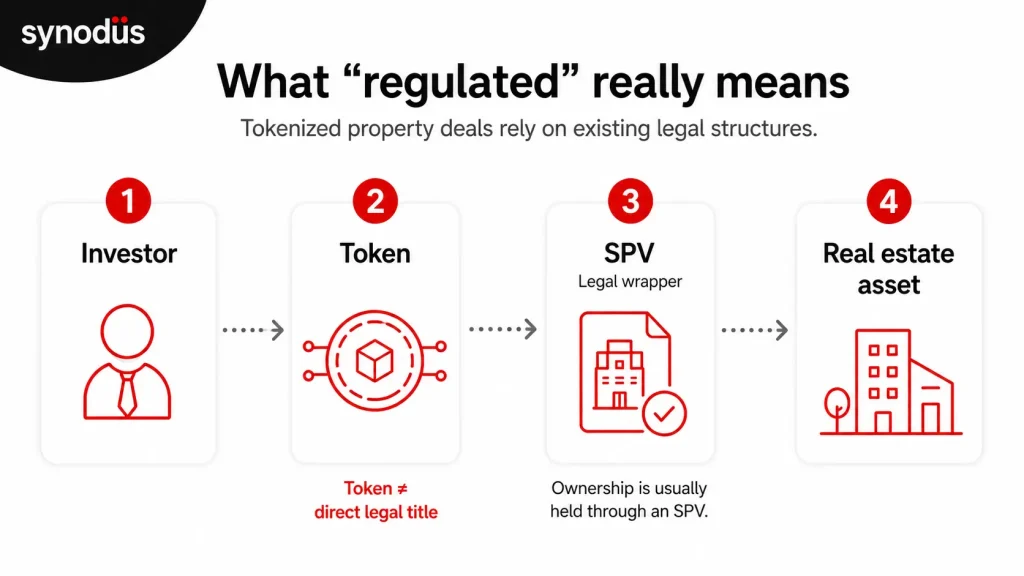
Most confusion around this topic starts from a wrong assumption: that a real estate token is a new kind of asset requiring new rules. In practice, almost every jurisdiction applies an existing test to decide how a token should be treated, and the answer is almost always the same.
In the U.S., that test is the Howey framework from a 1946 Supreme Court case: if someone invests money in a common enterprise and expects profit primarily from the effort of others, the resulting instrument is a security. A token that pays rental income, shares in appreciation, or carries voting rights over a property clears that bar easily. The blockchain layer does not change the analysis. Singapore, Hong Kong, and the UK ask a similar underlying question through their own tests rather than importing Howey directly, but they arrive at the same place: if a token behaves like an investment in someone else’s effort, it gets treated like one.
Classification is one question. What the token actually represents is a separate one, and it gets glossed over in a lot of marketing content: a token almost never represents direct legal title to a physical building. Legal ownership typically sits with a special purpose vehicle, and the token represents an economic or equity interest in that vehicle. Land registries, notarial systems, and property law have not been rewritten to accept a wallet address as a deed. The blockchain records who holds a claim. It does not replace the underlying legal structure that makes the claim enforceable.
Once that framing is in place, the country-by-country differences become much easier to read, because they are really differences in licensing structure and investor access, not in the underlying legal classification.
Real estate tokenization laws by country: How the major markets compare
| Jurisdiction | Regulator/framework | Core mechanism | Investor access |
|---|---|---|---|
| United States | SEC and CFTC, joint Digital Asset Interpretation (March 2026) | Reg D 506(c), Reg S, Reg A+, or Reg CF | Reg D limited to accredited investors; Reg CF opens to retail with raise caps and resale restrictions |
| European Union | Markets in Crypto-Assets Regulation (MiCA), enforced through national regulators | Security tokens fall under MiFID II, not MiCA | Varies by member state and offering type |
| United Kingdom | Financial Conduct Authority | New statutory regime (Cryptoassets Regulations 2026); full effect October 2027 | Authorization required for firms; access rules phase in with the new regime |
| Singapore | Monetary Authority of Singapore | “Same activity, same risk, same regulation” | Accredited and institutional investors for most offerings |
| United Arab Emirates | ADGM Financial Services Regulatory Authority, plus Dubai Land Department | Facilitative, risk-based licensing | Depends on the specific exchange and licensing track |
| Hong Kong | Securities and Futures Commission | Same substance-over-form approach as Singapore | Predominantly professional investors |
| Switzerland | Financial Market Supervisory Authority (FINMA) | Risk-based classification with a dedicated sandbox | Varies by token classification |
| Vietnam | Ministry of Finance, State Bank of Vietnam, under Resolution 05/2025/NQ-CP | Five-year controlled pilot (2025 to 2030) | Only Vietnamese-incorporated companies may issue; foreign ownership capped at 49% |
Why Vietnam’s teal estate tokenization rules deserve their own section
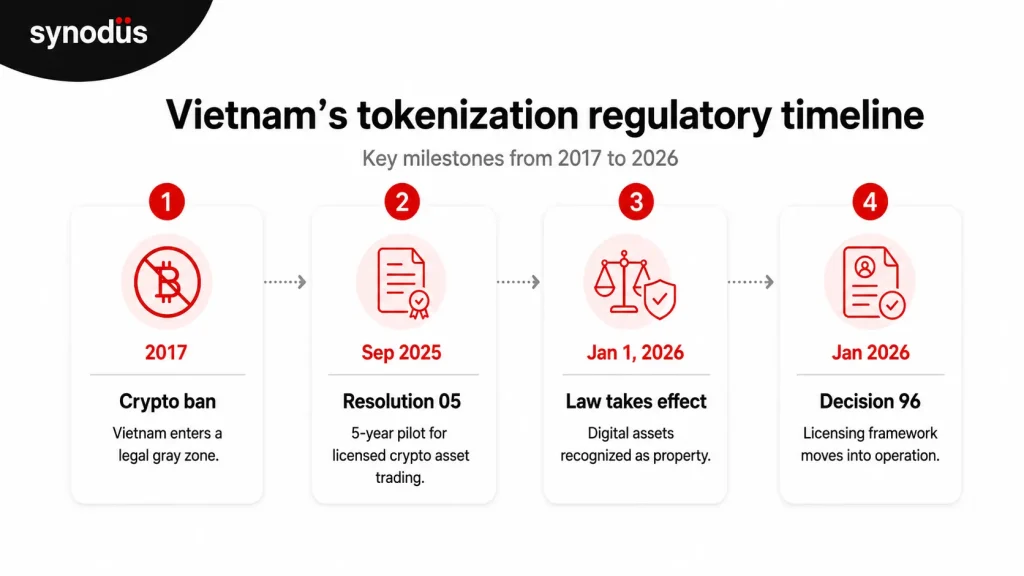
Most regulatory landscape guides skip Vietnam entirely, which is worth fixing given how much changed here this year. After nearly a decade in a legal gray zone, the Law on Digital Technology Industry took effect January 1, 2026, formally recognizing digital assets as property under the Civil Code. The operational rules sit in Resolution No. 05/2025/NQ-CP, which opened a five-year pilot (2025 to 2030) for licensed crypto asset trading, with a high bar by design: roughly VND 10 trillion in minimum charter capital, at least 35% held by financial institutions, and a 49% cap on foreign ownership per licensed platform.
For real estate tokenization specifically, this creates a parallel domestic market rather than a retrofit of the existing property market: only Vietnamese-incorporated companies can issue, and foreign investors get a legitimate entry point through licensed platforms for the first time. Vietnam is no longer unregulated, but the rules are still a five-year pilot, not a finished legal system, so licensing thresholds and the local-incorporation requirement need to be designed into a platform from day one.
Compliance issue every real estate tokenization project must solve
Investor accreditation: Nearly every framework above restricts at least part of the market to accredited or institutional investors, and the definition of “accredited” is not the same from country to country. A platform built for one jurisdiction’s investor base usually cannot be dropped into another without rework.
KYC and AML: Identity verification, source-of-funds checks, and anti-money-laundering controls are baseline requirements everywhere, not optional add-ons. Vietnam’s path out of the FATF grey list, for instance, was tied directly to strengthening AML controls for virtual assets and service providers, so this is not a box-checking exercise in markets still building regulatory credibility.
Custody and SPV structuring: Because most tokens represent an interest in a special purpose vehicle rather than direct title, the legal quality of that SPV, and how cleanly it connects to the underlying asset and to the smart contract that governs the token, matters more than the code itself. That code also needs to hold up as an enforceable agreement if a dispute ever reaches a court, not just execute correctly on-chain.
Tax and reporting: Rules here are still catching up in several markets. Vietnam’s Circular 15/2026/TT-BTC, for example, only arrived in 2026, well after the underlying trading framework. Any compliance plan needs to account for reporting requirements landing later than the licensing requirements.
Choosing a build approach that matches your regulatory reality
The right development approach for a tokenization platform depends heavily on which of the above you are building into, and that is where a lot of generic advice falls short. Three broad paths tend to fit three different regulatory situations:
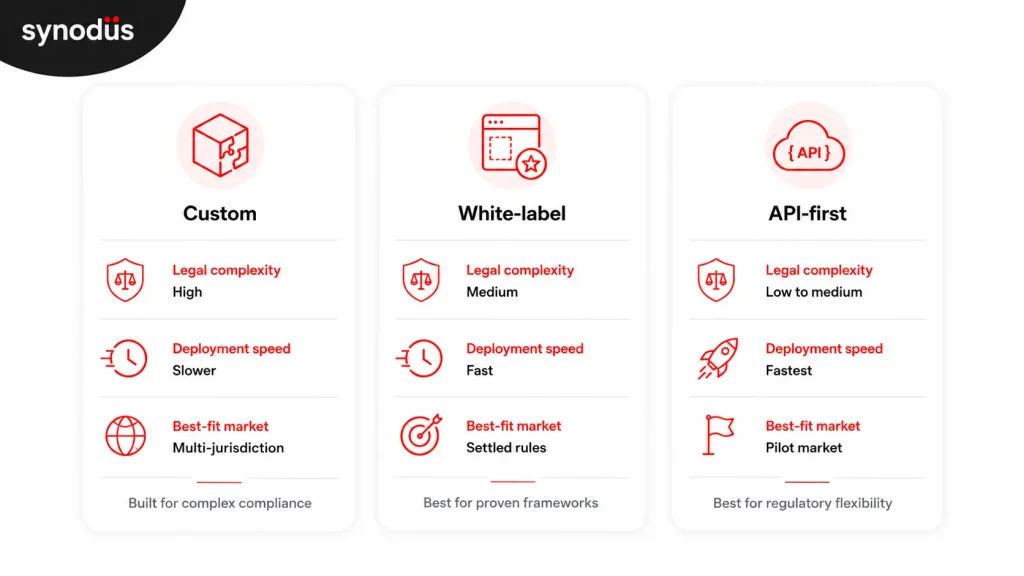
Custom-built platforms make sense when a project needs to operate across multiple jurisdictions with materially different rules, for example combining a Reg D offering in the U.S. with a parallel structure in the UAE. The legal and technical work to keep SPV structures, investor eligibility, and reporting aligned across borders is substantial enough that off-the-shelf tooling rarely covers it well. This is roughly the situation Synodus walked a Vietnamese real estate client through in a recent case study, where the regulatory picture was still forming as the platform was being built.
White-label platforms are a reasonable fit for markets with a settled, well-documented framework, such as Singapore or the UAE, where the licensing path and investor categories are already clear and a project mainly needs to move quickly within known rules.
API-first, lighter-weight builds suit early-stage pilots in markets that are still forming their rules, which describes Vietnam’s current five-year pilot window well. Committing to a heavy custom build before licensing thresholds and reporting requirements are finalized creates real rework risk.
None of these paths remove the need for proper legal structuring. They change how much of the compliance burden gets engineered into the platform itself versus handled through contracts and process.
A pre-launch compliance checklist for real estate tokenization
- Confirm how your specific token structure would be classified under the target jurisdiction’s securities test, not just how similar projects have been classified elsewhere.
- Identify which exemption or license track you actually qualify for (Reg D, Reg S, Reg CF, or a licensed platform status such as Vietnam’s Resolution 05 framework), since this determines your entire go-to-market shape.
- Confirm the legal ownership chain: how the SPV holds the asset, and how the token maps to an interest in that SPV.
- Build KYC, AML, and accreditation checks into onboarding rather than bolting them on after the fact.
- Map tax and reporting obligations separately from trading rules. In several markets, including Vietnam, these arrive on a different timeline than the core licensing framework.
- Revisit the plan on a fixed schedule. Several of the frameworks above, including the U.S. taxonomy and Vietnam’s pilot program, are explicitly designed to be updated as regulators learn more.
Where real estate tokenization regulation is header next
The direction across nearly every jurisdiction here is toward more clarity, not less, but that clarity has mostly meant confirming existing securities and property law applies, not creating a lighter-touch regime. KPMG and EY analysts have flagged this as a real constraint on retail growth in markets like the U.S., yet institutional capital keeps moving in regardless, with real estate now the largest single category of tokenized real-world assets. For teams evaluating this space, the question is no longer “is this legal” but “which license track, which jurisdiction, and which build approach fit the deal.” Getting that sequencing right early saves far more time than retrofitting compliance after launch.
If you are weighing a custom build against a white-label or API-first approach for a specific market, Synodus can walk through which tier fits your regulatory situation and timeline. For a broader look at vendors across all three tiers, see our comparison of real estate tokenization development companies.