What is an NFT marketplace aggregator?
An NFT marketplace aggregator is a product that combines NFT listings, market data, or trading routes from more than one marketplace. Instead of making a user search each venue separately, the aggregator creates a common view of inventory and, where supported, lets the user act on that inventory through one trading flow.
Aggregation can stop at data display or extend into transaction execution. A data-focused product may combine floor prices, listings, sales, traits, and wallet activity. A trading aggregator goes further by translating different marketplace order formats into a common model and routing the final purchase, sale, bid, or sweep to the relevant external contracts.
NFT marketplace vs NFT marketplace aggregator
| Area | NFT marketplace | NFT marketplace aggregator |
|---|---|---|
| Inventory | Primarily native listings created for the marketplace | Listings can come from multiple external marketplaces |
| Liquidity | Depends mainly on its own marketplace activity | Can expose liquidity that already exists across several venues |
| Order data | One marketplace or protocol model | Several order formats must be normalized |
| Execution | Executes through its own marketplace flow or protocol | May route transactions to external marketplace protocols |
| Core product challenge | Create supply, demand, discovery, and trading UX | Maintain integrations, data freshness, normalization, and routing |
| Typical value proposition | A destination where users list and trade | A unified layer for cross-market discovery and execution |
The categories are not mutually exclusive. A product can run its own marketplace and aggregate external liquidity at the same time. Blur, Magic Eden, and Rarible illustrate how marketplace and aggregator functions can exist in the same product.
Three common aggregator models
- Trading aggregator. Combines listings or bids from several marketplaces and allows users to execute trades against those sources. The product needs both market data and an execution layer.
- Analytics aggregator. Combines collection, wallet, price, sales, or activity data. It may help users compare the market without routing every trade.
- Aggregation infrastructure. Provides APIs, SDKs, order feeds, or execution tooling so another company can build its own marketplace or aggregator. The GoTrading SDK, for example, is an open-source development kit that exposes order fetching and trading methods across several NFT marketplaces.
How does an NFT marketplace aggregator work?
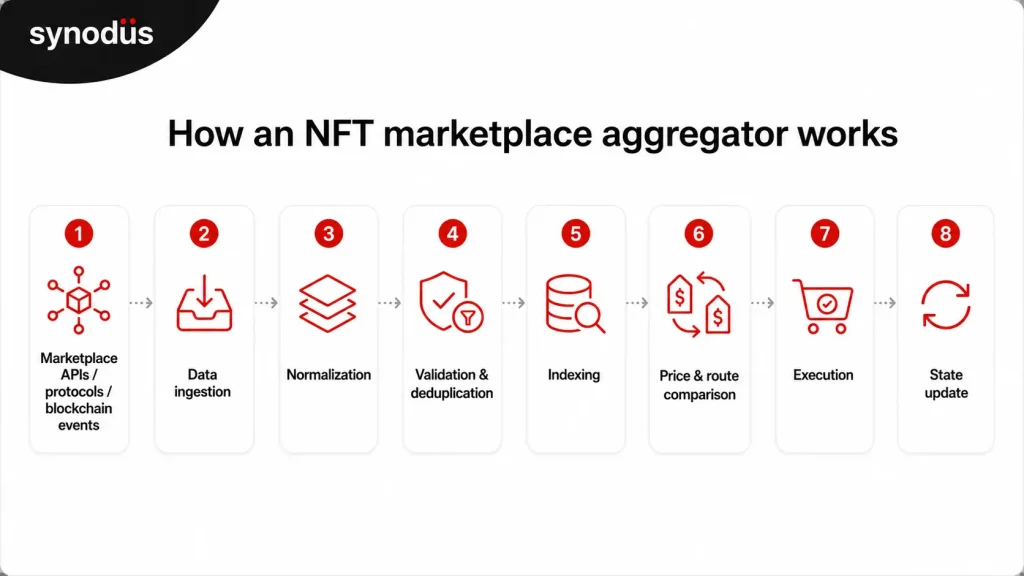
A reliable aggregator has to turn several external markets into one usable trading view. The exact architecture varies, but the core flow usually looks like this:
1. Collect marketplace and blockchain data
The first job is to collect orders and NFT state from the sources the product supports. Depending on the marketplace, that may involve public or partner APIs, protocol SDKs, order feeds, blockchain events, or a dedicated indexer.
A production product should not assume that every source exposes data in the same way. One integration may provide a structured order API, while another may require the team to combine an API with direct on-chain verification. Rate limits, authentication requirements, and supported order types also differ by source.
2. Normalize listings and orders
Raw external orders are rarely compatible with one internal data model. Marketplaces can differ in price representation, payment currency, fee logic, royalty handling, expiration rules, order type, and the contract used for settlement.
The aggregator needs a normalization layer. A normalized order can expose fields such as token, seller, price, currency, source marketplace, expiration, fee data, order kind, and execution payload. This gives the search and routing layers one schema to work with even when the underlying markets differ.
3. Validate and deduplicate inventory
One NFT can be listed on several marketplaces at the same time. It can also be sold or transferred on one venue while a cached listing remains visible somewhere else. The aggregator has to distinguish a valid executable order from an outdated record.
Typical checks include current ownership, token approval, order expiration, cancellation state, payment requirements, and whether the order has already been fulfilled. These checks are central to the user experience because stale listings create failed purchases and misleading price comparisons.
4. Index and enrich NFT data
Listings alone are not enough for a useful marketplace interface. The data layer also needs collection metadata, token traits, ownership, sales activity, floor prices, offers, and other fields required for search and filtering.
This is where blockchain indexing and application databases become important. The blockchain remains the source of truth for ownership and transactions, but a marketplace cannot query raw chain data for every screen in real time and still provide a responsive search experience.
5. Compare prices and available routes
A displayed list price is not always the complete cost of execution. A routing layer may need to account for payment currency, marketplace fees, creator royalties where applicable, approvals, and the transaction path needed to reach the underlying order.
The goal is not to promise that the aggregator will always find the cheapest possible trade. The practical requirement is to show valid routes clearly and calculate the costs that the product can determine before the user signs the transaction.
6. Route and execute the transaction
When a user buys, bids, or sweeps through a trading aggregator, the execution layer sends the required calls to the marketplace or protocol that owns the underlying order. The aggregator may prepare approvals, construct transaction steps, and group compatible actions into a batch.
The GoTrading SDK is a useful public example. Its marketplace methods cover creating and fulfilling listings and offers across supported orderbooks, while its order fetcher exposes normalized access to orders from several marketplaces.
7. Update marketplace state
After execution, the aggregator needs to refresh the affected NFT, ownership, order, and activity data. A completed trade can invalidate other listings for the same token, so event processing and cache invalidation are part of the transaction lifecycle rather than background housekeeping.
NFT marketplace aggregator architecture
The main architectural difference between a standard NFT marketplace and an aggregator is the number of external dependencies. An aggregator has to stay synchronized with marketplaces, protocols, and blockchain data it does not control while presenting that information through one coherent interface.
| Layer | Role |
|---|---|
| Marketplace connectors | Adapters for external APIs, SDKs, protocols, and contract interfaces |
| Ingestion and indexers | Collect orders, events, ownership changes, sales, and market data |
| Normalization layer | Convert marketplace-specific orders into a common internal schema |
| Order and NFT data store | Keep searchable listings, assets, collections, activity, and source attribution |
| Search and analytics | Power filters, collection pages, price sorting, trait views, and market data |
| Routing engine | Select an executable order or transaction path and prepare required actions |
| Wallet and execution layer | Handle signing, approvals, currencies, transaction submission, and status |
| Monitoring | Detect stale data, integration failures, API changes, indexing lag, and execution errors |
Marketplace connectors
Each marketplace integration behaves like a dependency that must be maintained. A connector can handle authentication, API mapping, order parsing, contract addresses, supported currencies, and marketplace-specific execution rules.
The complexity grows with the number of sources. Supporting OpenSea, Blur, LooksRare, and Sudoswap is not simply four copies of the same integration because each source can use different order and liquidity models.
Data ingestion and indexing
Aggregator UX depends heavily on freshness. A basic discovery product may tolerate slower updates, while a professional trading product needs faster order and ownership changes. That usually pushes the architecture toward event-driven indexing, streaming feeds, or frequent validation rather than occasional API polling.
Normalization layer
The normalization layer is one of the most important pieces of the backend. Without it, every search query, filter, price comparison, and execution workflow would need marketplace-specific logic.
A good internal model should preserve the source-specific data needed for execution while exposing a stable common schema to the rest of the product.
Search, pricing, and analytics
Once orders are normalized, the application can build fast search and sorting on top of them. The same layer can calculate collection-level views, available floors, top offers, activity history, and source-specific inventory.
Routing and transaction execution
The routing engine bridges market data and blockchain execution. It determines which order can be fulfilled, builds the required transaction steps, and reports the expected outcome before the user signs.
If the product supports batch purchases, routing also has to decide whether all actions must succeed together or whether partial completion is acceptable. That decision affects smart-contract design, error handling, and the way the user sees failed items in a sweep.
Key NFT marketplace aggregator features
An aggregator still needs many standard NFT marketplace capabilities, but the features below are the ones that make aggregation materially different from a single-venue marketplace.
Cross-marketplace search. Search collections and listings across supported liquidity sources without changing websites.
- Aggregated listings and price comparison. Show where an NFT or collection is available and keep the source marketplace visible.
- Advanced filtering and sorting. Filter by traits, source marketplace, price, order type, and other normalized fields.
- Sweep and batch purchase. Select several NFTs and prepare compatible purchases through one trading flow.
- Unified listing management. Where integrations allow it, view, cancel, or replace listings created on external marketplaces.
- Market and portfolio analytics. Combine floor, offers, ownership, sales activity, and wallet data from supported sources.
- Transaction routing. Turn selected listings into executable actions against the relevant external marketplace protocols.
- Multi-chain support. Aggregate across more than one blockchain when the product can support separate indexers, wallets, RPCs, and execution models.
Batch purchasing can reduce repeated signing or transaction overhead, but it should not be marketed as making many purchases cost the same amount of gas as one purchase. Gas still depends on the number and complexity of the operations executed.
Features such as user profiles, asset detail pages, bidding, wallets, and collection pages are shared with standard marketplaces. They are covered separately in our NFT marketplace features guide.
Examples of NFT marketplace aggregators and infrastructure
NFT aggregation takes different forms across trading platforms and developer infrastructure. The examples below show how current products approach cross-market listings, liquidity, data, and execution.
| Product | Model | Best reference for | Key consideration |
|---|---|---|---|
| OpenSea Pro / Pro Mode | Marketplace with pro aggregation lineage | Advanced marketplace UX, sweeping, analytics | OpenSea acquired Gem in 2022 and later integrated pro trading into the broader OpenSea experience |
| Magic Eden | Marketplace + aggregator | External listings and unified listing management | Current 2026 NFT aggregation guidance is centered on Solana after EVM and Bitcoin marketplace changes |
| Blur | Marketplace + aggregator | Professional trading and multi-market sweeping | Built around active trader workflows rather than casual collection browsing |
| Rarible | Marketplace with aggregated listings | Cross-market listing discovery | Supported aggregation sources and chains should be checked before implementation decisions |
| NFTGo GoTrading | Open-source SDK / infrastructure | Builder-side order aggregation and execution | Useful as a technical reference rather than a consumer marketplace recommendation |
OpenSea pro and OpenSea pro mode
OpenSea’s aggregation lineage comes from Gem. In 2022, OpenSea acquired Gem, which it described as an NFT marketplace aggregator built for advanced users. OpenSea later brought that pro experience under its own brand.
OpenSea now exposes a Pro Mode for active buyers and sellers. Its Pro Mode documentation highlights data-heavy views, depth charts, and workflows for buying or bidding on many items.
What to study: pro trading UX, collection sweeping, market depth, and how aggregation features can be absorbed into a larger marketplace instead of remaining a separate product.
Magic Eden
Magic Eden provides a clear example of a marketplace that also offers aggregation. Its NFT Aggregator guide explains buy-side aggregation for sweeping external listings and sell-side management for listings created on other marketplaces.
The current scope matters. Magic Eden announced major marketplace service changes in 2026, including the end of EVM and Bitcoin marketplace support while continuing its Solana marketplace. A development team should verify present-day chain and source coverage instead of copying an older integration list.
What to study: marketplace plus aggregator UX, external listing management, and the operational impact when supported chains or APIs change.
Blu
The Blur marketplace is designed for active NFT traders. Its current product page highlights faster sweeping, advanced analytics, and the ability to sweep across multiple marketplaces.
Blur is useful as a product benchmark because aggregation is embedded inside a trading-first workflow rather than presented as a separate comparison tool. The interface is optimized around speed, depth, bidding, and portfolio activity.
What to study: high-frequency trading UX, bulk actions, data density, and the relationship between aggregated liquidity and professional marketplace features.
Rarible
Rarible combines its own marketplace with external aggregation. Its help center documentation lists NFT sources including OpenSea, LooksRare, X2Y2, and Immutable X. Rarible’s 2026 marketplace FAQ also confirms that the core NFT marketplace remains non-custodial and that its relaunched product aggregates certain physical collectible listings from partner marketplaces.
The main lesson is not the exact number of sources, since that can change. Rarible shows how a marketplace can mix native inventory with aggregated inventory while preserving source-specific execution and fee rules.
What to study: native plus external inventory, source attribution, and the need to keep aggregation documentation synchronized with a changing product.
NFTGo GoTrading
For the builder side, NFTGo GoTrading is a useful public reference. The open-source SDK describes itself as a toolkit for building NFT trading aggregators and marketplaces and provides methods for fetching, creating, fulfilling, and cancelling orders across supported orderbooks. For more on open-source NFT marketplace tools, see our open-source NFT marketplace guide.
What to study: connector abstraction, normalized order access, execution actions, and how an SDK can hide marketplace-specific logic from the rest of an application.
Benefits and limitations of NFT marketplace aggregators
Benefits
- Broader liquidity discovery: Users can see inventory that would otherwise be split across separate marketplace interfaces.
- Better price visibility: Normalized listings make it easier to compare available prices and order sources for the same collection or asset.
- Fewer marketplace hops: Traders can research and act from one interface instead of repeating the same search across several venues.
- More efficient trading workflows: Sweeping, bulk actions, advanced filters, and route preparation are particularly valuable to active traders.
- Unified market data: An aggregator can combine listings, offers, ownership, activity, and analytics into one search and portfolio layer.
Limitations
- Stale or invalid listings: A displayed order can become invalid because ownership, approval, price, or order state changed elsewhere.
- External dependency: The product depends on APIs, contracts, rate limits, and protocol behavior it does not control.
- Inconsistent fees and royalties: Underlying marketplaces can apply different fee, royalty, and payment rules.
- Routing and smart-contract risk: More external integrations create a larger execution surface that has to be tested and monitored.
- Chain fragmentation: Multi-chain aggregation requires separate indexing, wallet, network, and contract logic instead of one universal connector.
- No guarantee of liquidity: Aggregation exposes existing liquidity. It does not create buyer demand or guarantee that an NFT can be sold.
Main technical challenges in NFT aggregator development
Stale orders and race conditions
A user can see a listing that was valid seconds ago but no longer is. The NFT may have been transferred, the order may have been cancelled, or another buyer may have fulfilled it first. A trading aggregator needs a final validity check close to execution, not only when the listing was first indexed.
Order freshness is part of transaction reliability, not just data quality.
Different marketplace order formats
Order schemas, signatures, currencies, fee behavior, and fulfillment methods vary by marketplace and protocol. The more sources an aggregator supports, the more valuable a stable internal order model becomes.
API limits and external product changes
External marketplaces can change endpoints, authentication, supported chains, contracts, and rate limits. Magic Eden’s 2026 marketplace changes are a concrete example of why integration maintenance has to be treated as ongoing product work, not a one-time development task.
Real-time indexing and data latency
A portfolio dashboard can tolerate more latency than a professional sweep interface. If the product competes on execution quality, slow ownership or order updates can produce bad routes and failed trades. Lower latency usually increases indexing and infrastructure complexity.
Batch execution and partial failures
A multi-item purchase can include orders from several marketplaces. One item may become invalid while others remain executable. The product has to decide whether the batch is atomic, whether valid items can still complete, and how the interface communicates partial success.
Wallet approvals and routing security
A router can interact with several external contracts and token approvals. Security review should cover approval scope, transaction construction, contract allowlists where appropriate, signature handling, and the consequences of a compromised external integration.
Multi-chain complexity
Supporting another chain is not just adding a network selector. It can require another indexer, RPC setup, token and currency logic, wallet behavior, finality assumptions, contract integrations, and monitoring path. Multi-chain scope should be treated as a first-class cost and architecture decision.
NFT aggregator marketplace development process
A useful development process starts with the aggregation scope rather than the interface. The main decisions are which markets provide liquidity, how fresh the data must be, and whether the product only displays external orders or also executes them.
A useful development process starts with the aggregation scope rather than the interface. The main decisions are which markets provide liquidity, how fresh the data must be, and whether the product only displays external orders or also executes them.
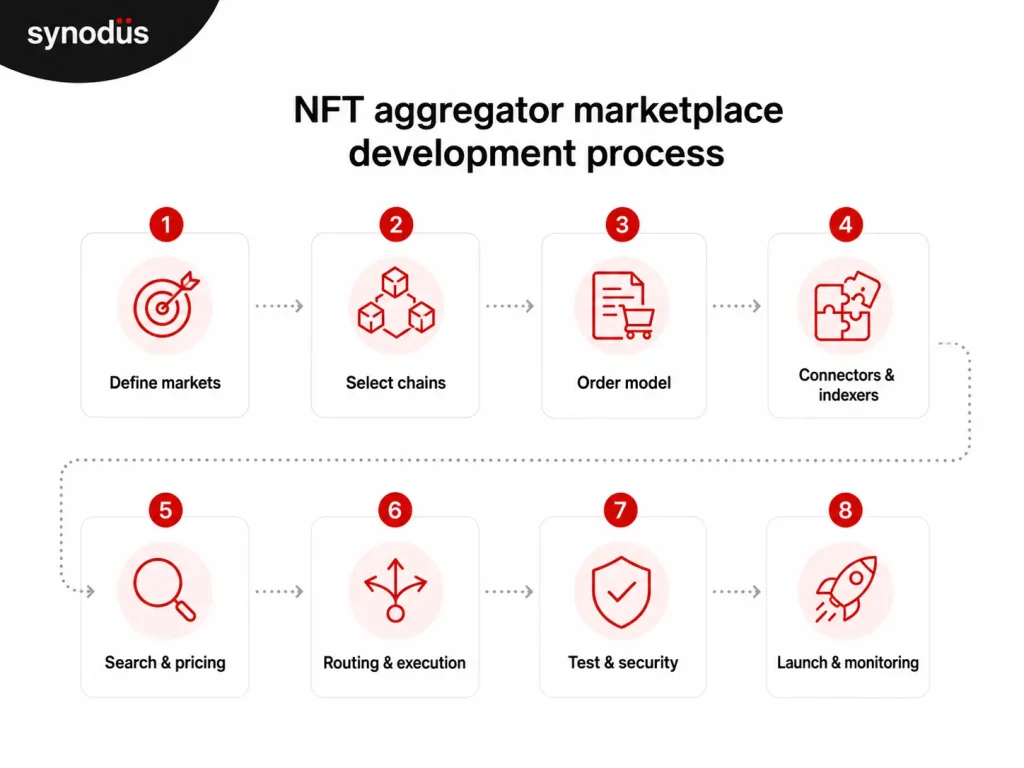
1. Define marketplaces and liquidity sources
Choose the external marketplaces, orderbooks, or protocols that matter to the target user. Document which actions each source must support: listings, offers, bids, sweeps, cancellations, or only read-only discovery.
2. Select chains and protocols
Separate single-chain and multi-chain scope early. Identify token standards, RPC requirements, settlement protocols, currencies, and wallet behavior for each chain.
3. Design the normalized order model
Create the internal schema for listings and offers before building the UI. Preserve source-specific execution data while exposing stable fields to search, analytics, and routing.
4. Build connectors and indexers
Implement data ingestion for each source, process chain events, and define how the system recovers from API outages, missed events, and rate-limit pressure.
5. Build search and pricing infrastructure
Store normalized orders and NFT metadata in a structure that supports fast filtering, traits, collection pages, price sorting, and market views.
6. Add routing and transaction execution
Construct the actions required to fulfill external orders, handle approvals and currencies, and define how batch purchases behave when one item fails.
7. Test integrations and security
Test stale orders, revoked approvals, expired listings, contract reverts, duplicate inventory, bad metadata, and unsupported currencies. Review any router or smart contract that can move user assets.
8. Launch with integration monitoring
Track API health, indexing lag, order failure rates, contract changes, and source coverage. Marketplace integrations need maintenance after launch.
NFT marketplace vs aggregator: Which should you build?
| Requirement | Standard NFT marketplace | NFT marketplace aggregator |
|---|---|---|
| Native listings | Core capability | Optional or combined with external listings |
| External marketplace inventory | Optional | Core value in most aggregator products |
| Cross-market price comparison | Limited to available integrations | Core capability |
| Data normalization | Usually limited | Critical |
| Transaction routing | Often unnecessary | Required for trading aggregation |
| External protocol dependency | Lower | Higher |
| Integration maintenance | Focused on own stack | Own stack plus every external source |
| Best fit | Own ecosystem, curated inventory, game assets, branded marketplace | Cross-market discovery, pro trading, liquidity access, marketplace infrastructure |
Build an aggregator when cross-market inventory or liquidity is part of the core product value. If users mainly trade assets created and listed inside one ecosystem, a standard marketplace is usually simpler to build, operate, and maintain.
A hybrid model is also common. The product can support native listings while aggregating selected external marketplaces to improve discovery or execution coverage. For teams that want to launch faster without building from scratch, our white-label NFT marketplace guide covers that alternative.
Final thoughts
An NFT marketplace aggregator becomes useful when a product needs to see or execute NFT inventory beyond one marketplace. Its value comes from unified discovery and access to external liquidity, but the engineering difficulty sits in the parts users rarely see: integrations, order normalization, data freshness, routing, and failure handling.
Before committing to aggregator development, define whether external liquidity is central to the product. If it is, the architecture should be designed around connectors, indexing, normalized orders, and execution from the start. If native inventory is enough, a standard marketplace can avoid a large amount of integration and maintenance work.
Teams evaluating a custom build can review Synodus’ blockchain development services for marketplace architecture, smart contracts, wallet integration, backend systems, and product delivery support.
FAQs about NFT marketplace aggregators
No. A marketplace primarily manages its own trading environment, while an aggregator combines external sources. A single product can do both.
OpenSea acquired the Gem NFT aggregator in 2022 and later integrated its pro trading direction into OpenSea. OpenSea now offers a Pro Mode for active traders, while the OpenSea Pro lineage remains a useful reference for aggregation-focused marketplace UX.
Batching can reduce repeated transaction overhead in some cases, but savings are not fixed. A transaction that executes several marketplace actions can still consume substantially more gas than a single simple purchase.
Not necessarily. Many aggregators expose listings or bids from external marketplaces. A hybrid marketplace may combine its own native orders with external liquidity.
Yes, but multi-chain support increases the scope considerably. Each chain can require separate indexing, RPC infrastructure, currencies, wallet logic, smart-contract integrations, and operational monitoring.
A typical NFT aggregator marketplace costs around $50,000-$150,000+ to develop, depending on integrations, chain support, and trading complexity. See our NFT marketplace development cost guide for a detailed breakdown.