Who this guide is for?
This guide is written for:
- Founders planning to launch an NFT marketplace as a core business model
- Product ownersturning marketplace requirements into a development scope
- Tech leads evaluating the architecture behind smart contracts, wallets, backend services, and user flows
If you are still deciding what type of marketplace to build, start by defining the business model and target users before making technical decisions.
How to create an NFT marketplace in 7 steps
Step 1. Define your marketplace type and transaction model
Before choosing a blockchain or development stack, define what kind of marketplace you are building and how users will interact with it.
Start with three questions:
- What type of assets will be traded? This could include digital art, gaming items, collectibles, music, virtual land, memberships, or tokenized real-world assets.
- Who can participate? A general marketplace may allow anyone to list assets, while a curated art marketplace may approve creators first. An RWA platform may require identity and eligibility checks before users can transact.
- How will assets be sold? Common models include fixed-price sales, offers, auctions, primary minting, and secondary trading.
These choices define the basic marketplace model and affect the requirements that follow.
A gaming marketplace, for example, may need fast transactions and detailed asset attributes. A curated art platform may place more emphasis on creator approval and auctions. An RWA marketplace may require identity verification, legal documentation, and controlled transfers.
At this stage, the goal is not to define every feature. It is to establish the marketplace model and the main transaction flow so feature planning and technical decisions have a clear foundation.
Step 2. Define your feature set and monetization model
Feature set
Once the marketplace model is clear, map the main user journey before deciding which features to build.
A typical transaction flow looks like this:
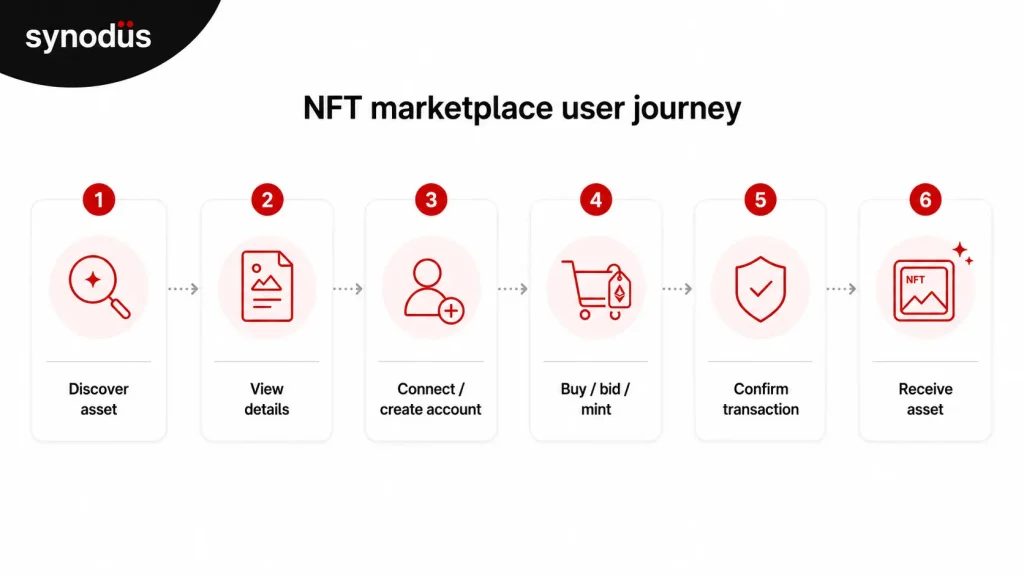
Use this flow to define the minimum feature set for your marketplace. Priorities will vary by marketplace type, so build only what supports the core transaction journey. Feature priorities also change depending on how decentralized the marketplace is. A decentralized NFT marketplace usually puts more emphasis on non-custodial wallets, smart contract settlement, permissionless access, and protocol-level interactions, while hybrid models rely more on platform-controlled workflows.
For a detailed breakdown by General, Curated Art, Gaming, and RWA marketplaces, see our NFT marketplace features guide.
Monetization model
Define how the marketplace will make money before finalizing the transaction and contract architecture. Some revenue models affect settlement logic and should be planned from the beginning.
- Transaction fees: The marketplace takes a percentage or fixed fee when a sale is completed. This model fits General marketplaces where frequent trading activity can generate recurring revenue.
- Primary sale commission: The platform takes a share when an NFT is sold for the first time. This works well for Curated Art marketplaces, where the platform may add value through artist selection, presentation, promotion, and access to collectors.
- Creator or issuer royalties: A creator, game publisher, or asset issuer receives a share of eligible secondary sales. This can fit Gaming marketplaces where assets are traded repeatedly. Royalty enforcement depends on the token standard, contract design, and marketplace implementation.
- Asset onboarding or issuance fees: The platform charges for verifying, structuring, tokenizing, or publishing an asset. This model is particularly relevant to RWA marketplaces, where onboarding may involve documentation, identity checks, legal review, and asset verification.
- Listing fees: Sellers pay when an asset is approved or published. This can work for controlled marketplaces where listing involves review or operational work, but it may create unnecessary friction in high-volume open marketplaces.
A marketplace can combine several revenue models. Keep the fee structure clear so users understand what they pay, when each fee applies, and who receives it.
Step 3. Choose the blockchain and system architecture
Blockchain selection
Choose the blockchain after marketplace requirements are clear. The right network depends on how the product will be used, not simply on which blockchain has the largest NFT ecosystem.
| Ethereum | Polygon/Base | Solana | Ronin / WAX / Immutable X | |
|---|---|---|---|---|
| General | Good, widely adopted | Better for cost-sensitive open listings | Growing ecosystem | Not typical |
| Curated Art | Best fit, collector liquidity lives here | Loses premium buyer audience | Limited art collector base | Not typical |
| Gaming | Too slow, too expensive | Viable for mid-scale games | Good for high-volume games | Best fit for dedicated game economies |
| RWA | Best fit, legal infrastructure built around it | Not typical | Not typical | Not typical |
Why this matters in practice: curated art collectors keep their assets on Ethereum. Moving to a cheaper chain reduces gas fees but cuts off the audience willing to pay for high-value digital art. That is why SuperRare and Foundation stay on Ethereum mainnet despite the cost. Gaming transactions happen at high frequency and low value per trade. Axie Infinity built its own Ronin sidechain to bring transaction costs close to zero rather than paying Ethereum gas fees on every in-game item trade.
Multi-chain support should be a product decision rather than a default requirement. Supporting several networks expands the potential user base but adds complexity to contract deployment, indexing, wallet flows, testing, and asset synchronization. For an MVP, starting with one network is easier to scope and maintain.
Decide what belongs on-chain
Not every marketplace function should run on the blockchain. A typical NFT marketplace separates on-chain transaction logic from off-chain application services.
- On-chain components: NFT contracts, asset ownership, transfers, marketplace settlement, offers or auctions, marketplace fees, royalty logic, permission or transfer rules.
- Off-chain components: user profiles, search, notifications, analytics, marketplace administration, cached listing data, KYC information, private documents, customer support data.
This split matters for both cost and performance. Storing every piece of marketplace data on-chain is unnecessary and makes the product more expensive and difficult to operate.
Supporting infrastructure
| Layer | Responsibility |
|---|---|
| Frontend | Marketplace pages, search, asset details, account and transaction flows |
| Backend | Business logic, APIs, notifications, integrations, admin functions |
| Database | Searchable marketplace and application data |
| Smart contracts | On-chain asset and transaction rules |
| Blockchain indexer | Processes contract events and updates marketplace state |
| Asset storage | NFT media, metadata, and supporting files |
| Wallet infrastructure | Authentication, signing, custody, or embedded wallet flows |
| Cloud infrastructure | Deployment, monitoring, APIs, databases, and scaling |
Outside of blockchain, most NFT marketplaces run on: React or Vue for frontend, Node.js or Python for backend, PostgreSQL or MongoDB for database, IPFS or Arweave for NFT metadata and assets, and AWS for hosting.
Step 4. Develop smart contracts and backend services
Smart contracts
Smart contracts handle the parts of the marketplace that need to execute on-chain. Depending on the product, this may include minting NFTs, creating or cancelling listings, accepting offers, running auctions, transferring assets, settling payments, collecting marketplace fees, and applying transfer restrictions.
Token standards to know:
- ERC-721: one token, one asset. Standard for 1-of-1 art, unique collectibles, and individual real estate NFTs.
- ERC-1155: one contract, multiple token types. Standard for gaming assets where the same item exists in multiple copies with different quantities.
Core contracts you will need:
- Marketplace contract: handles listings, offers, sales, and fee distribution.
- Minting contract: controls who can mint (open vs. gated) and what metadata gets attached.
- Royalty contract: defines how royalties are calculated and distributed on secondary sales. EIP-2981 is the current standard for on-chain royalty specification.
The NFT contract and marketplace contract do not have to be the same contract. Separating asset creation from trading and settlement logic makes the system easier to test, audit, and maintain.
Smart contract development should account for failure cases, not just successful transactions. Test scenarios such as invalid signatures, expired listings, cancelled offers, insufficient balances, unauthorized contract calls, duplicate transactions, failed transfers, incorrect payment amounts, permission changes, and unexpected transaction ordering.
For contracts that handle valuable assets or significant transaction volume, an independent security audit should be completed before production deployment. Do not skip the audit to save cost. A single exploit on an unaudited contract can drain user funds and end the platform.
Backend services
The backend connects on-chain activity with the user-facing marketplace. A typical event-driven flow looks like this:
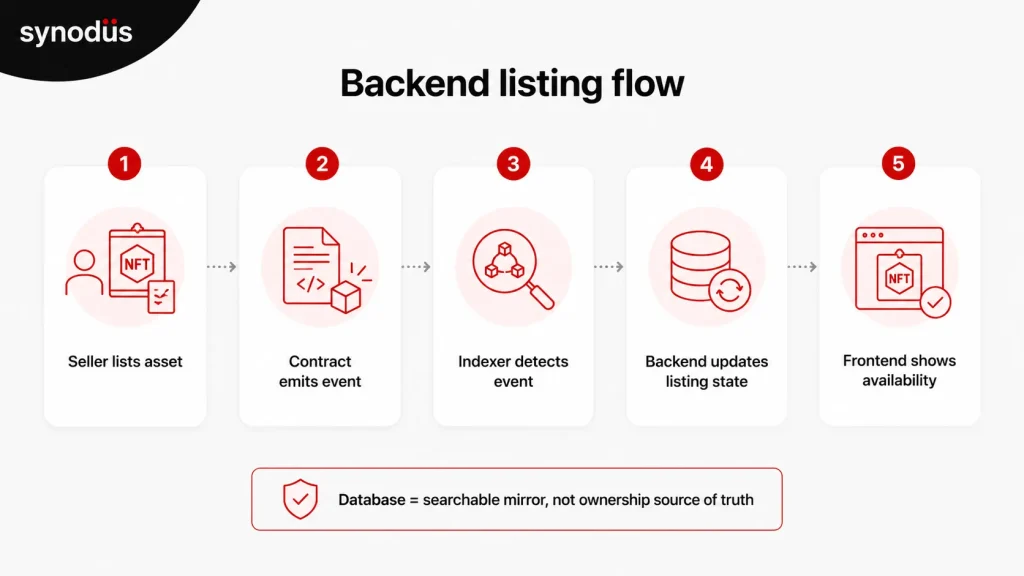
This flow allows users to browse marketplace data without querying the blockchain directly on every page load.
The backend also manages user accounts, creator profiles, search indexing, notifications, transaction history, metadata processing, admin workflows, analytics, external integrations, and compliance services.
The database should not be treated as the source of truth for on-chain ownership. It acts as a fast, searchable representation of blockchain and application data.
Step 5. Design and build user experience
NFT marketplace UX needs to make blockchain transactions understandable without forcing users to understand every technical detail behind them.
Start by mapping the main user journeys before designing individual screens: browsing and searching for assets, viewing NFT details, creating or connecting an account or wallet, minting, listing, buying, making or accepting an offer, bidding, managing owned assets, and tracking transaction status.
Pay particular attention to these areas:
Wallet and account onboarding: Support at minimum MetaMask, Coinbase Wallet, and WalletConnect. These three cover the majority of active NFT users across all marketplace types. A crypto-native marketplace may work well with external wallets only. A consumer product may benefit from an embedded wallet or account-based flow alongside external wallet support.
Network state: If the platform requires a particular blockchain, clearly show when the user is connected to the wrong network and provide a simple way to switch.
Transaction costs: Show expected network fees and marketplace fees before the user confirms a transaction.
Pending transactions: Blockchain transactions are not always instant. Users should be able to see whether a mint, purchase, transfer, or listing is waiting for confirmation.
Failed transactions: Do not leave users with a generic error. Explain whether the problem came from a rejected signature, insufficient funds, a network issue, an expired listing, or another known condition.
Asset information by marketplace type
- General: search and filter performance is critical. Users should be able to filter a catalog of millions of items in under a second.
- Curated Art: storefront presentation and provenance display matter most. Each artwork page should clearly show ownership history, edition number, and auction status.
- Gaming: attribute display and filtering need to be fast and granular. Players are scanning for specific stat combinations, not browsing.
- RWA: the wallet connection and KYC flow must be seamless and clearly explained. Users unfamiliar with identity verification on a blockchain platform will drop off if this step is confusing.
Step 6. Test, audit, and deploy
NFT marketplace testing needs to cover both conventional application behavior and blockchain-specific failure cases.
Smart contract testing
Test contract permissions, transaction conditions, settlement logic, edge cases, and failure scenarios. Automated contract tests should cover both expected behavior and attempts to use the contract incorrectly. Run a gas optimization audit since high gas costs on common actions will drive users away.
Functional testing
Test the main user flows from beginning to end: account or wallet onboarding, minting, listing, buying, selling, offers, auctions, transfers, fee calculations, and profile and portfolio updates.
Integration testing
Check how the different parts of the marketplace behave together: smart contracts, wallets, backend APIs, blockchain indexer, asset storage, database, payment services, and KYC services where applicable. A transaction that succeeds on-chain but fails to update the marketplace interface is still a product failure.
Performance and security testing
Test the system under the traffic and transaction volumes expected at launch. Review API performance, database load, indexer delays, RPC failures, rate limits, authentication, authorization, secrets management, and smart contract access control.
Deployment sequence
Deploy to testnet first. Run the full test suite against testnet with real wallets before touching mainnet. Fix issues on testnet, then deploy to mainnet. Keep production configuration separate from test environments. Contract addresses, API credentials, RPC endpoints, database access, and administrative permissions should all be verified before release.
Step 7. Monitor, maintain, and grow
Launching the marketplace is the start of the operating phase.
Monitor both application infrastructure and blockchain activity so problems can be identified before they affect a large number of users.
Track areas such as:
- API errors
- Failed transactions
- RPC availability
- Blockchain indexing delays
- Smart contract events
- Wallet connection failures
- Page and search performance
- Marketplace activity
- User drop-off points
- Security alerts
User feedback should be compared with actual product data.
If users repeatedly abandon a purchase at the wallet step, for example, the problem may be onboarding friction rather than a missing marketplace feature. If search activity grows as the catalog expands, better filtering may become more valuable than adding another sale format.
Plan releases around what users actually need.
Ongoing work may include:
- Bug fixes
- Security patches
- Performance improvements
- New marketplace features
- Additional blockchain support
- Contract upgrades where the architecture permits them
- Wallet improvements
- Search and indexing improvements
- Infrastructure scaling
Community and marketing activities can run alongside this work, but they should not replace product monitoring and maintenance.
Next steps
Once your marketplace type, feature set, tech stack, and build plan are clear, the next decision is whether to build in-house or bring in a technical partner.
Our guide to the top NFT marketplace development companies covers what to look for when shortlisting vendors. Our NFT marketplace development cost guide breaks down what a realistic budget looks like for each marketplace type in 2026.
If you would rather talk through your specific build scope directly, we can help you map it to a realistic plan and timeline.
Final thoughts
Building an NFT marketplace is less about adding as many features as possible and more about making the right product and architecture decisions early.
Start by defining the marketplace type, users, transaction model, and core features. Choose the blockchain only after those requirements are clear. From there, design the on-chain and off-chain architecture, develop the contracts and application services, build the user experience, and test the complete transaction flow before launch.
A clear scope also makes it easier to estimate development time and cost, identify security risks early, and decide which features can wait until later releases.