NFT art marketplace’s growth & volume
Art NFT marketplaces are platforms designed specifically for artists and art collectors, where digital artworks are minted, showcased, and traded as NFTs. Unlike general NFT marketplaces, art-focused platforms prioritize curation, aesthetics, and artist reputation over sheer trading volume.
Art segment NFT sales volume has kept falling through 2025 and 2026, with trading volume down more than 90% from the April 2021 peak, according to a February 2026 market analysis. The steepest drop followed the 2022 market correction, and it accelerated again during the 2024 to 2026 marketplace shutdown wave.
The global NFT art market was valued at approximately 3.3 billion USD in 2024 and is projected to reach 45.97 billion USD by 2033, growing at a CAGR of around 34% from 2025 to 2033, according to Market Data Forecast’s 2026 NFT art market report.
The NFT art market has entered a consolidation phase. Between late 2023 and early 2026, several of the sector’s most established marketplaces shut down entirely: Async Art (October 2023), KnownOrigin (July 2024, following eBay’s 2022 acquisition), MakersPlace (January 2025), and most notably Nifty Gateway, the Gemini owned platform that helped define the 2021 boom, which closed on February 23, 2026. Foundation, once a flagship invite only platform, ceased independent operations in April 2026 following a failed acquisition.
Trading volume across the sector has reportedly fallen more than 90% from 2021 peaks, driven by business models built for boom era speculation and structural fragility in how NFT metadata and artwork are hosted. A 2026 Pinata analysis found roughly 27% of top collections still rely on centralized servers rather than fully on chain storage, meaning artwork can vanish if a platform disappears.
What is replacing the closed platforms is a smaller set of survivors that adapted: general marketplaces consolidating trading volume (OpenSea, Blur, Magic Eden), and a few purpose built creator tools (Manifold, Zora’s open protocol) gaining ground with artists who want direct ownership of their smart contracts instead of dependency on one platform’s continuity.
This shift affects how artists should choose a platform today. Platform longevity and where artwork and metadata are actually stored are no longer secondary concerns, and belong in the decision criteria section below rather than just the marketplace list.
How to choose the best NFT marketplace for artists
For a broader breakdown of how features differ by marketplace type, see our NFT marketplace features guide. Different platforms attract different collectors, support different blockchains, charge different fees, and give creators varying levels of control over royalties and smart contracts.
Before publishing your work, consider the following factors.
Audience and type of artwork
Start with where your target collectors are most active. Some marketplaces focus on curated digital art and one-of-one pieces, while others support a broader range of NFTs, including photography, music, collectibles, gaming assets, and generative art.
A specialized art marketplace can offer better discovery among serious collectors, but it may have a smaller audience or stricter creator requirements. General marketplaces typically provide broader exposure but also more competition.
Creator access
Not every NFT marketplace is open to all creators. Some allow anyone to mint and list NFTs, while curated platforms may require an application, invitation, or portfolio review.
Open marketplaces are usually easier for emerging artists to enter. Curated marketplaces, meanwhile, can offer stronger positioning and a more focused collector base once you are accepted.
Blockchain network
The blockchain behind a marketplace affects transaction costs, wallet compatibility, environmental footprint, liquidity, and the communities you can reach.
Ethereum remains widely used for digital art, while networks such as Tezos, Base, Polygon, and others may offer lower transaction costs or appeal to different creator communities.
Artists should also consider whether a marketplace supports multiple chains or locks their collection into a single ecosystem.
Marketplace and gas fees
Minting is only one part of the cost. Depending on the platform and blockchain, artists may also encounter:
- Marketplace fees on primary or secondary sales
- Blockchain gas fees
- Collection or contract deployment fees
- Withdrawal or conversion costs
These costs can significantly affect earnings, especially for lower-priced artwork. Always check the marketplace’s latest fee structure before listing. For teams planning to build their own art marketplace, see our NFT marketplace development cost guide for a breakdown of what different project scopes typically cost.
Creator royalties
Royalties allow artists to potentially earn from secondary sales, but they should not be treated as guaranteed income.
Royalty policies vary between marketplaces. In some cases, royalties are supported or enforced by marketplace rules or smart-contract mechanisms; in others, they may be optional.
Before choosing a platform, check how creator royalties are handled, what percentage you can set, and whether those royalties remain effective when the NFT is traded elsewhere
Control over your smart contract
Artists should also consider how much ownership they want over the underlying NFT contract.
Some marketplaces mint NFTs through shared platform contracts, while creator-focused tools allow artists to deploy and manage their own smart contracts. Owning the contract can give creators greater flexibility over metadata, editions, royalties, future drops, and distribution across marketplaces.
For artists planning to build a long-term Web3 brand rather than sell a few individual pieces, this can be an important consideration.
Discovery and collector activity
A marketplace with many users does not automatically mean better exposure. Large platforms usually bring more potential buyers, but they also contain significantly more competing collections.
Smaller or curated marketplaces may offer stronger discovery within a particular niche, such as fine digital art, photography, or generative art.
Look at the type of artwork currently being traded, the artists featured by the platform, and how collectors discover new creators before deciding where to publish.
Platform longevity and ownership
NFTs can remain on-chain even when the marketplace where they were originally listed changes direction or shuts down. Several well-known NFT platforms have already closed or significantly changed their business models over the years.
For that reason, artists should consider where their metadata is stored, whether they control their smart contract, and how easily their NFTs can be viewed or traded outside the original marketplace.
With these factors in mind, here are some of the NFT marketplaces artists can consider in 2026.
Top 10+ best art NFT marketplaces for artists
The NFT marketplace landscape looks very different today from the market of a few years ago. Several once-prominent platforms have shut down, while others have expanded beyond NFTs or shifted toward more specialized creator models.
For artists, this makes choosing a marketplace less about finding the biggest platform and more about finding the right audience, blockchain, sales model, and level of control over your work.
The marketplaces and creator platforms below are among the most relevant options for artists in 2026, based on their art focus, creator tools, accessibility, blockchain support, and approach to selling digital work.
| Marketplace | Best for | Blockchain | Creator access | Main trade-off |
|---|---|---|---|---|
| OpenSea | Broad audience and general NFT exposure | Multichain | Open | Less focused on fine art |
| SuperRare | Premium 1/1 digital art | Ethereum | Invite only | High barrier to entry |
| Rarible | Multichain creators | Multichain | Open | Less art-focused |
| Objkt | Tezos digital art | Tezos | Open | Smaller ecosystem than Ethereum |
| Manifold | Smart contract ownership and independent drops | Ethereum ecosystem | Open | Requires more Web3 knowledge |
| Art Blocks | On-chain generative art | Ethereum, Arbitrum, Base | Application-based | Highly specialized |
| fxhash | Generative and experimental art | Tezos, Ethereum, Base | Open | Mostly suited to generative artists |
| Magic Eden | Solana and multichain NFTs | Multichain | Open | Collectibles-oriented |
| Fellowship | Curated digital art, AI art, and photography | Varies by release | Curated | Not accessible to every creator |
| Verse | Contemporary and generative digital art | Primarily Ethereum | Curated | Smaller collector ecosystem |
OpenSea – Best for broad NFT exposure
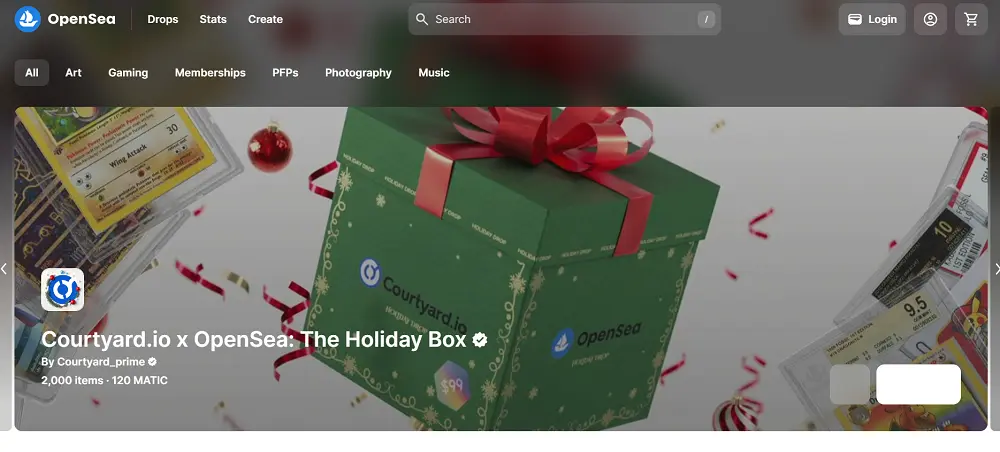
OpenSea remains one of the most accessible choices for artists who want to reach a broad NFT audience rather than limit their work to a highly specialized art community. Its marketplace covers digital art alongside collectibles, photography, gaming assets, memberships, and other tokenized content.
The platform also operates across multiple blockchain ecosystems, making it useful for creators who do not want their collections tied to one network.
OpenSea currently charges a standard 1% marketplace fee when NFTs are sold, although different fees can apply to primary drops. Creator earnings are also not automatically guaranteed across every collection: depending on the NFT contract, they can be enforced or optional.
NFT type: Art, photography, collectibles, gaming assets, music, and other digital assets
Why consider OpenSea: Its broad marketplace makes it suitable for artists who prioritize reach, flexibility, and access to collectors across multiple NFT categories.
Main trade-off: The same openness that gives creators more reach also means significantly more competition. Artists may need an existing audience or strong marketing strategy to stand out.
Rarible – Best for multichain creators
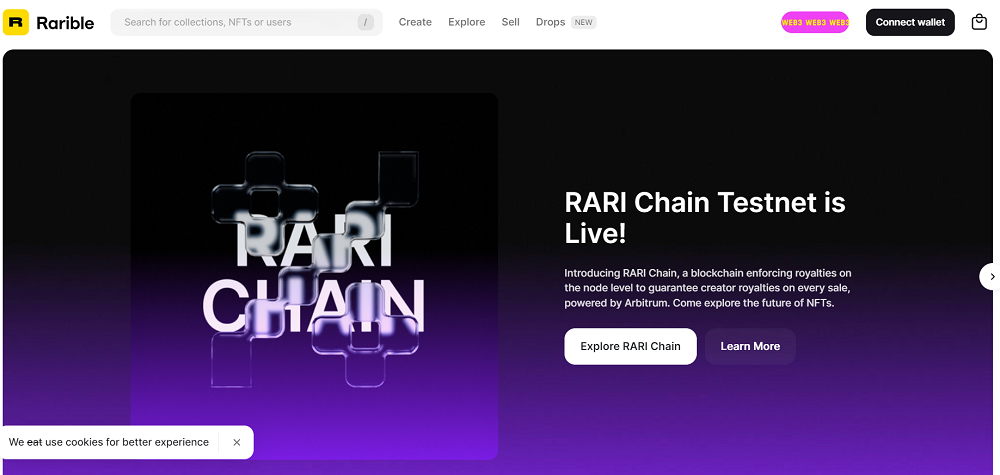
Rarible has evolved from its early Ethereum-focused marketplace into a broader cross-chain NFT ecosystem.
Its current marketplace provides access to NFTs across networks including Ethereum, Solana, Base, Arbitrum, Polygon, and other supported chains.
Rarible is worth considering for artists who want to experiment with multiple blockchain communities
NFT type: Art, collectibles, gaming assets, community collections, and other NFTs
Why consider Rarible: Multichain support gives artists greater flexibility over where they publish and sell their work. It can also be useful for creators who want access to different NFT communities through a single marketplace ecosystem.
Main trade-off: Rarible is no longer primarily an art marketplace. Artists looking specifically for collectors of high-end digital art may find curated platforms more targeted.
SuperRare – Best for premium digital art
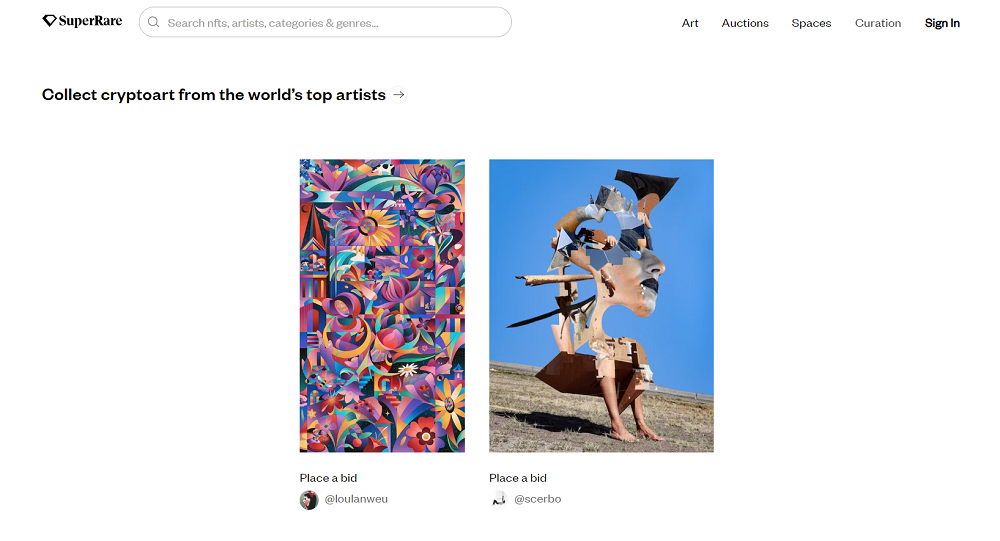
SuperRare takes a very different approach from open marketplaces. It focuses heavily on original digital artwork and maintains a curated creator community rather than allowing anyone to mint directly.
Artists must be invited before they can publish work on SuperRare. The barrier to entry is higher, but it helps maintain the platform’s positioning.
Its fee structure also differs considerably from mass-market platforms. On primary sales, artists currently receive 85% of the sale amount, while 15% goes to the SuperRare DAO Community Treasury. On secondary sales through SuperRare, the original artist receives a 10% royalty. Buyers also pay a 3% marketplace fee on sales.
NFT type: 1/1 digital art
Why consider SuperRare: It is particularly suitable for established digital artists who value curation, collector positioning, and a marketplace built around art rather than broad NFT trading.
Main trade-off: Getting accepted is considerably harder than joining an open marketplace, and the 15% primary-sale commission is higher than that of many general NFT platforms.
Objkt – Best for artists in the Tezos ecosystem
Objkt is one of the strongest options for artists who want to create and sell NFTs on Tezos.
Unlike general NFT marketplaces dominated by collectibles and PFP projects, Objkt has developed a particularly visible digital-art community. Artists can create collections, mint work, set royalties, and use different sale mechanisms within the Tezos ecosystem.
Objkt currently charges a 5% marketplace fee on successful sales through its smart contracts, paid by the seller. Artist royalties are deducted separately according to the royalty configuration of the token.
NFT type: Digital art, photography, generative art, editions, and collectibles
Why consider Objkt: It combines relatively accessible creator tools with a marketplace audience that has a stronger art focus than many general NFT platforms.
Main trade-off: Tezos has a smaller overall NFT ecosystem than Ethereum, so artists are trading broader market size for a more specialized community.
Manifold – Best for artists who want control over their smart contracts
Manifold is slightly different from a traditional NFT marketplace. Instead of primarily competing to become the place where collectors trade NFTs, it gives creators infrastructure for launching and managing their own NFT contracts and drops.
Creators can deploy their own ERC-721 or ERC-1155 contracts and retain control over functions such as metadata, minting, permissions, and royalty configuration. Manifold also supports extensions that allow creators to build more customized minting experiences.
Artists can mint NFTs through their own contracts and then distribute or sell those assets through mint pages or external marketplaces.
NFT type: 1/1 art, editions, digital collectibles, experimental NFTs
Why consider Manifold: It is a strong choice for artists who care about contract ownership and want to build a long-term on-chain identity rather than mint everything through a marketplace-owned contract.
Main trade-off: The additional control comes with more complexity. Creators who simply want to upload an image and list it for sale may find traditional marketplaces easier.
Art Blocks – Best for on-chain generative art
Art Blocks occupies a very specific position in NFT art: it focuses on generative artwork in which the artist’s algorithm forms an essential part of the work.
Artists create generative scripts, and when a collector mints an NFT, the system uses blockchain data to produce a unique output from that algorithm. Art Blocks’ architecture is specifically designed around preserving generative projects on-chain.
Art Blocks projects currently live across Ethereum, Arbitrum, and Base. Artist applications are reviewed rather than automatically accepted, making it more selective than fully open creator platforms.
For Art Blocks Studio projects, artists receive 90% of primary sales, with 10% going to Art Blocks. Secondary royalties can be configured up to 5% in total.
NFT type: Generative and on-chain art
Why consider Art Blocks: Few platforms have such a clear specialization in on-chain generative art. For artists working with code and algorithmic systems, this specialization can be far more valuable than the reach of a general NFT marketplace.
Main trade-off: It is highly specialized and requires both technical ability and a strong understanding of generative art.
fxhash – Best open platform for generative artists
fxhash is another marketplace built around generative art, but its approach is more open and experimental.
Artists can publish generative projects that create unique outputs when collectors mint them. The platform supports both primary and secondary markets and provides creator tools for developing custom generative minting experiences.
fxhash supports Tezos alongside Ethereum-compatible ecosystems including Base, making it particularly interesting for creators who want to experiment across different generative-art communities.
The platform has also continued experimenting with new formats, including open-form generative projects and art-coin mechanics, making it more than a conventional fixed NFT marketplace.
NFT type: Generative art and interactive digital art
Why consider fxhash: It offers a relatively creator-friendly environment for programmers and generative artists without the same level of curation required by Art Blocks.
Main trade-off: Its specialization is also its limitation. Artists working primarily with static illustration, photography, or traditional digital painting may find other marketplaces more suitable.
Magic Eden – Best for Solana and multichain NFT creators
Magic Eden is best known for its role in the Solana NFT ecosystem but has expanded into a broader multichain marketplace.
Creators can use its tools to create collections and work across networks including Solana, Ethereum, Base, and Bitcoin, although specific creator features differ between networks.
On its Solana marketplace, Magic Eden currently charges no listing fee and takes a 2% transaction fee. Creator royalties can be honored by buyers or enforced in certain cases depending on how the collection is configured.
NFT type: Art, collectibles, gaming NFTs, PFPs, and Bitcoin Ordinals
Why consider Magic Eden: It is a useful option for artists who want exposure to Solana or want to distribute NFTs beyond the Ethereum-centric art market.
Main trade-off: The marketplace is heavily associated with collectibles and NFT projects, so pure digital artists may find less art-specific discovery than on SuperRare, Objkt, or Verse.
Fellowship – Best for high-end digital art, AI art, and photography
Fellowship sits closer to a contemporary digital-art gallery than an open NFT marketplace.
Its programs focus on curated artists working across digital photography, generative systems, AI, algorithms, and other technology-driven artistic practices. Fellowship continues to run exhibitions and releases both online and through major physical art events.
For example, Fellowship presented Sougwen Chung at Art Basel Hong Kong in March 2026 and continues to operate curated programs around AI art and photography.
NFT type: Digital art, AI art, generative art, photography
Why consider Fellowship: It is suitable for established artists looking for gallery-style representation, curated releases, and connections between digital art and the traditional contemporary-art market.
Main trade-off: Fellowship is not designed as a self-service marketplace. Artists cannot simply create an account and upload a collection, making it inaccessible for most beginners.
Verse – Best for curated contemporary and generative digital art
Verse is a platform specifically built for releasing and collecting digital art, with support for artists, galleries, primary releases, and secondary-market activity. Its release models include 1/1 works, editions, generative projects, curated releases, auctions, and other sale formats.
Primary-market releases are currently supported on Ethereum mainnet as well as off-chain modes, while Verse can also surface secondary-market information from additional sources.
Verse currently charges creators a 6% platform fee on primary-market sales. Secondary-market sales carry a 2.5% fee paid by the seller.
NFT type: Contemporary digital art, generative art, 1/1 artwork, editions
Why consider Verse: Its artist-focused release infrastructure and variety of sale mechanics make it particularly interesting for established creators and galleries that want more structured digital-art releases.
Main trade-off: It has a more specialized audience and considerably less general NFT traffic than mass-market platforms such as OpenSea.
Frequently asked questions (FAQs)
It depends on your goals. SuperRare suits curated digital art, OpenSea offers broader exposure, Objkt is strong for Tezos artists, while Art Blocks and fxhash focus on generative art.
Costs may include marketplace fees, gas fees, minting costs, and smart contract deployment fees. The exact amount depends on the platform and blockchain.
Not always. Some marketplaces are open to everyone, while curated platforms may require an application, invitation, or portfolio review before artists can mint or sell.
Yes, but royalties are not always guaranteed. Whether they are paid depends on the marketplace’s policy and how the NFT smart contract handles creator earnings.
The cost to convert art to an NFT typically involves fees for minting the token on a blockchain platform, which can range from a few dollars to hundreds of dollars depending on the platform and its associated gas fees.
Wrapping up
The NFT art market continues to evolve, and the right marketplace will depend on each artist’s audience, creative style, and preferred way of selling their work. Rather than following the most popular platform, focus on the one that offers the best fit for your long-term goals.