The challenges of healthcare’s digital transformation
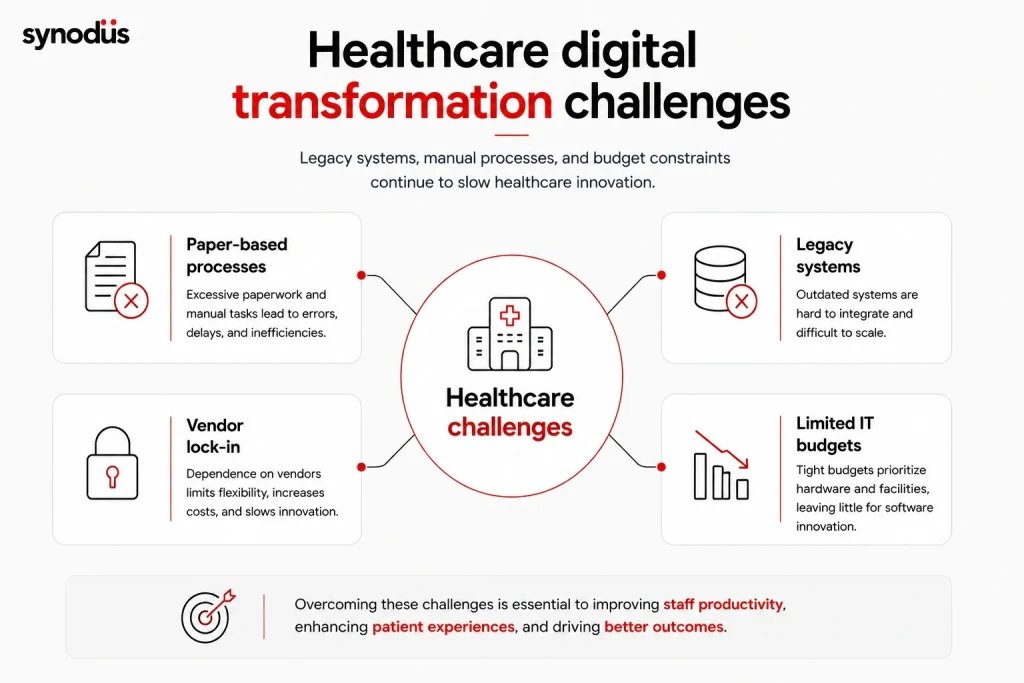
Healthcare is one of the most innovative industries when it comes to hardware, yet internal digital transformation often lags, held back by low software adoption and complex data handling. There is still a huge amount of paperwork and manual work.
Teams understand the need to modernize, but IT departments are often stuck with legacy systems and vendor lock-in, which leaves software unusable and forces a return to manual processes. Imagine spending a day examining dozens of patients and handling critical cases, then facing a pile of reports and paperwork at the end of it.
Budgets are tight, too. Most spending goes to what matters most, hardware and facilities, so building applications from scratch is simply too expensive for many providers. The long-term result is burned-out staff and frustrated patients, which pushes healthcare organizations to look for a better way. That is where low-code comes in.
What is low-code?
Low-code is an application development approach that uses graphical interfaces, drag-and-drop builders, and minimal code. Citizen developers and business users with little or no traditional coding experience can build powerful enterprise applications to handle a range of tasks, processes, and challenges.
For healthcare specifically, look for a low-code platform with these features:
- Compatibility across mobile, tablet, and desktop.
- HIPAA-compliant cloud hosting.
- Interoperability with legacy and other health IT systems.
Why use low-code in healthcare
Why choose low-code over other development methods for healthcare?
- Faster development and time-to-market: boilerplate code, reusable components, and pre-built templates speed up building, and you can still customize any part you want.
- Scalable architectures: support for cloud-native SaaS and on-premises setups lets you scale resources to your uptime and cost needs.
- Healthcare workers take part: because it is easy to use, analysts, doctors, nurses, and business staff can all contribute.
- Lower development and maintenance costs: low-code eases the load on IT and cuts software life-cycle costs, giving you time to validate ideas and secure investment.
- Compatibility with third-party and legacy systems: replace outdated systems with modern tools like telehealth, administration, and scheduling software.
- Rapid testing: fast prototyping and constant iteration shorten the development cycle and speed up delivery of new applications.
To see both sides, read our breakdown of low-code benefits and disadvantages.
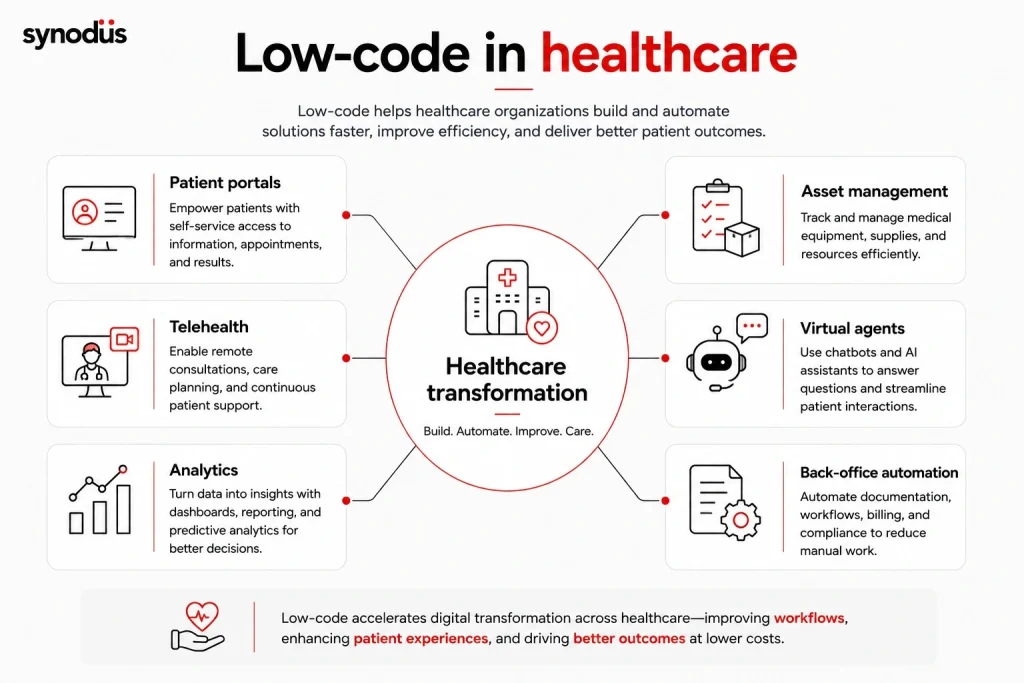
6 ways to leverage low-code in healthcare
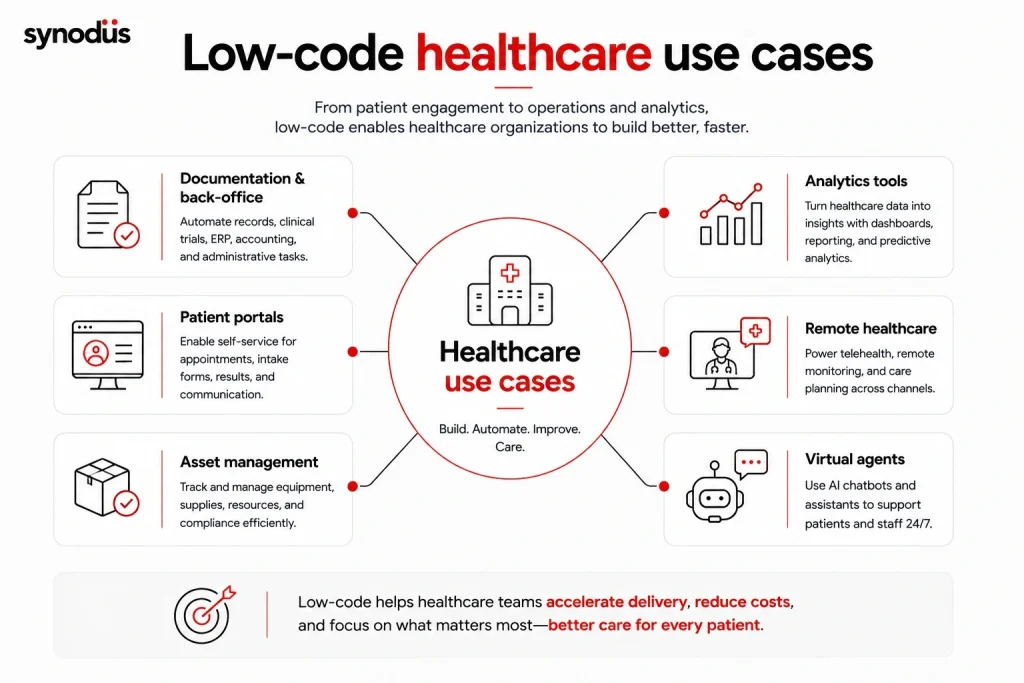
| Use case | What it does |
|---|---|
| Documentation and back-office | Automates records, trials, ERP, accounting |
| Client portals | Booking, intake forms, test results, reminders |
| Asset management | Resource allocation, supply and compliance tracking |
| Analytics tools | Decision support and predictive analytics |
| Remote healthcare | Telehealth and remote care planning |
| Virtual agents | Chatbots and AI assistants for patients |
Support documentation and automate back-office tasks
Drug trials need consistent iteration testing and precise documentation, which is time-consuming and error-prone to track manually. Automating documentation stages speeds up internal processes significantly. You can build a centralized, scalable low-code database for client information, test results, and trial performance, and automate data classification, analysis, and storage.
Back-office uses go further, including building an employee portal, an accounting app, a custom low-code ERP system, or agents that automate simple, repetitive tasks.
Create client portals
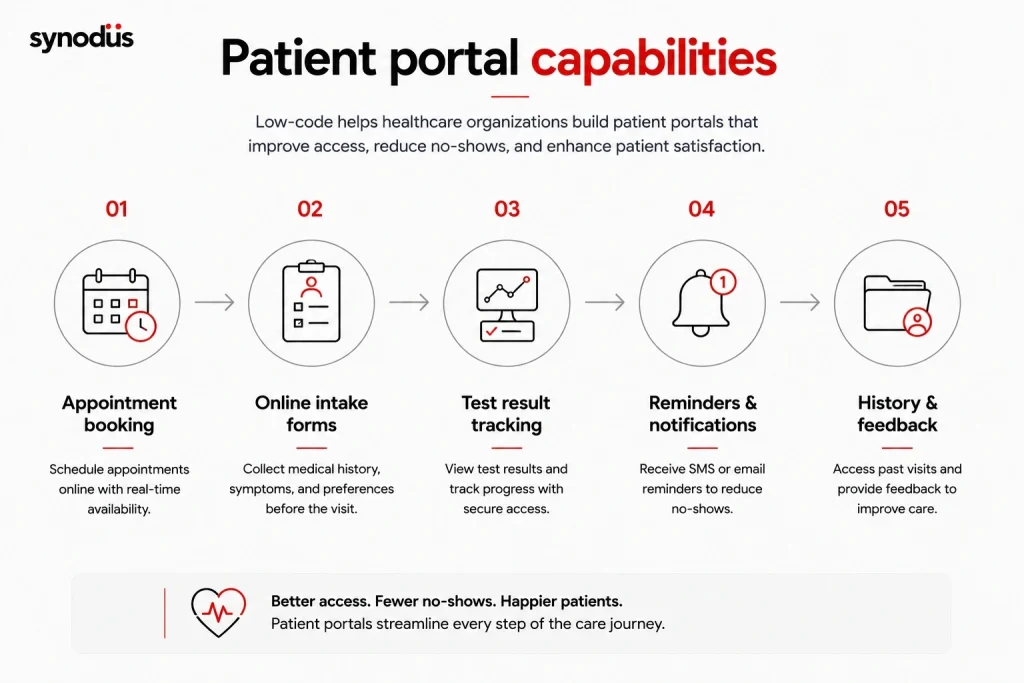
Many patients hesitate to visit hospitals because they get little support before appointments. Client portals store information and answer questions online, easing those concerns and smoothing treatment. Common portal features include:
- Test result tracking: patients see when to come in for a re-check with a few clicks.
- Appointment booking: schedule without lengthy paperwork, plus SMS or email reminders to reduce no-shows.
- Online intake forms: capture lifestyle, medical history, symptoms, and next steps, saving time and reducing errors.
- Medication and vaccine availability checks before traveling to the hospital.
- Access to past appointments and feedback or review tools for performance reviews.
Optimize asset management
Low-code tools with AI and machine learning can streamline daily operations, allocate hospital resources, manage drug delivery, flag low stock, and handle supplies. They can also automate regulatory compliance, such as patient documentation and insurance requirements, more efficiently than manual methods.
Develop healthcare analytics tools
Emory Healthcare, Georgia’s largest healthcare network with 11 hospitals and 20,000 employees across 250 sites, wanted to aggregate and analyze billing, claims, and financial data affecting patient experience. It used low-code to build a decision-support system that integrated multiple data sources and supplemented existing tools. With AI and machine learning, low-code can serve as a reliable predictive analytics tool. Explore our roundup of low-code AI platforms.
Facilitate remote healthcare
When symptoms are unclear but you still want an answer, telehealth helps by reducing physical visits for less urgent needs. Low-code platforms support remote care planning by making patient assistance more accessible.
Improve patient experience with virtual agents and chatbots
A growing low-code feature is the ability to build intelligent chatbots that respond in natural language, raising self-service while reducing the load on human staff. See our guide to low-code chatbot platforms. These are only a few examples, since low-code can build almost any application, which makes it a good way to test an idea before investing in fully custom software.
The AI shift in healthcare low-code
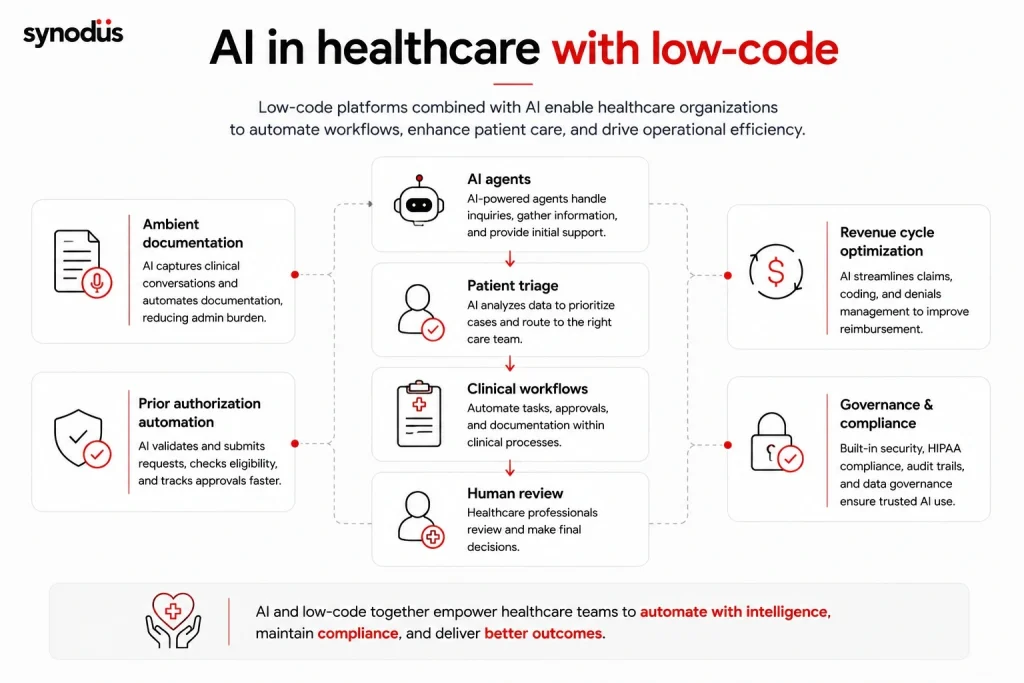
In 2026, AI has become part of the basic plumbing of healthcare, not an experiment at the edges. A February 2026 survey of 120 health systems found that 75% had deployed at least one AI solution, up from 59% a year earlier, with only 25% having no AI at all. Ambient documentation, where AI listens to a clinician-patient conversation and drafts the notes, is the fastest-moving use case, and one health system reported saving 66 minutes per provider per day with ambient scribing.
For low-code in healthcare, the shift is from chatbots that answer to AI agents that act, completing multi-step workflows like prior authorization, patient triage, and revenue cycle tasks. The lesson from these deployments is that governance and clean data decide success, and that easy escalation to a clinician must stay in the loop. A well-governed low-code platform, with HIPAA-compliant hosting and clear audit trails, is exactly the foundation these AI workflows need. When planning a build, ask where an AI agent could safely go beyond a static workflow.
Real-life examples of using low-code for healthcare
The platforms available today meet the needs of demanding healthcare organizations. Here are real examples, with figures drawn from each organization’s published case studies, so treat them as point-in-time results.
Patient referrals
The Royal Berkshire NHS Foundation handles around 125,000 patient referrals a year across 40 specialist areas, and processing them manually was slow. With a low-code tool, it automated the referral process, making it 6 times faster and saving an estimated 15,000 work hours per year.
Centralized communication tool
Luz Saude, a leading Portuguese healthcare group, needed a tool for content management, access control, and scheduling. A full engineering team expected more than 9 months of work, but a low-code platform let the group finish the customized software with a team of 7 in 4 months.
Homecare planning system
Saga Healthcare, one of the UK’s largest homecare agencies, needed a new homecare scheduling system. The initial budget was $16 million over 3 years, but a low-code solution delivered it in 6 months for less than $333,500.
Pharmaceutical ERP
Synodus built an ERP for a pharmaceutical company on Dynamics 365, Power BI, and Azure, delivered in 6 months by a team of 5. The system manages orders, customers, and inventory, and supported 80% year-on-year growth. See the full pharmaceutical ERP case study.
Analytics platform for medical implants
A US hospital wanted to digitize transaction and billing management for implantable devices. A standard stack would have taken ten developers about a year, but a low-code platform let the company build it with one developer in nine months. The software identifies contracting issues, analyzes invoices, and finds cost-cutting opportunities, helping hospitals save roughly 30% on medical implants.
Top low-code healthcare platforms to use
Most healthcare staff are non-technical and short on time, so an easy-to-use, flexible platform that anyone can adopt quickly is ideal. Here are strong options:
- Creatio: build mobile apps and process automation tools with a user-friendly interface, pre-built features, and customizable templates, and it is one of the simplest to learn.
- Microsoft Power Apps: a leading enterprise option, with extensibility, scalable infrastructure, a friendly interface, and flexible integration across systems and devices. See how Power Apps removed paperwork at Vitas Healthcare.
- Mendix: supports app development, workflow automation, and project management, and integrates with healthcare core systems, ERP, and CRM.
- Zoho Creator: with 550+ building blocks, it builds apps that run on all devices, and scalability is a strength.
- Appian: a clean interface and simple features that help enhance patient experience, reduce paperwork, and boost productivity.
For more options sorted by company size, see our roundup of the best low-code platforms.
As a Microsoft Power Platform specialist in APAC, Synodus builds and customizes secure, HIPAA-aware low-code solutions for healthcare, from patient portals to ERP. Looking for tech consultation in the healthcare industry? Our low-code experts can help you rapidly build applications and cut paperwork from internal processes.
Frequently asked questions
It can be. Compliance depends on the platform and how you configure it. Choose a platform with HIPAA-compliant hosting, strong access controls, and audit trails, and build under proper governance, rather than assuming any platform is compliant by default.
Common builds include patient portals, appointment booking and intake forms, electronic health records, medication and inventory management, decision-support and analytics tools, telehealth, and AI chatbots and agents for patient support.
Yes, when used correctly. Centralized, governed low-code platforms are more secure than scattered spreadsheets and shadow IT. The key is choosing a compliant platform, applying access controls, and keeping clinicians in the loop for AI-driven workflows.
It varies, but the examples above show large gains: a referral process made 6 times faster, a system built in 4 months instead of 9, and a scheduling tool delivered for a fraction of a multi-million-dollar budget. Savings come from faster delivery, fewer developers, and less manual work.
Wrapping up
Healthcare providers benefit from robust applications built for their specific needs, but custom healthcare software is hard to develop with limited IT resources. Low-code bridges that gap, shortening development cycles to meet the real-time demands of patients and staff, and now pairs naturally with AI to cut documentation and administrative burden.
If you would rather have experts build it for you, Synodus delivers custom low-code service for healthcare that turn your data into apps 10x faster and cut development costs by half, with the security and compliance the sector demands. Book a free consultation to find the right fit for your organization.