How we evaluated these WordPress NFT minting plugins
There are fewer active WordPress NFT minting plugins than the long product lists found across older search results might suggest.
For this comparison, we reviewed current WordPress.org listings and official product documentation and looked at:
- Actual NFT minting functionality
- Supported blockchains
- NFT standards such as ERC-721 and ERC-1155
- Wallet integration
- Smart contract support
- WooCommerce integration
- IPFS and metadata handling
- Lazy minting
- Marketplace features
- Plugin maintenance
- WordPress compatibility
- Documentation and pricing transparency
We excluded tools whose main function is displaying NFTs, importing marketplace listings, or selling cryptocurrency without an NFT minting flow. Standalone React, Next.js, and Unity applications were also excluded because they are not WordPress plugins.
Maintenance was also considered. A WordPress NFT plugin may depend on wallet libraries, blockchain networks, APIs, smart contracts, and WordPress itself. A plugin that has not kept up with these changes requires more testing before it is used in production.
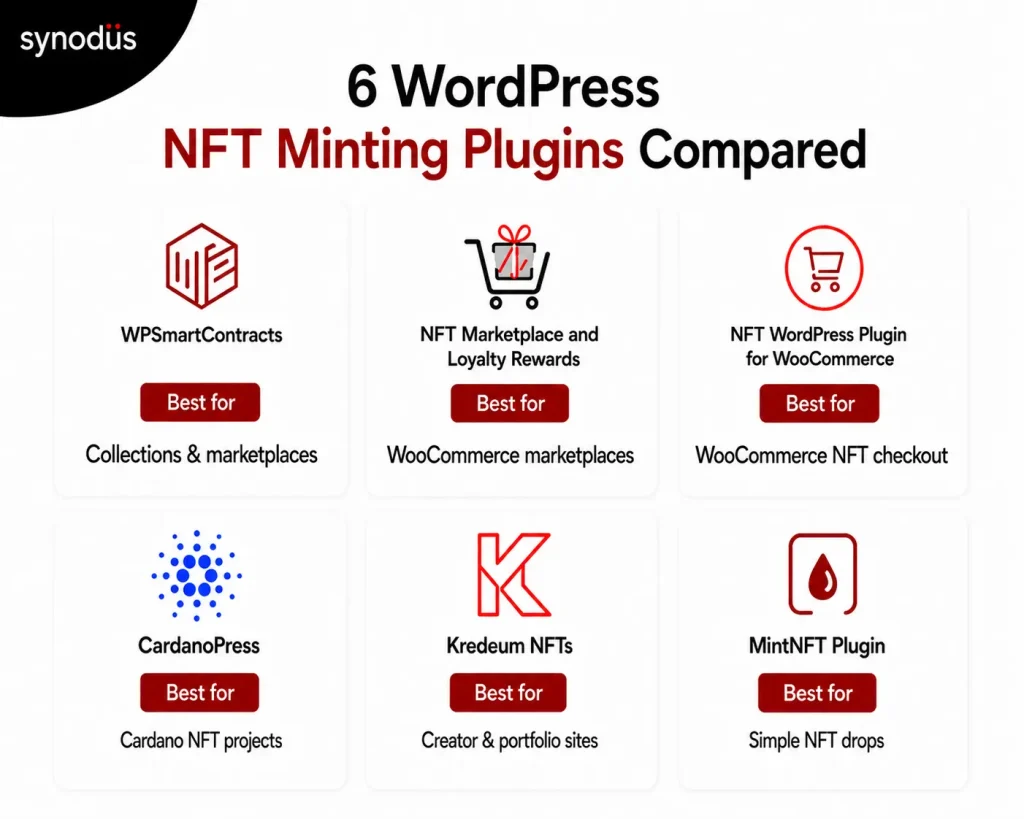
Best WordPress NFT minting plugins at a glance
| Plugin | Best for | Blockchain support | NFT standard | WooCommerce |
|---|---|---|---|---|
| WPSmartContracts | NFT collections and marketplaces | Ethereum, Polygon, BNB Smart Chain, Arbitrum, Avalanche, PulseChain | ERC-721, ERC-1155 | Not its main focus |
| NFT Marketplace and Loyalty Rewards | WooCommerce NFT marketplaces | Ethereum, Polygon and other supported networks depending on plan | ERC-721, ERC-1155 available in paid offerings | Yes |
| NFT WordPress Plugin for WooCommerce | Selling NFTs through WooCommerce checkout | Ethereum and compatible EVM networks | ERC-721 | Yes |
| CardanoPress | Cardano NFT projects | Cardano | Cardano native assets | Integrations available |
| Kredeum NFTs | Creator and portfolio sites | Ethereum, Polygon and several EVM networks | Mainly ERC-721 minting | Not required |
| MintNFT Plugin | Simple ERC-721 minting projects | Ethereum, Polygon | ERC-721 | No |
1. WPSmartContracts
WPSmartContracts is designed for NFT projects that need more than a basic mint button, with built-in options for collections, marketplaces, auctions, NFT royalties, and smart contract deployment.
Users can choose different contract configurations depending on the NFT model they want to build. This includes standard collections, marketplace functions, token payments, multiple NFT quantities, and lazy minting.
Key features
- NFT collection creation
- Marketplace functionality
- Auctions
- Royalties
- Lazy minting on selected contracts
- IPFS support
- Web3 login
- Front-end NFT media uploads
- Smart contract deployment
The plugin can be installed for free, while some smart contract deployments carry separate fees depending on the contract and network. Blockchain gas fees are not included in those deployment fees. See current pricing
Pros
- Several smart contract configurations
- Marketplace and auction functionality
- Royalties and lazy minting available
- Contracts can be deployed through WordPress
- Covers more advanced NFT use cases than a simple minting plugin
Cons
- More complicated than a basic mint page
- Contract deployment may involve additional fees
- Blockchain gas fees still apply
- Some understanding of wallets and smart contracts is helpful
2. NFT Marketplace and loyalty rewards by miniOrange
miniOrange combines NFT minting with marketplace and WooCommerce features, making it better suited to ecommerce, NFT trading, and loyalty use cases than a simple collection launch.
The plugin covers the main marketplace functions in one setup, including NFT creation, lazy minting, collections, royalties, user portfolios, buying and selling, bulk uploads, and NFT-based rewards.
Key features
- NFT collection deployment
- Lazy minting
- Lazy listing
- NFT royalties
- Marketplace and portfolio pages
- Bulk NFT uploads
- NFT buying and selling
- IPFS integration
- NFT rewards and loyalty features
- Multiple collections
One point needs checking before purchase. WordPress.org currently places ERC-1155 and end-user minting under its Enterprise feature set, while miniOrange’s pricing page also shows these functions in the Premium offering. If either feature is essential, confirm the current plan scope with miniOrange before purchasing.
The Premium Plan is currently listed at $999, and miniOrange uses an annual subscription model.
Pros
- Combines minting and marketplace functions
- Lazy minting
- Royalties
- NFT rewards and loyalty features
- Multiple collection support
- Suitable for more complex commerce projects
Cons
- Many production features require a paid plan
- $999 annual Premium pricing is high compared with basic WordPress plugins
- Official sources currently differ on some plan-specific features
- The WordPress.org release has not been updated recently
3. NFT WordPress plugin for WooCommerce
NFT WordPress Plugin for WooCommerce lets businesses sell NFTs through their existing WooCommerce checkout instead of requiring customers to complete the entire purchase through a crypto-native marketplace.
An NFT can be minted when a product is published or after payment is confirmed. The plugin also supports royalties, vendor or administrator minting, resale, NFT series, custom metadata, and IPFS storage.
Key features
- Fiat and cryptocurrency payment workflows
- Lazy minting
- Minting after product publication or payment confirmation
- NFT royalties
- IPFS storage
- Custom NFT metadata
- NFT series
- Vendor or administrator minting
- Resale
- Multi-vendor marketplace integration
The plugin currently starts at $8.99, with pricing varying by license and subscription option. NFT minting also requires the PRO version of Cryptocurrency Product for WooCommerce, so $8.99 should not be treated as the total implementation cost.
Its payment architecture is also worth understanding. A customer can complete payment through WooCommerce while the NFT is minted in a separate blockchain transaction. Conventional checkout becomes possible, but payment and NFT creation are not necessarily part of the same on-chain transaction.
Pros
- Works with a conventional ecommerce checkout
- Supports fiat-oriented purchase flows
- Lazy minting
- IPFS support
- Can fit into multi-vendor store setups
Cons
- Requires additional components for a complete setup
- Requires a suitable NFT contract and minting permissions
- The $8.99 starting price does not reflect the full implementation cost
- Payment and minting can occur as separate transactions
4. CardanoPress
CardanoPress provides the WordPress front end for Cardano-based NFT drops, wallet login, token-gated content, memberships, and ADA payments.
For NFT minting, the plugin handles the website experience while the actual minting process can be connected to external Cardano services. This makes it more useful as a WordPress integration layer than as a standalone NFT deployment tool.
Key features
- NFT minting front ends
- Wallet login
- NFT-gated content
- Token-gated content
- ADA payments
- NFT-based roles and permissions
- Integration with external minting services
- Whitelisting and community access features
Pros
- Recently updated
- Useful for token gating as well as NFT minting
- Strong wallet-based membership functionality
- Integrates with other WordPress plugins
- Open-source core plugin
Cons
- Minting may depend on another service
- Not an all-in-one NFT contract deployment tool
- Much less relevant outside the Cardano ecosystem
5. Kredeum NFTs
Kredeum connects NFT minting directly with the WordPress media library, making it particularly useful for creators who already manage images and other digital media on their website.
Users can create NFT collections, move media to decentralized storage, mint NFTs from WordPress, and add NFT selling or marketplace links to existing pages.
Key features
- WordPress media library integration
- NFT collection creation
- IPFS storage
- Swarm storage
- NFT sell shortcodes
- Direct NFT sales from WordPress
- Marketplace links and display functions
Kredeum supports networks including Ethereum, Polygon, Arbitrum, Optimism, Gnosis, BNB Smart Chain, Fantom, and Avalanche. Later releases have also referenced additional EVM networks such as Base, Scroll, Linea, Zora, and Polygon zkEVM.
Pros
- Natural fit for creator and portfolio websites
- Works closely with the WordPress media library
- Decentralized storage options
- Does not require a full ecommerce setup
- Can sell NFTs directly from WordPress
Cons
- Last WordPress.org update was two years ago
- WordPress.org displays a compatibility warning
- Official documentation is behind the current plugin version
- Requires careful testing before production use
6. MintNFT Plugin
MintNFT focuses on a simple NFT drop workflow, covering smart contract deployment, MetaMask connection, metadata preparation, decentralized storage, and front-end minting.
The setup is relatively straightforward for projects that need a basic collection page rather than marketplace, auction, or ecommerce functions.
Key features
- Smart contract deployment
- MetaMask integration
- Front-end NFT minting
- Automatic metadata generation
- JSON metadata upload
- IPFS support
- Pinata integration
- NFT collection display
- OpenSea visibility
Pros
- Straightforward minting workflow
- MetaMask support
- IPFS and Pinata integration
- Free WordPress plugin
- Suitable for prototypes and simple experiments
Cons
- Last updated two years ago
- Small installation base
- No submitted reviews
- Documentation still references retired testnets
- Not a strong first choice for a business-critical platform
How to choose a WordPress NFT minting plugin
The plugin with the longest feature list is not automatically the best option.
A creator selling a collection, a WooCommerce store, and a multi-user NFT marketplace all involve NFT minting, but the technical requirements are very different.
Start with what users need to do
Define the user flow before selecting a plugin.
You may need users to:
- Buy NFTs created by the site owner
- Mint NFTs themselves
- Create collections
- Buy and resell NFTs
- Pay through WooCommerce
- Pay directly with crypto
- Use NFTs to unlock content
- Receive NFTs as ecommerce rewards
If you only need a fixed collection with a simple minting flow, a full marketplace plugin can create unnecessary complexity.
If users need to create, mint, list, trade, and resell assets, a basic mint page will not be enough.
Check blockchain support
Choose the blockchain before you choose the plugin.
WPSmartContracts, Kredeum, and NFT WordPress Plugin for WooCommerce mainly target Ethereum and EVM-compatible networks. CardanoPress is designed specifically for Cardano. Their official listings also show that network coverage can differ between free and paid plans.
Check the exact production network, not just whether a plugin says it supports blockchain or Ethereum.
Testnet support should also be current. Networks can be deprecated, as happened with Ethereum Goerli and Polygon Mumbai in 2024.
Check the NFT standard
For EVM projects, ERC-721 and ERC-1155 cover different requirements.
ERC-721 is generally used for individually unique tokens. ERC-1155 can manage multiple token types and quantities from one contract.
Not every WordPress NFT plugin supports both. WPSmartContracts currently provides both ERC-721 and ERC-1155 contract options, while the miniOrange offering includes ERC-1155 in its paid feature set.
If ERC-1155 is a requirement, confirm it before building the rest of the site.
Understand smart contract ownership
Before deploying an NFT contract, find out:
- Who deploys it?
- Which wallet owns it?
- Who can mint?
- Can minting permissions be changed?
- Can contract ownership be transferred?
- Can you interact with the contract without the WordPress plugin?
- What happens if the plugin provider stops operating?
A WordPress front end can be rebuilt. Regaining control of a smart contract after losing access to the owner wallet can be much harder.
Check the wallet experience
Wallet support affects more than the initial connection.
Users may have to connect a wallet, select the correct network, sign messages, approve payments, submit transactions, and wait for confirmations.
CardanoPress, for example, currently lists several CIP-30 Cardano wallets, while MintNFT centers its flow around MetaMask.
The right wallet setup depends on the audience. A consumer-facing NFT project may need a simpler onboarding flow than a product built for experienced Web3 users.
Calculate the full cost
Do not compare plugins by license price alone.
The actual cost can include:
- Plugin subscription
- Smart contract deployment
- Gas
- Companion plugins
- RPC services
- IPFS or pinning services
- External minting services
- Development
- Security testing
- Ongoing maintenance
For example, WPSmartContracts charges separate deployment fees for some contract types and excludes gas from those fees. miniOrange currently lists its Premium NFT Marketplace plan at $999 per annual licensing cycle. NFT WordPress Plugin for WooCommerce starts at $8.99, but NFT minting requires a separate PRO companion plugin.
Compare the cost of the full working setup, not the price displayed next to the plugin name.
Check metadata and storage
An NFT token and its media do not necessarily live in the same place.
Several plugins in this comparison use IPFS or an IPFS pinning provider for NFT media and metadata. WPSmartContracts includes Pinata-related IPFS functionality, miniOrange lists native IPFS integration, NFT WordPress Plugin for WooCommerce supports IPFS through services such as Pinata, and Kredeum supports IPFS and Swarm.
Before launch, understand what happens to the NFT metadata if the WordPress site, external storage service, or plugin vendor becomes unavailable.
Look at maintenance history
Maintenance deserves extra weight when evaluating a Web3 plugin.
Check:
- Current plugin version
- Last update
- Tested WordPress version
- Changelog
- Security fixes
- Network changes
- Wallet support
- Documentation
WordPress NFT plugin vs custom NFT platform
WordPress makes sense when NFT marketplace features are only one part of a broader website, but it becomes less suitable when the NFT marketplace itself is the core product.
| Requirement | WordPress NFT plugin | Custom NFT platform |
|---|---|---|
| Simple NFT drop | Good fit | Usually unnecessary |
| Creator or WooCommerce store | Good fit | Depends on scope |
| NFT-gated content | Good fit | Usually unnecessary |
| Multi-vendor marketplace | Limited | Better fit |
| Custom smart contracts | Limited | Better fit |
| Complex roles or workflows | Limited | Better fit |
| KYC or compliance | Limited | Better fit |
| Deep integrations or high scale | Limited | Better fit |
When a WordPress NFT plugin in enough
A plugin is usually suitable when the blockchain functionality is relatively standard.
Typical examples include:
- An artist selling an NFT collection
- A brand launching a limited NFT campaign
- A WooCommerce store selling NFT-linked products
- A membership website using NFT ownership for access
- An ecommerce project issuing NFTs as customer rewards
In these cases, WordPress can continue handling content, SEO, pages, user management, and ecommerce while the plugin adds the required Web3 functions.
When custom NFT development makes more sense
Custom development becomes more relevant as the NFT functionality gets closer to the core product.
Examples include:
- Multi-vendor NFT marketplaces
- Custom bidding and auction rules
- Complex royalty distribution
- Proprietary smart contract logic
- Fractional ownership
- Asset tokenization
- Cross-chain transactions
- Custodial wallets
- KYC and AML workflows
- Custom seller approval
- Complex payment settlement
- Integration with existing business systems
Trying to reproduce these requirements by combining several WordPress plugins can introduce unnecessary dependencies and make the final system harder to maintain.
The choice should come from the product requirements rather than the initial plugin cost.
Final thoughts
There is no single WordPress NFT minting plugin that fits every project.
WPSmartContracts offers the broadest smart contract options in this comparison. miniOrange and NFT WordPress Plugin for WooCommerce are better aligned with ecommerce, while CardanoPress is the clear choice for Cardano. Kredeum and MintNFT can cover simpler use cases, but their maintenance history calls for more testing before production use.
For a standard NFT collection, creator store, or WooCommerce project, a plugin may be enough. If the product depends on custom contracts, marketplace logic, complex user roles, compliance, or deeper integrations, custom development gives you more control over the system from the start.
FAQ about WordPress NFT minting plugins
Yes. WordPress itself does not mint NFTs, but plugins can connect the site to smart contracts, wallets, blockchain networks, and NFT storage services.
Yes, for basic use cases. Some plugins provide ready-made smart contracts and minting interfaces, so you do not need to write Solidity yourself. You still need to configure wallets, networks, contract permissions, and transaction fees correctly.
It depends on the project. WPSmartContracts is a strong option for NFT collections and marketplaces, while miniOrange and NFT WordPress Plugin for WooCommerce are better suited to ecommerce. CardanoPress is designed specifically for Cardano projects.
Yes. Plugins such as miniOrange and NFT WordPress Plugin for WooCommerce can connect NFT minting and sales with WooCommerce.
Yes. NFT WordPress Plugin for WooCommerce allows NFT products to use payment methods supported by WooCommerce, while the NFT is minted separately on the blockchain.