How digital transformation has evolved
Companies must become more digitally oriented to keep pace with technology and rising customer expectations. Done well, digital transformation raises work efficiency, strengthens security, and sharpens a brand’s image with its key customers. It is not only about implementing tech, but also about putting the right practices and talent at every level of the business.
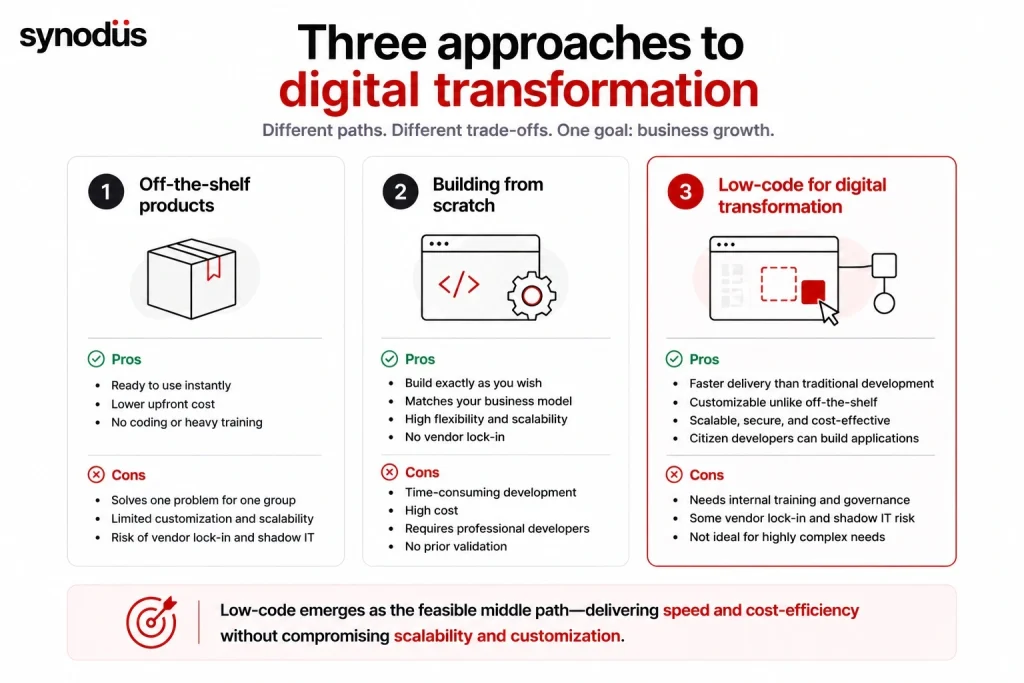
Today, companies have three approaches to unlock digital maturity:
| Off-the-shelf products | Building from scratch | Low-code for digital transformation | |
|---|---|---|---|
| Pros | Use instantly, cost-saving, no coding or heavy training, pre-validated, auto-updates | Build exactly as you wish, matches your model, high flexibility, scalable cross-department, no vendor lock-in | Faster than traditional but customizable unlike off-the-shelf, scalable and secure, cost-effective, citizen developers can build too |
| Cons | Solves one problem for one group, limited scaling, limited integration and customization, vendor lock-in, shadow IT risk | Time-consuming, high cost, needs professional developers, no prior validation | Needs internal training, some vendor lock-in and shadow IT risk |
Key takeaway: low-code emerges as a feasible middle path. It is more cost-effective and faster than traditional development, and better than off-the-shelf products for scalability and customization, which matters most when the demand for tech outpaces a company’s resources.
Digital transformation in future: The trends reshaping it
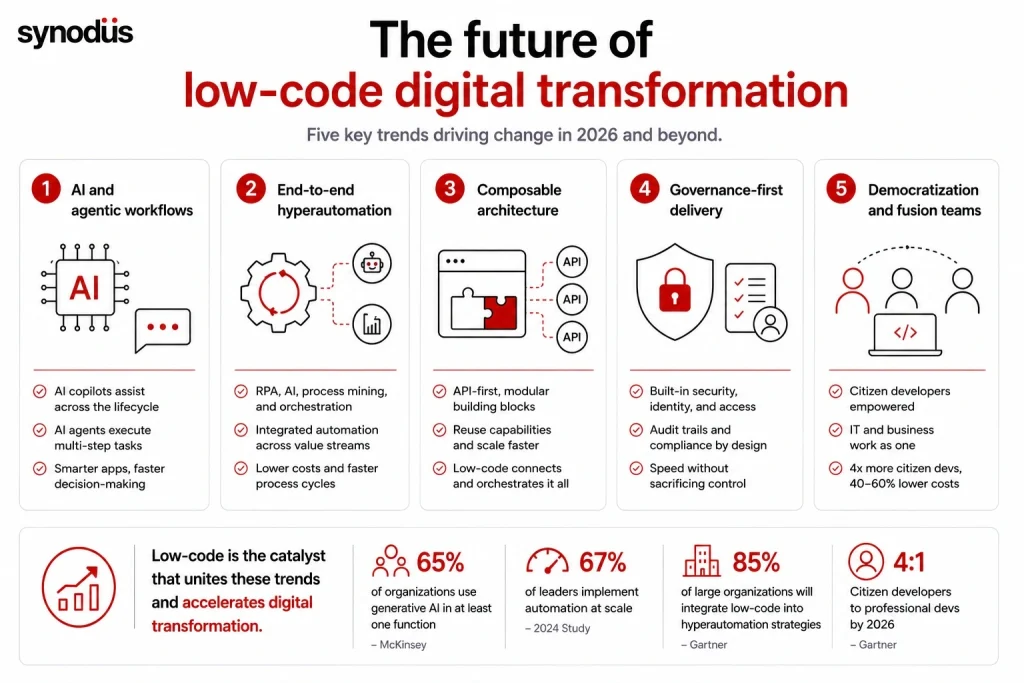
Digital transformation in 2026 looks different from a few years ago, and low-code sits at the center of the change. Four forces are driving it at once, a developer shortage traditional hiring cannot close, pressure to ship faster than IT can build, the rise of composable and AI-native architectures, and business teams technical enough to build their own apps. Low-code is the one technology that addresses all four. These are the trends to know.
AI and agentic workflows
AI is no longer an add-on, it is the engine of how apps and workflows get built. McKinsey reports that 65% of organizations already use generative AI in at least one function, and by 2026, AI agents that reason and act are becoming standard across CRM, ERP, finance, and HR. On a low-code platform, you can now describe an app in plain language and build agents that complete multi-step work, not just chatbots that answer. See our roundup of low-code AI platforms.
End-to-end hyperautomation
Automation is moving beyond isolated bots to integrated stacks that combine RPA, AI, process mining, and orchestration across full value streams. A 2024 study found 67% of leaders implementing automation at scale, reporting 20 to 35% lower costs and 50% faster process cycles. Low-code is the orchestration layer that ties these pieces together, which we cover in our guide to low-code workflow automation.
Composable architecture
Monolithic systems are giving way to composable ones, where businesses assemble capabilities from reusable, API-first building blocks. Gartner expects low-code to be integral to hyperautomation and composable strategies in 85% of large organizations by 2026. This model breaks down if the workflows connecting the components are rigid, which is exactly where low-code fits.
Governance-first delivery
For years, low-code meant trading governance for speed. That trade-off is gone. With the average data breach costing around $4.9 million and 75% of IT leaders citing security as their top concern, the platforms winning enterprise deals are the ones that let IT set guardrails, identity, data access, audit trails, without slowing builders down. Governed low-code becomes your operational backbone, while ungoverned low-code becomes shadow IT.
Democratization and fusion teams
Digital transformation is now a team sport. Gartner reports 41% of employees are business technologists, and citizen developers are expected to outnumber professional developers four to one at large enterprises, cutting development costs 40 to 60%. The mature model is the fusion team, where business users build fast and IT sets the rules.
A brief intro to low-code
Low-code is made of point-and-click configuration, where pre-built code and design elements are dragged into place, plus the ability to customize. Because of this, citizen developers can create simple applications, while professional coders focus on the customization that makes an app fit the business model.
A good low-code platform should match your business strategy and development method. We recommend pairing low-code with agile development, since the technology supports the process so well, though it can work with waterfall or a hybrid approach with the right ground rules.
How low-code drives better digital transformation
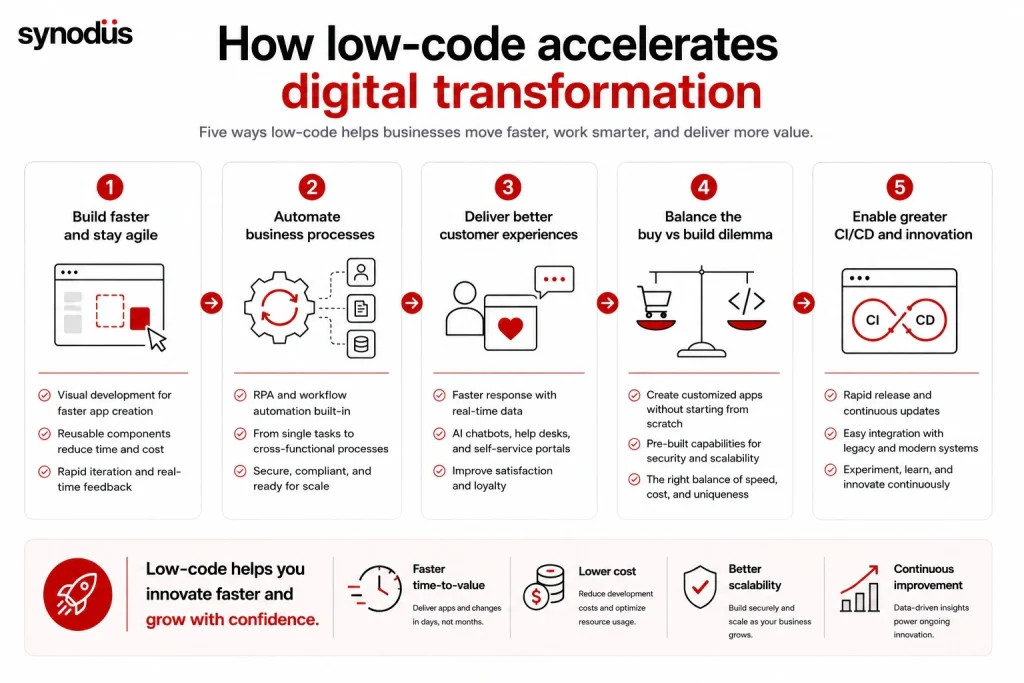
1. Speed and agility that stay cost-effective
Low-code drops the complex architectural stack of traditional coding for a visual, functional format. Developers of any level can create apps with a low risk of bugs and reuse components freely. That means less money and labor spent on transformation, shorter development time, quick changes, and immediate feedback on projects.
2. Automating business processes
Most platforms have RPA and automation abilities, so you can build automation tools with low-code. A centralized workflow tool helps managers and boosts team collaboration, since anyone can access data and see progress instantly. You can:
- Create a service worker to automate a single task, like scanning documents or classifying raw data.
- Automate single-department processes such as HR onboarding, offboarding, and recruitment.
- Build cross-department and cross-functional processes like order processing, CRM, and ERP.
Built-in security features make low-code a reliable choice for data-sensitive industries like finance and healthcare.
3. Meeting customer needs faster
The primary goal of digital transformation is serving customers by responding faster with technology. Imagine how satisfied a customer is when a package arrives early because you used low-code to automate the process behind it. Low-code platforms provide flexible design for a better experience, cutting delivery timeframes to hours, updating data in real time, and using feedback to refine apps. Here is what you can build:
- AI chatbots and virtual assistants.
- Customer analytics systems.
- Automatic call routing and help desk tools.
- Customer service applications and self-service portals.
- Sign-up web portals.
4. Tackling the buy-or-build dilemma
When building an app, businesses usually choose between building their own or buying an off-the-shelf product. Building gives a competitive edge but takes time and effort, while buying is faster and cheaper but limits customization and uniqueness. Low-code is a balanced mix: you create customized apps without starting from scratch, backed by robust, ready-to-use functionality for security, scalability, and flexibility.
5. Enabling greater CI/CD
With minimal coding, business users can develop apps in rapid cycles and experiment without overspending. Low-code also connects in-house legacy and internal systems quickly, so businesses can make decisions on real-time insights. Enterprises can use it for complex apps while still supporting simpler ones, creating a balanced approach across the application portfolio.
Successful use cases of low-code for digital transformation
These results come from each company’s published case studies, so treat them as point-in-time outcomes.
- Toyota Motor North America gave employees access to the Microsoft Power Platform and built more than 400 apps for internal and external purposes, involving developers of all levels in tech creation.
- Namu Travel Group, a boutique-vacation network, used Creatio to integrate advanced apps into its systems, including an opportunity assigner, event tracking, and profiling, which lowered customer funnel time and lifted agent productivity.
- Coca-Cola United expanded through franchising and integrated a low-code platform so its IT and logistics teams could handle more orders across more channels while reducing manual workload.
Top low-code digital transformation platforms to use
Depending on your needs, the best-suited platform should target your problem areas. A few top recommendations:
- Microsoft Power Apps for internal tools and automation. It suits businesses of all sizes and embeds directly into Office 365, Teams, and SharePoint. See our review of the Power Apps low-code platform.
- Creatio for CRM and app development, with deep features for tailoring sales and marketing systems.
- Salesforce Lightning for mobile app development, with interactive design elements and robust back-end code.
There are other emerging platforms too, which we cover in our review of the top low-code platforms.
To get the most from any platform, customization matters. If you want a hand, Synodus is a Microsoft Power Platform specialist that offers a custom low-code development service. We blend agile flexibility with waterfall predictability and work on fixed pricing, so we take on the risk of overruns, an approach that has earned the trust of companies like BOC Aviation, KPMG, and Unilever across more than 100 projects.
Digital transformation with low-code is good, but not always the full answer
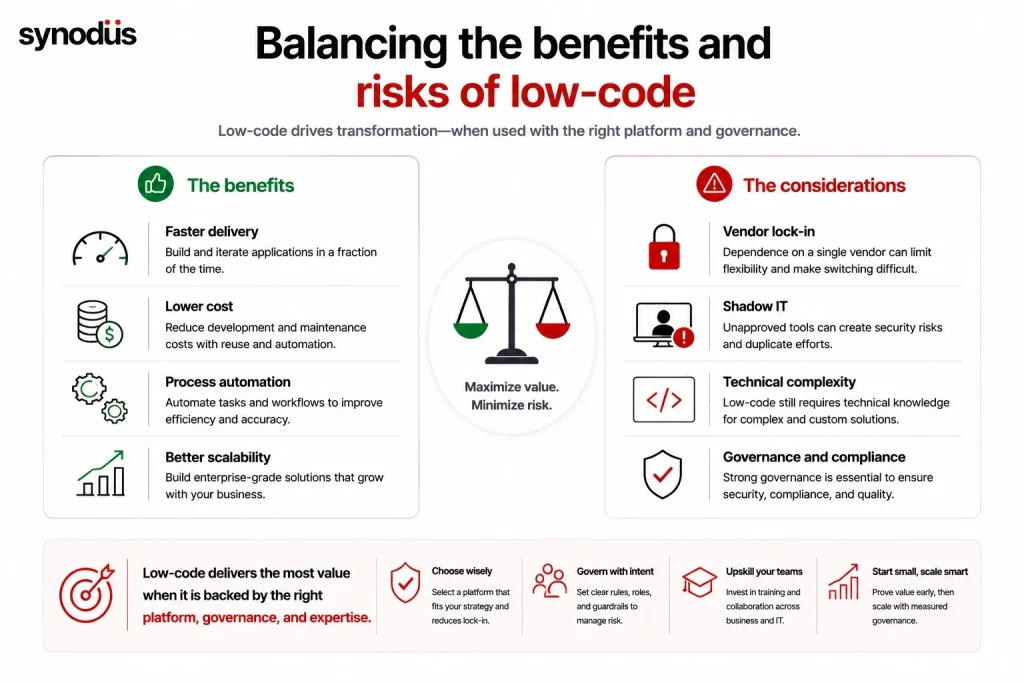
Despite its benefits, low-code has downsides that can make it less than ideal for every transformation:
- Vendor lock-in: you rely on your chosen vendor, and some limit capabilities or block changes after you stop using their service, which complicates switching.
- Shadow IT: using unauthorized low-code tools exposes teams to risk and wasted resources. Set up low-code governance to keep it in check.
- Overlooked complexity: low-code is simpler than hand-coding, but it still rewards basic coding knowledge, so it is not effortless.
Frequently asked questions
Low-code speeds up building and changing apps, automates business processes, and lets both developers and business users contribute. That helps companies overcome developer shortages, ship faster, and adapt quickly, which is why it sits at the center of digital transformation in 2026.
It is a middle path. Low-code is faster and cheaper than building from scratch, and more customizable and scalable than off-the-shelf products. For highly complex or performance-critical systems, custom development can still be the better choice.
A central one. In 2026, AI powers how apps and workflows get built, from natural-language app creation to AI agents that complete multi-step tasks. Low-code provides the visual builder and governance layer these AI features run on.
The main ones are vendor lock-in, shadow IT, and hitting a complexity ceiling on advanced apps. All are manageable with the right platform choice, a governance framework, and some technical oversight.
Wrapping up
Low-code is a strong option for digital transformation, improving development speed, automating processes, and saving budget while leaving room to experiment. As AI, hyperautomation, composable architecture, and governed citizen development reshape transformation in 2026, low-code is the technology that ties them together. Still, weigh its trade-offs before making it your final solution.
If you would rather have experts guide it, Synodus offers a low-code development service that turns your data into apps 10x faster and cuts development costs by half, with a delivery model that balances agile flexibility and predictable results. Book a free consultation to find the right fit for your business.