The need for customer service automation and digital transformation
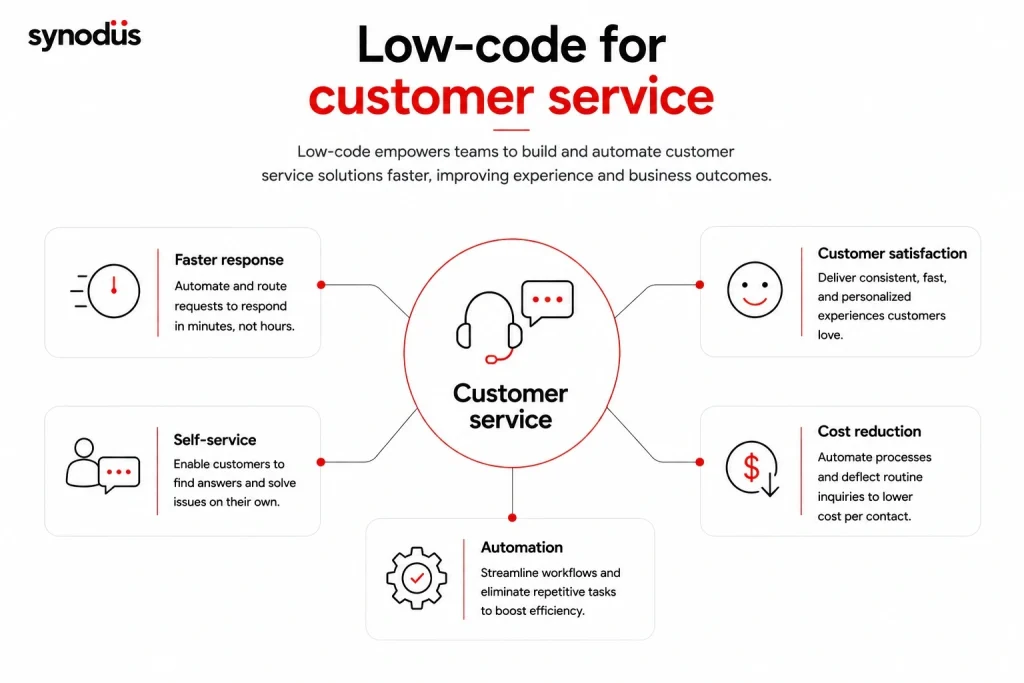
In customer service trend research, manual processes are consistently named the number one drag on service speed. Teams spend too much effort classifying data and typing in information, which steals time from what matters most: taking care of customers.
Traditional customer service also runs on a jumble of legacy systems, web portals, and desktop apps. Agents switch between screens and log into multiple systems, which slows responsiveness. Meanwhile, customers expect more: 24/7 access, instant answers, no repeating themselves, and resolution in a single contact.
Most companies rely on their IT team, a software vendor, or outsourcing to build the apps they need, but that process is often long and costly. So businesses are looking for an alternative that builds applications faster and adapts to constantly changing customer needs. Low-code stands out for exactly that rapid development ability.
What is low-code?
Low-code is a development approach that reduces complex coding when building applications. With drag-and-drop elements and pre-built code blocks, you can assemble apps that run across devices and platforms, far faster than hand-coding.
What makes low-code stand out is that it is accessible to everyone. Citizen developers and people with little coding knowledge can build applications with a few clicks. The technology is now common across industries, and many enterprises increasingly apply it to customer service to lift satisfaction and improve the experience. For a fuller primer, read our guide to what low-code is, its pros, cons, and use cases.
The customer service metrics low-code can improve
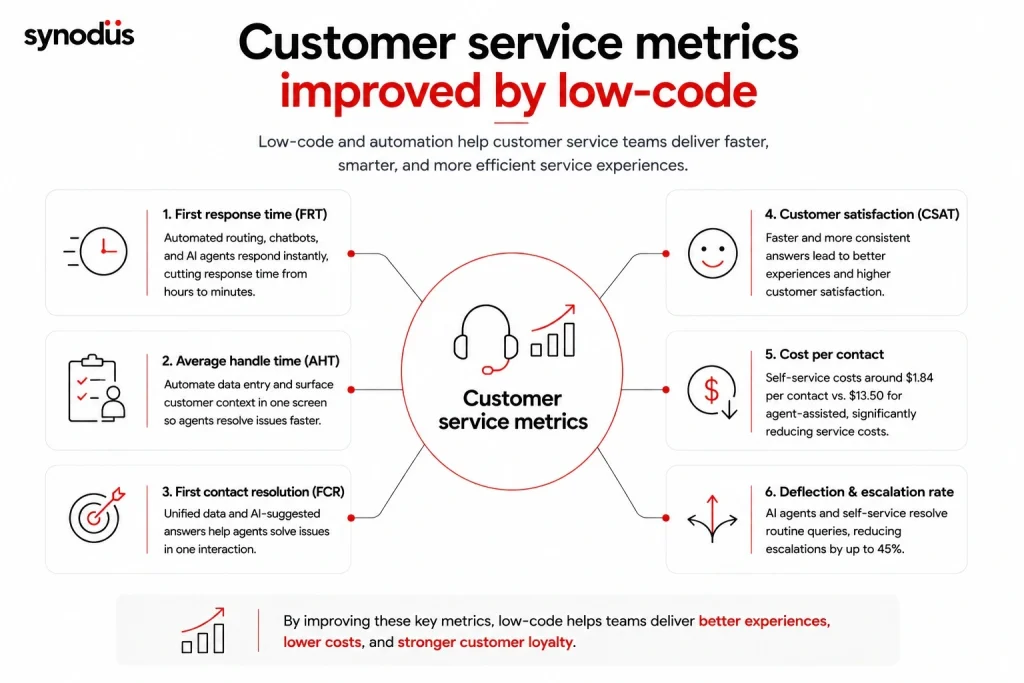
Because the goal is better service, it helps to know which metrics low-code and automation move. These are the ones to watch:
- First response time (FRT): automated routing, chatbots, and AI agents answer instantly, cutting response time from hours to minutes. Zendesk found that tier-1 AI deflection dropped response time to under two minutes and lifted satisfaction by 18% within 90 days.
- Average handle time (AHT): automating data entry and surfacing customer context in one screen lets agents resolve issues faster.
- First contact resolution (FCR): unified data and AI-suggested answers help agents solve issues in one interaction, and AI-native setups now reach 55 to 70% first contact resolution.
- Customer satisfaction (CSAT): 92% of businesses report improved CSAT after implementing AI, largely because faster, more consistent answers raise the experience.
- Cost per contact: Gartner benchmarks self-service at around $1.84 per contact versus $13.50 for agent-assisted, so deflecting routine queries to self-service and AI cuts cost sharply.
- Deflection and escalation: self-service portals and AI agents resolve routine tickets without a human, and teams using AI agents report up to 45% fewer escalations than those on rule-based chatbots.
One caution: measure resolution from the customer’s point of view, not just deflection. Gartner notes only 14% of customers feel fully resolved by traditional self-service, so track CSAT and resolution alongside deflection to make sure “handled” really means “solved.”
The benefits of low-code in customer service
Boost digital transformation and adaptability
Low-code lets businesses continually refresh and adapt to a changing climate. Because the learning curve is shallow, people from any technical background can adopt it, which brings new ideas to how tools are built. IT can sit too far from the actual problems to design the right fix, so low-code gives customer service teams and other departments a way to express and build their own solutions.
Reduce operating costs
Low-code customer service development is more straightforward than traditional coding, which eases the load on IT. Complex, time-consuming work becomes manageable, so your firm depends less on IT developers and spends less on hiring and retaining them.
Increase development speed
Low-code also speeds up delivery. Drag-and-drop automates the coding process, and API connectors plus pre-built components remove the need to build from scratch. Apps reach customers faster, which means faster responses and higher engagement.
Manage shadow IT
Shadow IT is the use of software and systems without IT approval, and while it can spur innovation, those apps are risky and insecure. Low-code helps in two ways: it offers a reliable platform for building and managing apps that IT can oversee, and it lets you set up governance so employees follow agreed rules, reducing unsanctioned apps.
Faster automation
With its BPM features, low-code lets you automate daily tasks and build workflows. For the full picture, see our breakdown of the advantages and disadvantages of low-code.
How to leverage low-code for customer service
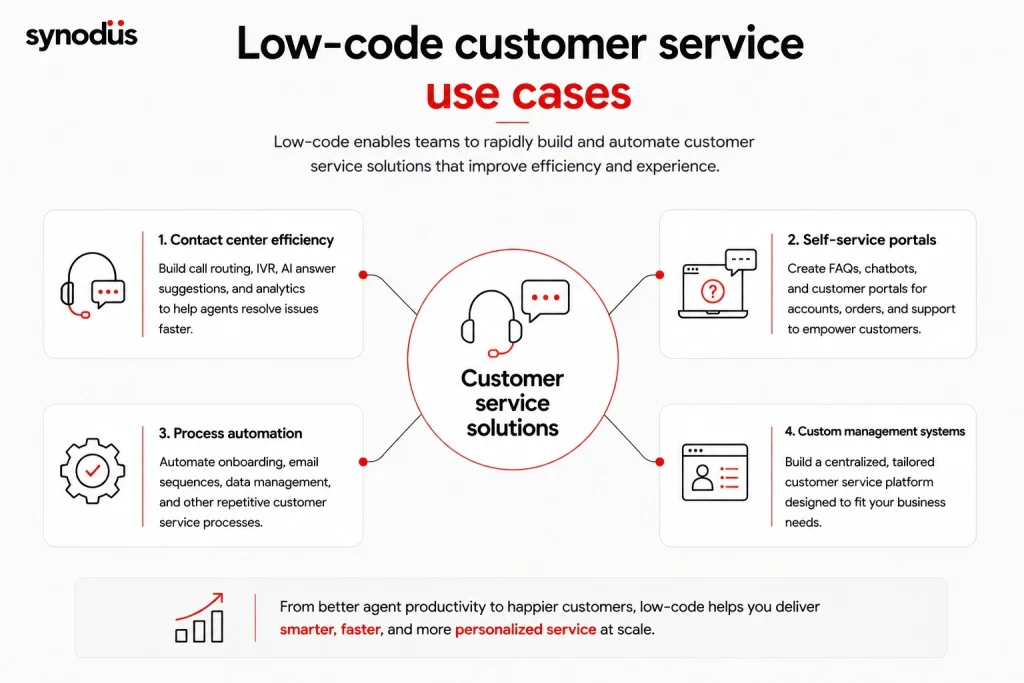
| Use case | What you can build |
|---|---|
| Contact center efficiency | Call routing, IVR, AI answer suggestions, analytics |
| Self-service portals | FAQ pages, chatbots, account and order portals |
| Process automation | Onboarding, email sequences, data management |
| Custom management systems | A centralized, tailored customer service platform |
1. Enhance contact center efficiency
A contact center handles a lot of data fast, both generated data (call volume, wait time, abandon rate) and unstructured data (customer sentiment, call topic, past interactions). Callers expect quick, clear answers even though their questions vary. Low-code lets you build tools that cut agents’ manual work, such as:
- AI and speech analytics that suggest answers so agents respond faster.
- Automatic call routing.
- A customized CRM and customer database.
- A voice response menu tree and interactive voice system.
- Analytics tools for your contact center.
2. Create self-service portals
A self-service portal resolves customer needs faster and eases the load on the contact center. You can:
- Build a searchable FAQ page. Our guide to low-code website builders can help.
- Create a low-code chatbot to chat with customers.
A portal is not only for answering questions. eCommerce businesses can add package tracking, finance companies can add balance checks, and any business can add event registration. Everything a customer enters online flows into the database automatically, so agents always have the latest information. With reusable modules and out-of-the-box workflows, low-code builds the exact portal you need in days, and digitizing support means staff stop rekeying data and switching between systems.
3. Process automation
Beyond the contact center, low-code can automate any customer service process, such as:
- Internal process automation: data management and handoffs between customer service and other departments.
- Email automation: onboarding sequences, how-to guides, and verification emails.
- Basic troubleshooting within the customer service system.
- Customer data management: gathering, identifying, and managing data.
- Virtual assistants for sign-up, onboarding, password resets, and payments.
- Supporting software: CRM, social listening, and help desk tools.
Explore more in our guide to low-code automation and its features.
4. Custom management systems
The biggest advantage of low-code in customer service is customization. Unlike off-the-shelf software, where you depend on what the vendor provides and often juggle multiple tools, low-code lets you build applications that fit your company exactly, all on one centralized platform.
The AI shift in customer service low-code
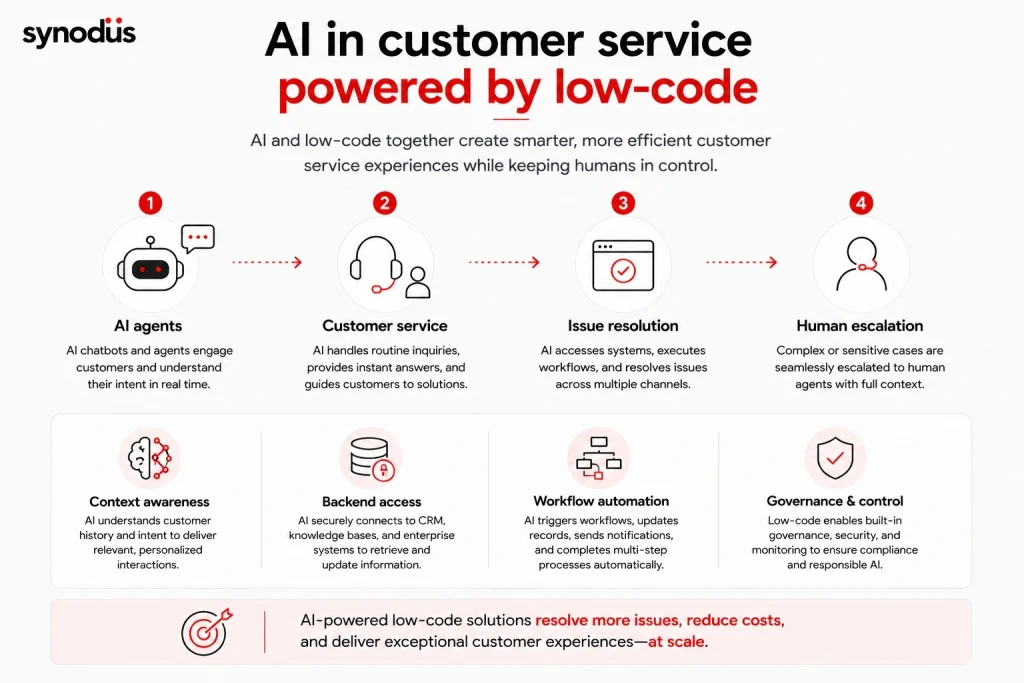
Customer service is the area AI is reshaping fastest, and 2026 is the tipping point. Salesforce reports 66% of service organizations now run AI agents, up from 39% in 2025. The shift is from scripted chatbots, which follow fixed rules, to AI agents that understand context, access backend systems, and complete multi-step workflows end to end.
For low-code customer service, this means the chatbots and portals you build can now resolve issues rather than just deflect them, with a human-in-the-loop for complex cases. The biggest lesson from 2026 deployments is that data quality decides success: an AI agent is only as good as the knowledge base and systems it can reach, which is exactly where a well-governed low-code platform helps. When planning a build today, ask where an AI agent could go beyond a static workflow, and keep governance and easy human escalation in place.
Real-life use cases of low-code customer service
- Spedal, a courier bike service in London, used to record client data on Google Sheets and notify customers by text, which got messy fast. With low-code, it built a client self-service portal that streamlined communication between customers and the business.
- Segment runs a program offering startups software deals and credits. It previously held 15,000 firms’ data on an Airtable dashboard but wanted a login feature and visual data. With low-code, members now log in to Segment’s Resource Hub through a self-service interface to view visualized deal books and redeem relevant deals.
These outcomes come from each company’s published case studies, so treat them as point-in-time results.
Top low-code platforms for customer service
With so many platforms available, here are strong options for customer service:
- Creatio: excellent for process management and automation in any industry, with drag-and-drop building, reusable templates, and customization blocks for contact center tools.
- Mendix: supports customer experience development and process automation, and promotes teamwork with a wide range of development tools.
- Kissflow: build cloud-based automated business apps that are easy to use, scalable, and integrate with many CRM and ERP platforms.
- UI Bakery: a cost-effective option for startups and SMBs, though it lacks some advanced features.
- Airtable: turn spreadsheets into modern apps, with pre-built templates for sales CRM and OKR tracking.
- Microsoft Power Apps: suited to enterprises whose customer service is more complex, built for professional-grade apps and automation.
- Pega: an enterprise platform supporting CRM, robotic process automation, and case management.
- Sitecore: strengthens customer data management and CX, best suited to enterprise and complex projects rather than smaller budgets.
For more options sorted by company size, see our roundup of the best low-code platforms.
As a Microsoft Power Platform specialist in APAC, Synodus builds and customizes low-code customer service solutions, from self-service portals to contact center automation. If you want consultation and customization support, our low-code experts can help you build robust apps and optimized customer service automation. Explore our low-code services.
Frequently asked questions
Low-code speeds up automation, routing, and self-service, which cuts first response time and average handle time, raises first contact resolution, and improves CSAT. By deflecting routine queries to portals and AI agents, it also lowers cost per contact.
Yes. Most low-code platforms now include AI features or integrate with AI services, so you can build chatbots and AI agents that resolve common issues end to end and escalate complex cases to humans, all within a governed platform.
Yes. Low-code is well suited to contact centers, where it can automate call routing, surface customer context in one screen, suggest answers with AI, and build analytics tools, all of which reduce manual work and speed up responses.
Simple self-service portals and workflows can be built in days using reusable modules and out-of-the-box components, while more complex, integrated systems take longer. Either way, it is far faster than traditional development.
Wrapping up
More businesses adopting low-code for customer service is a sign of digital progress and a drive to improve the customer experience. Once applied, low-code delivers real benefits, from faster automation to better service metrics, and it can take the shape of a customer portal, contact center tools, chatbots, or a full customer management system.
If you would rather have experts build it for you, Synodus delivers custom low-code solutions for customer service that turn your data into apps 10x faster and cut development costs by half, with the governance and AI readiness modern service teams need. Book a free consultation to find the right fit for your business.