Best open source NFT marketplace projects on GitHub
The repositories below are not ranked by GitHub stars. They were selected because their public code, license, documentation, or production use makes them useful references for teams evaluating open-source NFT marketplace development.
| Project | Type | Chain/scope | License | Best for |
|---|---|---|---|---|
| DexKit Open NFT Marketplace | Full marketplace starter | EVM networks supported by its 0x-based implementation | Apache-2.0 | Teams that want an EVM marketplace frontend and trading flow to fork |
| Decentraland Marketplace | Production marketplace app + indexer | Decentraland ecosystem / EVM-linked architecture | Apache-2.0 | Studying a real marketplace frontend, backend indexer, and domain-specific product |
| Seaport by OpenSea | Marketplace protocol | EVM | MIT | Order creation, matching, settlement, and advanced trading logic |
| Rarible Protocol Contracts | Protocol contracts + exchange logic | EVM | MIT for protocol smart contracts | Building a custom marketplace around reusable exchange and royalty components |
| Tensor Marketplace | Marketplace program + JS/Rust clients | Solana | Apache-2.0 | Solana marketplace execution, listings, bids, and digital-asset trading |
| M2 by ME Foundation | Marketplace smart contract | Solana | Apache-2.0 | Studying lower-level Solana listing, bidding, escrow, and settlement flows |
DexKit open NFT marketplace
DexKit Open NFT Marketplace is one of the clearest examples of a reusable marketplace application rather than just a smart-contract repository. The project describes itself as an open-source showcase for using 0x v4 NFT smart contracts in a production app and includes a Next.js, React, Material UI, and TypeScript frontend.
The repository supports ERC-721 listings and offers across several EVM networks supported by its 0x integration, and its README provides local setup and deployment instructions. It is licensed under Apache-2.0, which makes the reuse terms much clearer than a public repository with no explicit license.
The main limitation is scope. DexKit explicitly treats the repository as a base application and lists items such as trading history, artist pages, cache optimization, richer balance APIs, collection-level statistics, and improved SEO as features outside the basic open-source starter. Useful for prototyping or as a frontend foundation, but not a complete production marketplace by itself.
Decentraland marketplace
Decentraland Marketplace is valuable because it exposes more than a toy marketplace demo. The repository includes a React-based marketplace frontend and an indexer, and it is released under the Apache-2.0 license.
For developers, it is a strong architecture reference for understanding how a production ecosystem marketplace separates user-facing application logic from the services that index and serve marketplace data. Decentraland also publishes a dedicated Marketplace Server that uses PostgreSQL, Redis, an indexer, and event-driven infrastructure to support search, trading data, favorites, analytics, and payment-related functionality.
It is not a generic marketplace template. The code is built around Decentraland assets and workflows, and teams should also note that the older marketplace-contracts repository was archived in February 2026. When studying Decentraland as a reference, review the current application and newer contract architecture instead of assuming every historical repository is still the recommended implementation.
Seaport by OpenSea
Seaport is OpenSea’s open-source marketplace protocol for buying and selling NFTs. It supports flexible orders in which an offer can contain multiple items and the consideration side can specify multiple assets and recipients, making it significantly more capable than a simple fixed-price marketplace contract.
The repository is MIT-licensed and includes deployment information, tests, documentation, fuzzing support, and published audit information. OpenSea also maintains Seaport.js, a TypeScript library that simplifies order creation, fulfillment, balance checks, approvals, and other interactions with the protocol.
Seaport provides the trading and settlement layer, not a complete marketplace frontend, search engine, metadata pipeline, indexer, user account system, analytics layer, or admin console. Best for teams that want a mature protocol component and are prepared to build the application around it.
Rarible protocol contracts
Rarible Protocol Contracts provides another protocol-level starting point. The repository contains Exchange V2 contracts for sales and auctions, NFT token contracts, royalty specifications, deployment tooling, and tests, with the protocol smart contracts available under the MIT License.
Rarible also documents the wider marketplace flow around the contracts: sellers approve assets, sign orders, and store those orders through the protocol API, while buyers discover matching orders and settle them through the exchange contracts. Seeing the contract as one part of a larger marketplace system is useful context before deciding how much to reuse.
The repository is better suited to teams designing custom marketplace infrastructure than to teams looking for a ready-made storefront. Product UI, indexing, order storage and discovery, wallet UX, metadata handling, moderation, analytics, operations, and infrastructure are all still needed around the protocol.
Tensor marketplace
Tensor Marketplace is an Apache-2.0 licensed Solana marketplace program maintained by the Tensor Foundation. It supports bids and listings for NFTs and other digital assets and ships with JavaScript and Rust clients, making it a useful low-level reference for teams building on Solana.
The repository uses the Solana and Anchor toolchain and documents build and test requirements for the marketplace program. Tensor also publishes a Next.js marketplace template that demonstrates how a web application can sit on top of Tensor APIs and Solana RPC infrastructure.
The distinction between the two repositories matters. The marketplace program is the execution layer, while the Next.js template is a starter application. A production product will normally need to combine protocol, data, wallet, frontend, infrastructure, observability, and product-specific services rather than expecting one repository to contain everything.
M2 by ME foundation
M2 is an Apache-2.0 licensed Solana marketplace smart contract that exposes lower-level actions such as listing, bidding, canceling, depositing into buyer escrow, withdrawing, and executing sales. The repository also includes an IDL and generated types that can be used to parse or integrate with the on-chain program.
M2 is useful when the goal is to understand marketplace contract mechanics rather than copy a complete product. It includes transaction examples that show how several contract entrypoints combine for actions such as buy now, price changes, and accepting an offer.
Its limitation is exactly that narrow scope. User interface, collection and metadata services, indexing, search, wallet flows, transaction tracking, moderation, analytics, and operational tooling still need to be built around the contract.
What does “Open source NFT marketplace” actually mean?
The phrase can describe several very different things. Before comparing repositories, identify what layer of the marketplace the code actually covers.
| Repository type | What it usually contains | What it usually does not contain |
|---|---|---|
| Full marketplace application | Frontend plus some application logic and integrations | Production infrastructure, advanced admin, complete security/operations |
| Marketplace starter / template | UI, sample flows, SDK integration, configuration | Complete backend, indexer, custom contracts, production hardening |
| Marketplace protocol | Order model, settlement, exchange contracts, SDKs | Storefront, search, metadata, user-facing product |
| Smart-contract repository | Listing, bidding, escrow, settlement logic | Frontend, indexing, database, analytics, operations |
| SDK / library | Reusable client functions and integration helpers | End-to-end marketplace product |
| Educational demo | Simplified contracts and UI for learning | Production security, scalability, maintenance guarantees |
The code layer also does not determine how decentralized the final product is. A repository can be fully open source while the marketplace still relies on centralized custody, governance, or frontend control, whereas a decentralized NFT marketplace shifts more of these functions to wallets, smart contracts, and open protocols.
Open source also has a legal meaning. A public repository is not automatically licensed for commercial modification and redistribution. The LICENSE file determines what you can do with the code, what notices you must preserve, and whether additional obligations apply.
Check the license before the star count. MIT and Apache-2.0 are commonly used permissive licenses, while copyleft licenses can impose additional distribution requirements. A repository with no clear license should be treated as commercially restricted until the owner confirms otherwise.
How to choose an open source NFT marketplace repository
The best repository is not the one with the most stars. It is the one whose license, architecture, chain support, maintenance status, and missing components fit the product you are actually trying to build.
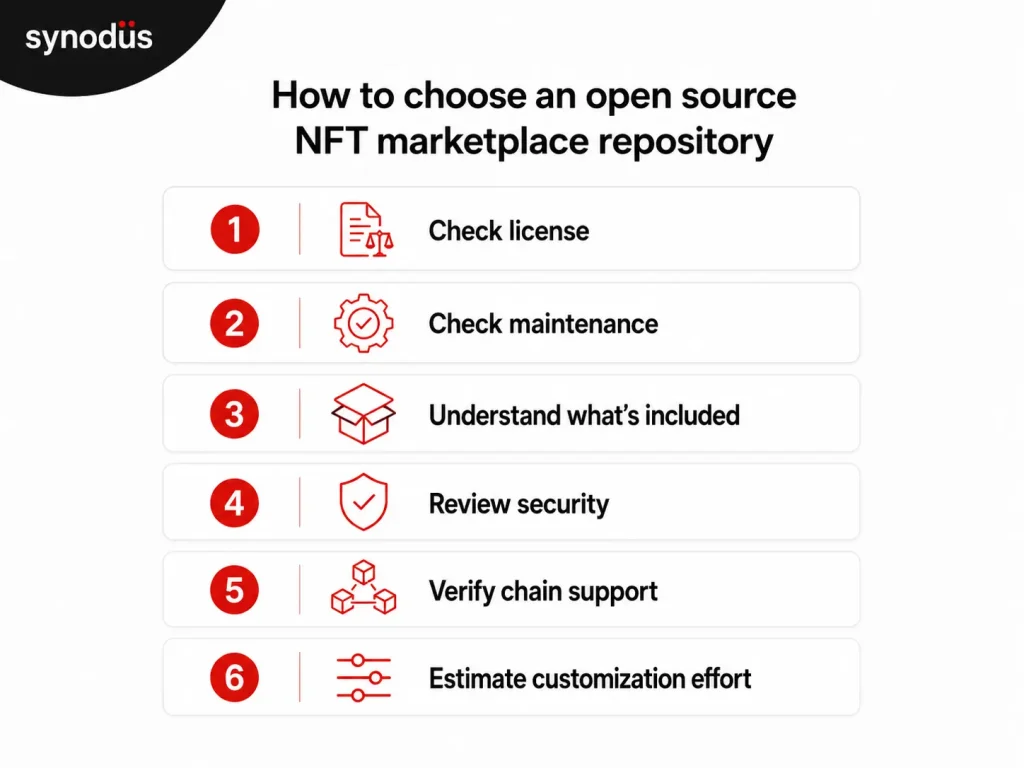
Check the license first
Review the LICENSE file before copying or modifying code. Confirm whether commercial use, modification, distribution, and sublicensing are permitted, and note any attribution, notice, patent, or copyleft obligations that affect your delivery model.
For a business project, the legal status of reused code affects source-code ownership, client contracts, due diligence, and what you can later distribute or license to customers.
Check maintenance and dependency health
Look at recent commits, releases, open issues, pull requests, and dependency versions. An old repository can still be useful as an architecture reference, but it should not be treated as a current production foundation if it depends on deprecated testnets, abandoned SDKs, or services that no longer exist.
The previous version of this article listed projects tied to Rinkeby, Ropsten, Kovan, and other retired infrastructure, which is exactly the kind of maintenance signal a current review should catch before development starts.
Understand what the repository actually includes
Read the directory structure and documentation before judging the project by its name. A repository called “NFT marketplace” might contain only Solidity contracts, while another might contain a frontend but depend on a hosted API for all marketplace data and order execution.
Map the code to your product architecture: contracts, frontend, backend services, indexer, database, search, wallet layer, metadata ingestion, storage, notifications, admin, analytics, and deployment. Every blank area becomes work your team still needs to own. For a reference on which components a marketplace actually needs, see our NFT marketplace features guide.
Review contracts and security evidence
For any repository that handles asset transfers or funds, inspect tests, audit reports, security policies, contract permissions, upgradeability, admin keys, and known limitations. A repository being open source does not make it secure, and a historical audit does not automatically cover your modifications.
If you change settlement logic, fees, royalties, custody, or token behavior, assume the customized contracts require their own security review. Production deployment should also include monitoring and incident-response planning outside the smart contracts themselves.
Verify blockchain and token-standard support
Confirm that the repository supports the network, token standards, wallet model, and transaction types your product needs today. Do not rely on old README references to retired testnets or assume an ERC-721-only implementation will cover ERC-1155, compressed NFTs, programmable NFTs, or chain-specific standards.
Chain choice also affects the surrounding infrastructure. RPC providers, indexers, metadata services, gas strategy, account abstraction, and wallet support can require significant work even when the marketplace contract itself is reusable.
Estimate customization effort
Forking a repository is cheap; making it fit a differentiated product may not be. List the requirements not covered by the codebase, then estimate changes to contracts, data models, UI, integrations, infrastructure, and security before deciding that open source is the lower-cost route.
If most of the repository would be replaced, an open-source starting point may add migration and maintenance complexity without saving much engineering time. For a realistic view of what full marketplace development costs, see our NFT marketplace development cost guide.
What you still need to build around open source code
A common mistake is to equate a working demo with a complete marketplace. Production NFT marketplaces usually need several layers that many GitHub repositories intentionally leave out.
| Layer | Why it matters in production |
|---|---|
| Indexing and data pipeline | Tracks ownership, listings, offers, transfers, sales, attributes, and chain events without querying the blockchain for every page load |
| Search and discovery | Supports collection search, filters, traits, ranking, sorting, recommendations, and fast browsing at scale |
| Metadata handling | Fetches, normalizes, caches, and refreshes metadata from IPFS, Arweave, HTTP endpoints, or chain-specific sources |
| Wallet and account layer | Handles wallet connections, embedded accounts, signatures, approvals, chain switching, and transaction states |
| Backend and database | Stores off-chain orders, profiles, favorites, moderation state, analytics, notifications, and operational data |
| Admin and moderation | Manages collections, reports, blocked assets, fees, permissions, disputes, and marketplace operations |
| Infrastructure | Provides RPC capacity, storage, caching, queues, monitoring, alerting, CI/CD, backups, and scaling |
| Security | Covers audits, access control, secrets, dependency review, incident response, monitoring, and re-audits after changes |
| Compliance and payments | May add KYC/AML, sanctions screening, fiat rails, tax reporting, or jurisdiction-specific workflows for certain marketplace types |
Open source does not mean free. A repository may remove license cost and reduce some initial engineering, but the project can still require substantial spending on customization, infrastructure, security, integrations, QA, deployment, and long-term maintenance.
It also does not mean gasless or fee-free. Network fees, protocol fees, storage, RPC usage, indexing, hosting, and other operational costs are independent from whether the source code is public.
Open source vs white label vs custom NFT marketplace
Open source is only one way to avoid starting from a blank codebase. The better choice depends on how much control the team needs, how much engineering it can own, and how differentiated the marketplace needs to be.
| Approach | Starting point | Control | Engineering effort | Best fit |
|---|---|---|---|---|
| Open source | Public code, protocol, contract, or template | Potentially high, subject to license and architecture | Medium to high | Technical teams that can own integration, security, and maintenance |
| White label | Vendor-maintained reusable platform | Medium, depends on provider and license | Lower initially | Teams prioritizing faster launch with relatively standard marketplace mechanics |
| Custom | Business-specific requirements and architecture | Highest | Highest | Differentiated products with custom workflows, contracts, compliance, or integrations |
Open source is attractive when your team wants to own the product and can maintain the code. White label is usually stronger when time-to-market matters more than architectural control, while custom development makes more sense when the marketplace itself depends on unique business logic.
For the vendor-managed option, see our white label NFT marketplace guide. For the broader implementation process, see our NFT marketplace development guide.
Final thoughts
Open-source NFT marketplace code can reduce the amount of work required to reach a prototype and can provide valuable reference implementations for marketplace contracts, order settlement, frontend flows, and indexing. The real decision is not whether a repository looks complete on GitHub, but whether its license, architecture, maintenance status, security model, and missing components fit the product you intend to operate.
For a production marketplace, treat the repository as one input into the architecture rather than the finished product. If the available codebases do not fit your requirements, compare the cost and control of extending open source with white-label and custom development before committing to a stack. Synodus can also help assess an existing codebase or design a custom blockchain solution when the marketplace requires deeper product, contract, or infrastructure work.
FAQ about open source NFT marketplaces
OpenSea publishes open-source components, most notably the Seaport marketplace protocol and Seaport.js. The entire OpenSea application, backend, indexer, search system, analytics stack, and operational infrastructure are not available as a complete open-source clone.
Only if the repository license permits the intended use and you comply with its conditions. Public visibility on GitHub is not enough. Check the LICENSE file and, for commercial projects, review the obligations with legal counsel when the terms are unclear or the project mixes several licenses.
The code may be available without a software license fee, but building and operating the product still costs money. Customization, audits, RPC services, indexing, storage, hosting, monitoring, DevOps, integrations, maintenance, and network fees can all become part of the total cost.
Not automatically. Some repositories are production components, some are ecosystem-specific applications, and others are learning projects or starters. Production readiness depends on current maintenance, security review, dependency health, infrastructure, testing, observability, and how much you modify the code.
There is no single standard stack. Current examples use combinations such as Next.js, React, TypeScript, Solidity, Rust, Anchor, wallet SDKs, RPC providers, indexers, PostgreSQL, Redis, and chain-specific APIs. The right stack depends on whether the repository is a frontend, protocol, contract package, or full marketplace application.
Choose open source when your team wants more control and is prepared to own integration, security, infrastructure, and maintenance. White label is usually more suitable when faster deployment and vendor-managed infrastructure matter more than deep architectural control.