What is low-code?
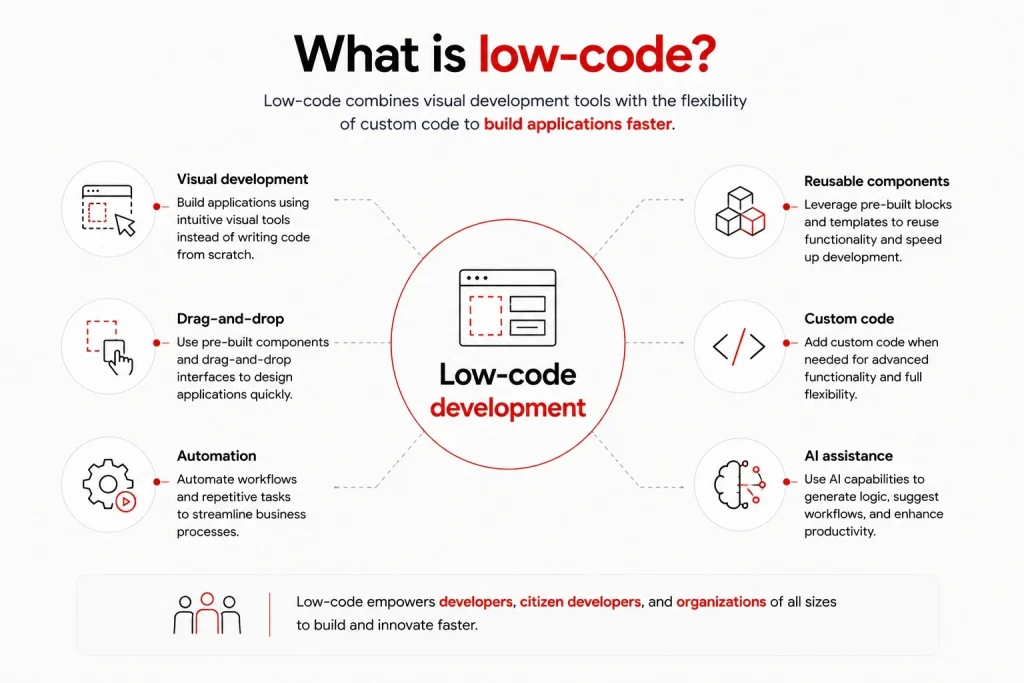
Low-code is a development approach where you use intuitive graphic tools, point-and-click configuration, and automation to build applications and websites quickly.
It reduces traditional code writing and gives developers a more streamlined experience for rapid delivery. Thousands of lines of code and syntax are replaced with pre-built blocks, while developers can still add custom code whenever they want.
That leads to a second definition. A low-code platform is a tool built on the low-code approach, with security, an easy-to-use interface, and vendor support, so businesses can apply it to almost any purpose. Some of the most popular low-code platforms are Creatio, Microsoft Power Apps, Mendix, and Kissflow.
So who can use low-code?
- Developers, to automate manual tasks and improve their coding performance.
- Citizen developers, meaning your non-technical employees, who can join digital transformation because low-code is easy to use without a technical background.
- Companies of all sizes. Startups can build an MVP to launch and test faster, SMEs can improve their workflows, and enterprises can modernize their legacy systems.
- All departments, from CRM and ERP to niche, specific use cases.
How low-code has evolved:
- 2010 to 2015: Basic form builders and workflow automation.
- 2016 to 2019: Enterprise platforms with mobile-first capabilities.
- 2020 to 2023: The citizen developer movement and the process automation boom.
- 2024 to 2026: AI-powered development with natural language interfaces and intelligent code generation.
Today’s low-code platforms include AI copilots that can suggest workflows, generate complex logic from a description, and even flag potential issues before they happen.
How low-code actually works
Understanding the mechanics behind low-code helps you judge whether it fits your project.
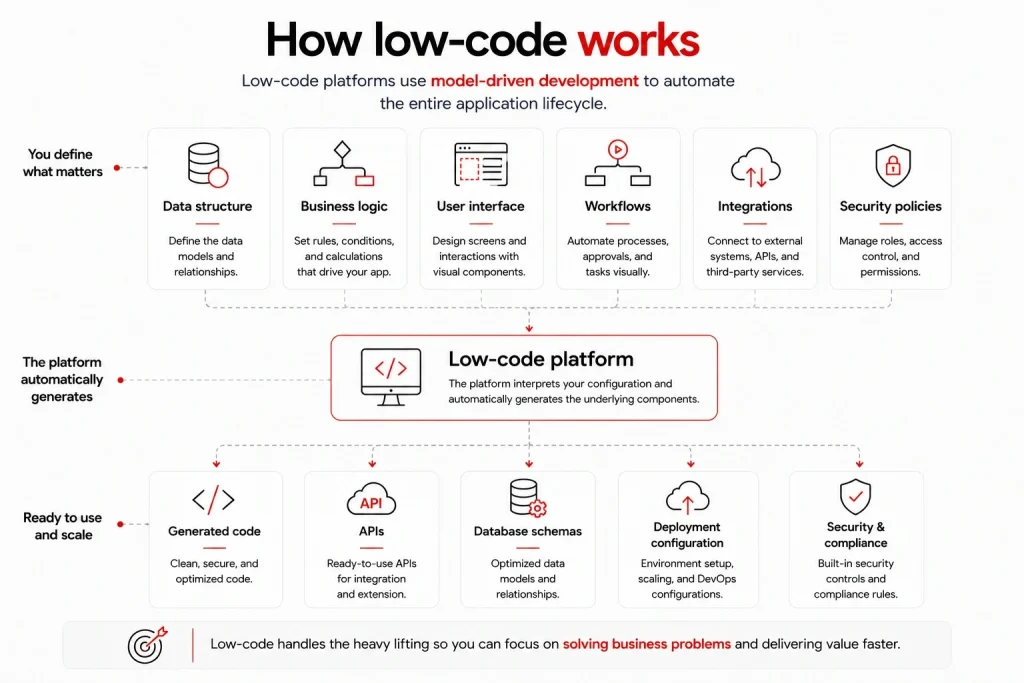
The architecture behind visual development
Low-code platforms use model-driven development, where you define:
- Data structure: what information your app manages.
- Business logic: how your app processes and transforms data.
- User interface: visual components and user interactions.
- Workflows: automated processes and approvals.
- Integrations: connections to external systems.
- Security policies: access control and permissions.
The platform then automatically generates the underlying code, database schemas, APIs, and deployment configurations.
Visual development vs traditional coding: Real example
Scenario: building an employee onboarding application.
Traditional development (estimated 80 to 120 hours) means database design and schema creation, backend API development, frontend UI work, workflow logic, integration with HR systems, testing and debugging, security implementation, and deployment setup.
Low-code development (estimated 10 to 20 hours) means dragging pre-built form components, configuring data fields with dropdowns, setting up the approval workflow in a visual flow designer, connecting to the HR system with a pre-built connector, configuring email notifications from templates, setting roles and permissions with checkboxes, and clicking deploy.
The result: the same functionality in 70 to 85% less time, accessible to team members with minimal coding experience.
Traditional code vs low-code vs no-code vs AI-augmented low-code
With the rise of low-code, people also talk about no-code and AI-augmented development, each with a different level of coding required. Here is how the four approaches compare.
| No-code | Low-code | AI-augmented low-code | High-code | |
|---|---|---|---|---|
| What it does | Builds simple, basic applications with no coding and no IT involvement | Lets both coders and non-coders build software, a mix of no-code and high-code | Low-code enhanced with AI copilots that generate code from natural language, suggest workflows, and optimize performance | Manual coding with multiple steps, languages, and technologies |
| Features | Visual environment, drag-and-drop, templates. No customization or integration | Visual environment plus custom code and plugins | Visual plus custom code plus an AI assistant for generation, testing, and optimization, with a natural language interface | Custom code from scratch across multiple stacks, frameworks, and tools |
| Complexity | Basic, simple | Basic to medium | Basic to advanced (AI bridges complexity gaps) | Medium to complex |
| Who can use it | Citizen developers, non-coders, professional developers | Citizen developers, people with light coding skills, professional developers | Any skill level, since AI assistance makes it accessible to all | Professional developers at all levels |
| Time to build | A day to 2 weeks | A few days to 4 weeks | A few hours to 2 weeks (AI speeds this up) | A month to 6 months |
| Cost to build | Cost-effective | Cost-effective, more for custom code | Cost-effective, premium for AI features | Requires real investment |
| Examples | Wix, Webflow, Glide | Creatio, Power Apps, Mendix | Power Apps with Copilot, Mendix AI Bot, OutSystems AI testing | CSS, HTML, PHP, Java, JavaScript, Python |
In 2026, AI-augmented low-code is the fastest-growing category. These platforms add natural language interfaces where you describe what you want and the AI generates the application logic, cutting development time sharply while keeping flexibility. For a closer look at one end of the spectrum, read our comparison of low-code vs high-code.
How low-code relates to vibe coding and agentic AI
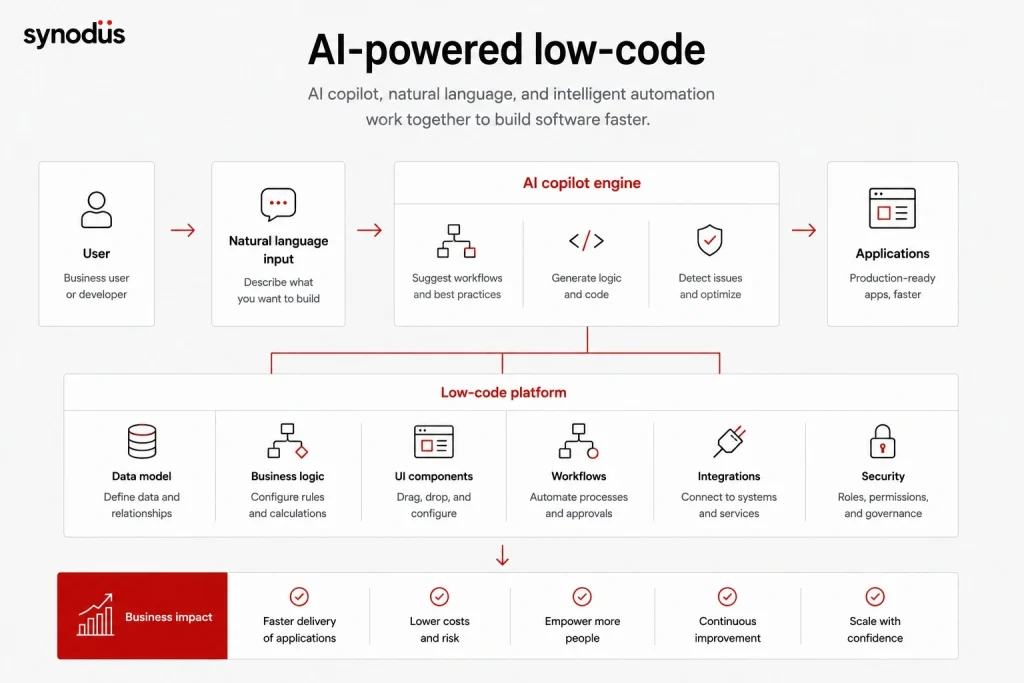
Two terms dominate the 2026 conversation around low-code, and it helps to know where they fit.
Vibe coding is the practice of building software by describing changes to an AI in plain language instead of drawing flows or writing code yourself. In a sense it is the natural language layer that now sits on top of low-code: with low-code you assemble visual blocks and optionally add code, while with vibe coding you talk to an assistant and it produces the blocks or code for you. Many low-code platforms now bundle this in, so the two increasingly work together rather than competing.
Agentic AI pushes the idea further. Instead of building an app, you give an agent a goal, and it plans the steps, generates the logic, and takes action across your systems. This both challenges and complements low-code. On one hand, agents can generate portable, standards-based code that avoids vendor lock-in. On the other, low-code platforms increasingly host these agents and supply the governance, the trusted data from systems like ERP and CRM, and the guardrails that keep an agent’s actions and costs in check.
The catch is quality. AI-generated code can introduce security gaps and technical debt if it ships without review, which is why the proven pattern is hybrid: use AI and vibe coding to move fast on prototypes and internal tools, then apply real engineering discipline, testing, and governance before anything reaches production. This is exactly where an experienced low-code and AI partner adds value, and it is a recurring theme in the latest low-code trends.
Why should businesses consider low-code?
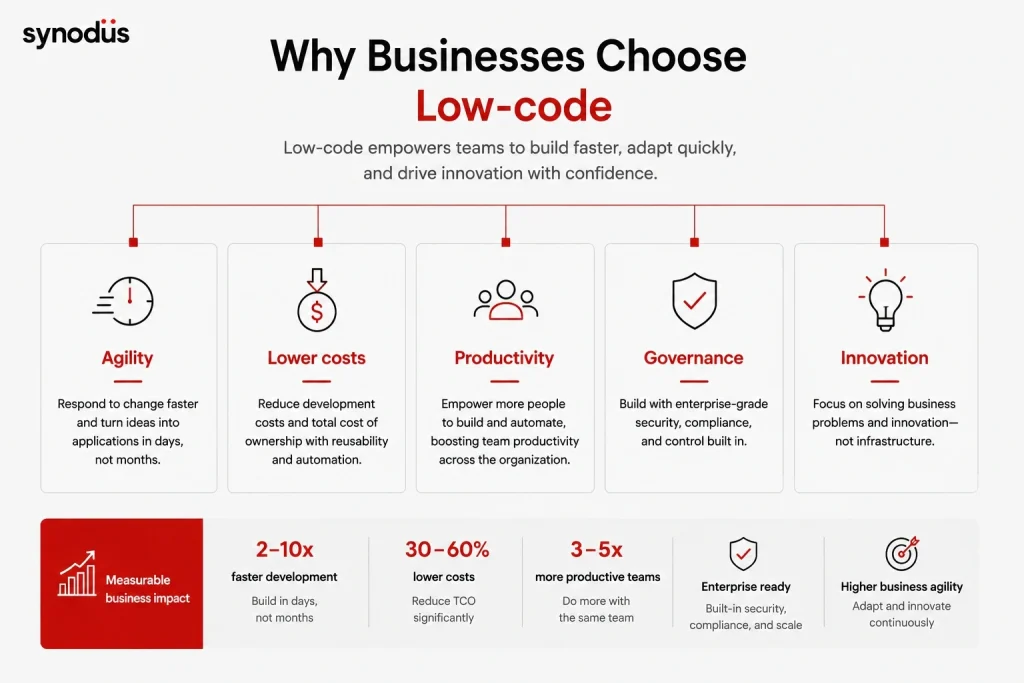
Whether your users are building software or streamlining how it gets built, low-code simplifies the creation of flexible apps.
- Improved agility: Low-code delivers apps fast and helps them run smoothly across devices. In a 2024 global survey, 29% of respondents said low-code was 40 to 60% faster than traditional methods, and another 29% reported speeds of 61 to 100% faster.
- Reduced costs: Because low-code builds apps 5 to 10 times faster, costs fall and fewer developers are needed. Forrester’s Total Economic Impact studies found companies achieved 260 to 506% ROI over three years with payback under 6 months. One composite organization avoided hiring two developers, adding roughly $4.4 million in business value, while another study showed $8.08 million in app delivery savings over three years.
- Fighting the tech talent shortage: Low-code is a strong answer to the global developer shortage. It empowers non-technical staff while freeing professional developers for complex, high-value work.
- Fighting technical debt: Low-code lets you move through every development step quickly instead of skipping them for speed, and it enforces best practices through built-in templates and patterns.
- Higher productivity: Low-code shortens time-consuming processes from months to days. Studies show developers using low-code report 40% higher job satisfaction thanks to fewer mundane tasks.
- Risk management and governance: Low-code helps enterprises meet regulatory standards while keeping pace with change.
- Better customer experience: Faster operations let businesses adapt to shifting market and client needs, which flows through to a better experience.
These benefits are why low-code is so often called the future of digital transformation. McKinsey research shows organizations that embrace citizen development and low-code score 33% higher on innovation metrics. Gartner forecasts that developers outside formal IT will make up 80% of the low-code user base by 2026, up from 60% in 2021, and predicts that by 2029, low-code application platforms will power 80% of mission-critical applications globally, up from just 15% in 2024.
The market reflects this. The global low-code market was valued at $28.75 billion in 2024 and is projected to reach $264 billion by 2032 at a 32.2% CAGR, while Gartner sizes the low-code technologies market at $44.5 billion in 2026.
That said, low-code carries some risks, such as vendor lock-in and shadow IT. With the right approach and low-code governance in place, you can keep these under control and manage low-code usage across your organization. For the full picture, see our breakdown of low-code benefits and disadvantages.
What are the types of low-code development?
Low-code programming splits into five main types.
Business process applications
Generally known as low-code BPM, these apps support enterprise-grade operations. They focus on streamlining workflows and automating repetitive tasks to improve efficiency.
Customer engagement applications
These let businesses build omnichannel, customer-facing apps to handle customer issues. Organizations build for acquisition, retention, engagement, and management to deliver high-quality, individualized service. Here is how low-code improves customer service.
Legacy modernization applications
Legacy modernization applications upgrade, digitize, and completely redesign outdated systems. The shortcomings of a legacy system limit an organization’s digital growth. To address rising demand, businesses can employ low-code platforms to create modern, versatile, and highly configurable apps.
Outdated system is one of the most common challenges of many enterprises, which slow down their performance and growth. Learn What use cases your enterprise can adopt low-code in this blog.
Database applications
Since businesses constantly deal with large volumes of data, database apps are essential. Low-code database platforms let organizations build their own hub to upload, retrieve, and manage data.
Collaboration and communication applications
For internal and external teams, these apps create a seamless working experience and boost productivity. People can share content, assign tasks, and speed up approvals from a single platform, which helps build a collaborative culture and an easy data flow.
Must-have features of low-code platforms
1. Visual modelling tools
Low-code lets professional and citizen developers build apps with far less time than hand-coding. 451 Research found that low-code reduces programming time by 50 to 90%. With a wide range of pre-built components and a model-driven approach, developers can visualize an app’s function and share it clearly across skill levels, with a low risk of syntax errors and strong reusability.
2. Drag-and-drop interface

Drag-and-drop is the core of every low-code tool. It gives citizen and professional developers ease of use throughout the build. Because it needs no prior coding knowledge, non-coders can quickly create their own apps, which shortens development time and encourages employees to contribute to technical progress.
3. Reusable components
Pre-configured modules, logic, and templates can be reused, customized, and extended. Since these components are pre-tested for performance and security, developers build with greater consistency and scalability. According to Mendix, low-code enables cloud-native application building with 70% fewer resources.
4. Security
A solid low-code platform should ship with out-of-the-box security tools and certifications such as SOC, PCI-DSS, and GDPR. Built-in security helps build safe apps with visibility into on-platform activity.
5. Collaboration tools

Built-in collaboration features provide feedback loops, revision tracking, user stories, and more. They help developers of different levels speak the same language, replacing the failed handoffs of traditional coding with smooth communication and less rework.
6. Integration and APIs
Low-code platforms securely integrate data from many sources to create a single digital ecosystem. Pre-made connectors enable bi-directional integration with third-party apps, while custom integration through REST, SOAP, and RPC APIs handles data collection and structural changes automatically. Combined with visual modeling, this lets developers work up to 10 times faster on new experiences and legacy modernization.
7. Application lifecycle management
Low-code platforms support every phase of the app lifecycle, from first idea to operation. Through automation and abstraction, each phase is accelerated, and many platforms streamline project management, version control, testing, and deployment.
Low-code applications across industries
Low-code now powers fast, accurate app development in almost every field.
Accounting and finance
Low-code builds custom apps for finance workflows and information management. A financial institution might automate loan approvals, risk assessments, and decision flows, or design a client portal for reporting expenses and income without heavy paperwork. Explore the ideas and real cases in our guide to low-code for financial services.
Human resources
HR teams use low-code to customize job posts, automate recruiting, screen candidates, and build training programs without straining IT. A good example is the task management system we built for Bamboo Airways, which coordinated 2,000 onsite and remote staff on Power Apps, Power Automate, and Power BI. The project shipped in 10 weeks with a team of 4, and within 3 months it raised task completion rates by 25% and cut manual tasks by 30%.
IT departments

Low-code frees IT teams from repetitive coding and increases agility. By growing the number of citizen developers, firms remove IT bottlenecks. Harvard Business Review notes that one IT developer can support ten or more citizen developers.
Supply chain
Low-code helps address supply chain disruption by improving trackability and traceability, building automated workflows to model and monitor operations, and digitizing legacy data and records.
Manufacturing
Low-code helps manufacturers build smart factories and run operations more smoothly, from processing raw materials to packing and delivering finished goods.
Healthcare and pharma
Regulated industries use low-code to modernize core systems while meeting compliance needs. Our pharmaceutical ERP project on Dynamics 365, delivered in 6 months by a team of 5, supported 80% year-on-year growth across order, customer, and inventory management.
Process automation
As demand for business process automation rises, low-code joins process automation as a driver of better results. It pinpoints bottlenecks in existing processes and passes those improvements to RPA bots to lift their performance.
Other common use cases include complaint management, employee lifecycle management, expense claims, IT bug and incident tracking, marketing budget management, purchasing, and sales lead management. Coca-Cola, Toyota, and the Rotterdam government have all used low-code to transform how they operate. See how leading brands use low-code for better results.
Top low-code development platform to use
The market offers many platforms, each with its own strengths.
| Platform | Best for | Key strength | AI features |
|---|---|---|---|
| Creatio | Process automation, CRM | Industry-specific templates | AI-powered recommendations |
| Microsoft Power Apps | Enterprise apps, Microsoft ecosystem | Seamless Office 365 integration | Copilot AI assistant |
| Mendix | Complex enterprise apps | Multi-cloud deployment | AI Bot for development |
| OutSystems | High-performance apps | Full-stack capabilities | AI-powered testing |
| Appian | Process automation | Unified data fabric | Process mining AI |
| Zoho Creator | Small and medium businesses | Affordability and scalability | Basic AI capabilities |
| Salesforce Lightning | CRM extensions | Salesforce ecosystem | Einstein AI integration |
New in 2026: most platforms now offer AI-powered features like natural language app generation, intelligent testing, and predictive performance optimization.
As a Microsoft Power Platform specialist, Synodus builds and customizes low-code solutions for ERP, fintech, and internal tools on top of these platforms rather than selling a platform of its own. We have also reviewed the top low-code platforms in detail, including their pros, cons, and when to use each.
Common FAQ about low-code
Low-code is helping organizations of every size achieve real technological innovation. Gartner expects around 75% of new applications to be built with low-code by 2026, up from less than 25% in 2020. It will not replace traditional code, but it is becoming a vital tool in most businesses. For more, see whether low-code is the future.
No. Low-code gives anyone the tools to build an application, but making it fit your business well is another matter. You can assemble a generic app quickly, then developers add custom code to make it excel.
Not quite. Low-code is a platform-based approach that uses visual blocks with optional custom code, while vibe coding means describing what you want to an AI and letting it generate the result. They overlap because most low-code platforms now include AI assistants, so in practice you often vibe code inside a low-code tool. The difference is that low-code gives you the governance, structure, and guardrails that raw AI generation on its own does not.
Yes, and how far you can go depends on your platform. Advanced low-code platforms let you deploy on-premises or in the public, hybrid, or private cloud. A study by IDC found that cloud environments with high maturity produce more net-new apps in low-code, and low-code can support entire cloud journeys.
Wrapping up
Low-code is a relatively new technology, but it is already used across countless use cases and industries. With its strong features, it suits businesses that want better productivity and results while keeping development costs in check. Keep in mind that it cannot beat traditional coding in every case, so choose carefully when to apply it.
If you are ready to put low-code to work, Synodus builds custom low-code solutions for businesses across finance, healthcare, aviation, and more. Talk to our team to find the right fit for your processes.