Why low-code fits data science
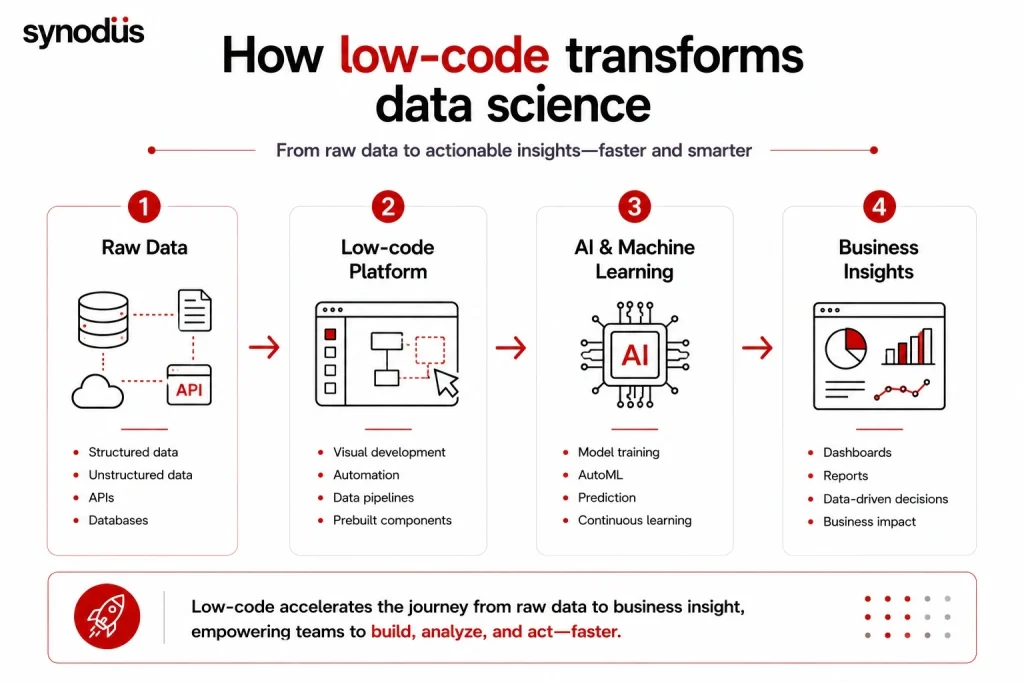
Data analysis has become central to how businesses make decisions. A global report from EY on analytics-driven organizations found that most CEOs surveyed believe data should sit at the center of every major decision. In practice, though, most data science teams run into a few recurring roadblocks.
The first is volume. Teams have to manage vast amounts of unstructured data when building applications, and by most estimates, unstructured data makes up somewhere around 80 to 90 percent of everything a business collects. Applications also generate logs in inconsistent formats, which makes standardizing everything before it reaches an ML pipeline harder than it sounds.
The second is the sheer difficulty of building ML and AI applications well. As a company accumulates more data, it needs to evaluate trends accurately to understand how each feature affects the customer experience.
Most digital products can benefit from AI capabilities such as sentiment analysis or image classification, but getting there requires data collection, cleansing, feature engineering, model training, and exploratory analysis, often in that order. Machine learning also remains one of the hardest AI skills to hire for, which puts this work out of reach for teams without a specialist on staff.
This is where low-code comes in. It gives teams prebuilt code blocks they can drag into place to assemble a working application without writing a line of code. Unlike simpler no-code builders, low-code data science tools still let you customize both the front end and back end to fit your requirements, which keeps the setup flexible and scalable. That saved development time goes straight back into training the model and tuning the data pipeline instead.
See why low-code AI is gaining ground over the traditional way of building machine learning systems.
How data teams get the most out of low-code
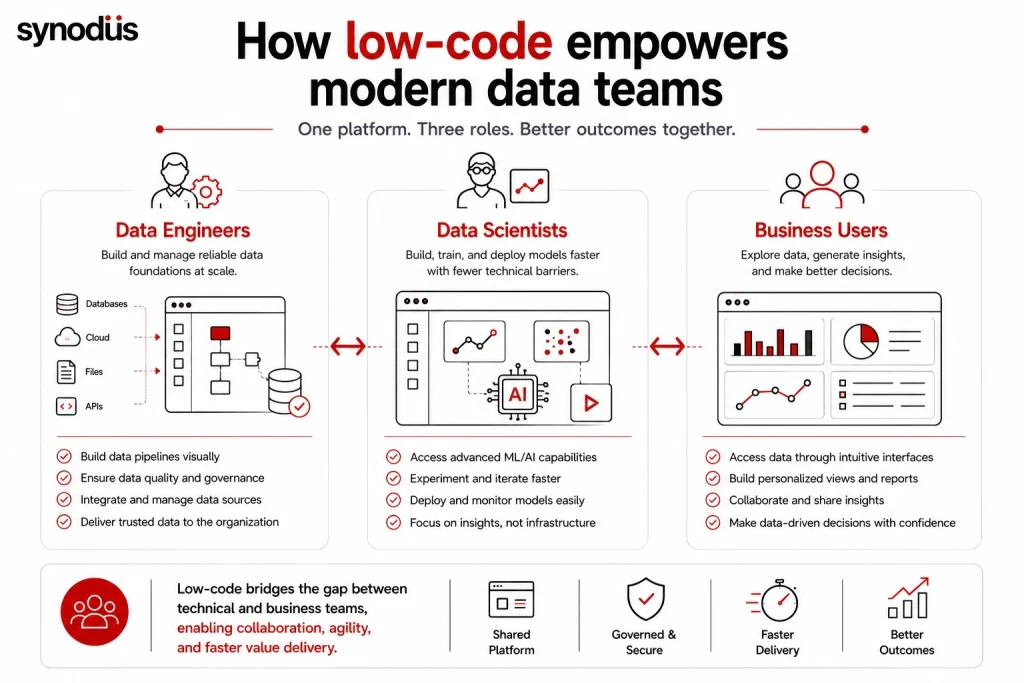
Low-code for data engineers
A low-code environment lets data engineers build data views visually and hand them straight to the people who need them. Engineers can set up internal data sources that follow governance requirements, while the end users get to personalize their own view of that data without touching the underlying setup.
Engineers can also swap one data source for another, such as moving to a new cloud storage provider, without users noticing any disruption. That means the team can keep delivering new and updated views to the organization’s data warehouse without a rebuild each time.
In practice, most of what data engineers do in this kind of environment is closer to visual SQL programming. They can still drop into actual code when needed, though in a well-built low-code setup that rarely comes up.
Low-code for data scientists
Many coding environments are either too complex or too limited for what a data science team actually needs day to day. Data scientists typically want precise control over a model’s parameters along with access to a wide library of methods to choose from.
A low-code environment gives data scientists room to:
- Work with a more flexible set of tools instead of being locked into one stack
- Spend more time on the interesting parts of the job by abstracting away tool interfaces and competing library versions
- Drop into deeper, hand-written code whenever a problem calls for it
- Pick up new techniques as the field moves, since the platform stays current
- Package and deploy trained models through a built-in mechanism
- Run the full set of data transformation steps needed to reach production
Better collaboration between data teams and business users
The relationship between a data science team and the business side is often tense: the business feels like it never got what it asked for, and the data team feels like it never gets credit for the work. A low-code environment gives both sides a visual, intuitive way to walk through how the team plans to reach an answer. Business users only need to follow the data flow and flag issues as they come up.
Low-code also gives the data science team a much faster turnaround, since changes to a data flow are quick to make and test. Data science stops being something built in isolation and becomes a shared effort that draws on both data and business expertise at once.
Where low-code fits into a data science workflow
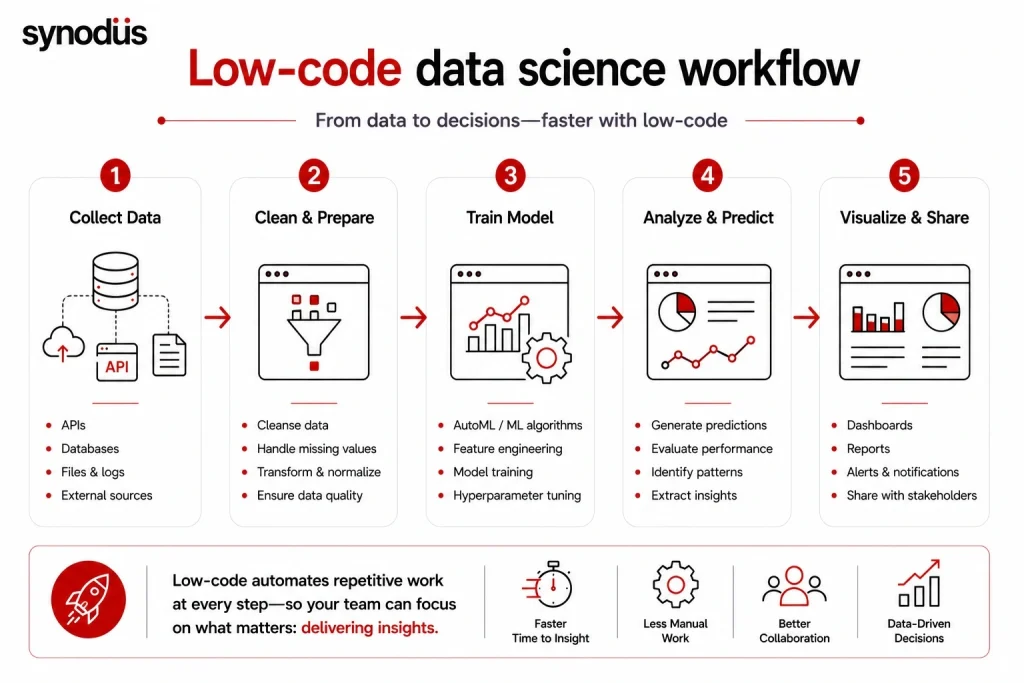
Low-code platforms cover a wide range of tasks that once required a dedicated engineering team. Visual programming has opened these functions up to far more people. Here is where low-code data science tools tend to add the most value.
Collecting data
Data science starts with collecting data, and low-code platforms can integrate APIs to pull data from web sources automatically. Data scraping has gotten much more accessible, and most of these services need no infrastructure of their own.
If you are a smaller team, you do not need to build in-house servers and databases just to collect data. Low-code gives you prebuilt connectors to reach several data sources on the internet, whether that is an internal database or a third-party system.
You can extend the number of sources you pull from quickly, which matters even more once you are acting on data in real time. For a closer look at the connector side of this, see how teams are linking their platforms to other systems with low-code API builders.
Structuring data
Much of the data on the internet has no structure at all. Getting insight out of it means removing erroneous, incomplete, or duplicated records first, a step usually called data cleansing.
Low-code platforms can automate this with bots. The drag-and-drop interface lets you build a visual automation that cleans your data on a regular schedule instead of doing it by hand each time.
Training and deploying machine learning models visually
Data science is more than collecting, organizing, and reading data. Deep learning, machine learning, and AI handle the more complex work in this space.
A number of low-code libraries help data scientists train and deploy ML models with far less code. PyCaret, for example, covers the full model development cycle. Auto-ViML, CreateML, AutoGluon, and Google’s Teachable Machine round out the space, with some requiring a bit of Python or R and others going fully codeless.
Turning results into business insight
This is usually the part that resonates most with founders and business stakeholders. Low-code data science platforms let you pull business insights straight out of cleaned data and trained models.
Visualization is rarely a low-code platform’s primary function, but it is a genuinely useful one. It gives you a way to present your data and findings in a format that is easy to read, and the drag-and-drop interface helps organize messy data into usable flows along the way.
Giving non-specialists access to AutoML
A growing set of libraries and no-code platforms let people train an algorithm using raw data with no ML background required. Google Cloud AutoML, Ludwig by Uber AI, Akkio, and Obviously.ai are a few of the no-code AutoML tools doing this well.
Building dashboards and reports
Beyond ML and AI prep, low-code helps data scientists build visualizations for quarterly reviews or for auditing a company’s overall data footprint. Most low-code platforms ship with modules built specifically for creating dashboards and interface-ready visualizations from a dataset.
Explore further: Centralizing data with low-code integration tools.
Top low-code data science platforms
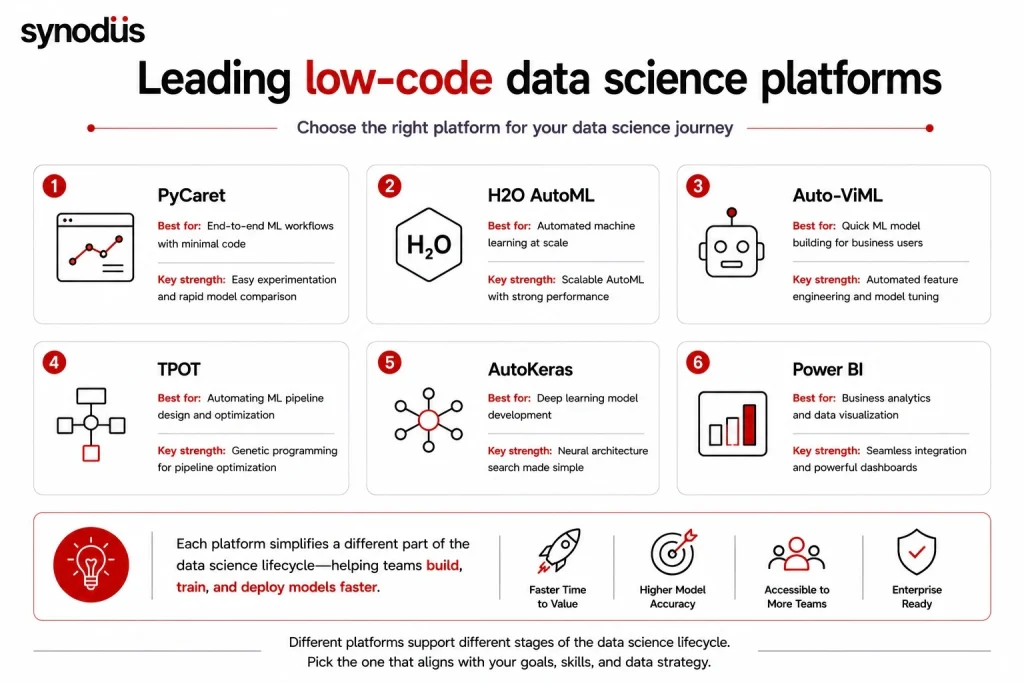
1. PyCaret
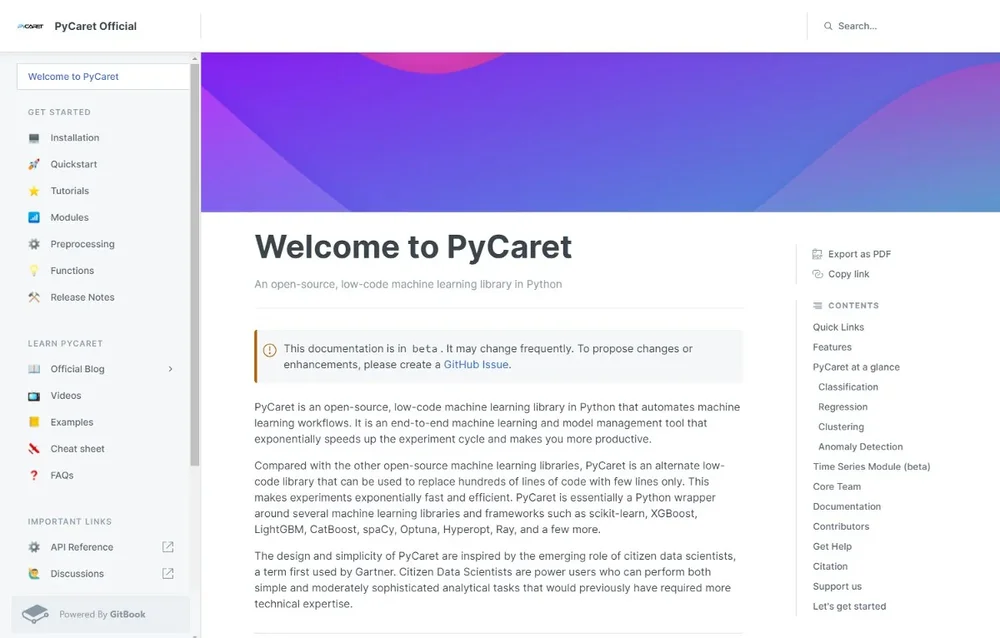
PyCaret is an open-source, Python-based library that helps data professionals build and deploy machine learning models quickly. Its range of functionality, including data preparation, model training, and evaluation, is a big part of why it is a popular first choice. Model deployment and hyperparameter tuning round out the feature set, all managed through one interface with built-in visualization tools.
PyCaret’s biggest draw is how little code it takes to get a working model. That frees data scientists up to spend their time on the parts of a project that need more attention. Because PyCaret handles most of the heavy lifting, newcomers can start experimenting with machine learning without needing a deep grasp of the underlying algorithms first, which lowers the entry point for people coming from outside a traditional data science background. It also sits within the broader set of open-source low-code platforms worth comparing before you commit to one.
2. H2O AutoML
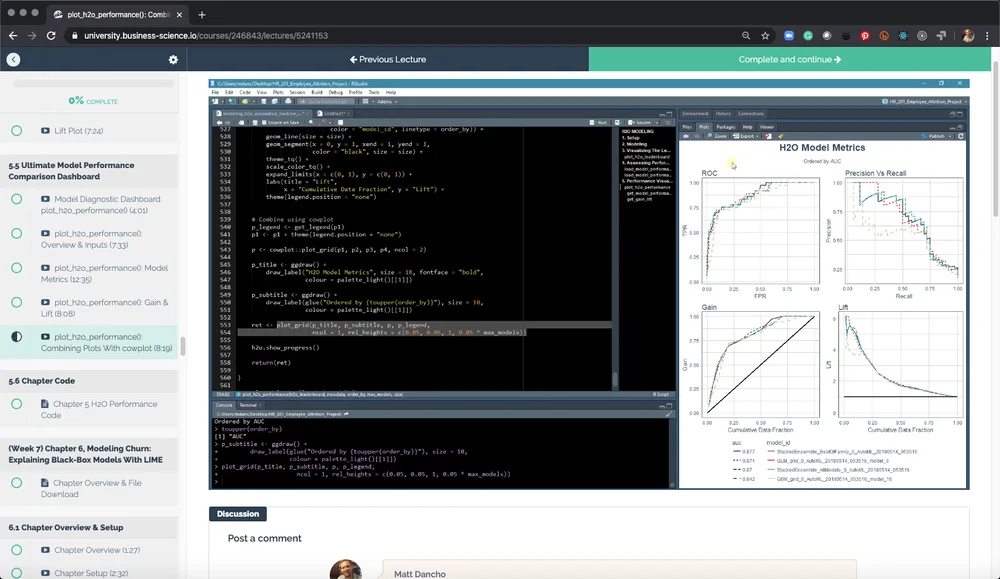
H2O AutoML gives users a set of algorithms and tools that automate the machine learning workflow end to end, from data prep through deployment. The goal is to help data scientists build accurate models without a lot of manual work along the way.
Like PyCaret, several steps here are automated, including feature engineering, hyperparameter tuning, and model selection. One standout feature is how well H2O AutoML handles large datasets and scales horizontally across machines, which makes it a solid fit for big data workloads. That scalability is also what lets it support use cases like regression, time-series forecasting, anomaly detection, and classification.
3. Auto-ViML
Auto-ViML is open source and built on top of scikit-learn, Pandas, and NumPy to simplify building machine learning models. Its interface makes it easy to put together realistic models quickly, which is why it automates so much of the repetitive work involved in ML development.
Its main advantages are ease of use and how little code it takes to get started, thanks to minimal required configuration. That makes it a solid fit for both beginners and specialists, and it supports regression, classification, and time-series forecasting out of the box.
4. TPOT (Tree-based Pipeline Optimization Tool)
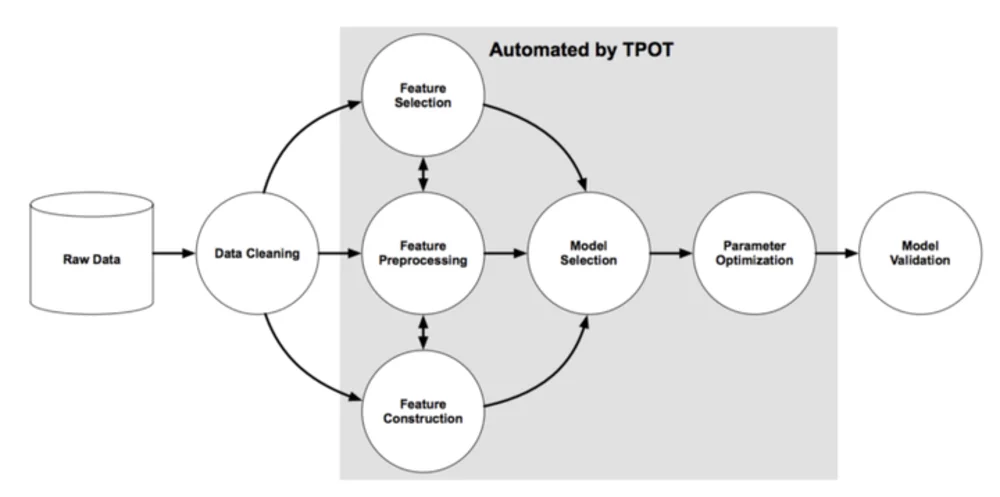
TPOT builds a tree-based representation of the pipeline space and generates a range of potential pipelines, which it then evolves across generations to optimize against a specific problem.
This tool focuses heavily on usability, giving users a straightforward interface that removes most of the manual effort from machine learning while still producing accurate models quickly.
5. AutoKeras
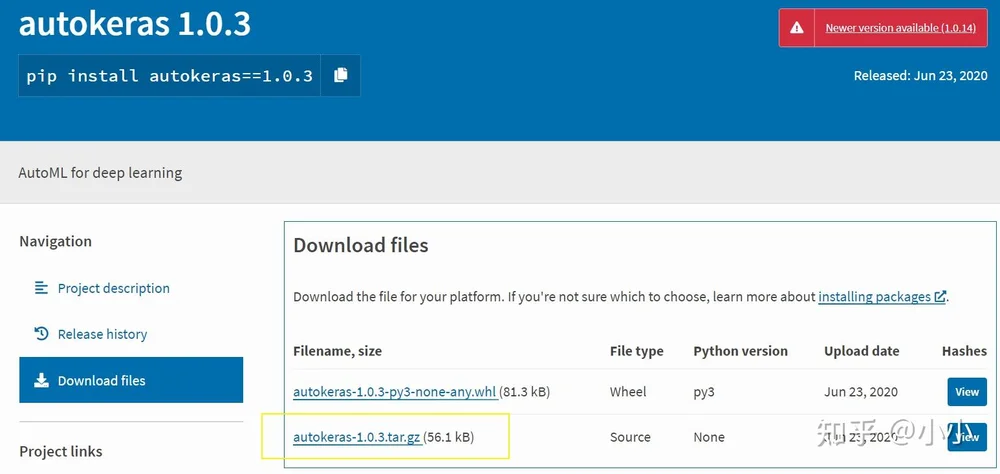
AutoKeras covers model selection, architecture search, and hyperparameter tuning through a technique called neural architecture search, which automates the process of finding the best neural network for a given task.
AutoKeras also handles both structured and unstructured data well. It automates preprocessing steps like encoding, imputation, and normalization, which makes it easier to build models across different data types.
6. Power BI
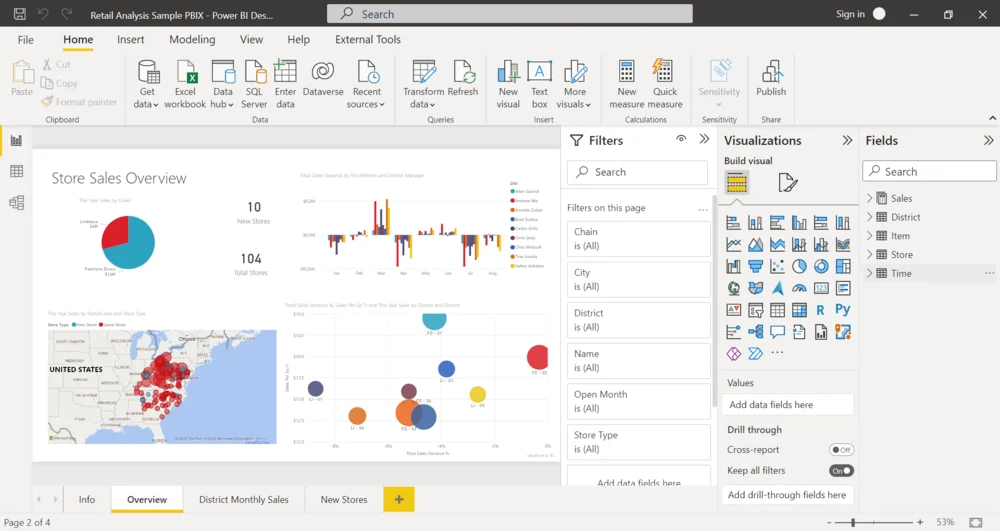
Power BI is Microsoft’s low-code data visualization product and one of the recognized leaders in the analytics and BI space. Power BI gives teams the tools to turn raw data into actionable insights and shareable visuals, without requiring a dedicated development team to maintain it.
Its AI-powered Copilot features can analyze and visualize data automatically, cutting down on manual, repetitive work. For teams already in the Microsoft ecosystem, Power BI also makes it easier to connect and centralize data across tools like Microsoft 365 or SharePoint.
Synodus has used Power BI as part of a larger Dynamics 365 and Azure build for a pharmaceutical client, supporting order, customer, and inventory management through 80 percent year-over-year growth. See the ERP and Power BI case study.
What to watch for with low-code data science
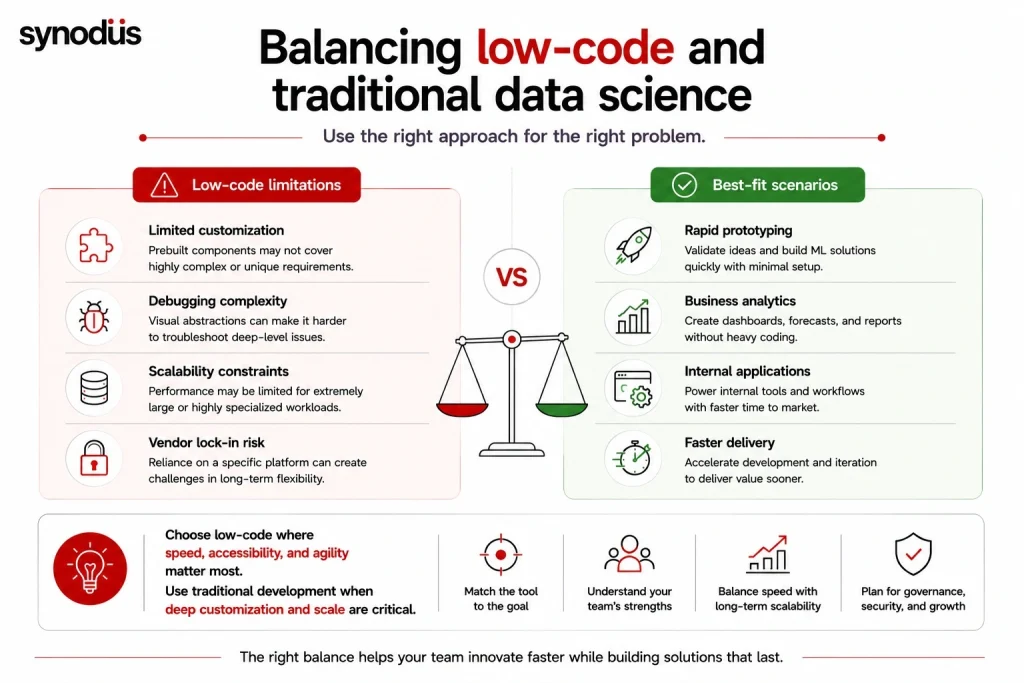
Traditional programming still has real advantages over low-code in a few areas.
- Customization: building highly customized models and algorithms is harder in a low-code environment. If your data challenges are complex enough, the traditional approach may still be the better fit.
- Debugging: when something breaks, low-code gives you less visibility into exactly where things fail. Hand-written code makes it easier to trace the problem back to its source.
- Scalability: tuning a low-code setup for performance can get complicated, and you may not match the speed or efficiency of a traditional build.
Also read: Prep yourself with 10 low-code challenges
Low-code data science can help knowledge workers across a range of roles solve real problems, but it will not replace the need for skilled technical contributors in every case. Weigh its benefits against your specific use case before deciding how much of the workflow to hand over to it.
Synodus builds on Microsoft Power Platform and BI tools to help teams put data to work faster. If you are exploring low-code data science services for your team, book a free consultation to talk through your data stack and where low-code fits.