What is a real estate NFT marketplace?
A real estate NFT marketplace is a platform where property-backed digital tokens are issued, bought, sold, and traded. Each token represents an ownership interest, income right, or access right tied to a property. That property can be physical (a house, apartment building, or commercial property) or virtual (land inside a metaverse environment).
This guide focuses on the first category: platforms built around real-world property. That distinction matters more than it might seem, and the next section explains why.
How does a real estate NFT marketplace work?
Tokenizing a property is not a single technical step. It is a chain of legal and operational stages, most of which happen before any code runs. A typical lifecycle looks like this:
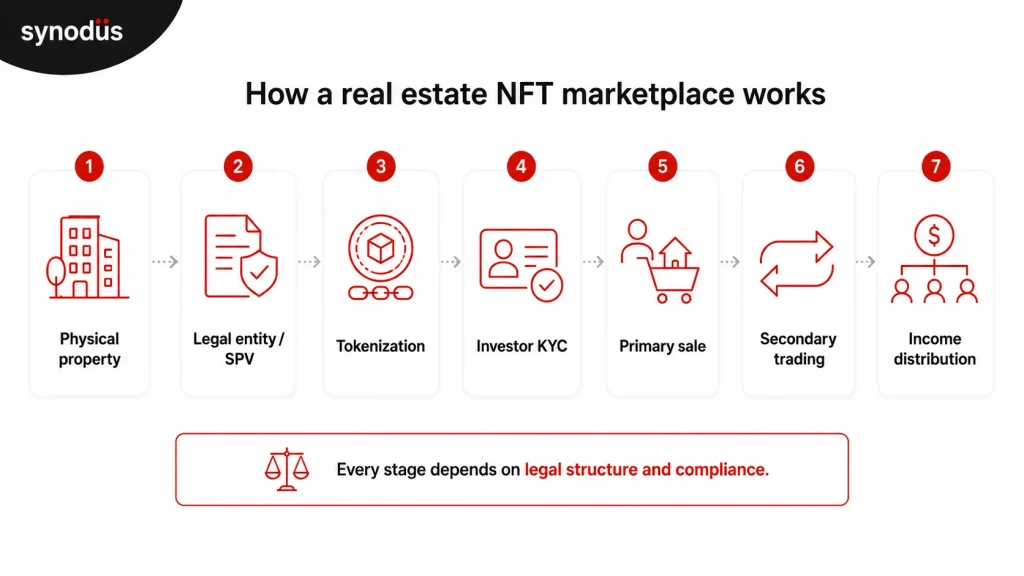
- Physical property. A property is selected, appraised, and legally prepared for tokenization. This includes title verification and resolving any existing liens or encumbrances.
- Legal entity / ownership structure. In almost every jurisdiction, an NFT cannot directly represent legal title to real property. Instead, the property is placed into a legal wrapper, typically an SPV (special purpose vehicle) or LLC, and the token represents ownership or shares in that entity, not the property itself.
- Tokenization. The ownership interest is minted as a token (or set of tokens, for fractional ownership) on a blockchain, with metadata linking it to the underlying legal entity and property documentation.
- Investor KYC. Before anyone can buy, sell, or hold a token, they typically need to pass identity verification and, depending on the offering structure, an accreditation check.
- Primary sale. Tokens are offered to investors for the first time, usually at a fixed price per share.
- Secondary trading. Verified investors can resell their tokens to other verified investors, subject to any transfer restrictions built into the offering.
- Income distribution. If the property generates rental income, that income is distributed to token holders, often automatically, through a smart contract, on a recurring schedule.
Every one of these stages has a legal dependency. That is the main reason real estate tokenization is a fundamentally different build than an art or gaming NFT marketplace.
Real-world real estate NFTs vs virtual real estate NFTs
These two categories get bundled together constantly under the same “real estate NFT” label, but they serve different markets, carry different regulatory exposure, and require different platform architecture.
| Real-world real estate NFTs | Virtual real estate NFTs | |
|---|---|---|
| Underlying asset | Physical property (residential, commercial) | Digital land inside a metaverse/game environment |
| Legal status | Usually requires a legal wrapper (SPV/LLC); token often qualifies as a security | No underlying real-world legal claim; typically not a security |
| Regulatory exposure | High: securities law, KYC/AML, property law | Low to moderate: mainly consumer protection and platform terms |
| Value driver | Property fundamentals: location, rental income, appreciation | Platform adoption, scarcity, speculative demand |
| Typical buyer | Investor seeking yield or fractional real estate exposure | Collector, brand, or speculator inside a specific virtual world |
| Platform examples | Propy, RealT, Lofty AI | Decentraland, The Sandbox |
If a platform needs to support both categories, that’s effectively two products with two different compliance postures. It is worth scoping and pricing them separately rather than treating them as one build.
Key features of a real estate NFT marketplace
A production-ready platform needs the following capabilities. Several of these overlap with core NFT marketplace features generally. The features below are the ones that are either unique to real estate or meaningfully different in this context.
- Property onboarding & verification: Intake workflow for property documentation, title verification, and appraisal before an asset is eligible for tokenization.
- Tokenization: Minting logic that links each token to a specific property and legal entity, supporting both whole and fractional issuance.
- KYC/AML: Identity verification and screening for every participant, typically more stringent than a general-purpose NFT platform due to securities regulation.
- Smart contracts: Automate transfer rules, income distribution, and compliance checks (covered in depth in the Technical Requirements section below).
- Investor dashboard: Portfolio view showing holdings, income history, and available secondary listings.
- Primary marketplace: Where new property offerings are listed and sold to investors for the first time.
- Secondary marketplace: Where existing token holders can resell to other verified investors, subject to transfer restrictions.
- Payments: Fiat and/or stablecoin rails for both the initial purchase and ongoing income distribution. This is close to a requirement for attracting non-crypto-native real estate investors.
- Income distribution: Automated, typically smart-contract-driven, disbursement of rental or other income to token holders.
- Document management: Secure storage and retrieval of legal documents (title, SPV formation documents, offering memoranda) tied to each property.
- Reporting: Compliance and tax reporting tools for both the platform operator and individual investors.
Examples of real estate NFT platforms
A handful of platforms illustrate what a working real-world real estate tokenization product looks like in practice. This is a short, verified reference list, not a ranked or exhaustive comparison.
- Propy: Built specifically for real estate, with smart contracts integrated into the legal title transfer process. Propy completed the first NFT-based real estate sale on U.S. soil in February 2022, selling a Gulfport, Florida home for $653,000 through a token tied to an LLC holding the property title (CoinDesk).
- RealT: Tokenizes rental properties (concentrated in US markets such as Detroit) on Ethereum, with rental income distributed to token holders and an investment minimum around $50.
- Lofty AI: Offers fractional ownership of US residential property with daily rental payouts and a built-in secondary market for liquidity.
- Securitize: Broader RWA tokenization infrastructure, not real-estate-exclusive, used by institutional issuers (Security Tokenizer). Relevant as a reference for compliance-first platform architecture at scale.
- Myco: Focused on co-ownership of vacation properties, combining usage rights with fractional financial ownership (BlockchainX). A different model from pure income-share tokenization.
Benefits and limitations of real estate NFT marketplaces
Real estate NFT marketplaces come with real advantages over traditional property investment, but also with trade-offs that founders need to weigh before committing to a build.
Benefits
- Fractional ownership lowers the capital barrier to real estate investing, letting investors buy a share of a property instead of the whole asset.
- Smart contracts automate transfer and income distribution, reducing the manual overhead of managing tenants, rent collection, and ownership records.
- Blockchain record-keeping improves transaction transparency and auditability, since every transfer and distribution is logged on a public or permissioned ledger.
- The model opens access to global investors, subject to whatever eligibility rules the offering requires, in a way traditional property transactions rarely do.
Limitations
- Token value can be as volatile as the underlying property market and the platform’s own liquidity, not just the property itself.
- The token itself is rarely direct legal title. Investors typically hold an interest in a legal wrapper such as an SPV, not the property directly.
- Legal recognition of tokenized property rights is still inconsistent across jurisdictions, so a structure that works in one market may not transfer cleanly to another.
- Undisclosed liens, unpaid taxes, or title defects can still affect investors if due diligence during onboarding is inadequate.
- Regulatory classification, most often as a security, adds compliance cost and operational complexity that a platform operator has to budget for from the outset.
Legal and compliance considerations
This is the section that determines whether a real estate NFT marketplace is viable at all. Get it wrong, and no amount of good engineering fixes it.
Property title: In most jurisdictions, a blockchain token cannot itself constitute legal title to real property. The token represents an interest in whatever legal structure holds title, which is why the next point matters so much.
SPV (special purpose vehicle): The standard workaround is to place each property (or portfolio) into its own SPV or LLC. The token represents shares or membership interest in that entity. This is the model Propy uses: the buyer acquires both the token and an interest in the US-based LLC holding the property title, giving the arrangement legal enforceability beyond the blockchain record itself (CoinDesk).
Securities classification: In the US, a fractionalized real estate token is very likely to be classified as a security under the Howey Test, since it typically involves an investment of money in a common enterprise with an expectation of profit from the efforts of others (U.S. SEC). That classification triggers registration or exemption requirements (e.g., Reg D, Reg S) and ongoing disclosure obligations. Other jurisdictions apply their own tests, but the underlying question of whether the token functions as an investment contract shows up almost everywhere.
KYC/AML: Because tokens are typically securities, investor verification requirements are stricter than on a general NFT platform: identity verification, sanctions screening, and in many offering structures, accredited investor verification.
Investor eligibility: Depending on the exemption used, the platform may need to restrict participation by investor type (accredited vs. retail) or by jurisdiction, and enforce those restrictions at the smart contract level, not just in the UI.
Transfer restrictions: Securities-law compliance often requires that secondary transfers only occur between eligible, verified holders, and sometimes only after a defined holding period. This needs to be enforced on-chain through compliance hooks in the smart contract, not left to voluntary compliance.
Tax: Token holders may owe tax on distributed rental income and on capital gains at resale; the platform operator may have withholding or reporting obligations depending on jurisdiction. This varies significantly by market and should be scoped with local tax counsel rather than treated as a standard build item.
This is not legal advice. Securities and property law vary by jurisdiction and change over time, so any real estate NFT marketplace should be structured with qualified legal counsel before launch.
How to build a real estate NFT marketplace
Step 1: Define the legal model
Decide on the ownership structure (SPV per property vs. umbrella structure), the securities exemption you’ll rely on, and which jurisdictions you’ll operate in, then choose between whole-property tokens and fractional tokens and select a token standard accordingly.
ERC-721 fits single, non-divisible ownership; ERC-1155 or a security-token standard like ERC-1400 fits fractional, compliance-restricted issuance, as covered in more depth in this NFT smart contract development guide. This decision shapes nearly every technical choice that follows, so it should happen before development, not alongside it.
Step 2: Choose a blockchain
Weigh public networks (broad liquidity and tooling, but less privacy and slower finality for compliance-heavy use cases) against permissioned or hybrid chains (more control over participant eligibility, at the cost of a smaller liquidity pool).
Step 3: Design the transaction lifecycle
Map every stage from onboarding through income distribution, as outlined earlier, into concrete system states and transitions. This becomes the spec for the smart contract layer.
Step 4: Smart contract development
Build the smart contracts that handle minting, transfer restrictions, compliance checks, and income distribution, following architecture patterns that avoid the vulnerabilities most common in this category of contract.
Step 5: KYC, property, and payment integrations
Connect identity verification providers, property/title data sources, and payment rails (fiat on/off-ramps, stablecoin settlement). This is also where wallet integration decisions get made, weighing custodial vs. non-custodial trade-offs for investors who aren’t crypto-native.
Step 6: Frontend and backend development
Build the investor dashboard, primary and secondary marketplace interfaces, and the admin tooling operators need for property onboarding and compliance monitoring.
Step 7: Security audit
Independent audit of the smart contracts and infrastructure before any real capital moves through the platform. This step is non-negotiable given the regulatory and financial stakes.
Step 8: Launch
Roll out with the first property offering, monitoring compliance workflows closely during the initial cohort of investors before scaling.
Real estate NFT marrketplace arrchitecture
A working platform splits cleanly into what belongs on-chain and what doesn’t:
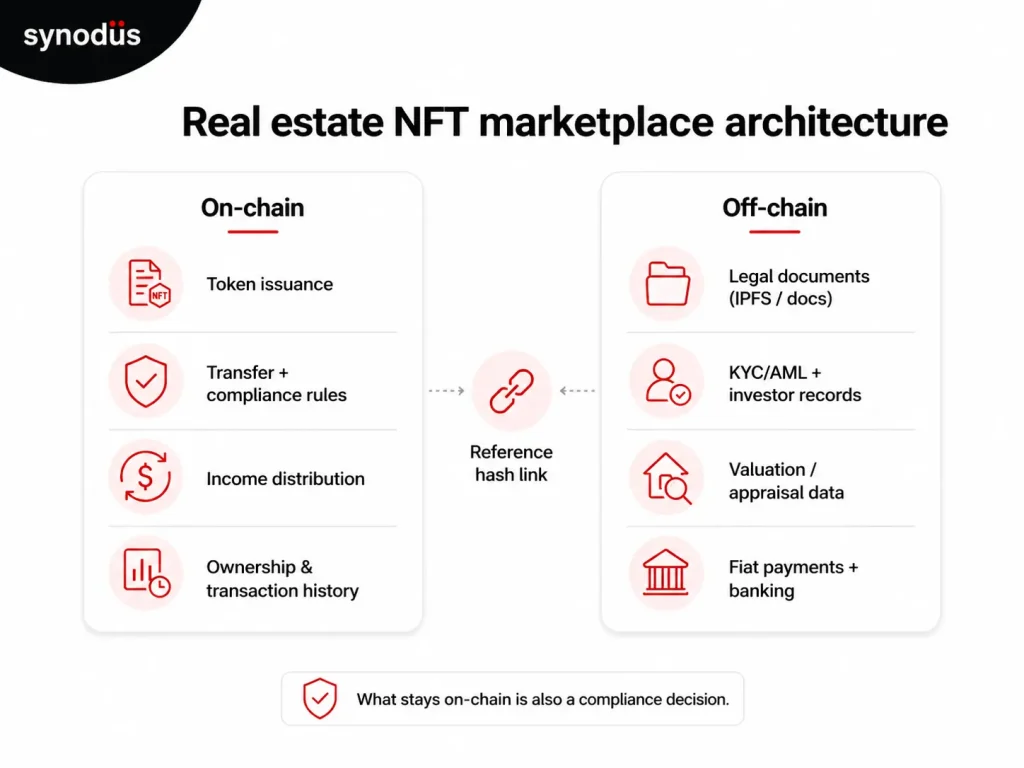
On-chain:
- Token issuance and ownership records
- Transfer logic and compliance restrictions (whitelist checks, holding periods)
- Income distribution logic
- Ownership and transaction history
Off-chain:
- Legal documents (title, SPV formation documents, offering memoranda), typically stored via a solution like IPFS with only a reference hash recorded on-chain
- KYC/AML data and investor eligibility records, kept off-chain for privacy and regulatory reasons
- Property valuation and appraisal data, often fed in via an oracle for periodic updates
- Fiat payment processing and banking relationships
Getting this split right is as much a compliance decision as a technical one. What goes on a public, immutable ledger has to be information the platform is comfortable making permanently visible.
How much does it cost to build?
Cost depends heavily on the legal model chosen, the number of jurisdictions supported, and how much of the KYC/compliance stack is built versus integrated via third-party providers. Real estate platforms generally sit at the higher end of NFT marketplace development costs because of this compliance layer.
Wrapping up
Building a real estate NFT marketplace is a legal project with a technical component, not the other way around. The platforms that hold up over time, including Propy, RealT, and Lofty AI, succeeded by treating title, securities compliance, and investor eligibility as core product requirements, not afterthoughts bolted onto a generic NFT template.
If you’re planning a real estate tokenization platform, Synodus’s blockchain development team can help you get the legal model, architecture, and compliance framework right from the start.
FAQ
No. In almost all cases, the token represents an interest in a legal entity (typically an SPV) that holds the property, not direct legal title to the property itself.
In most cases, especially where ownership is fractionalized, yes. That means securities law, not just NFT marketplace norms, governs how the platform can be built and operated.
Sometimes, for simpler, single-jurisdiction offerings. But the compliance requirements specific to real estate, including transfer restrictions, investor eligibility enforcement, and jurisdiction-specific KYC, often exceed what generic white-label NFT marketplace infrastructure supports. That is why most real estate platforms end up as custom builds.
There is no universal answer. It depends on the compliance model. Public chains offer more liquidity and tooling; permissioned or hybrid chains offer more control over who can hold and trade tokens, which matters more when transfer restrictions are legally required.