Key takeaway
- High-code is traditional programming, where you use languages, frameworks, and tools to build an application from scratch.
- Low-code uses pre-built code blocks to speed up development while still allowing custom programming when needed.
- Low-code is faster and cheaper but less extensive and flexible than high-code, which makes it best for simple to mid-complex projects.
- Both approaches are evolving with AI, and many enterprises now run hybrid strategies that combine the two. The right choice depends on project complexity, timeline, budget, scalability needs, and team capabilities.
What is low-code?
Low-code is a development method that lets you turn an idea into a working app using drag-and-drop features with minimal coding. To make this possible, a wide range of low-code platforms provide the features you need, automating much of the process and removing repetitive, tedious tasks during programming.
Low-code includes visual development environments, APIs, data connections, and ready-made code templates, which all speed up delivery and free you to focus on the product itself.
Who can use low-code:
- Professional developers: speed up delivery by automating boilerplate code.
- Citizen developers: non-technical employees who can build applications for their teams.
- Business analysts: create prototypes and proofs of concept without IT bottlenecks.
- Anyone with an idea: use the technology to practice coding skills or build an app without learning complex tech.
Gartner predicts that by 2026, 80% of low-code users will come from outside formal IT departments, up from 60% in 2021.
What is high-code?
High-code, also called pro-code, is the traditional coding method still widely used today. You program from scratch with a language, frameworks, and development tools in a code-driven workflow.
In practice, you hire a team of developers to design each part of your app, while content and data are served on demand through a headless CMS or API-based services. High-code relies heavily on developers but offers far greater versatility, with no real limits on the kinds of modules you can build.
Traditional development keeps evolving in 2026, too:
- AI coding assistants: GitHub Copilot, ChatGPT, and similar tools speed up code writing.
- Better frameworks: modern frameworks like Next.js and Flutter reduce boilerplate.
- DevOps automation: CI/CD pipelines make deployment faster.
- Cloud-native tools: serverless and containerization simplify infrastructure.
High-code is not standing still, it is getting more efficient too.
The differences between low-code vs high-code
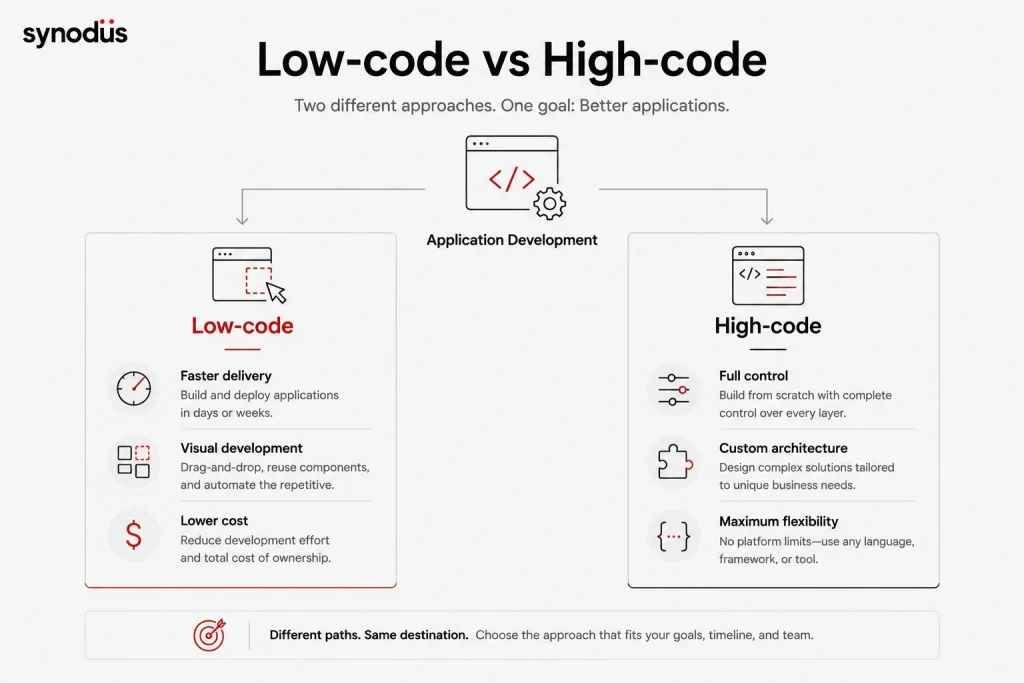
Here is a side-by-side comparison to help you understand the two approaches.
| Low-code | High-code | |
|---|---|---|
| Approach | User-driven. A platform that limits hand-coding and lets citizen developers take part. | Code-driven. Depends on developers to write and implement code. |
| Learning curve | Quick and easy. 70% of first-time users learn low-code platforms in a month or less. | Slow. Typically takes months to years to master languages and frameworks. |
| Who builds it | Both citizen developers and IT developers, thanks to pre-built components and a drag-and-drop editor. | IT developers at all levels. Citizen developers cannot take part. |
| Customization | Medium. Pre-built components, but custom code can be integrated for more control. | High. Built from scratch, so customization is significantly greater than low-code. |
| Technical knowledge | Little to none for basic apps. Some coding helps with advanced customization. | Medium to high. Requires languages, frameworks, databases, and architecture. |
| Development cost | Affordable. Mostly subscription-based ($10 to $500 per user per month). Organizations report avoiding 2+ hires and saving $4.4M+ over 3 years. | Expensive. An experienced team ($50,000 to $150,000+ per developer per year), plus infrastructure and ongoing management. |
| Development speed | Rapid, with reusable blocks and templates. Studies show 29% report builds 40 to 60% faster and another 29% report 61 to 100% faster. | Slow. Built from scratch over many iterations, often taking 3 to 12+ months for complex apps. |
| Time to market | Days to weeks for simple apps, weeks to months for complex ones. | Months to years. Enterprise apps typically take 6 to 18 months. |
| Reusability | High. Features and blocks reuse easily across apps via component libraries. | Variable. Depends on the stack. For example, dynamic web source code cannot be reused for a mobile app, though PWA source code can be reused for native development. |
| Scalability | Yes, within platform limits. Scales to thousands of users, and enterprise platforms handle millions of transactions. | Yes, and can go further. Full control over architecture allows tuning for extreme scale. |
| Performance | Good for most business apps. May fall short for millisecond-level response needs. | Excellent. Can be optimized to exact specs, ideal for trading, gaming, and real-time systems. |
| Vendor dependency | High. Tied to the vendor’s roadmap, pricing, and ecosystem, and migration can be hard. | Low. Your IT team owns support, and many open-source frameworks have strong communities. |
| Security | Built-in features and certifications (SOC 2, HIPAA, GDPR), but less control over the details. | Full control over security, though it takes more expertise to get right. |
| AI integration | Increasingly built-in, with AI copilots for code generation, workflow suggestions, and optimization. | AI as separate tools. Copilot and ChatGPT help, but need integration work. |
Will low-code replace traditional code?
There is a lot of debate about whether high-code will fade as low-code rises. The short answer is that this is still a long way off.
The growth of low-code is undeniable. The market grew from $28.75 billion in 2024 and is projected to reach $264.40 billion by 2032, a 32.2% CAGR, and Gartner predicts that by 2029, 80% of mission-critical applications will use low-code platforms, up from just 15% in 2024. Yet traditional code remains the backbone of software development for good reasons.
Low-code is reshaping digital transformation by letting citizen developers join in. A marketer or HR lead can now build an app that makes their job easier. But skilled developers and traditional coding are not going away. High-code stays essential for:
- Open-source contributions: frameworks and libraries that others build on.
- Performance-critical systems: game engines, high-frequency trading, real-time processing.
- Highly customized products: unique experiences that differentiate your brand.
- Complex algorithms: proprietary AI models, scientific computing, advanced data processing.
- Legacy system integration: deep integration with existing custom systems.
The reality is that many enterprises let low-code and traditional code work together rather than picking one. A typical setup makes low-code available to every employee for testing ideas, builds quick proofs of concept in low-code to validate with users, then either keeps the prototype in low-code if it meets performance needs or hands it to technical teams for a high-code rebuild. According to McKinsey research, companies that empower citizen developers score 33% higher on innovation while keeping strong technical foundations with professional developers.
Which to use: Low-code or high-code?
To decide with confidence, define what you need and the resources you have. In short, low-code is the ideal solution for a shorter time to market, while high-code is about advanced customization.
Low-code offers templates, functionality, and tools for building apps with little or no hand-coding, which makes it ideal when you need to:
- Create internal applications at high volume.
- Let everyone in the company, across departments, contribute ideas to tech creation.
- Give developers visual tools to test app ideas or prototype designs.
- Reduce manual tasks and improve efficiency.
- Build apps quickly with only minor customization.
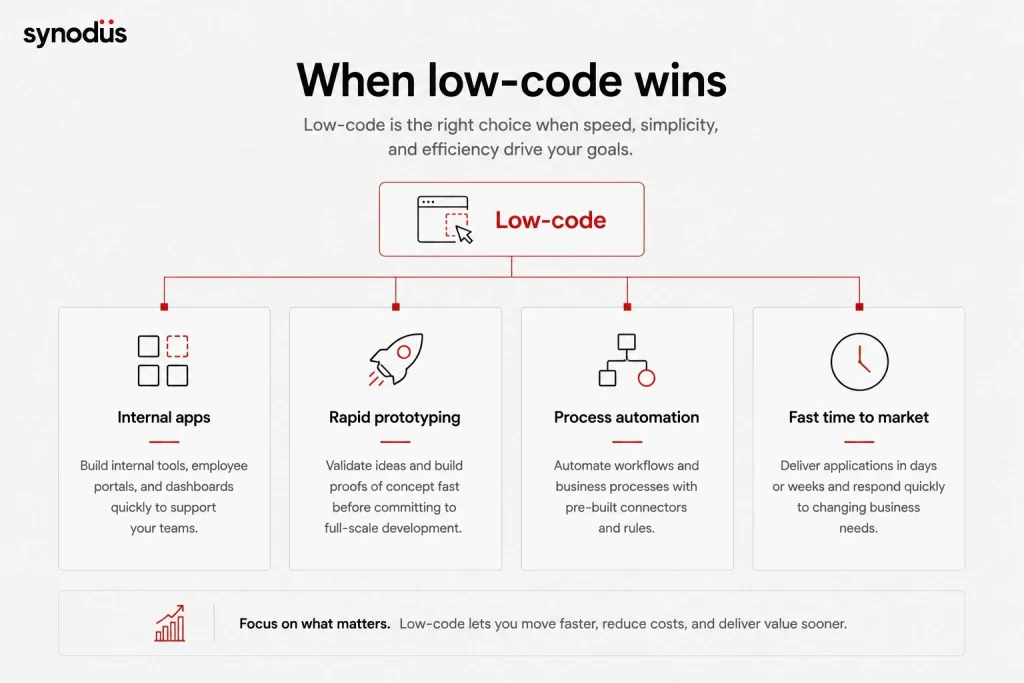
For inspiration, see how leading brands use low-code.
High-code offers greater extensibility, flexibility, and robustness at the cost of longer development. It is the right choice when:
- You need comprehensive, enterprise-level apps, websites, software, or cloud products.
- You want to push the features and functionality of an application further.
- You plan to monetize or publish your app publicly, where stability and full control over performance and source code matter most.
No-code is another technology often confused with low-code. Despite some shared features, each can outweigh the other in certain cases. Learn more in our guide to low-code vs no-code.
Questions to ask before making the final decision
These questions help you settle which approach fits best.
1. Is this a mission-critical project, and how critical?
If your app is the heart of your business, lean toward traditional development, unless you only want to test an idea, where low-code is enough. The more crucial the role it plays, the more investment it deserves. Top-priority projects are usually worth building in high-code for maximum customization, performance, and control.
For example, an e-commerce platform processing $1M+ a month or a banking app handling transactions suits high-code, while an internal employee directory, expense approval workflow, or inventory tracker suits low-code.
2. Do you have a detailed product roadmap?
Choose traditional development if you expect the product to evolve heavily as the company grows. If you are automating a stable business process that will not change much, low-code is a solid alternative. High-code fits products with 3 to 5+ year roadmaps and frequent major updates, while low-code fits tools that solve a specific current problem with stable requirements.
3. How many users do you expect?
If your users are both internal and external with open public access, choose high-code for stability, scalability, and full control of your code and data. Low-code is best for a small, defined group, which is why many enterprises use it for internal apps. As a rough guide, low-code suits 10 to 10,000 mostly internal users, while high-code suits 10,000+ users with unpredictable public traffic.
4. Do you have development resources?
Traditional development is the best use of skilled developers when you have them, since it maximizes their expertise and gives full control. If you are short on developers or buried in backlog, low-code makes more sense. A 6 to 18+ month IT backlog or hiring difficulty points to low-code, while a strong in-house team with complex requirements points to high-code.
5. What is your time to market?
Traditional coding takes far longer (3 to 12+ months versus days to weeks). When you need to move fast on a market opportunity or urgent need, low-code is ideal. As benchmarks, high-code runs roughly 2 to 3 months for simple apps and 6 to 18+ months for complex ones, while low-code runs 1 to 4 weeks for simple apps and 3 to 6 months for complex ones.
6. What are your budget limits?
A budget of $5,000 to $50,000 usually points to low-code, $50,000 to $150,000 favors a hybrid approach, and $150,000+ makes full traditional development feasible. Remember that budget is not only upfront cost: factor in training and support, ongoing maintenance (15 to 20% of the initial cost per year), subscription renewals, developer salaries, and integration needs. Our guide to low-code development cost breaks this down further.
7. What are your performance requirements?
If your app needs sub-100ms response times, thousands of transactions per second, real-time processing, complex algorithms, or video and audio processing, lean toward high-code. If not, low-code likely meets your needs.
8. How important is vendor independence?
Ask whether you can accept being tied to a platform vendor’s roadmap and pricing, and whether you need to own 100% of your codebase. A high tolerance for vendor dependency makes low-code acceptable, while a need for complete independence calls for high-code.
Decision framework at a glance
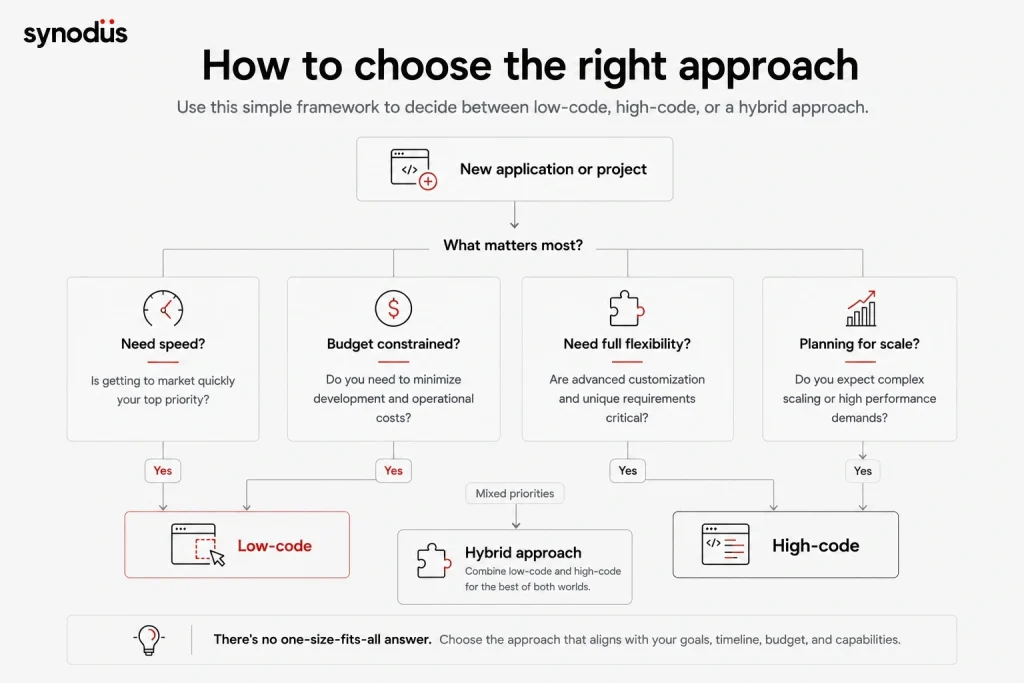
START: New application project
|
+-- Is it mission-critical to revenue or operations?
|   +-- YES: How many external users?
|   |   +-- Thousands to millions -> HIGH-CODE
|   |   +-- Hundreds or internal only -> check budget
|   |       +-- Budget > $150K -> HIGH-CODE
|   |       +-- Budget < $150K -> LOW-CODE with heavy customization
|   |
|   +-- NO: Time to market?
|       +-- Live in < 3 months -> LOW-CODE
|       +-- 3+ months acceptable -> evaluate complexity
|           +-- Standard CRUD/workflows -> LOW-CODE
|           +-- Complex algorithms -> HIGH-CODE

Special cases:
- Prototype or MVP first? Start low-code, migrate if needed.
- Internal tool for < 1,000 users? Low-code.
- Customer-facing with unique UX? High-code.
- Need AI/ML integration? Both support AI now, so evaluate either.
Hybrid strategy: Combining low-code and high-code
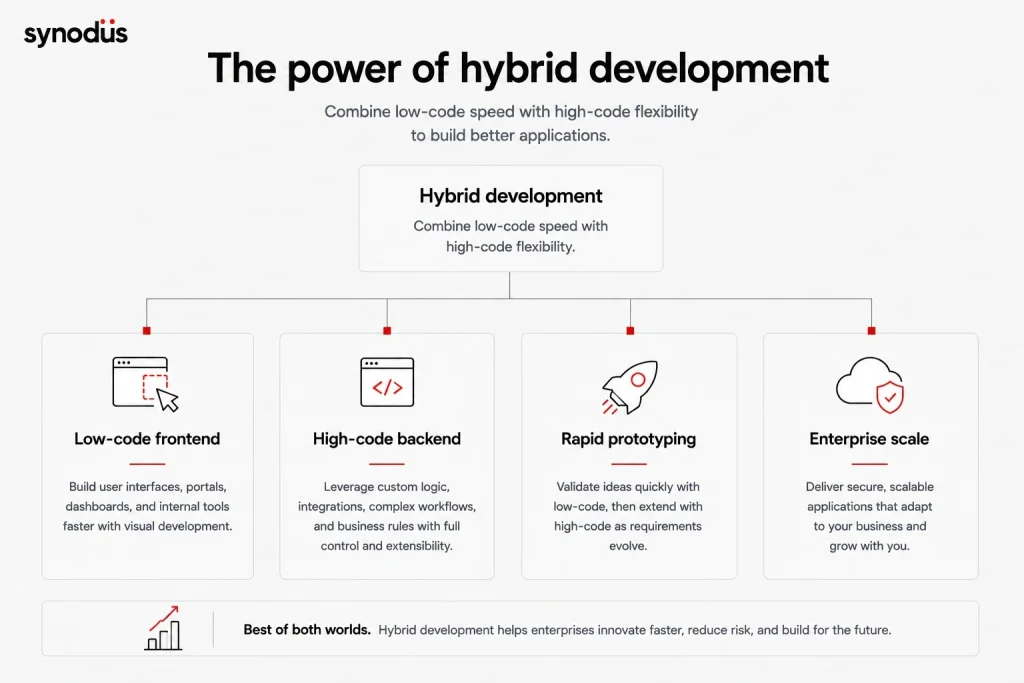
Many successful organizations do not choose between low-code and high-code, they use both on purpose.
Pattern 1: Low-code frontend plus high-code backend. Use low-code for interfaces, forms, and dashboards, build complex logic in traditional code, and connect through APIs. Best for apps with standard UIs but heavy processing.
Pattern 2: Low-code for internal, high-code for external. Employee-facing tools (HR, workflows, reporting) in low-code, customer-facing products (e-commerce, mobile apps) in high-code. Best for enterprises that need both internal efficiency and external products.
Pattern 3: Low-code prototyping plus high-code production. Build MVPs in low-code in 1 to 2 months, validate with users, then rebuild proven concepts in high-code for scale. Best for new products with uncertain requirements.
Pattern 4: Low-code modules in a high-code architecture. Build the core in traditional code and specific modules in low-code for fast iteration, integrated through standard APIs. Best for large apps that need flexibility in certain areas.
In practice, this is how Synodus tends to deliver. For Bamboo Airways, we built an internal task management system for 2,000 staff on the low-code Power Platform in 10 weeks with a team of 4, raising task completion rates by 25% within 3 months, exactly the kind of internal, fast-turnaround project where low-code shines, while heavier custom work stays in pro-code.
The AI factor in 2026
Both low-code and high-code are being reshaped by AI, which is narrowing some of the gaps.
On the low-code side, platforms now offer natural language to app generation, automated workflow suggestions, intelligent code completion, and auto-generated testing, with Microsoft Power Apps Copilot and Mendix AI Bot as examples. On the high-code side, GitHub Copilot generates boilerplate, ChatGPT assists with debugging, and AI review tools catch issues, making traditional development roughly 30 to 40% faster.
As AI improves, the productivity gap between the two narrows, but the use-case differences remain significant. For a deeper look, read our roundup of the best low-code AI platforms.
Frequently asked questions
No. Low-code is growing fast and will handle more mission-critical apps over time, but high-code remains essential for performance-critical systems, highly customized products, complex algorithms, and deep legacy integration. Most organizations use both rather than choosing one.
For simple to mid-complex apps, yes. Low-code needs fewer developers and ships faster, which lowers cost. For large, highly customized, or performance-critical products, high-code can be more cost-effective over the full lifecycle because you avoid platform limits and vendor fees.
Yes, and many enterprises do. Common patterns include a low-code frontend with a high-code backend, low-code for internal tools and high-code for customer-facing products, or low-code prototypes that get rebuilt in high-code for scale.
Low-code, by a wide margin. Most first-time users learn a low-code platform in a month or less, while mastering traditional languages and frameworks usually takes months to years.
Wrapping up
There is no one-size-fits-all answer, since every company has its own vision and needs. Choosing between low-code and high-code is one of the first hurdles businesses face when deciding how to build applications, and the best solution comes down to your requirements, expected timeline, team expectations, and budget.
If you want help making that call, Synodus builds custom low-code and hybrid solutions for businesses across finance, healthcare, aviation, and more. Talk to our team to find the right fit for your project.