What is low-code AI?
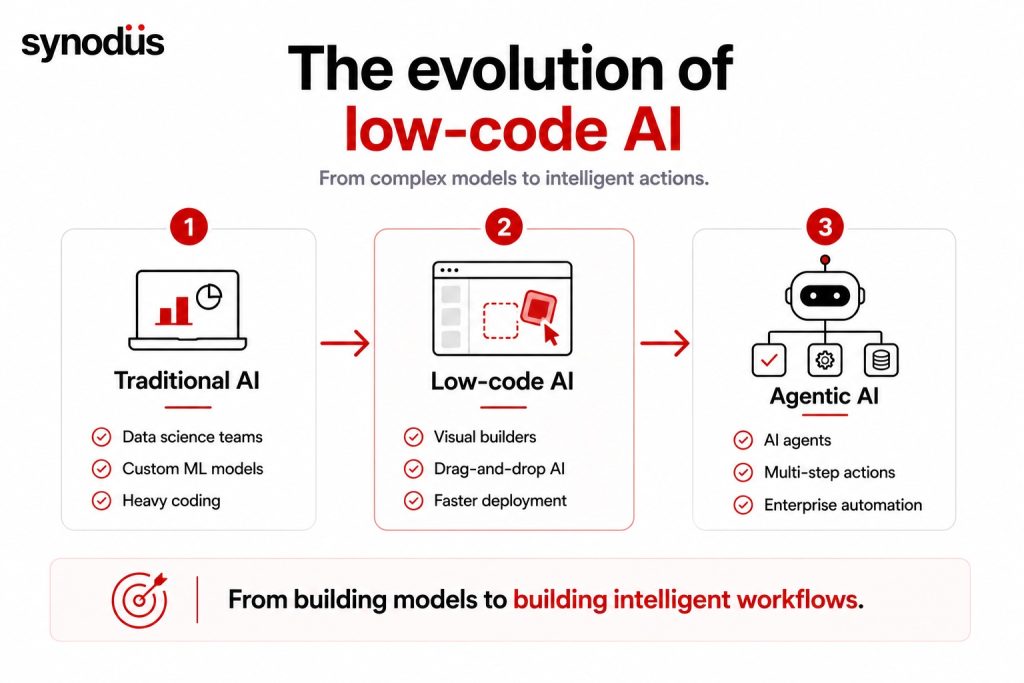
Low-code AI is the practice of building AI-powered applications with visual, drag-and-drop tools instead of extensive coding. It lets non-specialists and professional developers alike create AI features, from chatbots and agents to predictive models, without deep data-science expertise, which reduces the IT backlog and widens who can build.
What “low-code AI” means has changed. A few years ago it mostly described AutoML and computer-vision tools for data scientists. In 2026, the center of gravity has shifted to generative AI and agents: platforms that let you assemble large language models, retrieval, memory, and tools on a canvas, then deploy the result as an app or an agent. The distinction that matters now is between a chatbot that answers and an agent that acts. A chatbot looks up an order status, while an agent verifies the order, checks inventory, starts a return, updates the shipping address, and confirms the new delivery, all from one instruction.
Low-code AI platforms by category
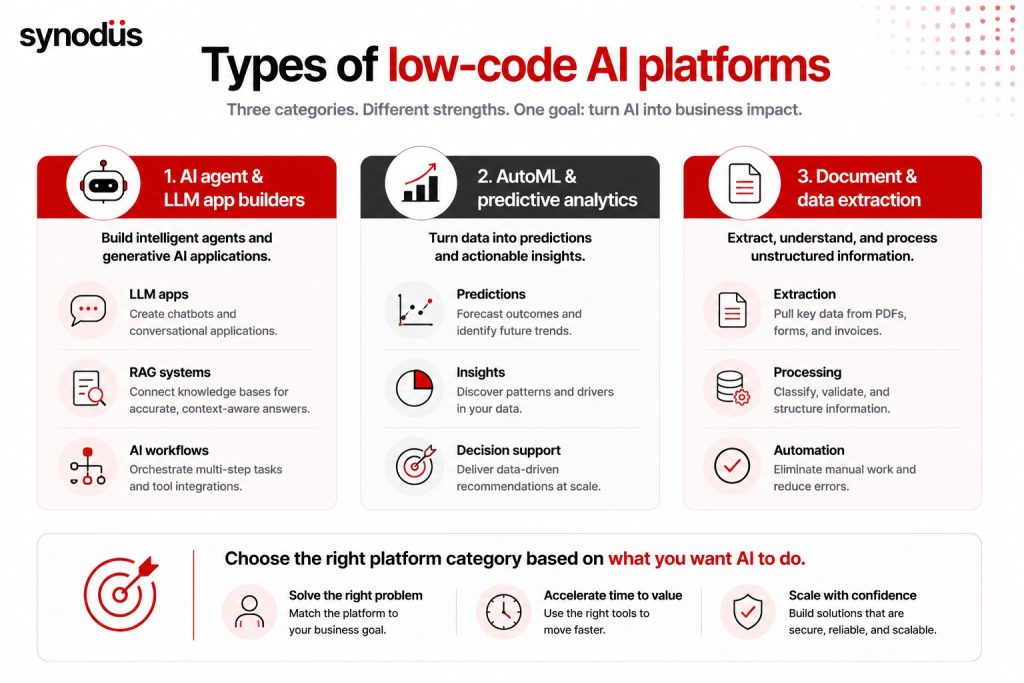
Because “AI platform” now spans several jobs, we have grouped the options into three categories: AI agent and app builders, AutoML and predictive analytics, and document and data extraction. Pricing is approximate and changes often, so confirm with each vendor.
AI agent and LLM app builders
This is the fastest-growing category, where you build agents and generative AI apps visually.
Microsoft Copilot Studio
Microsoft Copilot Studio is the enterprise standard for teams in the Microsoft ecosystem, part of the Microsoft Power Platform. Its 2026 Agent Builder lets you describe an agent in natural language and have the system generate prompts, select tools, and configure steps, with human-in-the-loop actions that pause a flow to collect input from a reviewer. It inherits Microsoft identity, access control, and governance, which makes it strong for internal, compliant use cases.
- Best for: organizations already on Microsoft 365 and Power Platform
- Pricing: usage-based, with some base Microsoft licensing
Google Vertex AI Agent Builder
Google Vertex AI Agent Builder is Google Cloud’s production-grade agent stack, with managed runtime, evaluation, and deep integration into GCP services like BigQuery. It suits enterprises standardizing on Google Cloud that need scale and operational discipline rather than just a quick demo.
- Best for: enterprises on Google Cloud needing production-grade agents
- Pricing: usage-based (compute, storage, API)
Dify
Dify is a leading open-source platform for building LLM apps and agents, bundling a visual builder, RAG knowledge base, and app scaffolding. You can self-host it with Docker for full data control, which makes it popular for rapid prototyping and teams that want flexibility. See more in our roundup of open-source low-code platforms.
- Best for: teams wanting open-source flexibility and self-hosting
- Pricing: free self-hosted, paid managed cloud
Langflow
Langflow is an open-source visual builder for LangChain- and LangGraph-style apps, ideal for RAG and multi-agent workflows when your team is comfortable dropping into Python for deeper control.
- Best for: teams that want visual building with code-level depth
- Pricing: free and open-source, managed cloud available
Flowise
Flowise is an open-source, drag-and-drop builder for LLM apps and agents, and the quickest of the group for getting a working chatbot or RAG demo running.
- Best for: fast prototyping of chatbots and retrieval apps
- Pricing: free and open-source, paid cloud tier
n8n
n8n is a workflow-automation platform with 400+ integrations where AI is one step inside a deterministic pipeline, which is the right fit when your “agent” really needs to plug into real business systems like CRMs and databases.
- Best for: AI-powered automation across many business systems
- Pricing: from around $20 per month, open-source self-hosting available
AutoML and predictive analytics
When the goal is prediction and analytics rather than a conversational agent, these platforms lead.
DataRobot
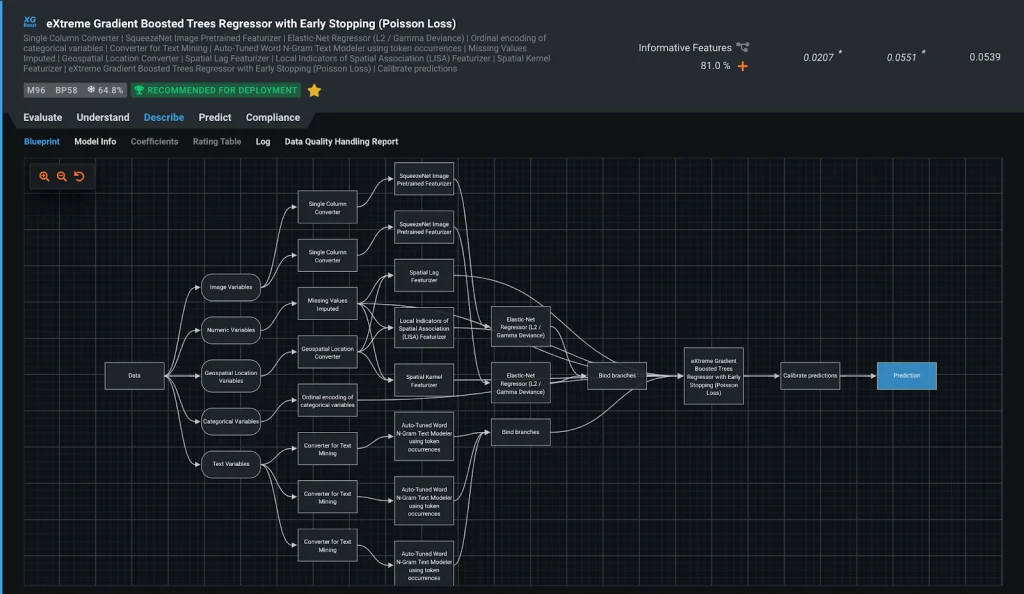
DataRobot is a cloud platform for automating data preparation, model building, and deployment, with dedicated models for banking, retail, healthcare, and the public sector. Its emphasis on explainable AI helps build trust in the insights and decisions it generates.
- Best for: enterprise predictive analytics with explainability
- Pricing: enterprise, contact vendor
GeneXus
GeneXus is a low-code enterprise platform that uses AI to automate application development and maintenance across systems and devices, combining generative AI and code generators to speed up building.
- Best for: enterprise app development with AI-assisted generation
- Pricing: approximate tiers, contact vendor
Pega
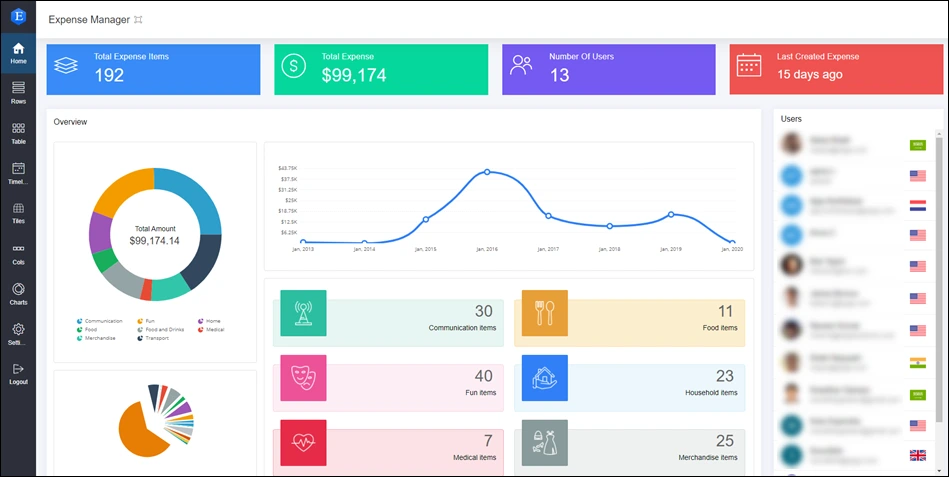
Pega brings AI-powered decisioning, predictive analytics, and event processing to enterprise automation, and is a strong fit for CRM, robotic process automation, and case management at scale. Learn more in our guide to low-code CRM.
- Best for: large-scale decisioning, CRM, and RPA
- Pricing: enterprise, case-based
Document and data extraction
Nanonets uses machine learning to automate extracting structured and semi-structured data from documents, forms, and images, learning and improving over time. It is a strong fit if your team spends heavily on manual data entry from paperwork.
- Best for: automating document and form data extraction
- Pricing: usage-based, free trial available
Quick comparison
| Platform | Category | Best for | Deployment |
|---|---|---|---|
| Microsoft Copilot Studio | Agent builder | Microsoft-ecosystem agents | Cloud |
| Google Vertex AI Agent Builder | Agent builder | Production agents on GCP | Cloud |
| Dify | Agent builder | Open-source flexibility | Self-host or cloud |
| Langflow | Agent builder | Visual plus Python depth | Self-host or cloud |
| Flowise | Agent builder | Fast prototyping | Self-host or cloud |
| n8n | Automation plus AI | System-connected automation | Self-host or cloud |
| DataRobot | AutoML | Predictive analytics | Cloud |
| GeneXus | AutoML | AI-assisted app generation | Cloud, on-prem, hybrid |
| Pega | Predictive | Decisioning, CRM, RPA | Cloud, on-prem |
| Nanonets | Document AI | Data extraction | Cloud |
How to choose a low-code AI platform
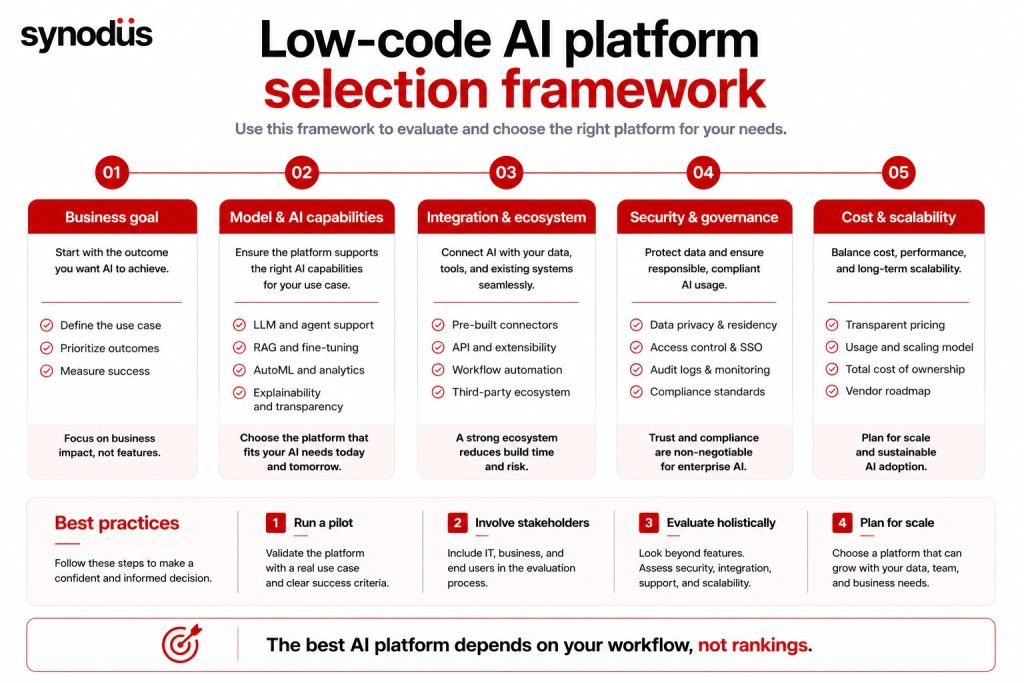
The best platform depends on your goal, not a single ranking. Weigh these factors:
- The job to be done: an agent that acts, a generative app, a predictive model, or document extraction. Match the category first.
- Model support: the LLM behind an agent affects cost, performance, security, and data residency, so favor platforms that let you choose your model.
- Integrations: an agent that cannot reach your CRM, ERP, or ticketing system is a demo, not a product. Check the connectors you actually need.
- Deployment and governance: for regulated industries, deployment model is often the deciding factor. Cloud-only tools are convenient but move sensitive data off your infrastructure, while self-hosted options keep it inside your perimeter. Look for role-based access, audit logs, and human-in-the-loop controls.
- Cost predictability: AI costs scale with tokens and usage, so set per-run budgets and caps, and attribute cost by workflow to catch outliers early. For more, see our guide to low-code challenges.
The pilot-to-production gap
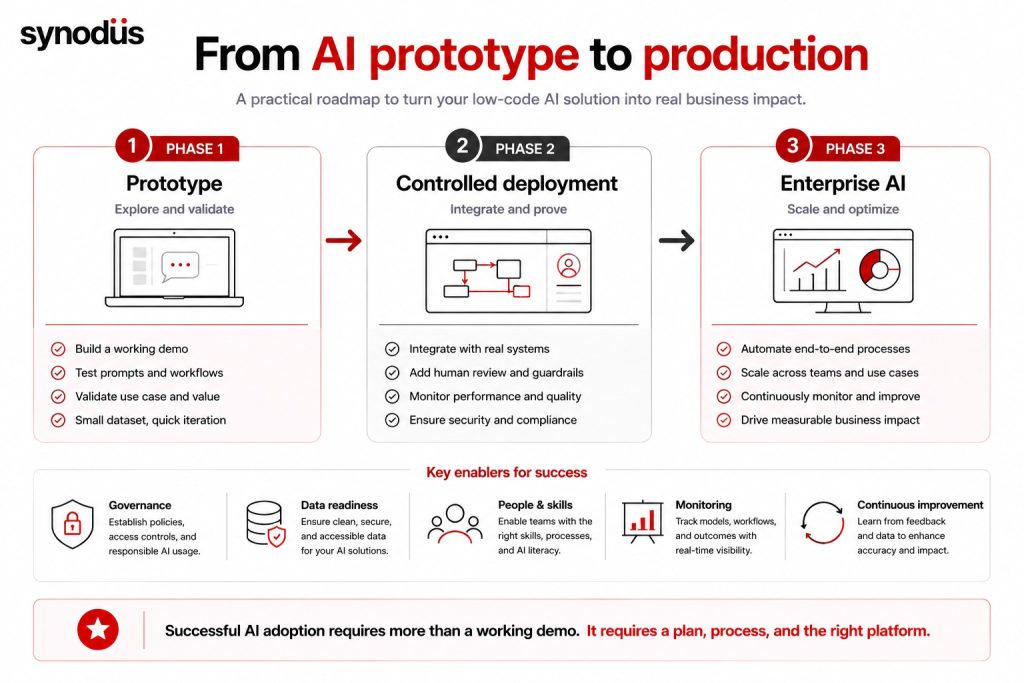
A word of caution: building an AI agent in a visual builder is the easy part, getting it safely into production is not. Many teams find that a slick demo stalls when it meets real integrations, compliance, error handling, and governance. The platforms that succeed pair low-code speed with guardrails and clean data, and the smart approach is to start with bounded, high-value workflows, keep a human in the loop for consequential actions, and expand autonomy as confidence grows.
Frequently asked questions
It is a tool for building AI-powered applications, such as agents, chatbots, or predictive models, using visual drag-and-drop instead of heavy coding. In 2026, most focus on generative AI and agents, letting you combine language models, data, and tools on a canvas and deploy the result.
A chatbot answers questions by looking up information, while an AI agent reasons, plans, and takes multi-step actions across systems. An agent might verify an order, start a return, update an address, and confirm delivery from a single request, rather than just replying.
For Microsoft environments, Copilot Studio is a natural fit, and for Google Cloud, Vertex AI Agent Builder. Open-source options like Dify and Langflow suit teams needing self-hosting and data control, while DataRobot and Pega lead in predictive analytics and decisioning.
They can be, and self-hosting is a key reason regulated industries choose them, since data stays inside your security perimeter. You are responsible for securing the deployment, so governance, access control, and audit trails still matter.
Wrapping up
Low-code AI has grown from AutoML tools into a broad field where the biggest shift is agents that act, not just models that predict. The right platform depends on your job, your ecosystem, and your deployment and governance needs, so match the category first, then compare on model support, integrations, and cost.
If you would rather have experts build it for you, Synodus is a Microsoft Power Platform specialist that offers a low-code AI development service, building AI agents and automation on Copilot Studio and Power Platform, with the governance regulated industries demand. Book a free consultation to find the right fit for your business.