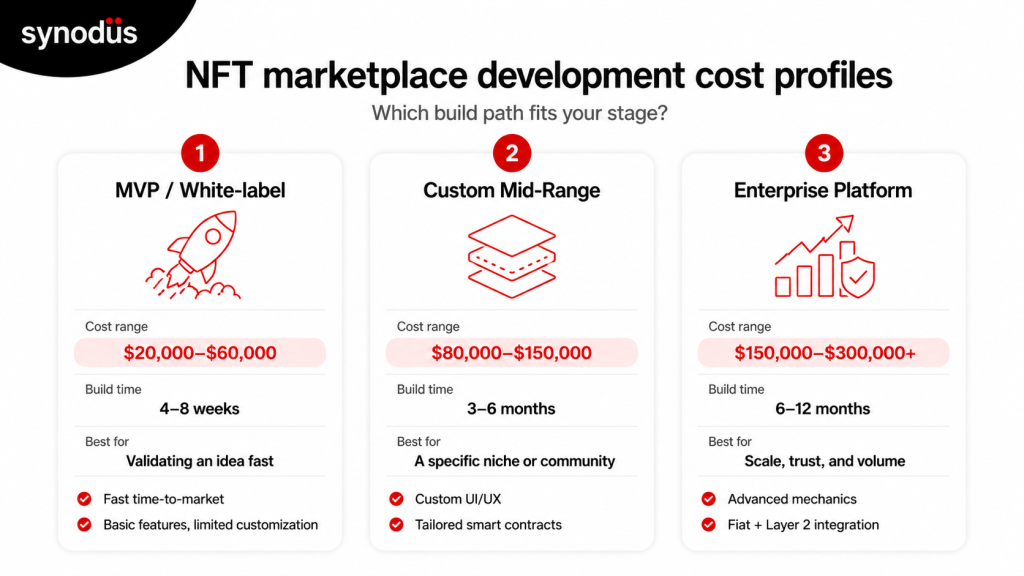
What actually determines where your project lands is the scope of what you’re building and why. Before looking at any cost figures, identify which of these three situations matches yours:
- You’re validating an idea and want to launch an MVP before committing a larger budget – jump to section 1
- You’re building for a specific niche or community, and a generic platform won’t serve them well – jump to section 2
- You need a full-scale platform built to compete on UX, volume, and trust – jump to section 3
Each situation here has a different cost structure, technical requirements, and hidden costs post-launch. The table below provides a quick overview before we dive into the details.
| Project scope | Cost range | Key characteristics |
|---|---|---|
| MVP / White-label Solution | $20,000 – $60,000 | Fast time-to-market, basic features, limited customization. |
| Custom mid-range marketplace | $80,000 – $150,000 | Custom UI/UX, multi-chain support, high security, tailored for specific niches (e.g., Gaming, RWAs). |
| Enterprise Platform | $185,000 – $340,000+ | Advanced mechanics (bidding, fractionalized NFTs), fiat on-ramps, Layer 2 integration, custom smart contracts. |
Note: the jump from MVP to mid-range reflects a shift in build model – white-label/SDK vs. fully custom – not a missing price tier.
Profile 1: “I need to test this idea before committing a large budget”
If you’re still validating your business idea, your goal is to launch quickly, attract early users, and gather real market feedback without overinvesting.
Most MVP NFT marketplaces take 4–8 weeks to build, with an upfront development budget ranging from $20,000 to $60,000.
Cost breakdown
Here’s where your initial investment typically goes.
| Component | Estimated cost |
|---|---|
| Smart contracts (standard ERC-721/1155) | $3,000 – $6,000 |
| Core features (wallet, minting, listing, search) | $12,000 – $40,000 |
| UI/UX design | $3,000 – $8,000 |
| QA & deployment | $2,000 – $6,000 |
| Security audit | Not required at MVP – but budget $5,000 if real funds are involved |
| Total upfront investment | $20,000 – $60,000 |
Features like auctions, multiple wallet integrations, or a custom admin dashboard push costs toward the higher end. Fixed-price listings, a single wallet, and minimal customization keep the project closer to $20,000.
Total cost of ownership (3 years)
| Phase | Minimum investment | Maximum investment |
|---|---|---|
| Upfront development | $20,000 | $60,000 |
| 3-Year operational cost | $18,000 | $44,000 |
| Total 3-year investment | $38,000 | $104,000 |
At this stage, infrastructure costs stay low because traffic is still relatively small – you scale it gradually as your user base grows.
How to stay within the MVP budget
If cost efficiency is your priority, there are two practical development approaches.
- A white-label solution is the fastest and cheapest way to launch, but customization is limited and you won’t own the source code.
- A hybrid approach uses Web3 SDKs like Thirdweb or OpenSea SDK to build a custom frontend on proven blockchain infrastructure, offering more flexibility without the cost of a fully custom build.
For most MVPs, the hybrid approach provides the best balance between speed, cost, and scalability.
Your blockchain choice also affects operating costs. Networks like Polygon, Arbitrum, Base, and BNB Chain offer significantly lower transaction fees than Ethereum mainnet, making them a more practical choice while you’re validating your product.
Not sure which chain fits your project?
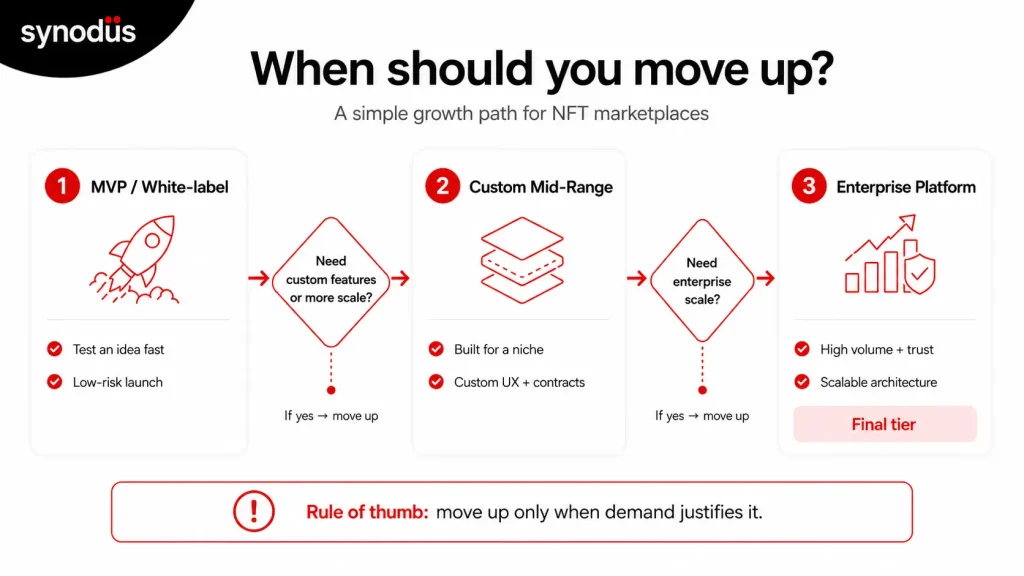
When is it time to move beyond an MVP?
You’ve outgrown this phase when:
- Your early users are asking for features your white-label or SDK can’t support
- The shared white-label database slows down when you cross 10,000+ active listings
- You’re ready to own the codebase and scale
Profile 2: “I’m building for a specific niche or community”
Once you’ve validated your idea, the next challenge is building a marketplace that truly fits your users.
Most custom NFT marketplaces in this stage take 3–6 months to build and require an upfront investment of $80,000 – $150,000. You own 100% of the source code – you’re paying for tailor-made smart contracts and a user experience built around one industry, not a generic template.
Cost breakdown
| Component | Estimated cost |
|---|---|
| Custom Smart Contracts | $8,000–$20,000 |
| Core marketplace features | $30,000–$60,000 |
| Custom UI/UX | $10,000–$20,000 |
| QA & deployment | $5,000–$10,000 |
| Security audit | $10,000–$20,000 |
| Total upfront investment | $80,000 – $150,000 |
Your project trends toward the $150,000 end when it includes physical asset evaluation (RWA), real-time game inventory sync, multi-wallet support beyond MetaMask, a KYC/AML compliance layer, or a comprehensive smart contract audit.
You can stay closer to $80,000 by keeping scope focused: a single asset category, crypto-native users only (no fiat on-ramp), and fixed-price listings without auction mechanics.
Why the same budget range can mean very different builds: even within this profile, the type of asset you’re trading changes the scope significantly.
| Niche | Typical cost | Why |
|---|---|---|
| Digital art & collectibles | $80,000 – $100,000 | Core marketplace functionality, creator royalties, curated collections – the most contained scope |
| Web3 gaming | $100,000 – $120,000 | Requires real-time sync with game inventory and game-specific NFT logic, which adds development and infrastructure time |
| Real-world assets (RWA) | $130,000 – $150,000+ | Goes beyond blockchain development – KYC/AML compliance, asset verification, and fractional ownership add legal and technical complexity |
Total cost of ownership
| Phase | Minimum investment | Maximum investment |
|---|---|---|
| Upfront Development | $80,000 | $150,000 |
| 3-Year Operational Cost | $65,000 | $126,000 |
| Total 3-year investment | $145,000 | $276,000 |
Unlike an MVP, this stage usually comes with a growing user base and higher transaction volume, so regular maintenance and security investment become a permanent line item, not a contingency.
How to stay within the mid-range budget
A custom build is the right call here – full ownership of codebase, smart contracts, and IP. To control cost, start with one asset category, prioritize crypto-native users, and postpone advanced trading mechanics until demand justifies them.
On blockchain choice: Polygon and Arbitrum suit art and collectibles, Immutable X is built for gaming, and Ethereum mainnet is typically reserved for projects where trust and liquidity outweigh higher deployment costs.
When to move to profile 3
A custom marketplace can support significant growth, but eventually you’ll need a more scalable architecture. If transaction volume is increasing rapidly, you’re expanding to multiple chains, or your roadmap includes features like fractionalized NFTs or on-chain governance, it’s usually time to move to an enterprise-grade platform.
Profile 3: “I need a full-scale platform built to compete on UX and volume”
At this stage, you’re building a marketplace that needs to handle high transaction volumes, deliver a seamless user experience, and earn user trust at scale.
Most enterprise NFT marketplaces take 6–12 months to develop and require an upfront investment of $185,000–$340,000+. A significant share of the budget goes toward scalability, security, and infrastructure built for long-term growth – not just core marketplace functionality.
Cost breakdown
| Component | Estimated cost |
|---|---|
| Advanced smart contracts | $30,000–$60,000 |
| Core + advanced marketplace features | $60,000–$100,000 |
| Enterprise-grade UI/UX | $20,000–$35,000 |
| Layer 2 / Multi-chain integration | $30,000–$60,000 |
| Fiat on-ramp integration | $10,000–$20,000 |
| QA & deployment | $15,000–$25,000 |
| Comprehensive security audit | $20,000–$40,000 |
| Total upfront investment | $185,000–$340,000 |
Projects usually move toward $340,000+ when they include multi-chain support, fiat payments, advanced features like fractionalized NFTs or staking, and stronger security requirements. A single-chain launch targeting crypto-native users with standard fixed-price listings and auctions can land closer to $185,000.
Total cost of ownership (3 years)
| Phase | Minimum investment | Maximum investment |
|---|---|---|
| Upfront Development | $185,000 | $340,000 |
| 3-Year Operational Cost | $186,000 | $408,000 |
| Total 3-year investment | $371,000 | $700,000+ |
As a general rule, expect your three-year total cost of ownership to be roughly 2–2.5× your initial development budget.
How to build for scale
A fully custom architecture is standard here. Most companies either work with a large specialized Web3 development team or adopt a hybrid delivery model, combining senior technical leadership close to the business with an experienced engineering team in a cost-efficient region.
Your blockchain strategy also becomes an architectural decision rather than simply a cost decision. Ethereum combined with Layer 2 networks such as Arbitrum, Optimism, or Base helps reduce transaction costs while maintaining strong security. If you need multi-chain support, expect higher development costs and a more complex architecture.
When you’re ready
At this stage, the difference between a successful launch and a costly rebuild usually comes down to how clearly the scope is defined before development starts. Talk to our team, we’ll scope your project and give you an itemized estimate within 48 hours.
How to choose the right development partner
Now that you have a realistic budget in mind, the next question is how to make sure you’re spending it wisely.
Regional pricing for NFT marketplace development
| Region | Hourly rate | Best fit |
|---|---|---|
| USA / Western Europe | $70–$150/hr | Profile 3 – Enterprise projects with strict compliance, close collaboration, or timezone requirements |
| Eastern Europe | $50–$80/hr | Profile 2 & 3 – Complex custom marketplaces requiring strong Web3 expertise |
| Southeast Asia | $25–$50/hr | Profile 1&2 – MVPs and custom marketplaces looking for the best cost-to-value ratio |
The same project can cost very differently depending on the region. For example, a marketplace that costs around $80,000–$150,000 in Eastern Europe could easily exceed $150,000 in the US, while an experienced team in Southeast Asia may deliver a similar scope for $50,000–$100,000.
That said, the biggest factor is the experience. A development company with multiple NFT marketplace launches is usually a safer choice than a general software agency taking on its first Web3 project.
Question to ask before signing
1. What happens if scope changes mid-project – how are additional costs calculated?
- Good answer: fixed change request process with clear pricing per additional feature.
- Bad answer: “we’ll figure it out” or no change order process mentioned.
2. Is the audit included, and which firm will conduct it?
- Good answer: names a specific firm (CertiK, Hacken, Trail of Bits) with estimated cost line-itemed separately
- Bad answer: “audit isn’t necessary at this stage” with no explanation – walk away.
3. What’s your QA process and how many hours are allocated?
- Good answer: QA is 15–20% of total dev hours with specific test cases for smart contract functions
- Bad answer: QA is bundled into development with no separate allocation.
4. Who owns the code and smart contracts at the end of the project?
- Good answer: full IP transfer to client upon final payment, explicitly stated in contract.
- Bad answer: vague language about “licensing” or no mention of IP ownership at all.
Vague answers to any of these are the clearest early signal of cost overruns later – not the headline number on the quote. The audit and QA questions matter most: according to the IBM Systems Sciences Institute, fixing a software defect after launch costs 15 to 100 times higher more than catching it during development and QA, and a single contract exploit can drain your entire platform. That’s why these two are never the place to economize, regardless of which vendor you choose.
Once you have your budget range, our guide to the top NFT marketplace development companies can help you shortlist the right partner for your marketplace type.
Where you can safely cut cost
- Starting with fixed-price listings only – Auction and bidding mechanics add 140–200 hours to your build. Launch without them, add later when you have users who actually want it.
- Using Web3 SDKs for standard functions – Don’t pay to rebuild what Thirdweb or OpenSea SDK already does well. Reserve custom development for the parts that differentiate your platform.
- Delaying fiat on-ramp integration – Stripe/MoonPay integration adds $3,000–$8,000. If your early users are crypto-native, skip it at launch.
- Choosing Polygon or BNB Chain over Ethereum mainnet – Same functionality, significantly lower gas complexity, lower audit cost, faster development cycle.
The smartest cost-cutting move: scope tightly, launch fast, and repeat. A focused $60,000 build that launches in 8 weeks and learns from real users will outperform a bloated $150,000 build that takes 9 months and guesses at what users want.
The bottom line
Building a successful NFT marketplace within a $20,000 to $300,000 + budget is entirely achievable if you choose the right development approach for your stage and plan for post-launch operating costs from day one. Don’t let hidden operational fees surprise your business 12 months down the road.