How we evaluated NFT game development companies
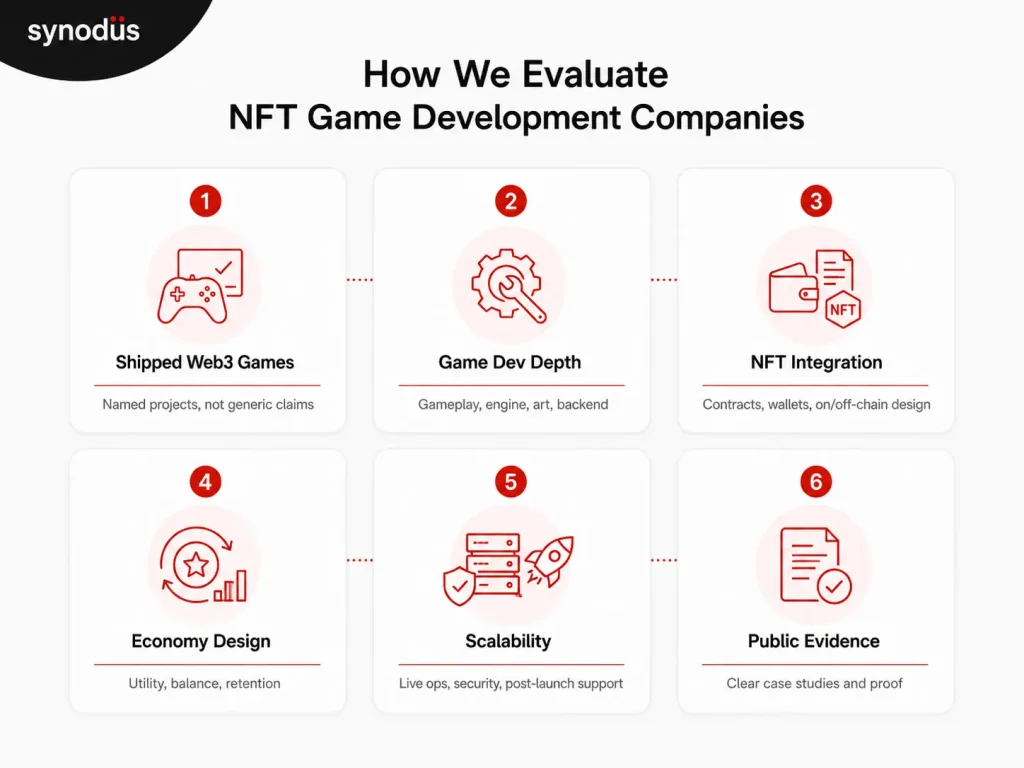
Shipped NFT or Web3 game experience
The strongest signal is a named NFT or Web3 gaming project where the vendor’s involvement can be identified. A public case showing responsibility for gameplay, backend systems, NFT integration, token mechanics, or live infrastructure carries more weight than generic claims about the number of NFT games a company has developed.
This distinction matters because blockchain experience alone does not translate directly into game development experience. Games introduce additional challenges around progression, balancing, multiplayer performance, content production, and player behavior.
Game development depth
Beyond smart contracts, teams need to handle the game itself. Relevant capabilities include Unity or Unreal Engine development, gameplay programming, multiplayer systems, game design, 2D/3D production, animation, backend development, QA, and live operations.
The right balance depends on the project. A blockchain-heavy GameFi product may need deeper smart contract expertise, while a gameplay-first NFT title may benefit more from a traditional game studio that has successfully added Web3 functionality.
Blockchain and NFT integration
NFT ownership should support the game rather than exist as an isolated marketplace feature. Experience with NFT contracts, wallets, marketplaces, token mechanics, blockchain networks, asset interoperability, staking, and on-chain/off-chain architecture all matter.
The strongest teams also understand what should not go on-chain. Real-time gameplay, rendering, voice, matchmaking, and other latency-sensitive systems often work better off-chain while blockchain handles ownership and settlement.
Economy and retention thinking
NFT economies can fail even when the underlying technology works. Excessive token emissions, poorly controlled asset supply, weak utility, or reward structures built around extraction rather than gameplay can undermine retention.
A development partner should be able to discuss gameplay loops, progression, asset sinks and sources, token utility, scarcity, wallet friction, and long-term player incentives, not just minting and token standards.
Scalability and post-launch capability
Architecture decisions made during development can become expensive constraints once real players arrive. Backend scalability, multiplayer infrastructure, contract upgradeability, marketplace performance, security, analytics, and live-content operations all matter after launch.
Teams that demonstrate the ability to support production systems and ongoing iteration, rather than stopping at deployment, are worth prioritizing.
Quality of public evidence
Public evidence matters when comparing vendors. Named projects with clear scopes carry more weight than anonymous portfolio claims or broad statements such as “100+ NFT games developed.”
A company without detailed public case studies may still have strong capability. Buyers should request stronger proof during the vendor evaluation process.
NFT game development companies at a glance
| Company | Strongest public NFT/Web3 game evidence | Main strength | Best fit |
|---|---|---|---|
| Synodus | Cyberium | Blockchain architecture + product engineering | Teams needing NFT systems, backend, marketplace, and game integration |
| Kevuru Games | Undead Blocks, MechaChain | Full-cycle game production | Gameplay-heavy Web3 games |
| Juego Studios | Operon Origins, Game X Change, Lazy Horse | Game development + NFT integration | Mobile and full-cycle NFT games |
| Moonmana | NFT farming game, Golden Star League | Unity co-development + Web3 | P2E and NFT game co-development |
| Whimsy Games | Zeedz | Gameplay systems + art production | Mobile NFT games |
| Starloop Studios | Gamma-4, Binamon | Full-cycle game development | Strategy, card, and PvP NFT games |
| Zatun | Reventon | Unreal Engine + Web3 game design | High-fidelity gameplay-first Web3 games |
| Fora Soft | ChillChat | Real-time multiplayer architecture | Social and multiplayer Web3 products |
| SoluLab | AnRKey X | Blockchain and GameFi systems | DeFi-heavy NFT gaming products |
| Antier Solutions | Web3/NFT gaming practice | Blockchain and token economy | Blockchain-first gaming products |
| Cubix | NFT gaming development practice | Full-service game production | Outsourced NFT game development |
| Quytech | Blockchain Ludo, Versailles Heroes | Mobile + blockchain integration | Smaller and mobile NFT gaming products |
Below is a list of NFT game development companies that have been involved in building blockchain-based games in different capacities.
Synodus
Synodus brings together blockchain engineering, backend development, NFT infrastructure, and product development, making it particularly relevant for projects where the Web3 layer is deeply connected to the game rather than added as a standalone feature.
One of its public GameFi projects is Cyberium, a 3D pool game designed around free-to-play and play-to-earn mechanics. Synodus’ scope included the game itself, a custom gaming NFT marketplace, interoperability between blockchain NFTs, tokens, and in-game assets, and smart contract systems for token deposits and withdrawals. The team also built infrastructure to handle high-volume data submissions during Gacha events and smart contract verification for Gacha boxes.
The Cyberium case is most relevant for projects where blockchain touches several layers of the product at once. Marketplace logic, token flows, in-game assets, backend events, and smart contracts all need to stay synchronized, which is a more complex integration problem than simply adding NFT minting to an existing game.
The trade-off is that Synodus is primarily a software and blockchain engineering company rather than a pure AAA art and game-production studio. Projects where cinematic production, large-scale 3D asset creation, or high-end game art dominates the scope may benefit from combining its engineering capabilities with a specialized art studio.
Kevuru Games
Kevuru Games comes from a traditional game development and art production background, which gives it a different starting point from blockchain-first vendors. Its Web3 portfolio shows blockchain mechanics being integrated into actual gameplay rather than treated as the product by themselves.
A notable example is Undead Blocks, a play-to-earn zombie survival FPS. Kevuru specialists contributed to areas including technical art and sound, while development decisions such as choosing Unity were influenced by the need to support lower-end hardware in markets where blockchain gaming had significant adoption.
The production mindset behind those choices is the more useful signal. Engine selection, hardware optimization, audio, art, and gameplay all affect whether a Web3 title can retain users after the initial novelty of token rewards fades, and these are areas a traditional game studio is more likely to treat as first-class product concerns.
Founders evaluating Kevuru should clarify which parts of the Web3 stack the studio will own internally and which require coordination with external blockchain specialists, especially for complex DeFi mechanics or custom protocol work.
Juego Studios
Juego Studios has worked on NFT games that use digital assets in noticeably different ways rather than repeating the same play-to-earn structure. Game X Change explores interoperable currencies and NFT assets across games, Operon Origins uses collectible cards, scarcity, trading, and auctions, while Lazy Horse combines racing with breeding, staking, and marketplace mechanics.
The range of NFT economy patterns behind these projects stands out. Interoperability requires assets to retain recognizable ownership and utility across environments, card-based economies depend more heavily on rarity and collection design, while breeding systems introduce supply-expansion mechanics that need to be controlled carefully to avoid asset inflation.
That variety suggests the team has dealt with NFTs as part of different gameplay and economy loops rather than treating them only as tradable collectibles. Buyers should still examine the exact scope of the proposed team, especially if the project depends on complex tokenomics or protocol-level blockchain infrastructure beyond the game itself.
Moonmana
Moonmana positions its NFT gaming work around game co-development rather than blockchain development alone. Its portfolio includes Unity-based NFT projects where the studio works on gameplay alongside blockchain-powered ownership and economy systems.
One example is a farming simulation where players develop NFT creatures, participate in multiplayer battle loops, and interact with assets powered by Ethereum and Polygon. Another is Golden Star League, a free-to-play football manager game using Polygon, NFT player cards, in-game tokens, and a user-driven NFT marketplace.
The portfolio shows that Moonmana tends to work across the game stack rather than only the blockchain layer. That matters in co-development engagements, where NFT mechanics often need to be adjusted alongside gameplay, QA, multiplayer systems, and content rather than delivered as a separate integration.
Teams seeking one vendor to handle strategy, product definition, blockchain architecture, and full business-side delivery should confirm the scope Moonmana can own beyond game production before engagement.
Whimsy Games
Whimsy Games provides a useful example of a studio joining an NFT product where part of the technical foundation already existed. On Zeedz, the team worked on combat, abilities, progression, balancing, animations, and other gameplay systems while integrating them with an existing no-code framework under a relatively tight launch schedule.
The important signal is not simply that Zeedz uses NFTs. Whimsy had to build player-facing game systems around existing technical constraints, which is a common situation for Web3 founders who already have smart contracts, token infrastructure, or an early product but still need to turn it into a game people actually want to play.
That experience also highlights the relationship between progression and NFT value. If combat rewards, upgrades, rarity, or progression are poorly balanced, the asset economy can distort the gameplay loop very quickly. A studio with hands-on responsibility for those systems adds more value than a team focused only on minting and wallet integration.
Starloop Studios
Starloop Studios has public Web3 work where blockchain mechanics were considered during game design and economy design, rather than added after the main gameplay had already been defined. For Gamma-4, the scope extended across game design, characters, aesthetics, core systems, prototype development, and tokenomics, while work on Binamon included programming, 3D production, UI/UX, and NFT integration.
Earlier involvement matters because NFT mechanics can change core design decisions. A card game’s rarity model affects progression and collection behavior, while PvP assets need careful balancing to prevent ownership advantages from turning competitive gameplay into a pay-to-win system.
The portfolio suggests a more integrated approach where game systems and tokenized ownership are designed together. This reduces the common handoff problem where one studio creates the game and a separate blockchain team later attempts to attach an economy that does not fit the original gameplay loop.
Zatun
Zatun offers a relevant case for projects where Web3 mechanics sit on top of a more conventional high-fidelity game experience. Its work on Reventon, an Unreal Engine 5 racing and vehicular-combat concept, combined racing, zombie survival, multiple currencies, NFT progression, staking, crafting, lending, and reward mechanics.
The more interesting part of the case is the attempt to balance free-to-play access with NFT-based progression. That creates a difficult economy-design problem: blockchain assets need enough utility to matter without giving paying or early NFT holders such a large advantage that the core competitive experience becomes pay-to-win.
Reventon also illustrates why Web3 architecture should follow gameplay rather than dictate it. Racing and combat still require responsive off-chain game systems, while ownership, rewards, asset progression, and economic interactions can use blockchain where persistence and transferability actually add value. Zatun’s experience is particularly relevant to teams starting with a real game concept first and adding Web3 only where it supports the player loop.
Fora Soft
Fora Soft offers one of the more technically informative Web3 gaming cases in this comparison. Its work on ChillChat illustrates not only NFT integration but also decisions about what should remain off-chain in a real-time multiplayer product.
ChillChat started as a multiplayer pixel-art social world with chat and proximity voice before adding NFT ownership. Fora Soft kept rendering, chat, voice, and other latency-sensitive operations off-chain while using Polygon for asset ownership, ERC-721 and ERC-1155 NFTs, wallet integration, IPFS-backed metadata, and an in-game marketplace. The team also migrated the client from Phaser to Godot as performance requirements increased.
The case highlights an important architectural principle: not everything in a Web3 game benefits from decentralization. Keeping blockchain out of the real-time gameplay path avoids forcing players to wait for block confirmation before actions that should feel instantaneous.
Fora Soft is particularly relevant for multiplayer, social, voice-enabled, or technically demanding Web3 experiences. Projects with major content pipelines may need complementary production resources.
Solulab
SoluLab‘s NFT gaming experience leans more heavily toward blockchain, DeFi, and GameFi infrastructure than traditional game production.
Its public work includes AnRKey X, an ecosystem combining DeFi, NFTs, competitive gaming, and social gaming. SoluLab handled backend development and worked on the gDEX protocol used to connect gaming activity, NFTs, and decentralized value exchange.
The systems complexity behind that scope is the relevant takeaway. Products combining gameplay, NFT assets, tokenized rewards, exchange-like infrastructure, and social interaction require stronger economic and backend architecture than a conventional collectible marketplace, which is where SoluLab’s profile is most differentiated.
Teams developing GameFi products with substantial DeFi mechanics should examine SoluLab closely, while projects whose primary requirement is high-end game production should compare it carefully with dedicated studios such as Kevuru, Juego, or Zatun.
Antier Solutions
Antier Solutions maintains an extensive current practice around Web3, blockchain, P2E, and NFT gaming. Its service scope covers smart contract development, NFT integration, tokenized game economies, Web3 wallets, multiple blockchain networks, and decentralized gaming architecture.
The breadth of this offering makes Antier relevant for blockchain-first products where the game is closely connected to token economies, NFT ownership, cross-chain assets, DAO functionality, or other Web3 infrastructure. Recent content shows continued work around gamified tokenomics and Web3 gaming rather than an NFT gaming service page left over from the previous market cycle.
Antier’s publicly accessible material provides less detail about specific shipped NFT game titles than several game studios in this comparison. Buyers should ask for named projects, the exact scope Antier owned, live-user performance, and post-launch work before comparing its gaming track record directly with vendors that publish detailed case studies.
Cubix
Cubix combines a broader game-development practice with a dedicated NFT gaming offering. Its current team structure includes game producers, designers, 2D/3D artists, blockchain developers, DevOps engineers, and QA, while its service covers P2E, play-and-own, collectible NFTs, metaverse-connected games, and other NFT game models.
That breadth means Cubix can assemble a single outsourced delivery team across both game and Web3 work. That simplifies ownership when a project needs conventional game production, wallet integration, NFT systems, backend services, and deployment under one vendor rather than several specialists.
The main limitation is evidence transparency. Cubix publicly states significant overall project and blockchain experience, but its current NFT game page provides less detail about named NFT game case studies than companies such as Juego, Whimsy, Starloop, or Zatun. Buyers should validate those claims against relevant projects before making a shortlist.
Quytech
Quytech has worked on comparatively focused blockchain-gaming products, including a blockchain-enabled Ludo game and an NFT marketplace connected to Versailles Heroes. These projects demonstrate practical integration of wallets, crypto payments, digital assets, rarity systems, and marketplace transactions without requiring the scale of a large 3D or massively multiplayer production.
The Ludo case exposes a challenge easy to underestimate in casual NFT games: wallet and transaction friction. Players accustomed to lightweight mobile games are less tolerant of repeated signatures, complicated onboarding, or crypto-specific steps, so blockchain functionality needs to remain secondary to the core game flow.
The Versailles Heroes work represents a different integration pattern, where NFTs support an existing game economy through heroes, weapons, and mystery boxes rather than defining the entire gameplay experience. Quytech is more relevant to teams validating smaller mobile or marketplace-connected concepts than to projects whose main challenge is AAA production or complex real-time multiplayer infrastructure.
How to shortlist an NFT game development company
| If you need | Prioritize |
|---|---|
| Fast NFT game MVP | Product engineering, prototyping speed, and reusable blockchain infrastructure |
| Gameplay-heavy Web3 title | Proven game development before blockchain credentials |
| Complex P2E or GameFi economy | Tokenomics, smart contracts, economy design, and blockchain backend |
| Multiplayer or social Web3 game | Real-time backend, networking, and scalability |
| High-end 3D game | Unreal/Unity experience, 3D pipeline, animation, and optimization |
| NFTs added to an existing game | Integration experience rather than greenfield game development |
| Mobile NFT game | Mobile optimization, wallet UX, gameplay systems, and cross-device QA |
| Long-term live product | Live operations, backend scalability, security, analytics, and maintenance |
Do not shortlist vendors based on headcount alone. A smaller game studio with two highly relevant shipped titles can be a better fit than a large blockchain company whose gaming experience consists mainly of smart contracts or marketplace templates.
Confirm what the vendor actually built on each reference project. Being listed as a development partner can mean anything from full-cycle production to art outsourcing, smart contract work, backend development, or one integration module.
Questions to ask before hiring an NFT game development company
- Which NFT or Web3 games have you shipped, and what exactly did your team build? Ask for named examples where possible. Clarify whether the team handled gameplay, art, backend, blockchain, tokenomics, marketplaces, or only one component.
- How do you decide what goes on-chain and what stays off-chain? A good answer should go beyond “we use blockchain.” Real-time gameplay usually requires a different architecture from ownership, settlement, and asset trading.
- How will you keep token or nft mechanics from damaging retention? Ask how the team approaches reward emissions, asset supply, sinks, progression, speculation, and the balance between earning and playing.
- What happens if traffic grows 10x after launch? The vendor should be able to explain how game servers, backend services, wallet infrastructure, marketplaces, databases, and blockchain integrations scale independently.
- How do you handle smart contract security? Clarify internal testing, contract reviews, external audits, upgrade controls, admin permissions, and incident response.
- What support is available after launch? NFT games often require ongoing balancing, new assets, seasonal content, smart contract changes, infrastructure monitoring, and economy adjustments. Confirm the engagement model covers the period after initial deployment.
Final thoughts
The right NFT game development company is not necessarily the largest blockchain vendor or the studio with the longest game portfolio. Look for relevant shipped work, strong game-development fundamentals, appropriate blockchain depth, and evidence that the team understands what happens after real players enter the economy.
For projects where NFT infrastructure, smart contracts, backend systems, marketplaces, and game integrations need to work as one product, Synodus is one option to evaluate alongside the game-specialist studios above. For a broader view of how NFT marketplace development is scoped and costed, see our NFT marketplace development cost guide.
FAQ
Start with companies that have relevant shipped game experience, then compare their game-development depth, blockchain expertise, economy design, scalability, and post-launch support.
NFT game development typically starts around $50,000 and can exceed $200,000 for complex multiplayer or GameFi products.
A simple NFT game MVP may take 3–6 months, while a more complex multiplayer or content-heavy product can take 6–12+ months. For the marketplace component, see our guide on how to build an NFT marketplace.
A complete team may include game designers, Unity or Unreal developers, backend engineers, blockchain developers, smart contract engineers, 2D/3D artists, QA, DevOps, and product specialists. The exact mix should follow the game’s scope.
Choose a game-first studio when gameplay, art, multiplayer systems, and content production are the hardest parts of the product. A blockchain-focused engineering company can be a better fit when smart contracts, NFT infrastructure, marketplaces, interoperability, token economies, or complex backend systems dominate the scope.