How low-code eases API development and integration
Traditional API development and integration comes with a familiar set of problems that slow an organization down. Security is one of them, and the vulnerabilities that show up usually trace back to how the API was built, not a flaw in the API concept itself.
A lack of standardization is another. Weak governance around API coding tends to produce inconsistent, low-quality code across a team. On top of that, traditional API projects often stretch out over months or years, which drags on an organization’s agility and overall output.
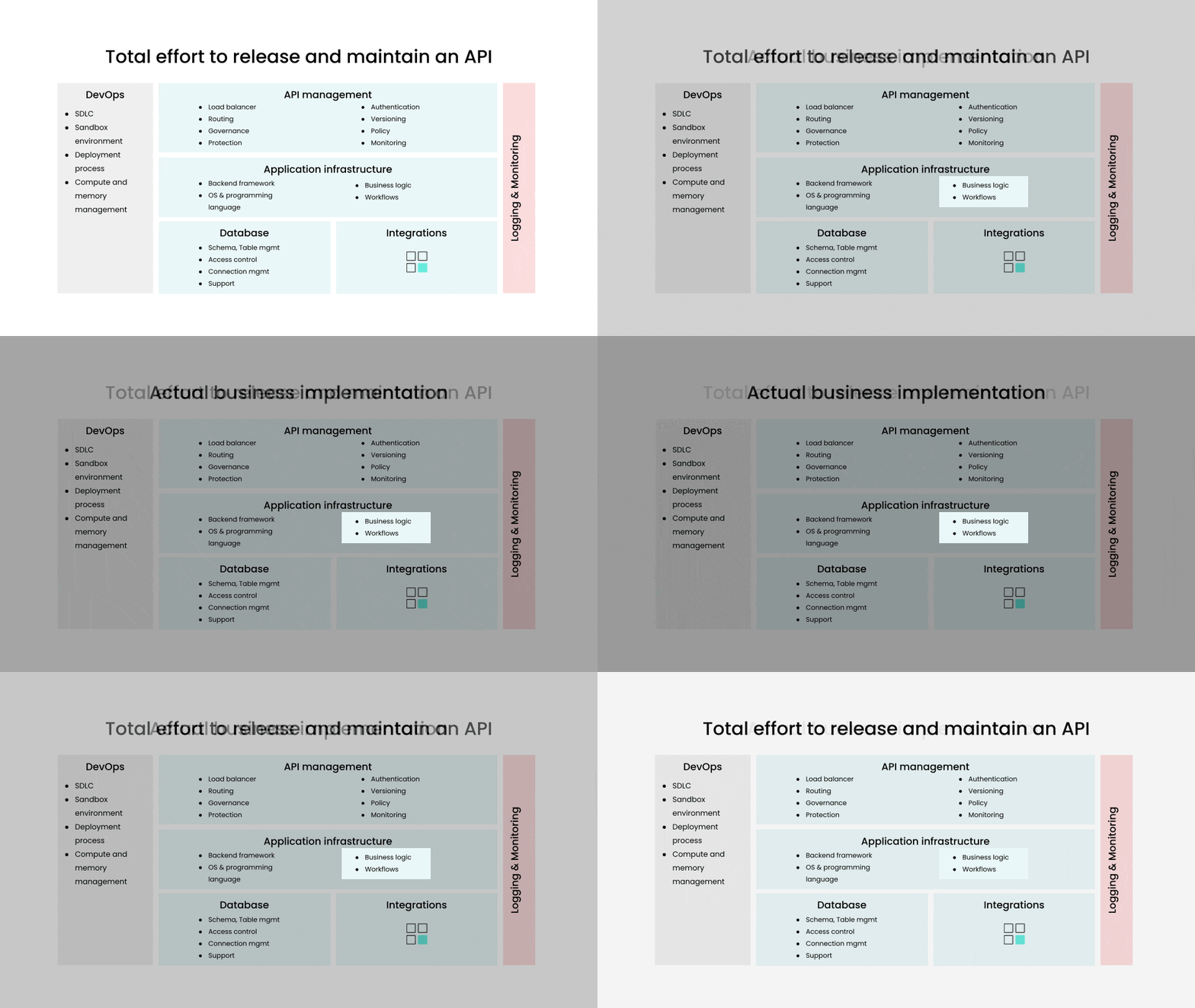
Low-code addresses these problems directly.
- A simpler build process. Point-and-click configuration lets users define API functionality without wading through code, which opens the work up to non-technical staff as well as engineers. One group moves faster on routine work, the other still gets to build custom logic where it matters.
- Faster updates. Teams closest to an issue can make changes themselves, without triggering downtime or waiting on a release cycle. Managing several APIs at once also gets easier, since the platform handles most of the coordination work.
- Fewer security gaps. Built-in security requirements reduce the errors that usually create vulnerabilities in a hand-coded API.
Quick comparison
Use this to narrow your options before reading the full breakdown below. Pricing is approximate and can shift, so confirm current rates directly with each vendor.
| Tool | What it actually does | Best for | Starting price |
|---|---|---|---|
| Fastgen | Build custom APIs, workflows, and a Postgres DB from scratch | Startups and small teams building an MVP backend | Free, then usage-based |
| ProcessMIX | Build APIs with a strong decisioning and BRMS layer | Banks and fintechs automating decision logic | Custom quote |
| Linx | Build and host back-end APIs with 1,000+ prebuilt functions | Teams that want more control than a pure no-code tool | ~$149/month |
| Filestack | Add file upload, transformation, and storage to an app via API | Apps that need file handling without building it from scratch | ~$49/month |
| Meta API | Connect and automate existing APIs | Teams orchestrating several existing tools, not building new APIs | Free tier available |
| Choreo | Enterprise API creation, governance, and marketplace | Professional dev teams needing full API lifecycle management | Pay per component |
| Airtable | Database with an auto-generated REST API | Teams that need an API as a byproduct of a no-code database | Free tier, then $20/user/month |
| DreamFactory | Instant REST API generation from any database | Enterprises needing on-premise or hybrid-cloud API generation | Free tier, custom above that |
| Xano | No-code backend with PostgreSQL and a visual API builder | Non-developers who need a scalable backend without hiring engineers | Free tier, then $85/month |
Choosing between these tools
Before picking from the list below, it helps to know what you are actually solving for:
- Are you building a new API, or connecting existing ones? Fastgen, Linx, DreamFactory, and Xano build APIs from scratch. Meta API and Choreo are closer to integration and management layers for APIs that already exist.
- Do you need a narrow feature or a full backend? Filestack solves file handling specifically. The others aim at general-purpose API or backend development.
- Who is building it? Xano and Airtable are built for non-developers. Choreo assumes a professional dev team. The rest sit somewhere in between.
- Cloud only, or on-premise too? DreamFactory and Linx both support on-premise deployment, which matters if your data cannot leave your own infrastructure.
Top 9 low-code API builders
1. Fastgen
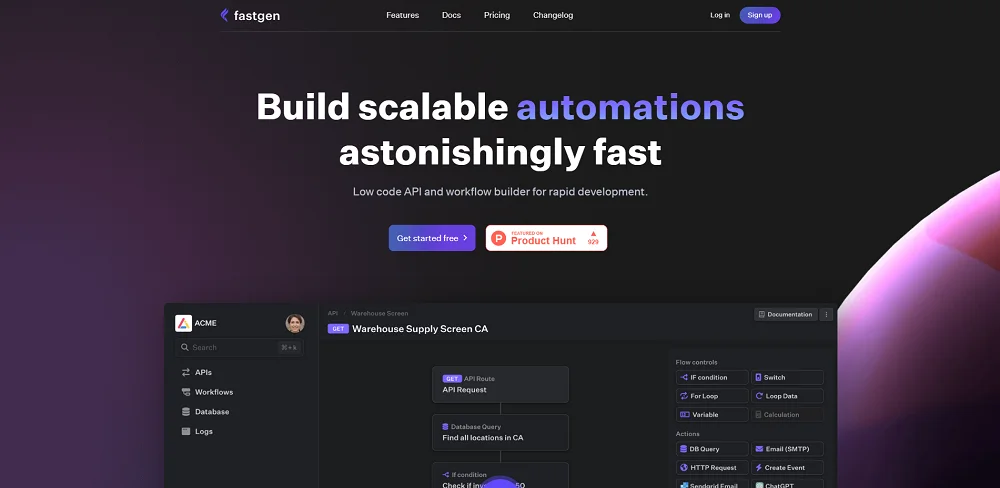
Fastgen is a low-code API builder built to speed up workflow and API development. It started as an internal tool and has since grown into a platform for building custom integrations quickly.
Main features:
- REST API building: a drag-and-drop interface for creating REST APIs, plus prebuilt integrations with tools like Sendgrid, Slack, and Twilio, and connectivity to any external API you need for data exchange.
- Workflow creation: build time-based and event-based workflows in the same interface as the API builder, with any action definable as a custom event that can trigger a separate workflow.
- Integrated database management: build and manage a Postgres database alongside your APIs and workflows in one place, with a direct connection to your existing database if you already have one set up.
Fastgen pricing: free plan available, with paid tiers (Starter, Pro, Team) now billed on a usage-based “flow run” model rather than a flat per-user rate. Fastgen was acquired by Lumos in December 2024 but continues to operate under its own name and product, so confirm current tier rates on fastgen.com before budgeting.
See how a low-code database fits alongside a setup like this if you are managing several data sources at once.
2. ProcessMIX
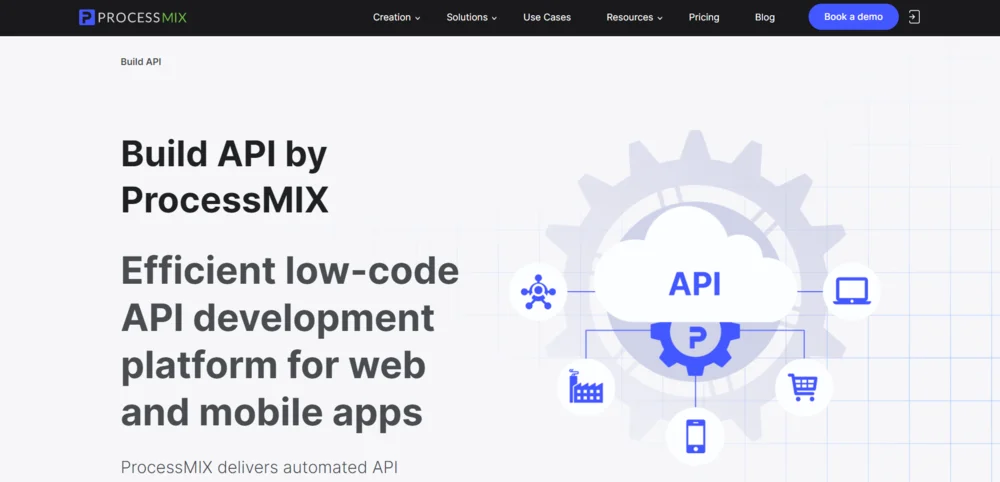
ProcessMIX is a low-code API development platform built mainly around decisioning and back-office automation, with strong roots in banking and financial services. It also works well as a general bridge between applications for web and mobile projects.
Main features:
- Automated API development: build a consistent back end and deploy to the cloud without needing deep programming skills.
- Adaptability: quick, intuitive API configuration that supports easy changes and flexible tool handling.
- Faster interactions: stronger database connectivity that speeds up data processing.
- Third-party integrations: connect to third-party service providers for secure, fast data sharing.
ProcessMIX pricing: custom quotes only, no published price list. Contact the vendor for a rate based on your use case.
3. Linx
Linx is a low-code back-end API builder aimed at teams with limited development time or in-house skills. It uses pre-wrapped functions and a visual interface to speed up API creation.
Main features:
- Low-code API development: you will need a basic grasp of data types and objects, but the rest of the process is significantly simplified.
- Plugin integrations: connect to a range of plugins, including cloud services, to build logic-rich APIs that generate files, call other APIs, query databases, and run custom SQL.
- Hosting and deployment: Linx hosts, deploys, and manages the application for you, with one-click deployment that removes the need for a separate deployment pipeline.
Linx pricing: starts around $149/month, with custom pricing for larger deployments. Note that a separate, unrelated identity security and governance product also goes by the name Linx, so look for linx.software specifically to reach this one.
4. Filestack
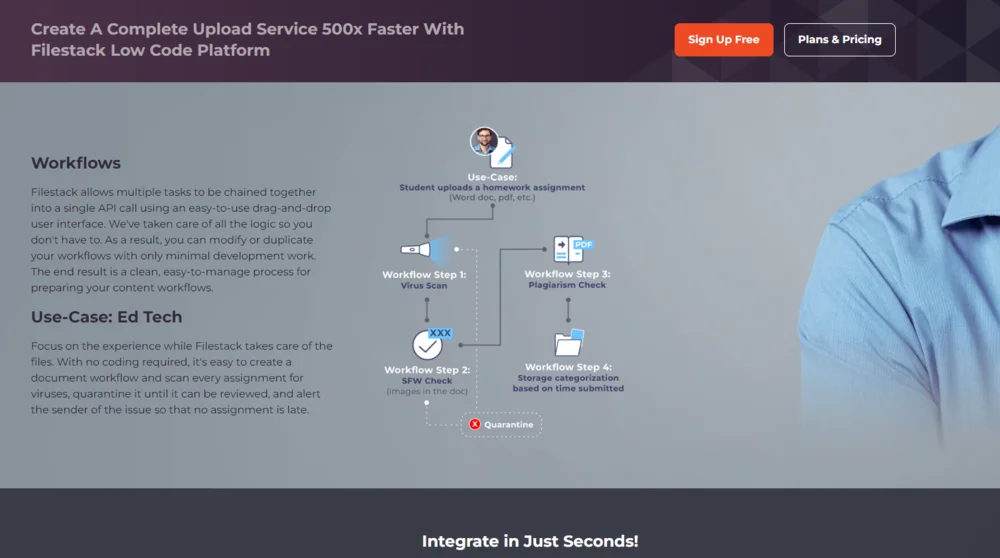
Filestack is a low-code API platform focused specifically on file management, rather than general-purpose API building. Its main features include:
- File picker generator: a ready-made JavaScript file picker widget, so developers do not need to hand-code file upload interfaces.
- Validation options: control file type, image validation, and the number of simultaneous uploads to keep the application stable.
- Multi-source file upload: users can upload from Facebook, Instagram, Dropbox, or local storage.
- API code generator: generates the code for common file operations like downloading, storing, and deleting, cutting down manual coding time.
Filestack pricing: roughly $49 to $379/month across published tiers, plus custom Enterprise pricing. Rates are based on bandwidth, transformations, and storage, so confirm current tier limits before choosing a plan.
5. Meta API
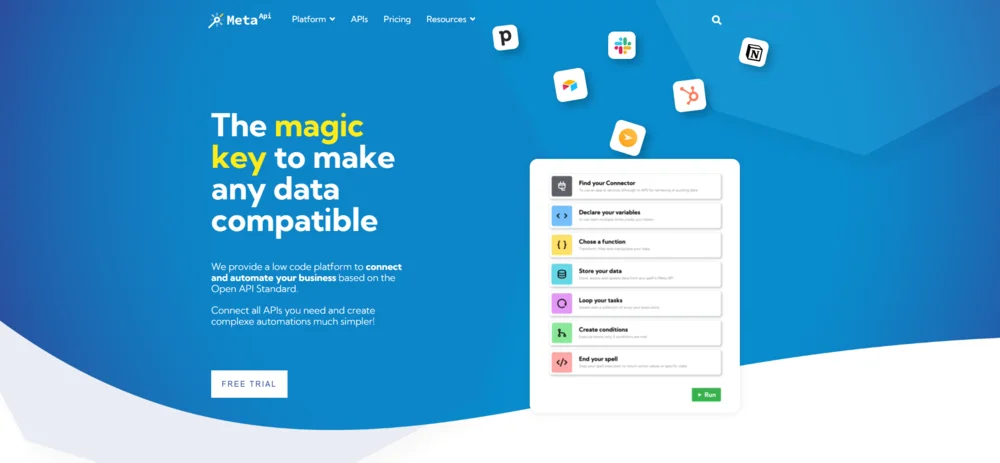
Meta API is a low-code integration platform built around the Open API standard. It is closer to an automation and orchestration tool than an API builder in the strict sense, since it focuses on connecting and running existing APIs rather than building new ones from scratch. Its main features are:
- API connectivity: connect to a large catalog of existing APIs to build automation workflows that streamline business operations.
- Data compatibility: make data compatible across systems with different formats and requirements.
- Low-code automation: simplify how APIs get connected and automated, cutting the time it takes to deploy a working automation.
Meta API pricing: free plan available, with paid tiers on top. Confirm current tier rates directly on meta-api.io, as published pricing details are limited.
6. Choreo
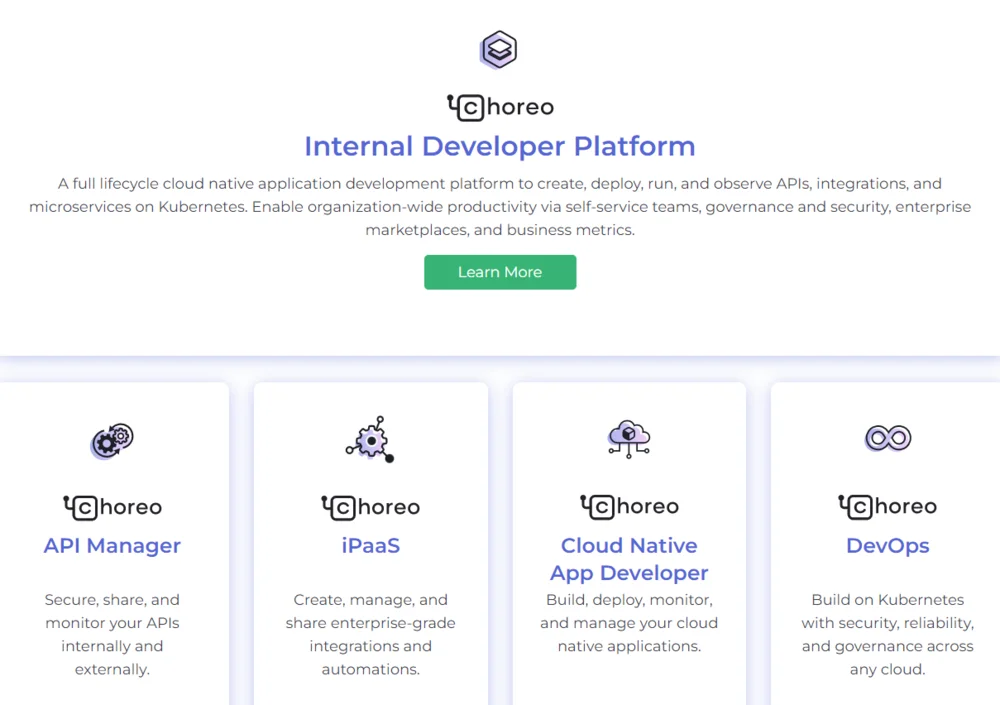
Choreo is WSO2’s platform for enterprise-grade, API-first development. It leans more toward professional developers than citizen developers, pairing a low-code interface with the ability to drop into code when needed, and covers everything from creating APIs to deploying and managing them.
Main features:
- API creation: build services and APIs across REST, GraphQL, WebSocket, Webhooks/WebSub, and SOAP.
- Access control: built-in integration with Asgardeo as an identity provider, or connect your own enterprise IDP.
- API marketplace: a managed marketplace where internal and external developers can discover and reuse APIs.
- Governance: manage credential sharing across environments and control which external APIs developers can consume, which keeps the security side of API management in check.
Choreo pricing: pay per component.
7. Airtable
Airtable works as a visual, spreadsheet-style database rather than a dedicated API builder. Every Airtable base comes with an automatically generated REST API, which is genuinely useful, but you are consuming an API that already exists rather than designing one from scratch the way you would with the other tools on this list.
Features and capabilities:
- Built-in API: every base gets a REST API that front-end tools can consume directly.
- Core operations: read, write, update, sort, and filter data through that API.
- Integrations: over 50 built-in integrations, including G Suite, Outlook, Sendgrid, Slack, and Jira.
Airtable pricing: free plan available; Team at $20/user/month and Business at $45/user/month (both billed annually, higher on monthly billing), plus a custom Enterprise Scale plan.
See how low-code data integration tools can centralize the data Airtable and similar tools produce.
8. DreamFactory
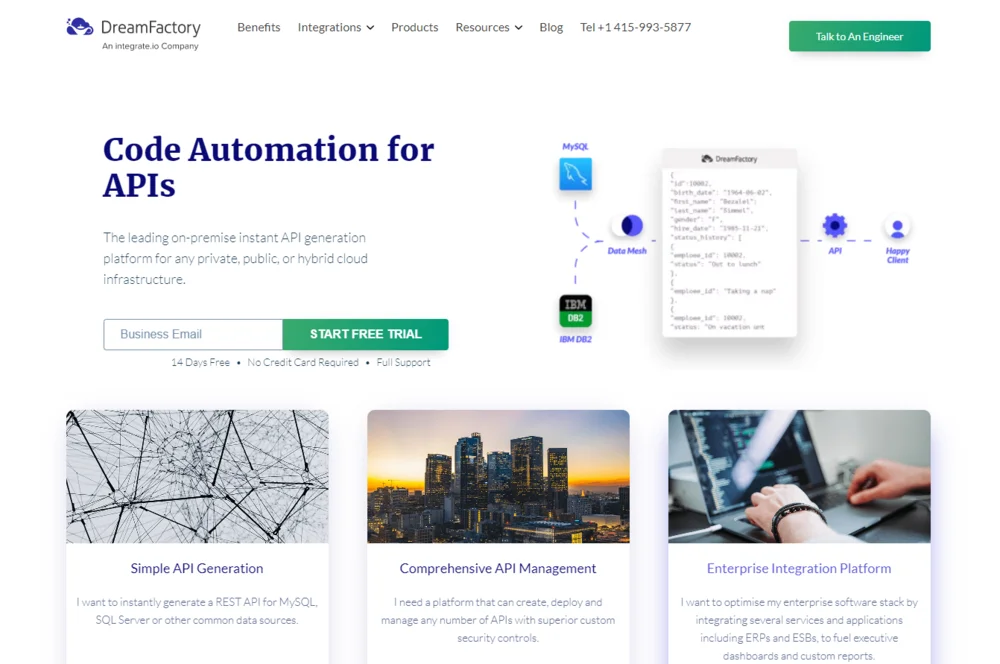
DreamFactory positions itself as an instant API generation platform for on-premises or any cloud infrastructure. This open-source low-code API builder handles the creation, deployment, and management of APIs with custom security controls built in.
Features and capabilities:
- Instant API generation: generate secure, standardized, fully documented REST APIs quickly, cutting out the usual IT bottleneck.
- API management: integrate multiple services and applications, including ERPs and ESBs, from one place.
- Security: supports Active Directory, OAuth2, Okta, OpenID Connect, and role-based access control.
DreamFactory pricing: contact vendor.
9. Xano
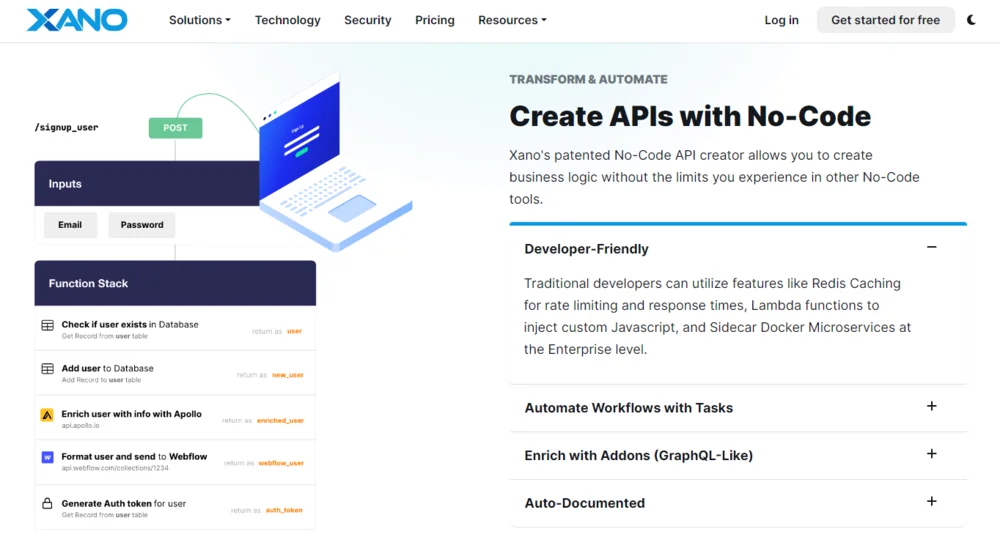
Xano gets you to a full working back end quickly, positioning itself as a no-code API creator built for teams that want a scalable back end without dealing with the usual coding overhead.
Features and capabilities:
- No-code API creation: build business logic without the limitations typical of other no-code tools.
- Flexible database: runs on PostgreSQL, supporting both relational and non-relational data with no record limits.
- Security and compliance: encryption at rest, secure transmission over SSL, and compliance with SOC 2 Type II, GDPR, HIPAA, ISO 27001, and ISO 9001.
Xano pricing: free plan available for building and testing; Essential at $85/month and Pro at roughly $224 to $249/month. Xano discontinued its older, cheaper Starter plan in January 2026, so budget for the current, higher entry point.
Frequently asked questions
It is a platform that lets you design, build, and often host an API through a visual interface instead of writing the backend code by hand. Most still let you drop into custom code for the parts that need it.
Not quite. A builder like Fastgen or Linx helps you construct a new API. A management platform like Choreo, or an integration tool like Meta API, focuses more on governing, securing, or connecting APIs that already exist. Several tools on this list blend both to some degree.
Xano markets itself as no-code, since you rarely need to write code to build a backend with it. It still gives you enough control over logic and data structure that experienced developers can push it further than a typical no-code tool.
It depends on what your main general-purpose low-code platform already handles. Many of these cover basic API needs on their own; a dedicated builder is worth adding once you need more complex logic, higher-volume integrations, or a back end that stands apart from the front-end app.
Choreo, DreamFactory, and Xano all publish specific compliance and access-control features built for enterprise use. For anything regulated, confirm the exact certifications you need directly with the vendor rather than relying on general marketing claims.
Closing thoughts
Not every tool on this list does the same job. Fastgen, Linx, DreamFactory, and Xano are true API builders, meant for constructing new APIs and back ends from scratch. Filestack narrows that same idea down to file handling specifically. Meta API and Choreo lean toward integration and management of APIs that already exist, while Airtable’s API is a byproduct of its database rather than something you actively build. Matching the tool to what you actually need to do, build a new API, connect existing ones, or manage them at scale, matters more than picking whichever one tops a list.
Synodus works with businesses across aviation, real estate, and enterprise operations to plan and build the right integration approach for their systems. If your team is weighing low-code development services for an API or integration project, book a free consultation to talk through what fits your stack.