What is an NFT marketplace?
An NFT marketplace is a digital platform for trading non-fungible tokens, which are blockchain-based tokens used to represent unique digital or physical assets.
On Ethereum, for example, the ERC-721 standard defines a common interface for tracking and transferring uniquely identifiable NFTs. A marketplace builds the discovery, listing, transaction, and user experience around tokens such as these.
A useful analogy is an ecommerce marketplace: sellers bring assets, buyers browse and purchase them, and the platform provides the environment in which the transaction happens. The difference is that ownership of the NFT is recorded through the blockchain rather than only in the marketplace database.
The underlying media is not necessarily stored directly on-chain. An NFT can point to metadata that describes the asset and references an image, video, or other resource. The ERC-721 metadata specification can include an image field that points to the represented asset through a URI, which is why token ownership, metadata, and the underlying content should be treated as related but separate layers.
Depending on the platform, users may be able to:
- Browse and search NFT collections
- Buy NFTs at a fixed price or through offers and auctions
- List owned NFTs for resale
- Mint new NFTs or import existing collections
- Connect an external wallet or create a marketplace-integrated wallet
- View collection activity, ownership history, attributes, and pricing data
- Receive or pay creator earnings where the marketplace and contract support them
An NFT marketplace is more than a smart contract. It also needs search, indexing, metadata handling, user interfaces, transaction routing, security controls, and conventional backend infrastructure.
How NFT marketplaces work
The exact transaction flow depends on the marketplace, but most NFT platforms follow the same basic sequence.
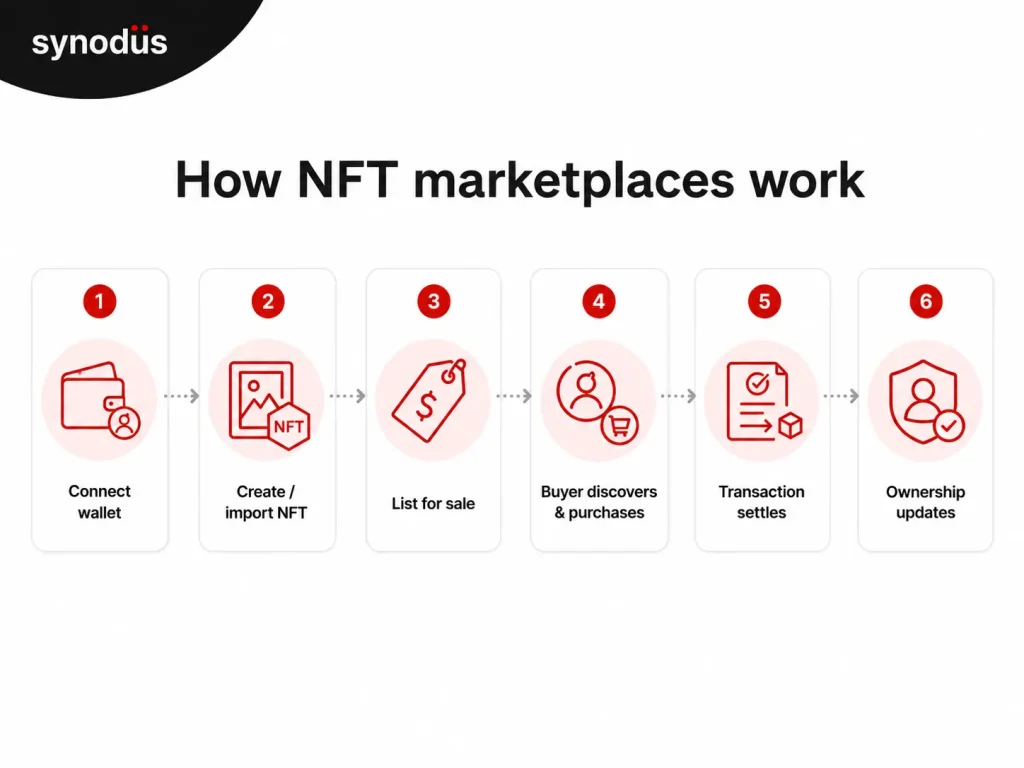
1. Connect or create a wallet
The user first needs an account or wallet that can authorize blockchain transactions and receive the NFT.
External wallets are still common, but a marketplace no longer has to require a browser-extension wallet. OpenSea, for example, supports email-based wallet creation for self-custodial EVM and Solana wallets, which reduces the amount of wallet setup a new user has to complete before using the marketplace.
The wallet does not work like a folder that contains the NFT file. Instead, the blockchain records ownership while the wallet gives the user access to and control over the associated address and assets. How wallets work on OpenSea explains this in more detail.
2. Create or import an NFT
A creator may mint a new NFT through the marketplace, deploy a collection contract, or list an NFT that already exists in their wallet. Some marketplaces also support lazy minting, where the on-chain mint is delayed until a buyer completes the purchase.
The marketplace typically reads the token metadata and prepares it for display through collection pages, asset detail pages, search, filters, and other discovery tools.
3. List the NFT for sale
The seller chooses how the NFT can be purchased. Common options include a fixed price, an offer-based sale, or an auction.
Different marketplaces support different sale formats. SuperRare currently supports auctions, offers, and Buy Now pricing, as detailed in its marketplace pricing documentation, while Foundation also uses marketplace smart contracts to manage bids, auctions, and purchases.
4. The buyer discovers and purchases the NFT
The buyer finds the asset through search, filters, collection pages, rankings, direct links, or marketplace recommendations. They can then purchase it directly, place an offer, or participate in an auction depending on the listing.
At checkout, the transaction may include the NFT price, marketplace fee, network fee, and creator earnings. These payments should not be treated as the same thing because they go to different recipients.
5. The transaction settles
When the transaction is accepted, the marketplace or marketplace protocol coordinates the transfer of payment and the NFT. Smart contracts can automate parts of this settlement, while other platform services handle data indexing, status updates, notifications, and the user interface.
Creator earnings are not automatically guaranteed simply because a royalty percentage exists. The ERC-2981 royalty standard provides a common way for a contract to return royalty recipient and amount information, but it does not enforce payment by itself. Marketplace policy and contract architecture determine how creator earnings are handled.
6. Ownership records update
After an on-chain transfer settles, the blockchain records the buyer address as the new token owner. The buyer can then view and manage the NFT through a compatible wallet or marketplace.
The marketplace may also update its own indexed data so the asset appears under the new owner, the sale shows in activity history, and the listing is removed or marked as completed.
Main types of NFT marketplaces
NFT marketplaces are better classified by the assets and users they serve than by their development technology. A Gaming marketplace, for example, could be custom-built or white-label and could use either normal or low-cost transaction architecture. Those are implementation choices, not separate marketplace categories.
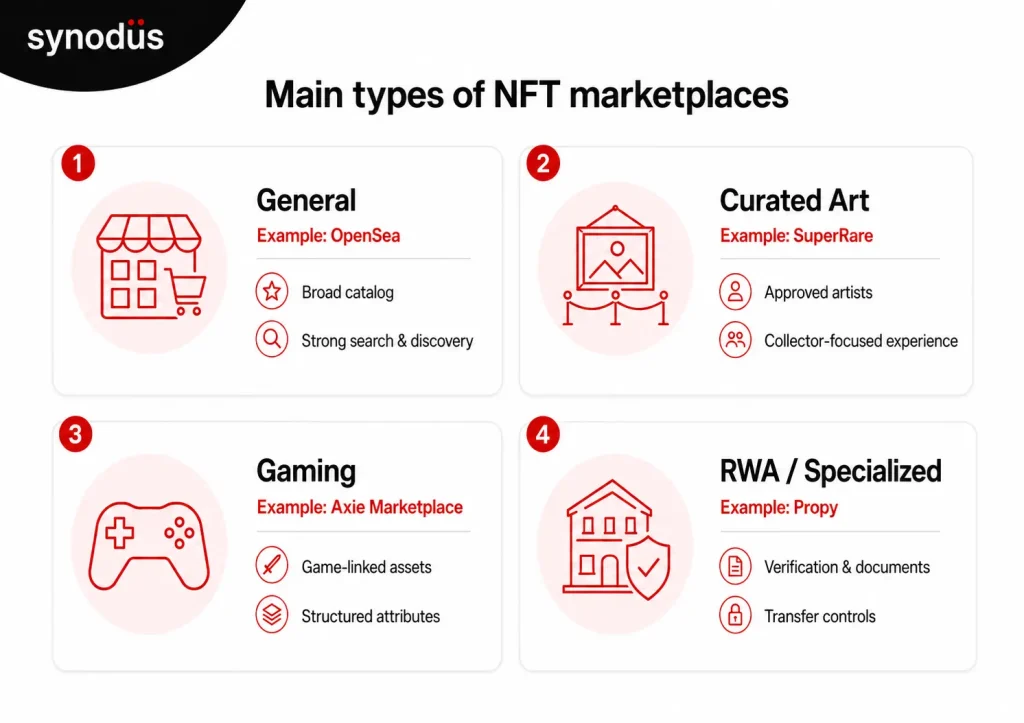
1. General NFT marketplaces
General marketplaces support a broad catalog of NFTs rather than one narrow category. Users may find digital art, collectibles, memberships, gaming assets, domain-related assets, and other on-chain items in the same marketplace.
OpenSea is a useful example of how broad this model can become. Its newer platform has expanded beyond NFT-only discovery and trading to include fungible-token trading, aggregation, and cross-chain purchasing, as described in OpenSea’s OS2 product announcement.
Breadth and discoverability are the main advantages. Organizing a large catalog well enough that users can find relevant assets and distinguish legitimate collections from noise is the main challenge.
2. Curated Art marketplaces
Curated Art marketplaces focus more heavily on artists, presentation, collector experience, and controlled supply. Instead of allowing every creator to list in the same way, the platform may use approval, curation, galleries, or collection-specific rules.
SuperRare remains a clear example of this model: only approved artists can mint on the platform, and artworks sell through auctions, offers, or Buy Now listings, as described in SuperRare’s creator access and sale formats. Foundation similarly supports art-focused galleries, drops, editions, auctions, and marketplace sales.
For these marketplaces, value often comes from curation and access to a specific collector audience as much as from transaction execution itself.
3. Gaming marketplaces
Gaming marketplaces are designed around assets used within games or gaming ecosystems, such as characters, skins, weapons, land, memberships, or other game-linked items.
The marketplace may be a standalone platform or a module inside the game product. Game-specific marketplaces often need structured attributes, inventory synchronization, fast transaction flows, and integration with player accounts or game backends.
Owning an NFT does not automatically make the asset usable across different games. Cross-game utility requires the receiving game to recognize the asset and implement the corresponding logic.
4. RWA and specialized marketplaces
Specialized marketplaces serve a narrow asset class or industry, such as music, memberships, fashion, intellectual property, or real-world assets (RWA).
For RWA, the token may represent an economic interest, access right, certificate, or other claim connected to an off-chain asset. The legal meaning depends on the product structure and applicable agreements, so the NFT should not automatically be treated as legal title to the underlying asset.
These marketplaces may require identity verification, issuer onboarding, document handling, transfer restrictions, reporting, or other workflows that are not common in an open digital-collectibles marketplace.
Businesses building their own marketplace can separately choose a custom, white-label, or protocol-based development approach. For example, the Rarible Protocol documentation covers APIs and SDK functionality for building custom and community NFT marketplaces. These are development approaches rather than marketplace types.
What are NFT marketplaces used for?
Marketplace type describes how the platform is positioned. Use case describes what people or businesses actually do with it. The same marketplace can support more than one use case.
Digital art and collectibles
Artists, studios, and collectors can use NFT marketplaces to issue, discover, sell, and resell digital works or collectible assets. Marketplaces can support fixed-price sales, auctions, limited editions, and collection-based discovery.
Gaming assets
Game developers can use marketplaces to let players trade game-linked assets. The value of the marketplace depends on how those assets connect to gameplay, scarcity rules, player demand, and the wider game economy.
Memberships, access, and brand collectibles
NFTs can also be used as access credentials or collectible representations of a brand, event, membership, or community. The marketplace provides a place to distribute or trade the token, while the associated benefit is delivered by the product or organization behind it.
Real-world asset and specialized tokenization
In specialized markets, NFTs or related token structures can be used to represent rights or interests connected to physical or financial assets. Marketplace functionality may then extend beyond trading into onboarding, identity, documentation, eligibility, and administration.
NFT marketplace vs crypto exchange
Both products facilitate digital-asset transactions, but they are designed around different asset models.
| NFT marketplace | Crypto exchange |
|---|---|
| Primarily trades unique or non-fungible assets | Primarily trades fungible tokens such as BTC, ETH, or stablecoins |
| Asset pages emphasize collections, metadata, traits, media, and ownership | Trading screens emphasize token pairs, prices, liquidity, and order execution |
| Common sale methods include fixed price, offers, and auctions | Common order types include market, limit, and other exchange orders |
| Discovery and curation can be central to the product | Price discovery and liquidity are usually central to the product |
| Each NFT can have distinct properties and transaction history | Units of the same token are generally interchangeable |
The boundary can blur. Some platforms now combine NFT trading with fungible-token trading or other on-chain products, but the underlying asset and transaction models are still different.
Benefits of NFT marketplaces
NFT marketplaces can make blockchain-based assets easier to discover and transact, but the benefits come from a combination of blockchain records and marketplace infrastructure.
1. Verifiable token ownership and provenance
Blockchain records can show which address owns a token and provide a traceable history of on-chain transfers. Provenance at the token level can improve as a result.
Token ownership is not the same as copyright ownership or proof that the underlying media is authentic. The U.S. Copyright Office NFT study specifically notes that NFT ownership and intellectual-property rights can be separate.
2. Broader market access
Online NFT marketplaces can connect creators and sellers with buyers across multiple regions without requiring a physical distribution channel. Access still depends on supported jurisdictions, wallets, payment methods, and any compliance restrictions applied by the platform.
3. More monetization options
Creators and issuers can generate revenue from primary sales, while marketplaces can use transaction fees, primary-sale commissions, onboarding fees, subscriptions, or other services depending on the business model.
Creators may also receive earnings from eligible secondary sales when the marketplace and contract support them. The way OpenSea handles creator earnings illustrates why secondary-sale royalties should not be treated as automatic, distinguishing between optional and enforced earnings depending on the NFT contract.
For a deeper breakdown of platform revenue, see our NFT marketplace business model guide.
4. Easier discovery and trading
Search, filters, collection pages, offers, auctions, and activity data can make NFT trading easier than arranging private transactions between individual wallets. Discoverability and tradability improve, but liquidity is not guaranteed. An NFT can be publicly listed and still have no buyer.
5. Transparency settlement history
Completed on-chain transfers provide a public record of token movement and transaction settlement, making ownership changes easier to verify than records that exist only inside one marketplace database.
Not every marketplace action is necessarily on-chain. Listings, offers, search data, metadata indexing, user profiles, and other functions may also rely on off-chain systems.
Challenges and limitations of NFT marketplaces
The same architecture that enables open digital-asset trading also creates product, market, and security challenges.
Liquidity can be uneven
A large catalog does not necessarily mean an active market. NFTs can be difficult to sell when buyer demand is limited, pricing is unclear, or the marketplace has insufficient trading activity.
Prices can be volatile
NFT prices can change quickly and may be influenced by market sentiment, collection popularity, utility, scarcity, and broader crypto-market conditions. Buyers should not assume that an NFT will retain or increase its resale value.
Fraud and security risks remain
Blockchain records do not prevent counterfeit collections, phishing, malicious links, compromised wallets, smart contract vulnerabilities, or social-engineering attacks. Marketplace verification and transaction warnings can reduce some risks but cannot remove them entirely.
Network and marketplace fees vary
Users may pay marketplace fees, blockchain network fees, creator earnings, or payment-processing costs depending on the transaction. The total cost can vary by blockchain, transaction type, and marketplace policy.
If reducing blockchain fees is the main concern, our guide to NFT marketplaces without gas fees explains the difference between lazy minting, sponsored gas, gas abstraction, and low-cost chains.
Regulation and compliance differ by market
NFT-related obligations can depend on the asset, transaction model, jurisdiction, payment flow, and rights attached to the token. RWA platforms and other regulated use cases may need identity, eligibility, reporting, or transfer controls that a digital-art marketplace does not.
User experience can still be complex
Wallet setup, transaction signing, network selection, gas fees, failed transactions, and private-key management can create friction for new users.
The onboarding model is changing. OpenSea’s email wallet setup shows how marketplaces can reduce wallet complexity without removing blockchain ownership.
How NFT marketplaces are evolving
NFT marketplaces are moving beyond the simple 2021 model of connecting a wallet, listing a collectible, and paying in one chain’s native token. Several areas of the product are changing.
Simpler wallet onboarding
Embedded and email-based wallets can reduce the requirement for users to install a browser extension, record a seed phrase during onboarding, and manually manage several wallet tools before their first transaction.
Multi-chain and aggregated trading
Large marketplaces are increasingly aggregating assets and liquidity across multiple networks. OpenSea OS2 introduced aggregated marketplace listings, cross-chain purchasing, and fungible-token swaps alongside NFTs, moving the product closer to a broader digital-asset interface than a single-chain NFT storefront.
More flexible creator-earnings models
Royalty handling has become more nuanced. The OpenSea creator earnings policy supports both optional and contract-enforced earnings for compatible collections, while ERC-2981 remains a royalty-information standard rather than a universal enforcement mechanism.
Lower-friction transaction architecture
Lazy minting, sponsored transactions, account abstraction, and low-cost networks can reduce or simplify the network-fee experience. These approaches change who pays, when the fee is paid, or how it is presented. They do not make blockchain execution costless.
Final thoughts
An NFT marketplace is the application layer that makes blockchain-based assets easier to discover, evaluate, and trade. Blockchain can provide the token ownership and settlement record, while the marketplace provides the search, transaction flow, data, account experience, and operational infrastructure around it.
Blockchain does not automatically guarantee authenticity, liquidity, security, or creator royalties. Those outcomes depend on the asset, contract design, marketplace rules, demand, and the systems built around the transaction.
If you are planning to build a marketplace rather than simply use one, see our guide to building an NFT marketplace for the decisions around marketplace type, features, architecture, smart contracts, testing, and launch.
FAQs
An NFT marketplace is an online platform where users can discover and trade non-fungible tokens. It combines marketplace features such as listings and search with blockchain-based ownership and transaction settlement.
It depends on the platform and transaction. Some marketplaces still require crypto for purchases and network fees, while others support card purchases, stablecoins, or simplified wallet funding.
An NFT ultimately needs a blockchain address for ownership, but users do not always have to bring an external wallet. Some platforms can create a self-custodial wallet as part of an email-based account setup.
No. NFT marketplaces are primarily designed around unique assets, collections, metadata, and asset-specific listings, while crypto exchanges mainly trade fungible tokens through token pairs and liquidity markets.
Common revenue streams include transaction fees, primary-sale commissions, onboarding fees, subscriptions, and premium services. The right model depends on the marketplace type, transaction volume, and value the platform provides.