Should you outsource blockchain development?
Yes, outsource if you lack in-house blockchain expertise, have a well-defined scope or an early-stage product, use blockchain as a supporting technology rather than your core business, and can establish clear ownership and security boundaries from the start. Because in these situations, outsourcing providers faster access to specialized expertise while keeping the associated risks manageable.
Don’t outsource if blockchain is your core competitive advantage, your project has strict security or compliance requirements, requirements are still evolving, or the solution requires deep, long-term integration with internal teams. The long-term cost of losing control over architecture, security, and product decisions often outweighs the short-term benefits of outsourcing.
To better understand when outsourcing is the right choice, it helps to compare it with the most common alternative: building an in-house blockchain team. The comparison below highlights the strengths, limitations, and ideal use cases of each model.
In-house vs outsourcing: what are the differences?
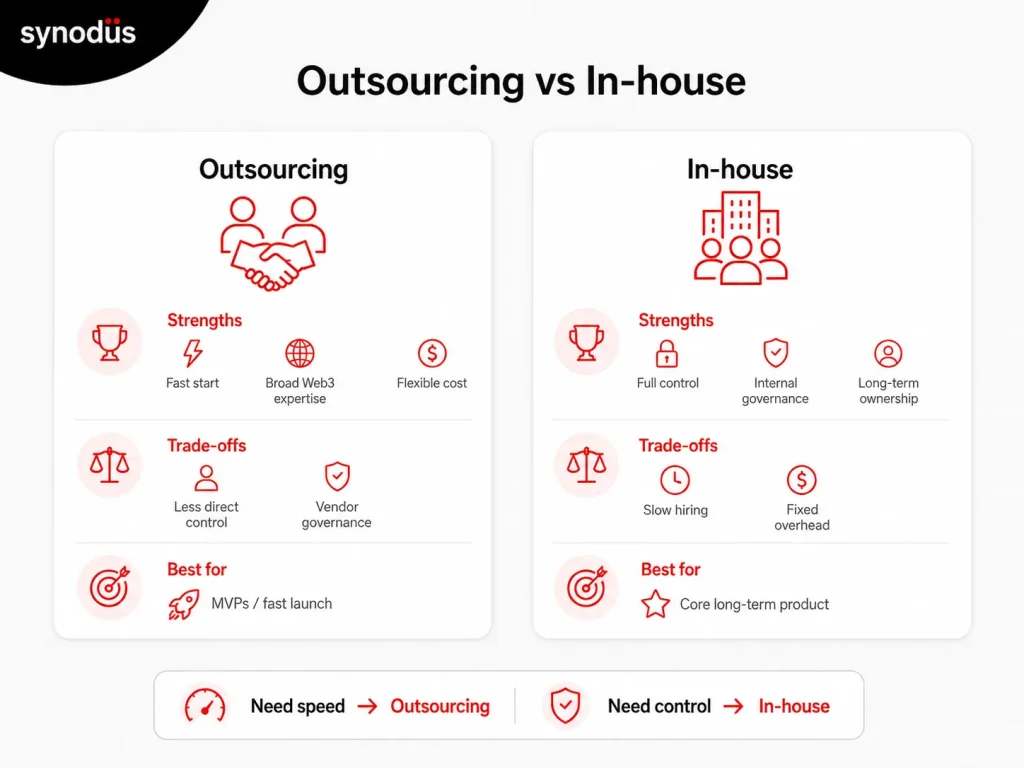
In-house development and outsourcing are often compared because they represent two fundamentally different ways of building capability. One builds expertise inside your organization; the other gives you access to external expertise on demand.
| Decision factor | Outsourcing development | In-house development |
|---|---|---|
| Access to Web3 expertise | Instant & Broad | Slow & Hard to hire |
| Speed to start | High (Days to weeks) | Low to medium (Months) |
| Control & ownership | Medium to low | High |
| Cost structure | Variable (Pay for delivery/time) | Fixed (High overhead) |
| Security governance | Setup-dependent | Strong & internal |
| Long-term flexibility | Medium | High |
When it comes to accessing Web3 expertise, outsourcing has a clear advantage. Experienced blockchain developers are in short supply, and hiring them often takes months because the role requires specialized knowledge in smart contract security, consensus mechanisms, and cryptography. An outsourcing partner already has this expertise in place, allowing projects to start within days or weeks instead of waiting through lengthy recruitment and onboarding.
That faster access naturally translates into faster delivery. For companies launching an MVP or validating a new blockchain use case, this shorter time-to-market is often one of the biggest advantages of outsourcing.
The biggest trade-off is control. An in-house team gives you complete ownership over architecture, priorities, and day-to-day execution, but it also means investing in recruitment, training, and long-term talent retention. Outsourcing provides immediate access to experienced engineers, but success depends on how well the vendor relationship is managed. Rather than managing developers directly, your focus shifts to managing delivery, communication, and governance.
The cost difference is also more nuanced than simply saying “outsourcing is cheaper.” Hiring an in-house blockchain team typically costs $40,000–$100,000+ per month in salaries alone for a cross-functional team, excluding recruitment, benefits, and infrastructure. By comparison, outsourced blockchain development is typically billed on a project or hourly basis, with experienced teams in Eastern Europe and Southeast Asia charging $25–$80 per hour. While the exact savings vary, Deloitte’s Global Outsourcing Survey found that 23% of organizations reduced operating costs by 11–30%, while 6% achieved savings of 31–50% after moving to outsourced delivery models.
Regarless of which model you choose, security and governance remain your responsibility. Smart contract audits, key management, compliance, and code ownership cannot simply be delegated to a vendor. If you choose to outsource, these responsibilities should be clearly defined before development begins. Otherwise, the cost of a single security incident can easily outweigh any savings from outsourcing.
So, once you choose outsourcing, the next step is choosing the right outsourcing model that best fits your project’s scope, budget, and delivery needs.
Common blockchain outsourcing models
The easiest way to tell them apart is by answering two questions: Who manages the work? And how do you pay for it?
| Model | What it means |
|---|---|
| Staff augmentation | Hire developers who work under your management; pay by the hour or day |
| Dedicated Team | Hire a full team that works exclusively for you; pay monthly |
| Project-Based | Outsource the Whole Project (Vendor manages everything, pay per project) |
| Time & Materials (T&M) | Pay only for the time and resources used (Ideal for evolving requirements or R&D projects) |
| Build – Operate – Transfer (BOT) | Vendor builds and manages a team first, then transfers it to you |
Staff augmentation
How it works: You hire individual Web3 specialists (e.g., Solidity engineers, Rust/Substrate developers, Smart Contract auditors) to work directly under your internal CTO or Engineering Lead.
Blockchain Context: Ideal when your core team understands the architecture but lacks niche technical execution (e.g., writing zero-knowledge circuits or setting up custom indexers/The Graph).
Management Overhead: High. You manage daily tasks, code reviews, and sprint planning.
Pitfall to Watch: Security Isolation. Never grant augmented developers access to mainnet deployer wallets or production private keys. All code must undergo peer-review by your internal lead before merging.
Dedicated team model
How it works: The vendor provides a full, self-managed Web3 squad (PM, Smart Contract Devs, Frontend/Web3.js Devs, QA) working exclusively on your product roadmap over an extended period.
Blockchain Context: Fits long-term product lines (e.g., DeFi protocols, NFT marketplaces, RWA platforms) that require continuous protocol upgrades, security monitoring, and feature iteration.
Management Overhead: Medium. You set strategic goals and milestones; vendor leads day-to-day execution.
Pitfall to Watch: Vendor Lock-In. Require clear smart contract documentation and open-source style repositories from Day 1 so your internal team can take over anytime.
Fixed-Price / Project-Based Model (Defined Scope MVP)
How it works: The vendor delivers a fully working product based on a predefined scope, strict timeline, and fixed budget.
Blockchain Context: Works best for standalone, low-complexity Web3 assets—such as a standard ERC-20/721 token launch, a simple staking dApp, or a fixed-scope smart contract audit fix.
Management Overhead: Low (Vendor owns end-to-end delivery against agreed requirements).
Pitfall to Watch: Audit Friction. Ensure the contract explicitly states whether Smart Contract Audit remediation is included. If an independent audit finds critical vulnerabilities, the vendor must fix them without extra charge.
Time & Materials – T&M (Agile & Evolving Scope)
How it works: You pay based on actual hours billed and resources used. Ideal for dynamic projects with evolving requirements.
Blockchain Context: Essential when integrating with rapidly changing protocols, testing experimental Layer-2 solutions, or navigating complex Web3 integrations where scope cannot be locked upfront.
Management Overhead: Medium-High (Requires tight oversight on bi-weekly sprint deliverables to control budget burn).
Pitfall to Watch: Uncapped Spend. Set hard budget caps per research milestone to avoid paying for endless technical trials.
Build-Operate-Transfer – BOT (Long-Term Subsidiary Setup)
How it works: The vendor builds a dedicated Web3 development unit offshore, manages it through initial mainnet deployment and scaling, and eventually transfers complete operational ownership and legal entity to you.
Blockchain Context: Tailored for enterprises or well-funded Web3 ventures wanting to establish an offshore Web3 R&D center without immediate local legal or hiring overhead.
Management Overhead: Low early on, High during transfer phase.
Pitfall to Watch: Key & Custody Transfer. Establish clear legal protocols for transferring HSM (Hardware Security Modules), admin multisig keys, and IP rights during the handover phase.
Here’s a quick way to choose the right model:
- Already have an engineering team? Choose Staff Augmentation
- Need an external team for long-term product development? Choose a Dedicated Team
- Have a fixed scope and budget? Choose Project-Based
- Expect requirements to change frequently? Choose Time & Materials
- Want to build your own offshore blockchain team over time? Choose BOT
Cost of outsourcing blockchain development
Cost by engagement models
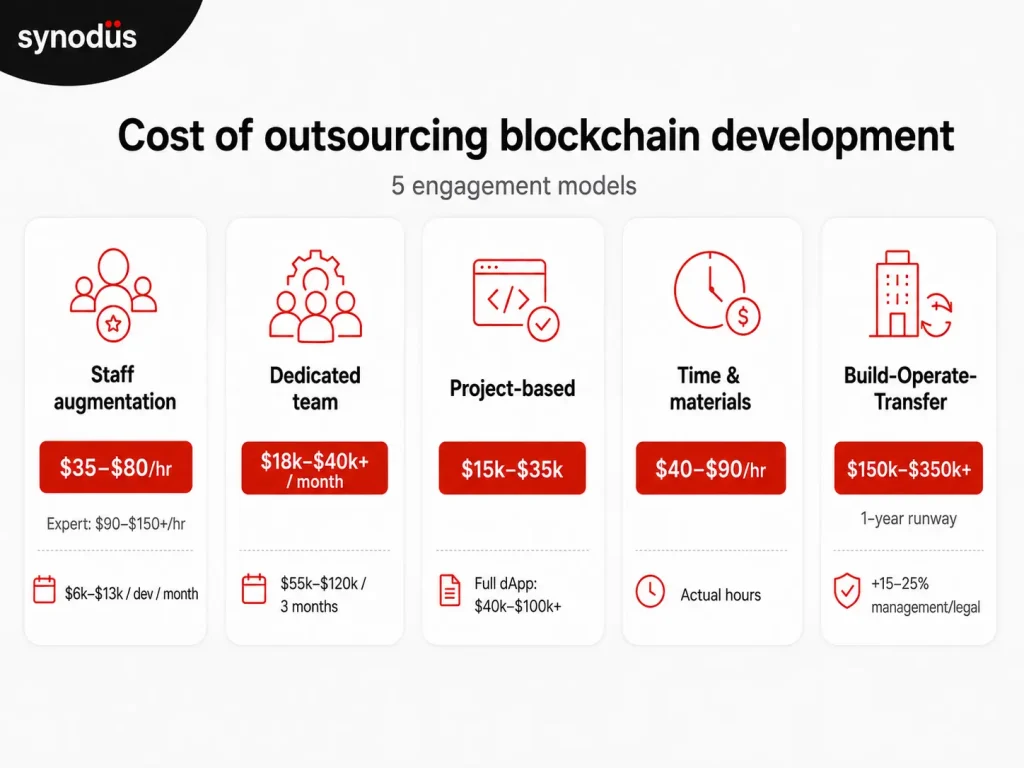
Once you have settled on the right model, the next question is what it actually costs and how that cost behaves differently across models. The breakdown below covers outsourcing-specific pricing; if you also need full cost modeling for building the app itself, from tech stack to team composition, see our blockchain app development cost guide. The ranges below reflect typical market rates reported across staffing platforms and outsourcing benchmarks as of 2026; treat them as planning ranges rather than a quote, since actual pricing depends on team seniority, region, and project complexity.
| Engagement model | Pricing benchmark (2026 market standard) | Real-world budget estimate |
|---|---|---|
| Staff augmentation | $35 – $80 / hour (Mid-Senior Web3 Dev) $90 – $150+ / hour for ZK / Cryptography experts | $6,000 – $13,000/ dev/month |
| Dedicated Team | $18,000 – $40,000+/month (Typical team: 1 Lead, 2 Smart Contract Devs, 1 Frontend Web3, 1 QA) | $55,000 – $120,000 for a 3-month milestone |
| Project-based (fixed scope) | $15,000 – $35,000 (Simple ERC-20/NFT/Staking) $40,000 – $100,000+ (Full dApp/DeFi Protocol) | $40,000 – $100,000+ (Full dApp / DeFi Protocol) |
| Time & materials | $40 – $90 / hour per resource | Billed bi-weekly based on actual hours |
| Build-Operate-Transfer | Base Squad Cost + 15–25% Management/Legal Fee (One-time Buyout/Transfer fee: 10–25% of annual contract value) | $150,000 – $350,000+ total 1-year setup & transfer runway |
Staff Augmentation: You pay $35–$80/hour for Solidity developers and $90–$150+/hour for specialized Rust, Move, or zero-knowledge engineers. This gives you the most flexibility since you pay only for the developers you need, but your internal team owns planning, reviews, and technical decisions. If developers are waiting on feedback or architecture calls, those hours are still billable, so inefficient internal management quickly shows up as higher project cost.
Dedicated Team: Typically $18,000–$40,000+ per month depending on team size and seniority. The advantage is predictable monthly spend on a stable team working exclusively on your product. The downside is utilization: during a security audit or a shift in priorities, you keep paying the same monthly fee even if development temporarily slows.
Project-Based: Usually $15,000–$35,000 for straightforward applications and $40,000–$100,000+ for larger platforms. If requirements are well defined, this gives you the highest budget predictability. Blockchain projects often evolve after security reviews or stakeholder feedback, though, and work outside the agreed scope typically becomes a change request that adds cost and time.
Time & Materials: You pay only for actual time spent, which suits research, experimentation, and evolving requirements. The trade-off is that there is no fixed budget. If technical challenges take longer than expected, costs can rise significantly, so clear milestones and regular budget reviews matter here more than in any other model.
Build-Operate-Transfer: Combines a monthly operational fee (base squad cost plus 15–25% management/legal fee) with a 10–25% one-time buyout fee at transfer. It requires a higher total runway ($150,000–$350,000+ over a year) but removes initial legal setup friction in overseas jurisdictions. The main cost risk is talent retention: build clear retention incentives into the handover phase so key engineers do not leave during the ownership transfer.
Cost by region
Engagement model explains how you pay; region explains why the hourly rate inside each model swings as widely as it does. Blockchain developer rates vary by geography roughly as follows:
| Region | Typical hourly rate |
|---|---|
| North America | $90-$150/hour |
| Western Europe | $70-$110/hour |
| Eastern Europe | $45-$80/hour |
| Asia-Pacific | $40-$70/hour |
Source: Flexiple, Cost to Hire a Blockchain Developer (2026)
Two things are worth flagging about this table. First, “Asia-Pacific” spans a wide range of local markets, and within it, Vietnam consistently prices toward the bottom of that band rather than the middle, alongside India and the Philippines. Second, the cheapest region on paper is not automatically the cheapest engagement: a lower hourly rate paired with weak project management, unclear specs, or limited audit maturity can cost more in rework than it saves in rate. Region should narrow your shortlist, not decide it outright, which is why the vetting criteria in Phase 2 below matter regardless of where a vendor is based.
Hidden costs that excluded from standard vendor quotes
The engagement model determines how you pay for development, but it does not capture every expense. Plan for these separately:
- Node infrastructure & indexing ($200 – $2,000+/month): Blockchain dApps depend on external RPC node providers (Alchemy, QuickNode, Infura) and custom indexers (The Graph) to read state data and broadcast transactions. These fees scale with your user transaction volume.
- Smart contract security audits ($10,000 – $50,000+ per audit): Independent third-party security audits from firms like CertiK or OpenZeppelin are separate expenses that must be planned independently from developer fees.
- Deployment & testing gas fees ($50 – $15,000+ per deployment): Mainnet deployment requires paying network gas fees, ranging from $50–$200 for a basic token contract to $5,000–$15,000+ for complex, multi-contract DeFi protocols on Ethereum during peak congestion.
- Post-launch maintenance (15–25% of initial build / year): Blockchain applications require ongoing monitoring, security patches, and proxy upgrades post-launch. As a rule of thumb, budget 15–25% of your initial development cost annually for maintenance (e.g., an $80,000 dApp build requires $12,000–$20,000 per year for operational maintenance, excluding major feature rewrites).
How the outsourcing process works
Now that you understand the costs, let’s look at what the blockchain outsourcing process actually involves. It’s a sequence of phases and you shouldn’t skipping or rushing any one of them if you don’t want to fail your engagements.
Phase 1 – Define scope before contacting anyone
Before a vendor conversation happens, you need answers to three things: what the smart contract logic needs to do, which chain it targets, and what security posture the system requires (custodial vs. non-custodial, upgradeable vs. immutable contracts). This will determines whether vendor quotes are even comparable to each other later.
Phase 2 – Find and vet vendors on evidence
Sourcing typically runs through platforms like Clutch, LinkedIn, or direct referrals. But the vetting that actually matters happens at the portfolio stage, and it should look for three specific things:
- Independent audit history – Has a third-party firm audited the vendor’s past work, and can you find the report? OpenZeppelin and Hacken publish completed audit reports you can cross-check against a vendor’s claims.
- Live mainnet deployments, not staged demos – a product still sitting on testnet hasn’t been tested by real usage or real attackers.
- Regulatory track record – Has their past work actually addressed KYC/AML, GDPR, or MiCA requirements, or is compliance an afterthought in their pitch.
Phase 3: Choose an engagement model and sign the agreement
Once you’ve picked a cooperation model (see the models section above), the engagement needs three interlocking documents, not just a verbal agreement:
- NDA – confidentiality on source code and architecture, with obligations that survive contract termination, typically for 2–5 years.
- MSA – the umbrella agreement covering payment terms, liability, and dispute resolution.
- SOW – the specific deliverables, timeline, and reporting cadence for this engagement.
- IP ownership clause – a separate, explicit clause stating that all smart contract code, infrastructure components, and deliverables are assigned to you. As one legal source on this exact issue points out, many template agreements contain IP clauses that don’t actually transfer code ownership to the client — the specific wording matters more than having a clause at all.
Phase 4: Develop the product in iterations
Because smart contracts are largely immutable once deployed, blockchain development cannot follow a build-everything-then-review cadence the way ordinary software can. In practice, work is broken into 1 to 2 week sprints: the vendor ships one verifiable piece of functionality, demos it on testnet, and you (or a third-party auditor) review it before the next layer is built on top. Catching a logic error on testnet costs a sprint. Catching the same error after mainnet deployment can cost the entire contract.
Phase 5: QA and security checks before mainnet
This is a distinct gate from ordinary QA: alongside functional testing, it includes an independent smart contract audit, penetration testing on any custodial components, and a review of how private keys and admin roles are structured. None of this is optional if the contract will hold user funds.
Phase 6: Deploy and hand over the project
The handover should be structured as:
- Deployment documentation: testnet and mainnet deployment steps, infrastructure setup, environment variables.
- Credential & key management: admin key transfers, multisig wallet reconfiguration, custody documentation.
- Governance & access rights: who can update upgradeable contracts, control validators, or manage bridge connections, transferred fully to your team.
- Legal & ownership handover: written confirmation that the vendor retains no system access post-handover.
Phase 7: Ongoing support and maintenance
After launch, the project enters its maintenance phase. This can include bug fixes, security updates, infrastructure monitoring, and support under a defined Service Level Agreement (SLA), depending on the terms of your engagement.
Key risks in blockchain outsourcing (and how to mitigate them)
Like any outsourcing engagement, blockchain development comes with inherent risks. However, the stakes are often higher because outsourcing shifts parts of the financial, operational, and legal responsibility to an external partner while accountability ultimately remains with your organization.
Risk 1: Private key management & custody leakage
During development and testing, vendors often hold administrative control, deployer private keys, or multi-signature wallet access. If a vendor’s local environment is compromised, or if an rogue engineer gains access to mainnet deployer keys, your treasury or smart contract admin functions can be hijacked permanently.
How to Reduce It
- Enforce strict key isolation. Vendors should only handle ephemeral keys on testnets (such as Sepolia). Mainnet deployment keys stay strictly in-house.
- Use multisig wallets (Safe or Squads) for all contract admin roles, with a threshold where internal team members hold the majority of signing keys.
- Use KMS (AWS KMS, GCP Cloud KMS) or hardware wallets (Ledger, Trezor) for deployment routines instead of storing raw private keys in .env files.
Risk 2: Smart contract vulnerabilities & Audit overhead
Outsourced developers may write functional code that passes unit tests but contains critical attack vectors, such as reentrancy, price oracle manipulation, integer overflow, or unchecked external calls. A common vendor trap is delivering un-auditable code, leaving you with unexpected costs when an independent auditor finds critical flaws right before mainnet launch.
How to Reduce It
- Contractual Audit Remediation: Include a clause in your vendor contract stating that code must be delivered “Audit-Ready.” If a top-tier 3rd-party auditor (e.g., CertiK, OpenZeppelin) discovers Critical/High severity bugs, the vendor must fix them at zero additional cost.
- Automated & Continuous Testing: Require vendors to supply full test suites (using frameworks like Foundry or Hardhat) with high code coverage (>90%) and integrated static analysis tools (Slither, Mythril) before accepting any sprint deliverable.
Risk 3: Cross-border regulatory & Tokenomic non-compliance
Crypto and token legislation varies radically across jurisdictions – from MiCA in Europe and VARA in Dubai to strict SEC enforcement in the US.
An offshore vendor unfamiliar with global crypto compliance may accidentally design smart contract mechanics (e.g., automated yield distribution, staking, or governance tokens) that legally classify your token as an unregistered security or trigger mandatory KYC/AML violations.
How to Reduce It
- Separate Tech from Compliance Legalities: Do not rely on an engineering vendor for legal or tokenomic design. Your internal team or specialized legal counsel must define compliance boundaries (e.g., adding whitelist/blacklist modifier functions or KYC integration requirements) before issuing technical specifications.
- Geofencing & On-Chain Compliance: If your product serves restricted regions, ensure the vendor embeds compliance checks at both the frontend (IP geofencing) and smart contract level (e.g., soulbound identity tokens or Chainlink proof-of-reserve integrations).
Executive risk mitigation checklist
Before signing a contract with any Web3 development partner, ensure these 4 security safeguards are explicitly written into the agreement:
- Zero Mainnet Key Sharing: Vendor never receives access to mainnet deployer or admin private keys.
- Audit Guarantee: Free remediation for Critical/High findings identified by independent security auditors.
- Automated Testing Suite: 90%+ test coverage using Foundry/Hardhat mandatory for milestone acceptance.
- Full IP & Repo Handover: Weekly code pushes to client-owned GitHub/GitLab repositories to prevent hostage situations.
How to choose the right partner for your blockchain projects
Everything we’ve covered so far, from costs and engagement models to risk management, all comes down to one final decision, that is choosing the right blockchain development partner.
Use this 5-point vetting checklist before signing any agreement:
- Problem Fit over Tech Stack: Does the vendor have proven mainnet experience with your specific domain (e.g., DeFi protocols, RWA tokenization, ZK circuits) rather than just general software capabilities?
- Decision Ownership Alignment: Have you defined early on who owns architecture, key security trade-offs, and release timing? (Avoid vendors who passively expect to be micromanaged or blindly make decisions without consultation).
- Proactive Risk Communication: Does the partner surface security vulnerabilities, compliance exposure, and maintainability concerns during early discussions—or do these topics only appear when contracts are finalized?
- Trial Collaboration First: Can you test the working relationship through a short discovery phase, pilot build, or limited-scope milestone before committing to a multi-month engagement?
- Continuity & Zero Lock-in: Do they enforce open-source repository standards, clear code documentation, and structured knowledge transfer so your internal team can take over code ownership at any time?
For a more detailed breakdown, read our comprehensive guide: How to Choose the Right Blockchain Development Company
To compare leading market players, review technical portfolios, and find the best fit for your region:
- Blockchain development companies in USA
- Blockchain development companies in Singapore
- Blockchain development companies in Vietnam
- Blockchain development companies in India
Final thought
The pattern worth remembering from everything above: cost is rarely where outsourcing decisions actually go wrong. Control is. Whichever model or partner you choose, the questions that protect you are the same, such as who owns the architecture, who’s accountable for security, and what’s written down before work starts, not negotiated after something breaks.
If you can answer those questions with confidence before signing a contract, you’re already in a much stronger position to build a successful blockchain project.