The challenges of traditional ERP platforms
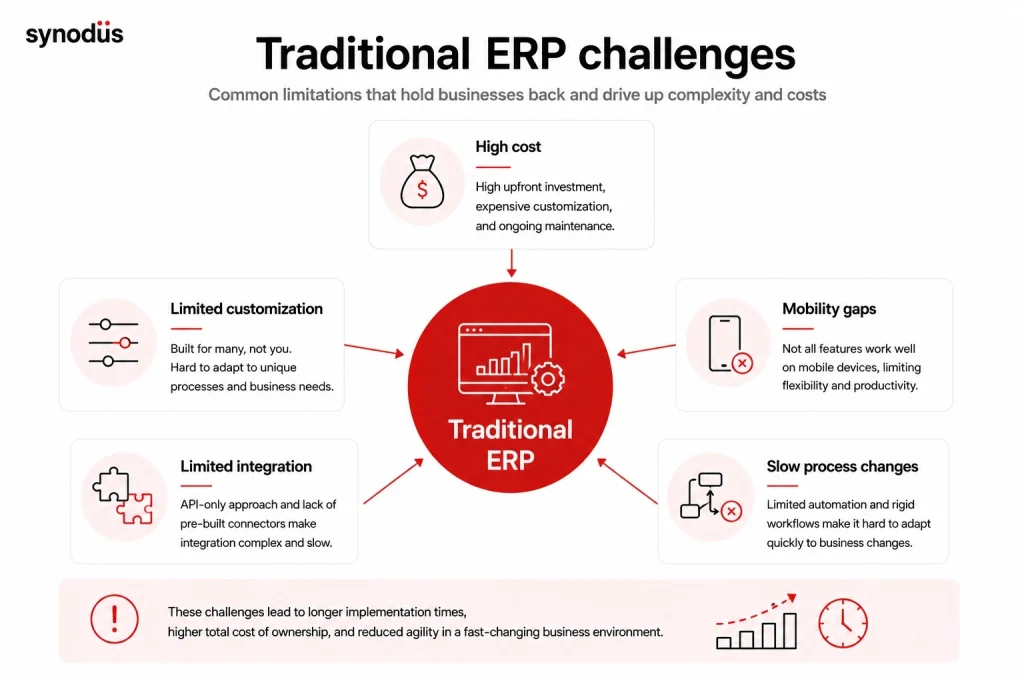
Investing in an ERP system is costly. Industry figures put the average cost at around $9,000 per user, with customization adding at least $150,000 per project. That puts traditional ERP out of reach for many small and mid-sized businesses, and even off-the-shelf systems only take an enterprise so far. A few things to weigh before buying or building a traditional ERP:
- Complexity for users: ERP can be hard to use at first because it serves so many purposes, so you have to train users and keep the system updated to get value from it.
- Limited customization: one ERP platform serves many companies across industries, so despite extensive configuration options, it is not a perfect fit for any single company’s needs.
- Mobility gaps: not all features work well on smartphones and tablets.
- Little process-oriented thinking: process automation is limited, so ERP is better at managing data than orchestrating cross-team workflows.
- Limited integration: many systems offer only an API and expect other systems to handle the integration, rather than providing ready-to-use connectors.
Faced with these drawbacks, companies are looking for a way to build a custom ERP on a limited budget. If the cost and complexity of a traditional ERP have held you back, low-code ERP may be the answer.
What is low-code ERP?
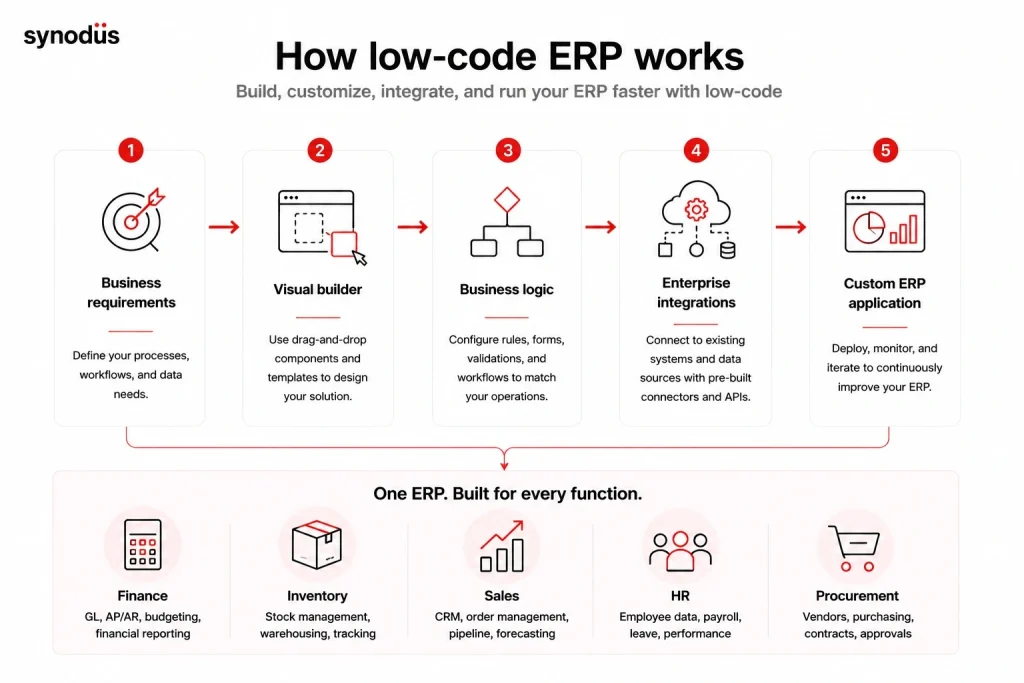
Low-code uses simple logic and intuitive drag-and-drop features, so people can build custom applications without heavy reliance on IT. Instead of starting from scratch or depending entirely on coding experts, you go through a structured configuration process to meet your requirements, and the building blocks make modifying, creating, and publishing applications much faster.
With low-code, you can build almost anything, from process automation and internal tools to a full ERP system, all customized until it fits. The drag-and-drop blocks act as a foundation, so you do not start from the ground up, and you can work with a developer to add as many advanced features as you need.
Traditional ERP vs low-code ERP
| Factor | Traditional ERP | Low-code ERP |
|---|---|---|
| Upfront cost | High, often six figures | Lower, pay for what you build |
| Customization | Limited, vendor-dependent | High, built to your processes |
| Time to change | Weeks to months | Hours to days |
| Integration | API-only, complex | Pre-built connectors |
| Process automation | Limited | Strong, with BPM layers |
| Best for | Large, standardized operations | Tailored, fast-changing needs |
Features that make low-code ERP a strong choice
Easy-to-use interface
You can build a friendly, dynamic low-code ERP that guides daily workers, such as a warehouse worker, a salesperson on the floor, or a manager, step by step through their tasks. The system is tuned to the optimal working path, which boosts efficiency, reduces confusion, and onboards new employees the same way every time.
A comprehensive process layer
Some low-code platforms let you build an ERP with a business process management (BPM) layer, so you can create applications that fit your department, process, and business model. Cross-department workflows help teams collaborate, and when you change part of a process, it updates automatically and notifies everyone involved.
Integration possibilities
Low-code platforms can act as an integration layer, connecting your ERP to data from many sources, including legacy and cloud systems. Pre-defined connectors make your IT architecture cleaner and technical integration easier. See our roundup of low-code data integration tools.
A bridge to advanced technology
Advanced low-code platforms can serve as a gateway to AI, the internet of things, and other emerging technologies. These add-ons can significantly increase the value of your ERP and improve overall efficiency, which is exactly where the biggest change is happening now.
Benefits of a low-code ERP system
ERP has entered a new era, one Gartner and others describe as composable, where enterprises rapidly assemble and adapt business capabilities instead of waiting months for each change. Previously, a single customization could take months, and if it was not right, another cycle would follow. Low-code collapses that timeline.
1. More personalization
ERP becomes more usable when it is personalized, since what a data entry clerk needs differs sharply from what a manager needs. Low-code lets users view, filter, and create their own reports, which lifts productivity over time and reduces reliance on the vendor by baking each process exactly how you want it.
2. Greater agility and adaptability
To compete today, you need business agility and speed. Your customers are online and your employees work on their phones, so an older on-premises ERP can cause you to miss opportunities. A single low-code ERP platform simplifies the IT stack and frees IT for more critical work, while giving business users the power to make strategic changes fast. When supply chains shift or demand swings, a low-code ERP lets you adjust product lines, workflows, and reporting in hours rather than months. Learn more in our guide to low-code and agile development.
3. Higher productivity and collaboration
One of low-code’s best strengths is flexible integration. Legacy integration is often limited or so complex it takes a long time, which leaves each department on a separate toolset. That is manageable at first, but as processes and data grow, constant exporting, importing, and app-switching becomes a burden. With low-code ERP, you integrate easily with existing systems, and some teams build a new CRM or database inside the platform to align with the ERP. Automatically transferring and syncing data saves time and raises productivity, since the process is consistent and error-free.
The AI shift: agentic ERP
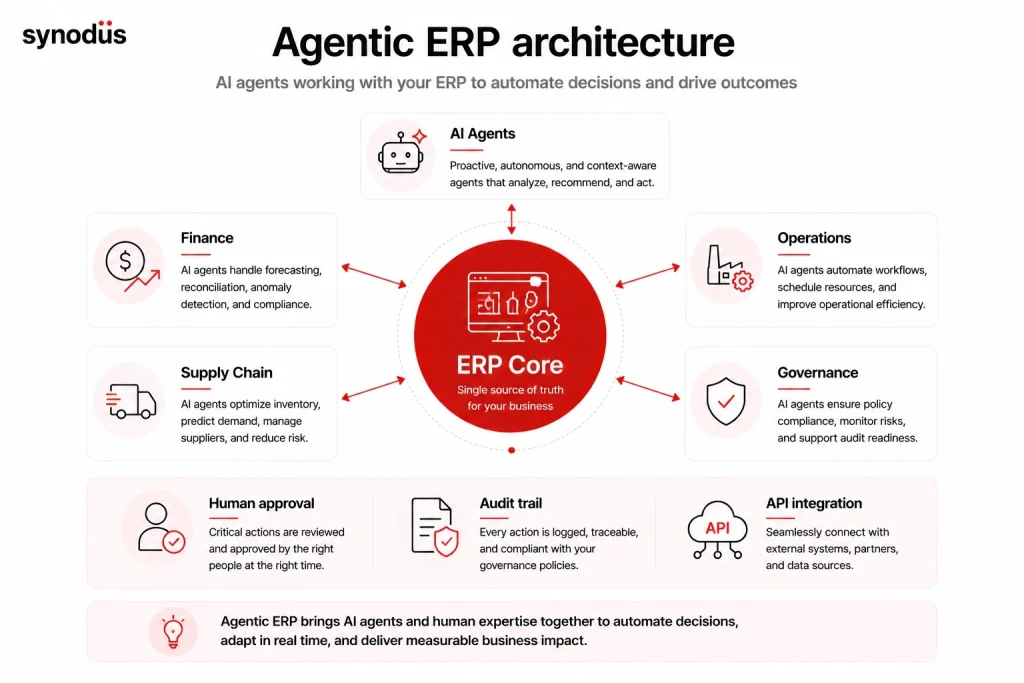
The biggest change to ERP in 2026 is agentic AI. ERP is moving from a passive system of record to an active system that gets work done, with AI agents that plan and execute multi-step tasks across finance, supply chain, and operations. A procurement agent, for example, can detect low inventory, analyze supplier pricing, generate a purchase order, route it for approval, and track delivery, all while maintaining governance and audit trails. Major vendors are already shipping this, from Microsoft Dynamics Copilot agents to Oracle Fusion’s finance agents.
The impact is significant. McKinsey research suggests AI agents can cut ERP implementation effort by at least 50% and halve program duration, with early adopters reporting EBIT gains of 5% or more. Low-code is central to this shift, because the composable, low-code application layer is where these agents operate around a stable core, using visual builders and APIs to reach enterprise data while keeping humans in the loop for exceptions. To go deeper, see our roundup of low-code AI platforms.
Will low-code replace traditional ERP?
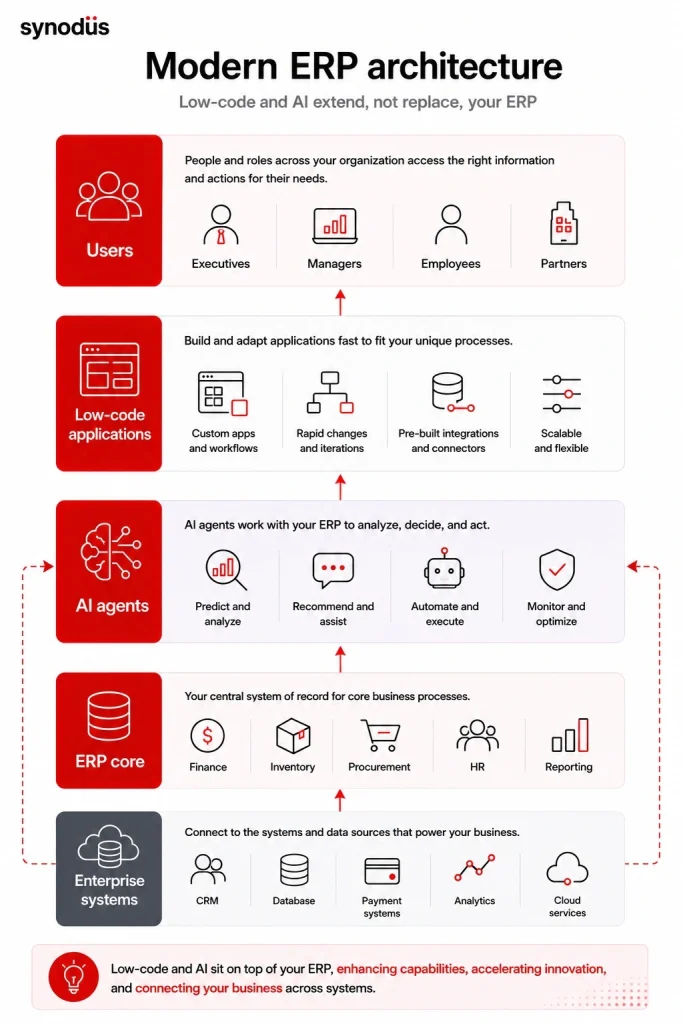
Not entirely, and that is the consensus among analysts. The likely future is ERP modernization, not replacement. Deloitte describes it as a move toward a modular, API-driven, agentic ERP where rules, data structures, and core workflows stay rigid in the core, while AI agents and low-code interfaces operate in a flexible application layer around it.
In practice, this means traditional ERP keeps doing what it does best: providing a stable, auditable, compliant system of record, especially for tightly controlled processes like financial accounting and accounts payable. Low-code sits on top, delivering the customization, integration, and fast-changing front-end experiences that monolithic ERP struggles with. For many businesses, especially SMBs priced out of a full traditional ERP, a low-code ERP can serve as the primary system. For large enterprises, low-code complements and modernizes the ERP they already run. Either way, the two are partners more than rivals.
Limitations of using low-code for ERP
Low-code is still maturing, so expect some trade-offs:
- It is not as “easy” as it sounds: low-code is easy to use, but an ERP is not easy to build. Even with drag-and-drop, advanced features need custom coding, so if you lack qualified technicians, you can outsource to a custom low-code development company short-term.
- Training is required: after development, make sure your team knows how to maintain and upgrade the system, whether you use a vendor or an in-house team.
- Vendor lock-in: even a customized low-code ERP follows the platform provider’s rules and technical requirements, so ask what happens to your apps if their code base or terms change before you commit.
- Governance and access control: low-code is open, so anyone can alter the interface or back-end. Small daily changes can quickly turn into a messy ERP, so use the platform’s access control to decide who updates and maintains it.
We cover both sides in detail in our breakdown of low-code benefits and disadvantages.
A real example
Synodus built an ERP for a pharmaceutical company on Dynamics 365, Power BI, and Azure, delivered in 6 months by a team of 5. The system manages orders, customers, and inventory, and supported 80% year-on-year growth, the kind of tailored, integration-heavy build where low-code ERP shines. See the full pharmaceutical ERP case study.
Frequently asked questions
Low-code ERP is an enterprise resource planning system built on a low-code platform using drag-and-drop tools and pre-built components instead of heavy hand-coding. It lets businesses customize the ERP to their exact processes far faster and more cheaply than traditional development.
Usually, yes. Traditional ERP often runs into six figures with high per-user and customization costs, while low-code ERP lets you pay for what you build and change. For SMBs priced out of a full traditional ERP, low-code is often the more realistic option.
No, but they are reshaping it. The consensus is modernization, not replacement: a stable ERP core handles rules, data, and compliance, while AI agents and low-code interfaces operate in a flexible layer around it. ERP becomes the trusted backbone that makes agentic automation safe and auditable.
Yes. A key strength of low-code is flexible integration, with pre-built connectors to legacy and cloud systems. Many teams also build a CRM or database inside the platform to align with the ERP and sync data automatically.
Wrapping up
A low-code ERP is a strong option for making sure your system fits your business processes rather than forcing your processes to fit the system. It connects your people, processes, and technology, and lets you keep customizations separate so you can re-connect rather than rewrite them when you upgrade. Paired with a stable core and the new wave of AI agents, low-code is how most businesses will modernize ERP in the years ahead.
If you would rather have experts build it for you, Synodus offers a low-code application development service that turns your data into apps 10x faster and cuts development costs by half, with the governance and integration ERP demands. Book a free consultation to find the right fit for your business.