Choosing a fintech app development company is not about finding the “best vendor”. It’s about avoiding the most expensive mistake for your specific product.
From our experience working on fintech systems (digital wallets, lending platforms, payment infrastructure), most failures don’t come from poor coding. They come from:
- Choosing a vendor that doesn’t understand the product domain
- Underestimating compliance and system complexity
- Optimizing for speed too early – or too late
This guide is built to help founders and CTOs answer one question: “Given my product and risk, which type of vendor should I actually choose?”
How to choose the right fintech development company
Choosing a fintech development partner isn’t about picking the most well-known company, it’s about understanding what can go wrong in your specific product and selecting a team that can handle that risk.
Different fintech products fail in different ways:
- Payment systems fail at transaction consistency
- Lending platforms fail at credit logic and compliance
- Digital banks fail at integration and system reliability
- Trading platforms fail at latency and data accuracy
Instead of evaluating dozens of generic criteria, focus on two things:
- What type of fintech product you are building
- What risk you cannot afford to get wrong
The table below helps you quickly map both and identify the type of vendor you actually need.
- Suggested for you: How to create a fintech app in 6 easy steps
Fintech app development companies: quick decision guide
The table below maps common scenarios to the most suitable development partners – based on performance, security, scalability, and time -to-market priorities.
| Your biggest risk | What you need | Best-fit vendor type | Suggested vendors |
|---|---|---|---|
| Ship fast MVP that cannot scale withou rebuild | Early alignment between product, architecture and delivery direction | Product-driven development partner | Synodus |
| Over-engineered system that slows down delivery | Ability to prioritize speed vs architecture based on product stage | System-focused engineering teams | Itexus |
| System rework caused by misalignment after launch | Clear milestones, scoped delivery, and controlled flexibility during development | Structured but flexible delivery teams | Synodus |
| Weak UX leading to low adoption | Strong product design and user experience capability | Design-led product teams | Netguru |
| Lack of domain logic in financial flows | Deep understanding of lending, payments, or insurance workflows | Fintech domain specialist | Upplabs |
| Limited scalability due to team constraints | Ability to scale multiple teams across system layers | Large-scale engineering partner | Innowise |
| Slow delivery due to compliance-heavy processes | Experience in regulated environments with structued delivery | Enterprise-focused vendors | ScienceSoft |
| Building from scratch when not necessary | Pre-built infrastructure to accelerate development | Platform-based providers | SDK Finance |
| Endless iteration without product direction | Close collaboration to refine product-market fit | Product-oriented startup partners | KindGeek |
| Gap between idea and execution | Ability to bridge product discovery and technical delivery | Balanced product + engineering teams | 10Clouds |
Detailed vendor insights for informed decision-making
1. DashDev – Fast-track approach for launching fintech products
DashDev is built around helping fintech teams go to market quickly without building everything from scratch. With experience across neobanking, payments, and open banking – and a proprietary white-label core (FintechCore) – they enable faster launches by reusing pre-built infrastructure.
Productized fintech delivery with built-in components
Their strength lies in combining custom development with ready-made modules (KYC/AML, card issuing, integrations), making them particularly effective for products that need to reach market within tight timelines. This is especially relevant for founders launching regulated products like EMI or neobanks.
Trade-off: less flexibility at system level
This approach relies partly on pre-built architecture, which may require adaptation if the product evolves beyond initial assumptions or requires highly customized core logic.
Where it fits best
- Most relevant for fast go-to-market fintech products, especially neobanks or platforms leveraging existing infrastructure.
- May be less relevant for systems requiring fully custom backend architecture from the ground up.
2. ScienceSoft – Enterprise-grade engineering for regulated financial systems
ScienceSoft brings over two decades of experience in IT consulting and financial software development, working across banking, payments, and insurance systems – particularly in environments where regulatory compliance and operational stability are non-negotiable.
They are typically involved in projects that go beyond product builds, including modernizing legacy systems, integrating with core banking infrastructure, and ensuring auditability across financial operations. This makes them more aligned with organizations that need to meet strict requirements around data handling, reporting, and system reliability.
Process-driven delivery with compliance focus
Their delivery model emphasizes structured processes, documentation, and risk control – often aligned with standards expected in enterprise environments. This is particularly relevant in cases where systems must pass internal audits, comply with regulatory frameworks, or integrate with existing institutional infrastructure.
As a result, ScienceSoft is often chosen not just for development, but for ensuring that systems are built in a way that can be maintained, audited, and scaled over time.
Trade-off: less optimized for early-stage agility
This model typically involves more formal processes and documentation, which can introduce overhead for teams still iterating on product direction.
Where it fits best
- Most relevant for enterprise fintech systems requiring compliance, stability, and long-term maintainability.
- May be less relevant for early-stage products prioritizing speed and flexibility.
3. Synodus – Balanced approach for building and scaling fintech products
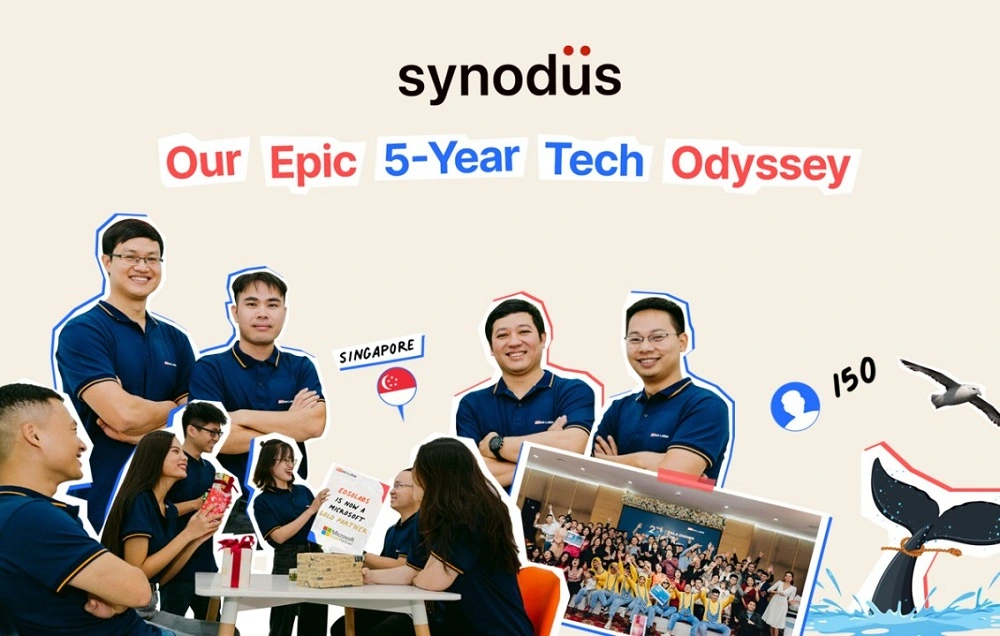
Synodus positions itself between speed-focused vendors and system-heavy providers, focusing on delivering fintech products that are both production-ready and adaptable from early stages.
With experience across digital banking, payments, and financial platforms, Synodus emphasizes aligning business goals, system design, and delivery execution from the beginning – rather than optimizing for only one dimension such as speed or architecture.
Hybrid delivery model with early clarity on scope and outcomes
A key aspect of their approach is combining elements of fixed scope and time & materials, allowing teams to define clear milestones early while retaining flexibility during development. This helps reduce common risks such as unclear scope, misaligned expectations, or costly rework after initial releases.
In practice, this makes them suitable for teams that need to move forward with a defined direction, while still adapting as product and technical requirements evolve.
Trade-off: requires early alignment on direction
This approach works best when there is a baseline level of clarity on product goals and priorities. For teams still in pure exploration mode without defined direction, the structured alignment phase may feel more involved than necessary.
Where it fits best
- Most relevant for fintech teams looking to balance speed, system reliability, and delivery predictability – particularly when moving from MVP to scalable product.
- May be less relevant in very early ideation stages where rapid experimentation without constraints is the primary focus.
4. Innowise: Scalable engineering capacity for fintech programs
Innowise operates as a large-scale engineering partner with 1,000+ specialists and 15+ years of experience, supporting fintech initiatives across banking, payments, and compliance systems. Their scale is particularly valuable in projects that require multiple teams working across backend, data, and frontend layers simultaneously.
They are often involved in building or supporting multi-system fintech platforms, where coordination between payment processing, compliance, and reporting becomes a core challenge.
Broad capability across fintech and adjacent technologies
Innowise brings experience not only in fintech but also in adjacent areas like AI, data engineering, and cloud infrastructure. This allows them to support use cases involving real-time data processing, fraud detection, or analytics-driven features, which are increasingly common in modern financial platforms.
This cross-domain capability makes them a practical choice for organizations that need a partner capable of handling both core product development and supporting technical layers at scale.
Trade-off: fintech is one of several verticals
While they have strong fintech experience, it is part of a broader service portfolio, which may result in varying domain depth depending on the team.
Where it fits best
- Most relevant for mid-to-large fintech programs requiring scalable teams and multi-domain capabilities.
- May be less relevant for niche products requiring deep, specialized fintech focus.
5. Netguru: Design-led digital product partner with fintech experience
Netguru combines product design, consulting, and engineering, supporting both startups and enterprises in building digital financial products. They are particularly strong in projects where user experience directly impacts adoption – such as digital banking apps, onboarding flows, and customer-facing platforms.
Rather than focusing on backend complexity, Netguru’s strength lies in helping financial products become more usable, intuitive, and conversion-driven, especially when modernizing legacy interfaces or launching new digital experiences.
Strong in UX-driven fintech transformation
They are often involved in redesigning or rebuilding the front layer of fintech products, improving how users interact with services like payments, account management, or financial insights – areas where poor UX can directly affect retention and growth.
Trade-off: more generalist positioning
Their approach is less centered on complex backend systems or infrastructure-heavy builds, which may require additional technical partners in projects with significant architectural demands.
Where it fits best
- Most relevant for fintech products where UX, product design, and customer experience are key differentiators.
- May be less relevant for highly complex backend or infrastructure-heavy systems.
6. KindGeek: Product-focused development with fintech startup exposure
KindGeek works closely with startups and scale-ups, with experience across fintech, marketplaces, and SaaS products. They are often involved in early-stage development, where product direction is still evolving and teams need a partner who can both build and refine the product along the way.
Their strength lies in combining engineering with a product mindset, helping teams shape features, validate assumptions, and iterate toward product–market fit rather than simply executing predefined specifications.
Flexible collaboration with product mindset
KindGeek’s approach emphasizes close collaboration and continuous feedback, making them well-suited for teams that need to test ideas, adjust scope, and evolve the product during development – especially in the early phases of fintech products where requirements are not fully defined.
Trade-off: limited scale for large systems
Compared to larger vendors, their capacity and enterprise delivery experience may be more limited for large, multi-system fintech programs.
Where it fits best
- Most relevant for early-stage fintech products requiring flexibility and product collaboration.
- May be less relevant for large-scale or highly regulated system builds.
7. SDK Finance: Platform-based approach for fintech infrastructure
SDK Finance provides a pre-built fintech platform (backend and back office) designed to accelerate the development of payment systems, wallets, and digital banking products. Instead of building core infrastructure from scratch, teams can launch on top of an existing system and focus on customization and business logic.
This significantly reduces time spent on foundational components such as account management, transaction processing, and administrative tools – areas that are typically resource-intensive to build independently.
Strong for building on top of existing core systems
Their approach is particularly effective for teams that want to move quickly from idea to launch, leveraging an existing architecture while tailoring features to their specific use case. This makes them relevant for products where speed and operational readiness are more critical than full system control.
Trade-off: dependency on platform architecture
Using a pre-built core introduces constraints around how far the system can be customized without significant rework.
Where it fits best
- Most relevant for teams building fintech products on top of an existing infrastructure layer.
- May be less relevant for fully custom systems requiring complete architectural control.
8. UppLabs – Fintech-focused development with domain specialization
UppLabs concentrates specifically on fintech, with experience across lending, insurance, and investment platforms – areas where product logic is closely tied to financial workflows and regulatory considerations.
Rather than treating fintech as a generic software project, they focus on aligning development with how financial products actually operate – from loan lifecycles and underwriting flows to insurance logic and investment processes.
Domain-driven delivery with industry alignment
This domain focus allows them to support teams in translating product ideas into solutions that are closer to real-world financial use cases, reducing the gap between concept and implementation – especially in areas where business logic is complex and tightly coupled with industry practices.
Trade-off: narrower positioning
Compared to broader firms, their focus is more concentrated on fintech use cases, which may limit applicability outside core financial products.
Where it fits best
- Most relevant for fintech startups needing domain-aligned development support.
- May be less relevant for cross-industry or highly diversified technology programs.
9. 10Clouds – Technology-driven delivery with fintech experience
10Clouds provides development and consulting across financial apps, banking systems, and digital platforms, with experience in modern stacks such as Python, Flutter, and React. They are typically involved in projects that require both early-stage product discovery and structured technical execution.
Rather than focusing purely on engineering or design, their approach sits in between – helping teams move from idea validation to working product with a relatively balanced mix of product thinking and development capability.
Balanced capability across product and engineering
10Clouds is particularly useful in scenarios where teams need support in defining what to build and how to build it, especially in early or mid-stage fintech products. Their combination of consulting and delivery helps reduce gaps between product direction and implementation.
Trade-off: fintech is one of multiple domains
Because they operate across multiple domains and balance both product and engineering, they may be less specialized in areas requiring deep fintech domain expertise or complex infrastructure design.
Where it fits best
- Most relevant for fintech products requiring a balance of engineering and product support.
- May be less relevant for highly specialized or infrastructure-heavy financial systems.
10. Itexus – System-first approach for integration-heavy fintech products
Itexus focuses on building stable foundations for fintech products where complexity lies in integrating multiple financial systems – such as KYC providers, payment gateways, and broker APIs.
They bring experience across banking, trading, and payments (300+ projects since 2013), particularly in environments where system reliability depends on how well these external components work together. This makes them a strong fit for products involving regulated flows, sensitive data, and multiple system dependencies.
Structured delivery with a focus on system reliability
Their approach leans toward structured scoping and risk management, which is especially relevant in projects where integration failures can directly impact transactions or compliance. This allows teams to reduce the risk of systems working in isolation but breaking under real-world conditions.
Trade-off: heavier upfront alignment
This model often involves more upfront alignment on architecture and integrations, which can impact speed in early MVP cycles or in products that require frequent iteration.
Where it fits best
- Most relevant for fintech products with complex integrations across external financial services, where backend stability and system coordination are critical.
- May be less relevant in scenarios prioritizing rapid MVP development, lightweight builds, or frequent product iteration.
Conclusion
Fintech is reshaping how we save, pay, and invest, turning traditional financial services into fast, secure, and accessible digital experiences. The companies behind these apps are not just building software – they are enabling financial inclusion, driving innovation, and setting new standards for convenience and trust.
As technology evolves with AI, automation, and embedded finance, the future belongs to fintech solutions that combine security, scalability, and user-centric design. Choosing the right approach today can define the digital financial landscape of tomorrow.
FAQ
Costs vary depending on complexity, features, and technology stack. A basic e-wallet or payment app may start around $30,000 – $50,000, while a neobank or DeFi platform can excedd $150,000, especially if regulatory compliance, blockchain, or advanced analytics are involved. Read more detail: How much does it cost to develop a Fintech app in 2026?
A fintech app typically takes 3 to 12 months to develop, depending on its complexity, compliance requirements, and integrations. A basic MVP may take 3-6 months, while a fully-featured, secure platform can take over a year. For more details:
A fintech app development company provides expertise in security, compliance, and scalable architecture, ensuring your app meets industry regulations. They also offer end-to-end services, from UI/UX design to deployment, helping you launch faster and reduce risks.