What is low-code ETL?
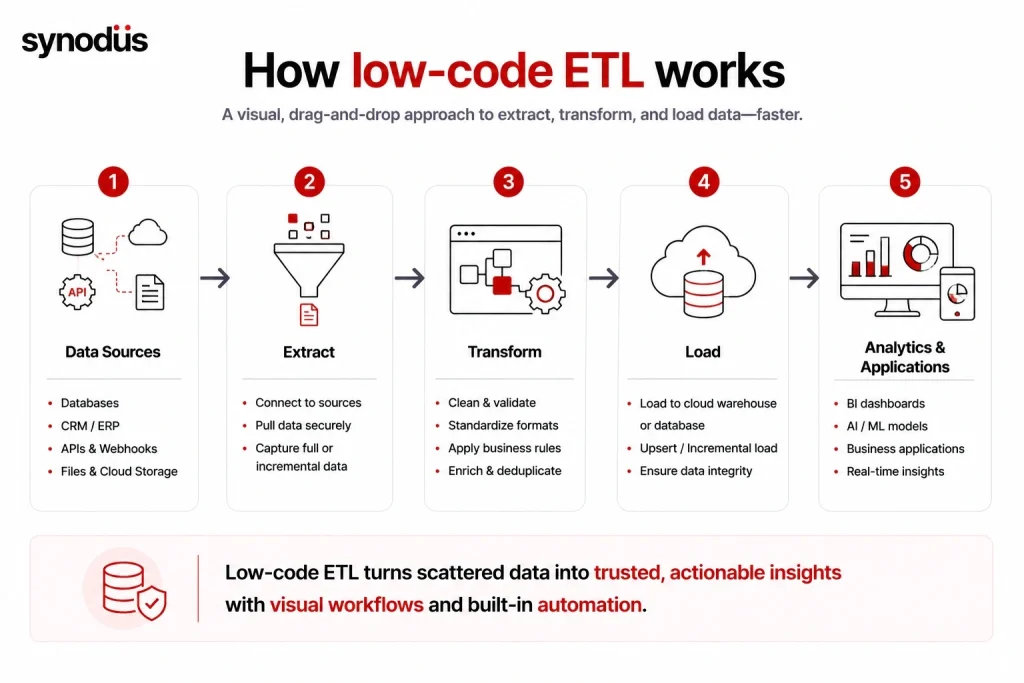
ETL is a core data warehousing process where extracting (E), transforming (T), and loading (L) happen with little or no hand-coding. You could call ETL the back end of data integration.
Low-code ETL tools are built to run that process visually while still letting developers insert custom code where it matters. They typically run on cloud databases with a drag-and-drop interface, so non-technical users can operate them and technical users can extend them. The payoff is faster data availability, which feeds better strategy and decision-making.
Differences between manual ETL and low-code ETL
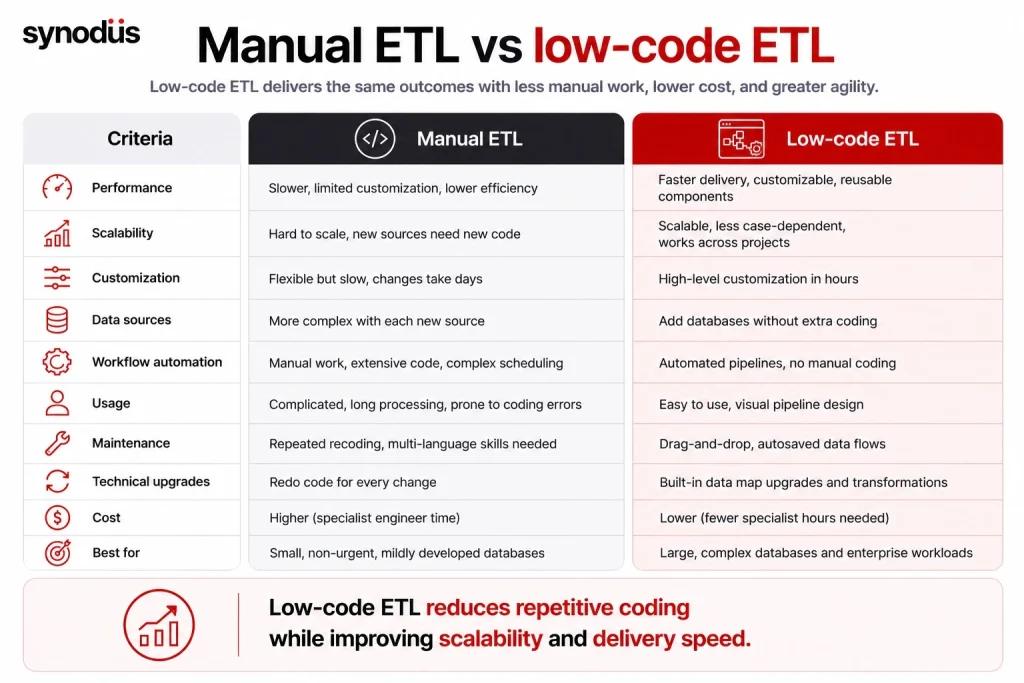
| Criteria | Manual ETL | Low-code ETL |
|---|---|---|
| Performance | Limited customization, slower to complete, lower overall efficiency | Customized to your needs, adjustable data sources and transformation rules, ships with predefined but modifiable code |
| Scalability | Hard to scale, built for specific cases, new data sources need new code | Scalable and less case-dependent, solutions reusable across projects |
| Customization | Flexible but slow, changes can take days | High-level customization delivered in hours, few restrictions |
| Data sources | Complexity rises with every source connected | Add databases without additional coding |
| Workflow automation | Manual attachment and extensive code required, scheduling is complex | No manual coding for pipelines, workflows automated |
| Usage | Complicated even for professionals, long processing, coding errors can break integration | Easy to use, minimal setup, visual pipeline design |
| Maintenance | Repeated recoding for each scenario, needs multi-language proficiency, often needs outside help | No deep multi-language proficiency needed, drag-and-drop pipeline creation, autosaved data flows |
| Technical upgrades | Redo the coding process for each change | Data map upgrades and transformations built in |
| Cost | Higher, driven by specialist engineer time | Lower, since fewer specialist hours are needed per pipeline |
| Best for | Mildly developed databases, non-urgent data | Extensive databases that would otherwise need heavy coding |
A note on cost: the gap is real but hard to pin to a single number, since manual ETL costs are mostly engineer salaries while low-code costs combine licensing with fewer engineering hours. Model both against your own data volume and team before deciding.
Types of low-code ETL
There are four main types worth knowing.
1. Enterprise ETL
Enterprise low-code ETL tools are built and supported by commercial vendors. They offer a graphical interface, ease of use, and broad features that make data integration accessible across a large organization.
They charge more for those features, but large organizations still favor them, especially where there is a constant stream of incoming data and a high demand for analytics within the pipeline. Read more in our guide to low-code for enterprise.
2. Open-source ETL
With an open-source tool, you can access and modify the codebase to fit your projects. Many are free and available on GitHub, though functionality and ease of use vary a lot between projects. Open-source options give you more control than closed platforms, and self-hosting keeps sensitive data inside your own perimeter, which matters in regulated industries. See our roundup of open-source low-code platforms.
3. Cloud-based ETL
Cloud-based low-code ETL tools use cloud infrastructure for low latency, elastic resources, and on-demand scaling that matches your workload. The trade-off is that they are tied to their cloud environment, which limits portability.
4. AI-augmented ETL (the newest type)
The newest category adds AI to the pipeline itself. Instead of writing transformation logic by hand, engineers describe the transformation in plain language and let the platform generate it, while AI agents monitor pipeline health, catch quality issues, and adapt to schema changes. Matillion, for example, has added AI agents that automate data engineering tasks, and Integrate.io has folded AI-driven automation into its visual pipeline builder. We cover this shift in more detail below.
Advantages of low-code ETL
- Cost-effectiveness: most low-code ETL tools are easier to deploy and need fewer resources, which lowers long-term maintenance costs.
- Flexibility: the biggest advantage. Users solve problems quickly without hand-coding complex transformations.
- Scalability: these tools fit any company or dataset size and make integrating multiple systems straightforward.
- Automation: something manual ETL cannot match. Workflows run automatically, errors drop, and accuracy improves, so teams focus on the business instead of repetitive work.
- Simple integrations: data engineers get ready-made components they can assemble into sophisticated pipelines, designing end-to-end flows without coding each stage. That opens the door for anyone who wants to explore an idea about data quickly.
For the full picture, see our breakdown of low-code benefits and disadvantages.
Low-code ETL still has downsides
- Error management: automation can raise the risk of undetected errors when there is less human oversight. Poor decisions baked into auto-generated code can be costly if they go unnoticed.
- Scalability limits: if a system must process too much data at once, it can slow down or fail, and the abstracted code underneath can make diagnosing the bottleneck harder.
- New AI risks: as AI enters the pipeline, generated transformation logic can ship with subtle flaws. Treat AI output as a draft and keep review, testing, and lineage tracking in place.
ETL vs ELT: The shift you should understand
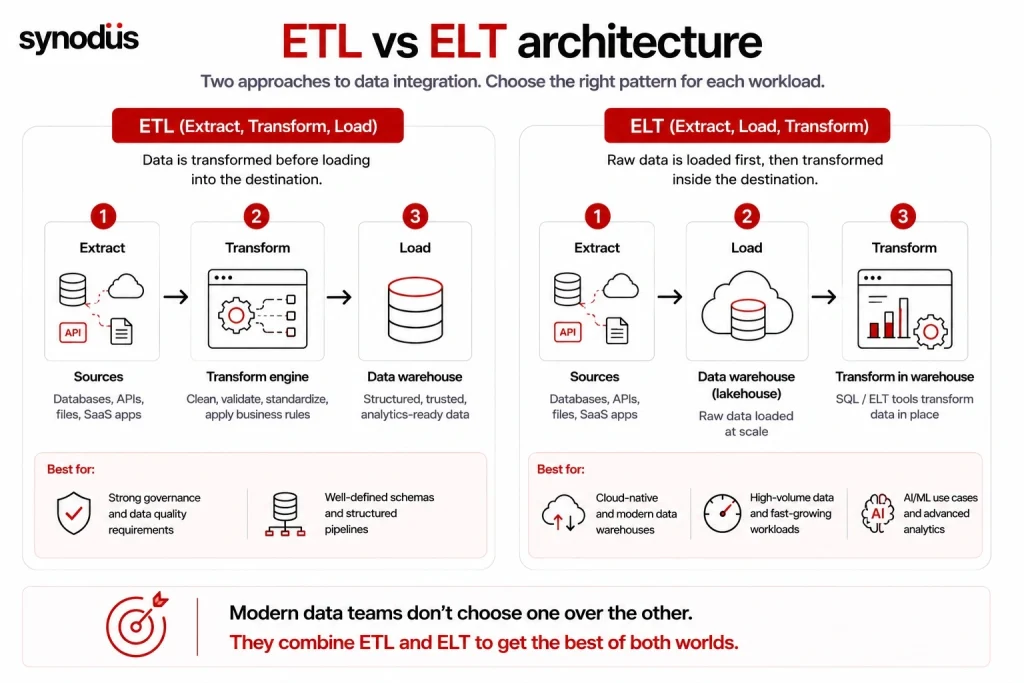
Before choosing a tool, understand the architectural change reshaping this space. Traditional ETL transforms data before loading it into the destination. ELT loads raw data first, then transforms it in place using the power of a modern cloud warehouse. The data integration software market grew 9.8% in 2024 to $5.9 billion, and much of that growth traces to the move toward cloud-native and AI-enabled pipelines.
Neither is universally better. ETL still wins where governance and structure matter most, since transforming before loading gives tighter control over what enters the warehouse. ELT leads on speed, scale, and AI readiness, since loading raw data first keeps options open. Most mature teams use both, choosing per source rather than picking one pattern for everything. Reverse ETL, which pushes modeled data back out to business tools, has become a third piece of the stack.
The AI shift: from static pipelines to agentic ETL
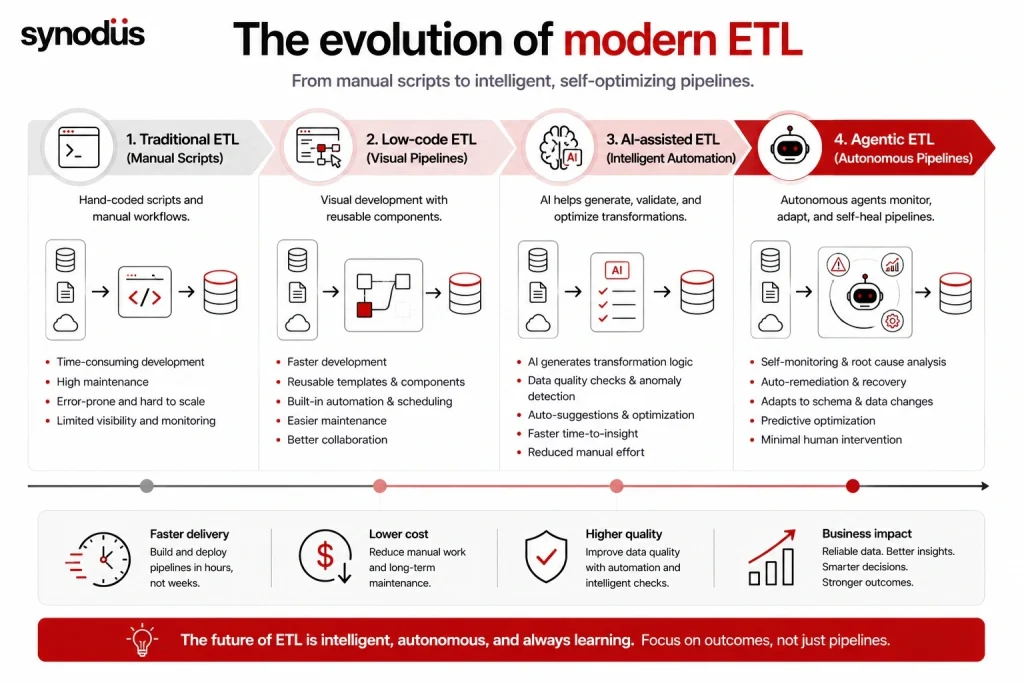
The bigger change in 2026 is AI moving inside the pipeline. Generative models now generate transformation logic from natural language descriptions instead of hand-written scripts, and a new practice called agentic data engineering is emerging, where autonomous agents manage orchestration, monitor data quality, and resolve pipeline issues on their own. Gartner predicts that by 2028, 33% of enterprise software applications will incorporate agentic AI.
The practical shift is from defining every transformation step to defining intent and letting the system work out how to get there, adjusting as schemas and volumes change. This matters most at scale, where pipelines that ran fine at 2TB start breaking at 20TB and teams spend their time babysitting them.
Two caveats. AI is not replacing ETL or ELT, it complements them, handling complex, unstructured, or fast-changing data while rule-based pipelines still serve simpler transformations well. And autonomy needs guardrails: keep humans in the loop for ambiguous cases, insist on versioned and auditable steps, and start with bounded workflows. See our roundup of low-code AI platforms for where this is heading.
Best low-code ETL tools to use
Pricing and ratings change often, so the figures below are a snapshot at time of writing. Confirm current details with each vendor.
| Platform | Approximate price | Best for |
|---|---|---|
| Integrate.io | Free tier, paid from around $15,000/year | Teams wanting ETL and ELT without deep pipeline engineering |
| Keboola | Free tier, enterprise pricing for advanced features | Automating end-to-end data operations |
| Matillion | Free trial, credit-based pricing | Building data models from many sources in a warehouse |
| AppMaster | Free tier, roughly $165 to $855/month | App building with integrated data handling |
| Microsoft Power Platform | Power Apps Premium from $20/user/month | Centralized management, ETL, and analytics on the Microsoft stack |
1. Integrate.io
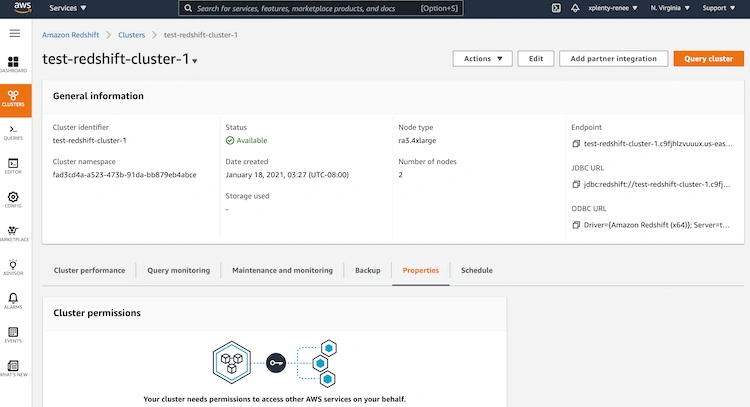
Using APIs, webhooks, and cloud platforms, Integrate.io connects data flows to your existing apps and warehouses, and handles both ETL and ELT well. It also offers no-code options and strong support, and has added AI-driven automation to its pipeline builder.
The learning curve is steep, since the product and its features take time to master. It lacks features for data replication and real-time synchronization, and logs can be hard to interpret when ETL jobs fail. Best for engineers who want a capable ETL platform without going deep into the mechanics of every failure.
2. Keboola
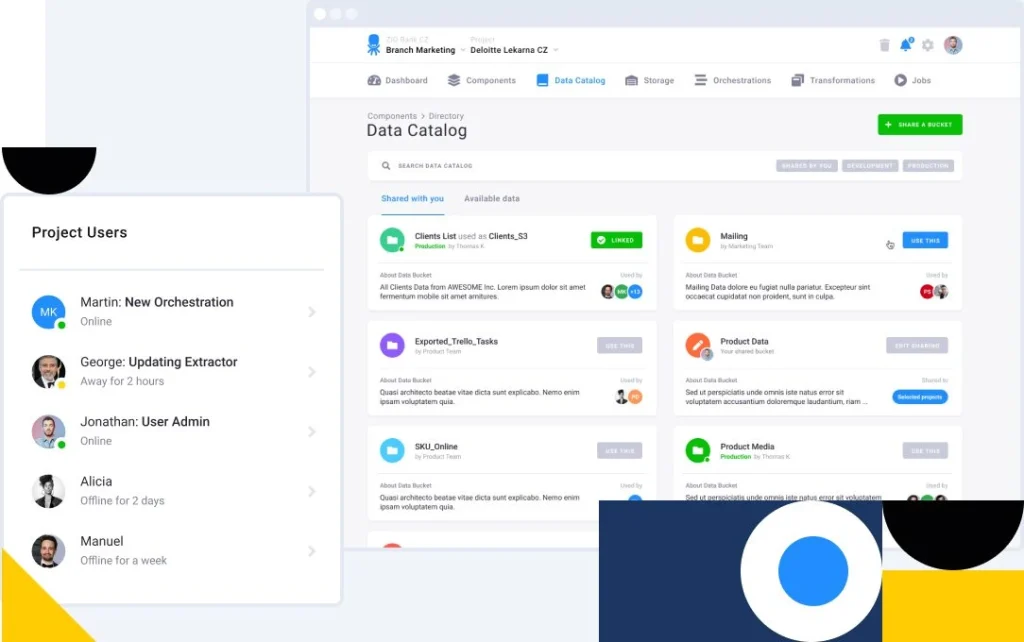
Keboola is a data platform that automates your data operations end to end, with the ability to build ETL, ELT, and reverse ETL flows. Beyond ETL, it covers data security, governance, and DataOps. Note that despite its extensibility and large library of pre-built components, it is a commercial SaaS platform rather than an open-source project.
Keboola balances performance and usability for both engineers and non-technical domain experts. It is not the best fit for real-time data flows. Best for technical data teams and data-driven business experts.
3. Matillion
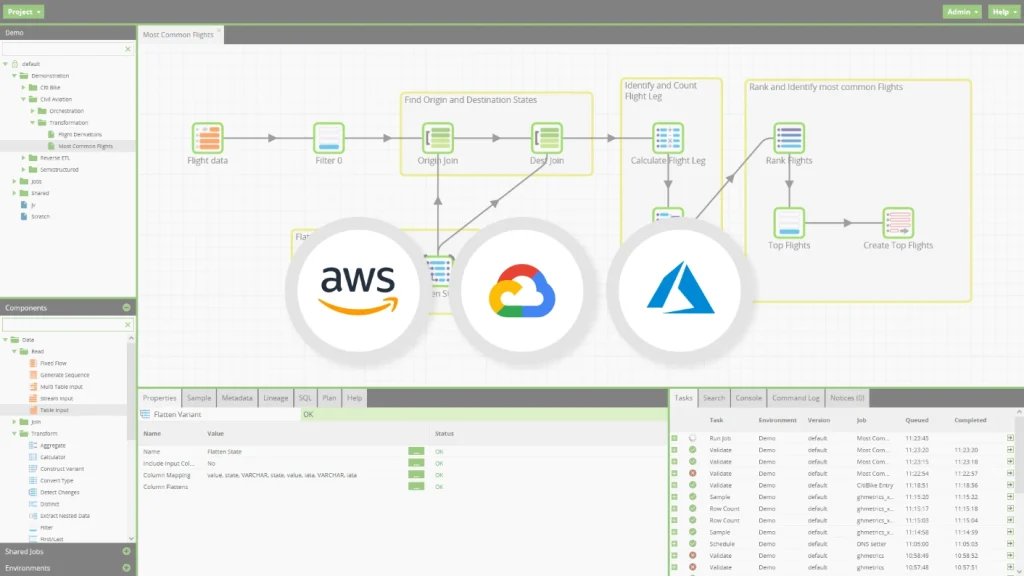
With a drag-and-drop interface and low-code support, Matillion builds ETL data processing at scale, with Change Data Capture (CDC) and batch processing, and full support for ETL, ELT, and reverse ETL. Recent versions add AI agents that automate data engineering tasks.
On the other hand, it only accepts warehouse destinations and does not feed linked data into visualization software, and scaling infrastructure can hit issues under higher loads. Best for database engineers combining many sources into a warehouse data model.
4. AppMaster
AppMaster is primarily a no-code application builder, but it handles extracting, transforming, loading, and validating data as part of building apps. With its PostgreSQL database, you can integrate, load, and convert data without coding, and its dashboards make information accessible across teams. Consider it when your data work sits inside a broader app build rather than as a standalone pipeline tool.
5. Microsoft Power Platform
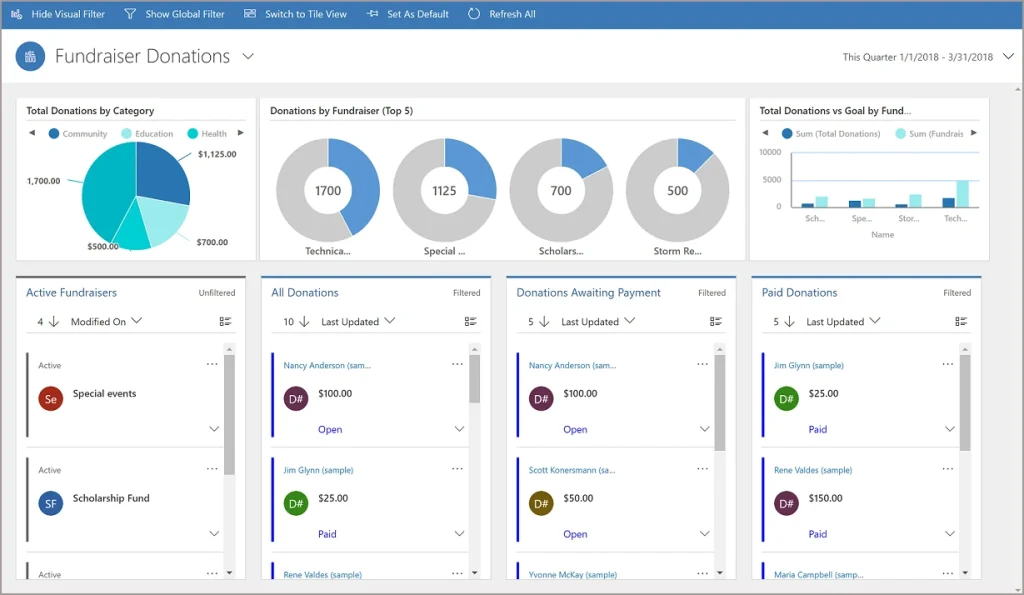
Microsoft’s Power Platform combines Power Apps (the low-code development tool), Power BI (data management and visualization), and Power Automate (workflow automation). Together they create a centralized tool for data management, ETL, and analytics.
How it supports ETL:
- Connects to a wide range of data sources.
- Supports data transformation, written in M language.
- Supports AI, machine learning, and cognitive services, with Copilot for AI-assisted building.
Pricing note: the older $5 per-app plan was retired in January 2026, so the current paths are Power Apps Premium at around $20 per user per month or Pay-As-You-Go at $10 per active user per app. To learn more, we have reviewed the Power Apps low-code platform in terms of performance, features, and extensions.
For more options in this space, see our roundups of low-code data integration tools and low-code databases.
As a Microsoft Power Platform specialist in APAC, Synodus offers a low-code development service alongside our data analytics service, with in-depth consultation and customization to build the ETL setup your business needs. We work on fixed pricing and blend agile with waterfall delivery, an approach trusted by companies like BOC Aviation, KPMG, and Unilever across more than 100 projects.
Popular languages for low-code ETL
- Python: a general-purpose language with an extensive library of packages. Once you can read Python and understand its core functions, you can find the database and analytics packages you need. Learning Python before using low-code ETL gives you a deeper understanding of how the technology works underneath.
- Java: distinct from web-oriented JavaScript, Java has a long history with ETL code. It has many rules and commands, but you will not need a wide Java vocabulary for most ETL work.
- Scala: a concise option, created partly as a response to Java’s complexity. It suits scaling needs and is approachable for low-code ETL users, and consistent practice builds the skills for writing ETL instructions.
Frequently asked questions
Low-code ETL is the extract, transform, and load process built with visual, drag-and-drop tools and pre-built components instead of hand-written scripts. It lets non-technical users build pipelines and lets developers add custom code where needed, which speeds up delivery and cuts maintenance.
ETL transforms data before loading it into the destination, giving tighter governance and control. ELT loads raw data first and transforms it in the warehouse, which is faster to ingest and more flexible for AI workloads. Most mature teams use both, choosing per data source.
No. It removes repetitive pipeline coding, but you still need engineers for architecture, complex transformations, performance at scale, and reviewing AI-generated logic. Low-code shifts their work toward higher-value problems.
AI now generates transformation logic from plain-language descriptions, and agentic data engineering is emerging, where autonomous agents orchestrate pipelines, monitor data quality, and fix issues. AI complements ETL and ELT rather than replacing them, and it still needs human oversight and auditable steps.
It depends on your setup. Matillion suits warehouse-centric data models, Integrate.io suits teams wanting both ETL and ELT without deep engineering, Keboola suits end-to-end data operations, and Power Platform suits organizations already on Microsoft.
Wrapping up
Low-code ETL outperforms manual ETL on ease of use and speed, though it comes with trade-offs around error visibility and scale. The landscape is moving too, from ETL toward ELT for cloud-scale work, and now toward AI-assisted and agentic pipelines. Weigh your tools, languages, and pipeline pattern against your objectives, budget, and data volume rather than following one trend.
If you would rather have experts build it for you, Synodus offers a low-code application development service that turns your data into apps 10x faster and cuts development costs by half. Book a free consultation to find the right fit for your data stack.