How does an NFT marketplace business model work?
At its simplest, an NFT marketplace creates an environment where sellers bring assets and buyers bring demand.
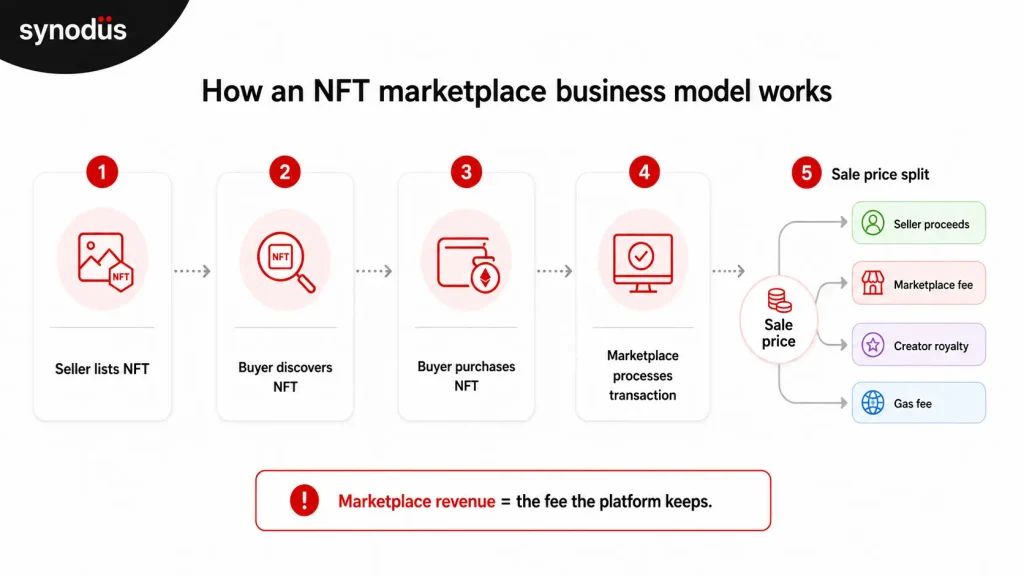
The marketplace can capture revenue during that transaction by charging a percentage of the sale price or a fixed platform fee.
If an NFT sells for $1,000 and the marketplace charges a 2% transaction fee, the platform generates $20 in gross revenue from that sale.

Blockchain network fees may also apply, but these are different from marketplace revenue because they are paid to the blockchain network rather than retained by the platform.
This distinction matters when building the financial model. Marketplace revenue is the portion of transaction value or service fees that the platform actually keeps. How those transactions are structured technically is a separate question covered in our guide to building an NFT marketplace.
How do NFT marketplaces make money?
Transaction fees are the most recognizable NFT marketplace revenue stream, but they are not the only option. The right combination depends on what is traded, who uses the marketplace, and what value the platform provides beyond facilitating a transaction.
Transaction fees
A transaction fee is a percentage or fixed amount collected when a sale is completed.
- NFT sale: $1,000
- Marketplace fee: 2%
- Marketplace revenue: $20
Transaction fees scale with volume. With low trading activity, they generate limited revenue regardless of the percentage.
The fee does not have to be charged to the seller. A marketplace can charge the buyer, seller, or both sides depending on its transaction model.
OpenSea provides a current example of a seller-side model. According to OpenSea’s fee policy, the platform typically charges a 1% fee for NFT sales, with the fee included in the price displayed to the buyer.
Transaction fees are particularly suitable for marketplaces where trading volume is central to the product, such as General NFT marketplaces and some Gaming marketplaces.
Primary sale commissions
A marketplace can also earn revenue when an NFT is sold for the first time.
This is common when the platform does more than provide secondary trading. A curated marketplace, for example, may help select artists, present collections, manage drops, and connect creators with an existing collector base.
The marketplace can take a percentage of the primary sale in return.
SuperRare uses this model. Under SuperRare’s current fee structure, the artist receives 85% of a primary sale and 15% goes to the SuperRare DAO Community Treasury. Buyers also pay a 3% marketplace fee on top of the sale price.
OpenSea also separates primary and secondary marketplace economics. For NFTs minted through OpenSea Drops, OpenSea currently charges a 10% fee on the primary mint sale, with the remaining 90% sent to the creator’s configured payout address.
Primary sale commissions make more sense than relying entirely on secondary trading when primary issuance is an important part of the marketplace.
Listing and onboarding fees
A marketplace can charge sellers or issuers to add assets to the platform.
A simple marketplace might charge a listing fee when an asset is published. More controlled platforms may charge for a broader onboarding process that includes asset review, collection setup, verification, token issuance, or documentation.
This model is generally easier to justify when listing itself provides value.
An RWA marketplace, for example, may need to review issuer information, verify documents, structure asset data, configure transfer restrictions, and onboard the asset before trading can begin. An onboarding or issuance fee fits that operating model better than a basic listing fee.
For a high-volume open marketplace, upfront listing fees can create unnecessary friction, especially when sellers have alternative platforms where listing is free.
Subscription and premium services
A marketplace can offer paid plans for professional sellers, creators, brands, or issuers that need more than the standard account.
Depending on the marketplace, premium functionality could include advanced analytics, additional storefront tools, reporting, API access, account management, or other business-oriented features.
Subscriptions create a recurring revenue stream from users who receive ongoing value from the platform without requiring every transaction to generate revenue. They only make sense when the paid functionality is valuable enough to justify recurring payment. Putting basic marketplace functions behind a subscription makes user acquisition harder.
Featured placement and promotion
Sellers may also pay for additional visibility, such as promoted collections, featured drops, sponsored placements, or enhanced storefront exposure.
Featured placement has limited value on a marketplace with few buyers. Once the marketplace becomes a discovery channel in its own right, visibility becomes something sellers are willing to pay for.
Promotional revenue works better as a secondary stream rather than a foundation, particularly at the early stage.
Additional marketplace services
Some marketplaces provide services around the transaction itself and charge separately for them.
Depending on the product, these services may include asset issuance, tokenization, managed drops, verification, custody, enterprise APIs, compliance workflows, or other infrastructure.
This is particularly relevant for marketplaces serving businesses or RWA issuers, where the platform may provide much more than a place to list and trade an NFT.
The revenue model should follow the actual service being delivered rather than adding fees simply because the platform uses blockchain.
Marketplace fees vs. royalties vs. gas fees
These payments are often discussed together, but they serve different purposes.
| Payment | Who receives it? | Marketplace revenue? | What it covers |
|---|---|---|---|
| Marketplace fee | Marketplace or protocol | Usually yes | Platform services and transaction facilitation |
| Creator royalty | Creator or designated recipient | Usually no | Creator earnings from eligible secondary sales |
| Gas fee | Blockchain validators | No | Processing a blockchain transaction |
| Seller proceeds | NFT seller | No | Payment for the asset being sold |
A marketplace fee is not the same as a gas fee. OpenSea explains that gas fees are determined by the blockchain and are not revenue received by OpenSea. Users may need to pay both a marketplace fee and a network fee during the same transaction, but the money goes to different recipients.
Creator royalties are also separate from marketplace revenue. A secondary NFT sale can distribute value to both the marketplace and the creator, but the creator’s royalty normally belongs to the royalty recipient rather than the platform.
Keeping these payments separate is important when calculating both user transaction costs and marketplace revenue.
What determines whether an NFT marketplace is profitable?
Charging a transaction fee does not guarantee a profitable marketplace. The business depends on how much activity the platform can generate and how much it costs to support that activity.
Trading volume and GMV
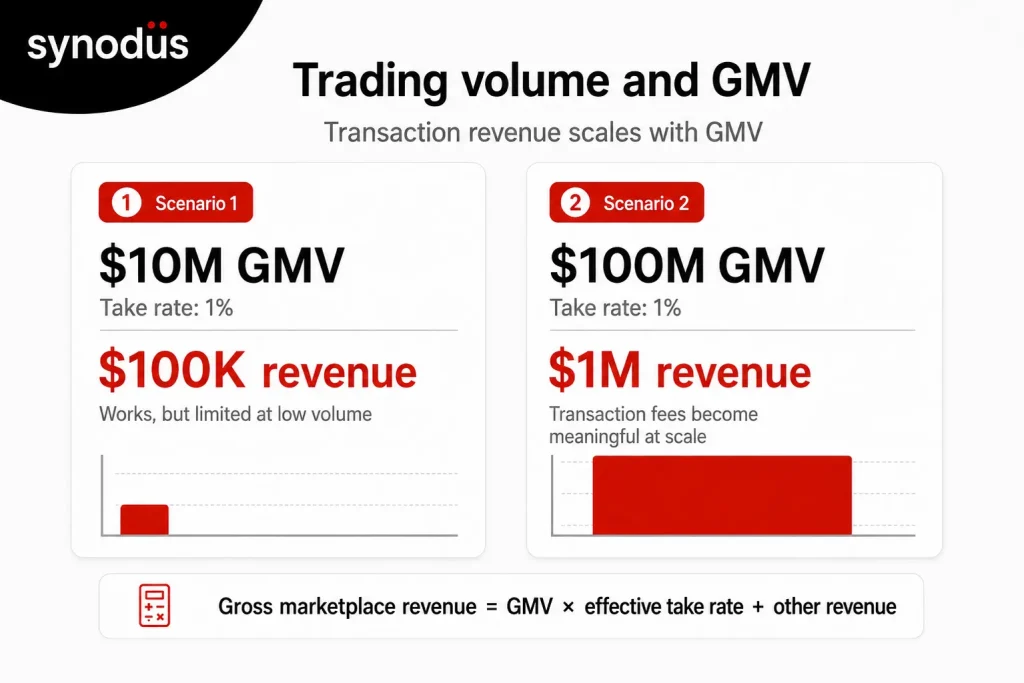
For a transaction-driven marketplace, gross merchandise value (GMV) is one of the most important metrics. GMV represents the total value of transactions processed through the marketplace during a period.
Gross marketplace revenue = GMV x effective take rate + other revenue
- Annual GMV: $10 million
- Effective take rate: 1%
- Transaction-based revenue: $100,000
At $100 million GMV with the same take rate, transaction revenue reaches $1 million. Transaction fees scale well at volume but produce limited revenue when trading activity is low.
Effective take rate
The advertised marketplace fee and the effective take rate are not always identical.
A marketplace may apply different rates to different transaction types, waive fees during campaigns, charge only one side of a transaction, or generate additional revenue from primary sales and premium services.
The financial model should calculate the percentage of GMV the marketplace realistically expects to retain rather than relying only on the headline fee.
Liquidity
Thousands of listed NFTs do not create revenue if buyers and sellers rarely complete transactions.
A marketplace needs sufficient liquidity so that sellers can find buyers and buyers can find relevant assets at acceptable prices. More attractive inventory brings more buyers, and a stronger buyer base encourages more creators and sellers to participate. Reaching enough liquidity for that cycle to begin is the hard part.
Customer acquisition
An NFT marketplace is a two-sided platform. It needs both supply and demand.
Acquiring sellers without buyers creates inactive inventory. Acquiring buyers without enough relevant assets gives them little reason to return.
Early-stage marketplaces may spend significantly on community development, partnerships, incentives, marketing, creator acquisition, or business development before network effects become meaningful. These costs need to be included when evaluating profitability.
Operating costs
Marketplace revenue has to support the infrastructure behind the product.
Depending on the architecture and marketplace type, costs may include product development, cloud infrastructure, blockchain RPC services, event indexing, data storage, search infrastructure, security monitoring, smart contract audits, customer support, third-party integrations, maintenance, and compliance operations. Some of these costs grow with transaction activity.
Profitability = marketplace revenue – development, infrastructure, security, acquisition, operational, and compliance costs
The objective is not to maximize the fee percentage. It is to find a model where enough valuable activity occurs to cover the cost of operating and growing the marketplace.
Which revenue model fits each NFT marketplace type?
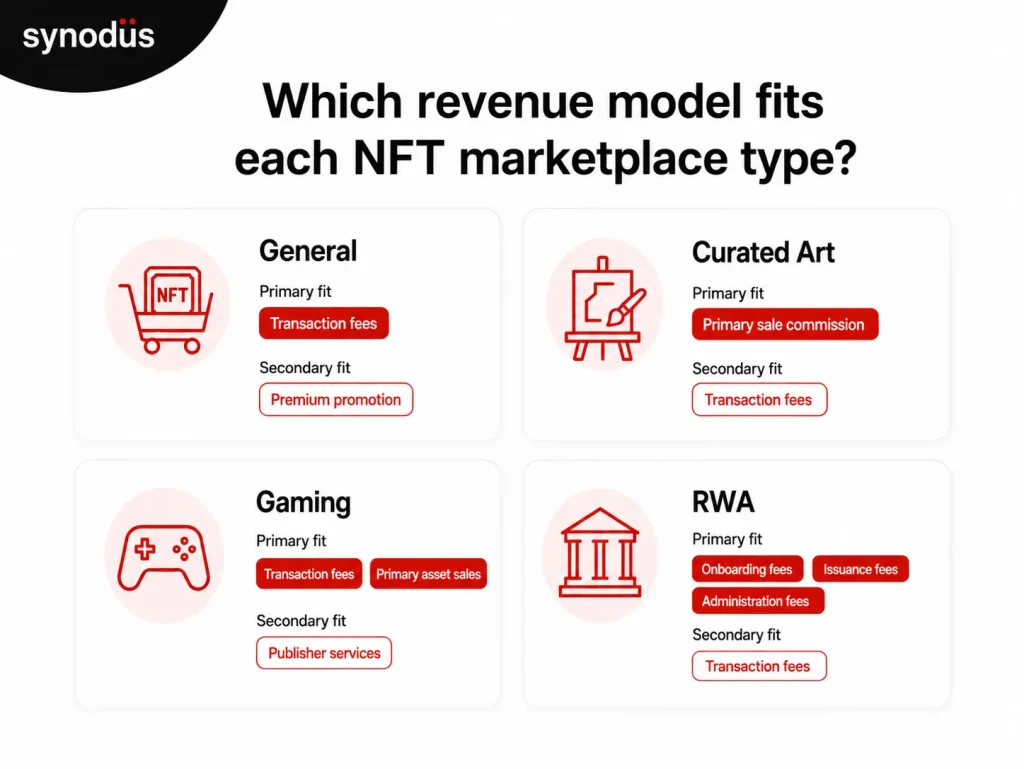
Different marketplace types create value in different ways and should not automatically use the same monetization model.
| Marketplace type | Monetization options worth considering | Why |
|---|---|---|
| General | Transaction fees, premium promotion | Revenue can scale with broad trading activity |
| Curated Art | Primary sale commission, transaction fees | Curation and access to collectors add value beyond transaction execution |
| Gaming | Transaction fees, primary asset sales, publisher services | Assets may trade frequently and can be connected to a wider game economy |
| RWA | Onboarding, issuance, transaction, administration fees | Asset structuring, verification, and operational workflows can be significant parts of the service |
These are not fixed rules. A General marketplace can support paid services, and an RWA platform can charge transaction fees. The point is to identify where the marketplace creates value and charge for that part of the user journey.
General marketplaces
A broad marketplace usually depends heavily on liquidity and trading activity. Transaction fees are a natural primary model because revenue rises as more assets are traded. Additional revenue can come later from promoted collections or seller tools once the marketplace has enough traffic for those services to have value.
The main risk is charging too aggressively before liquidity develops.
Curated Art marketplaces
A curated marketplace provides value through selection as well as transaction infrastructure. Artists may gain access to a specific collector audience, while buyers receive a more controlled catalog.
That gives the marketplace more room to monetize primary sales, secondary transactions, or selected creator services. SuperRare demonstrates this by combining a primary-sale allocation with a buyer-side marketplace fee rather than depending on one flat secondary trading fee. SuperRare explains the full split in its marketplace pricing documentation.
Gaming marketplaces
Gaming marketplaces can be more transaction-intensive because NFTs may represent characters, skins, weapons, land, or other assets that users trade as part of a larger game economy. Transaction fees work well when assets change hands frequently.
The marketplace can also sit within a broader commercial model involving primary asset sales, game publishers, issuance services, or other ecosystem revenue. The appropriate structure depends heavily on how the marketplace connects to the game itself.
RWA marketplaces
RWA marketplaces have a different economic structure. Secondary trading may be only one part of the platform. Asset onboarding, issuer verification, token issuance, documentation, identity checks, administration, reporting, and controlled transfers may all be part of the operating model.
Onboarding, issuance, or administration fees may be more appropriate than relying entirely on secondary-market volume. The revenue model should be chosen after the marketplace type and transaction flow are defined.
NFT marketplace business model examples
OpenSea, Rarible, and SuperRare illustrate three different approaches to marketplace fees.
| Marketplace | Current fee approach | What it demonstrates |
|---|---|---|
| OpenSea | Secondary transaction fee + primary drop fee | Different rates can apply to primary and secondary activity |
| Rarible | Transaction fees that vary with transaction value | A marketplace does not need one flat take rate |
| SuperRare | Primary sale allocation + buyer marketplace fee | A curated platform can monetize several points in the transaction lifecycle |
OpenSea
OpenSea is primarily transaction-driven.
Under OpenSea’s current fee structure, the platform typically charges a 1% fee when an NFT is sold. For primary drops, the platform fee is 10% of the mint sale price.
A platform can monetize primary issuance and secondary trading differently because it provides different services at each stage. Gas should not be included when calculating OpenSea revenue. OpenSea states that it does not control or profit from blockchain gas fees.
Rarible
Rarible shows a different way to structure transaction fees.
Rather than applying one percentage across every transaction, Rarible currently uses a regressive fee structure. Its published rates vary with transaction value, with lower percentages applied to higher-value trades.
Users can also reduce transaction fees by locking RARI, Rarible’s governance token, with eligible users qualifying for 0% fees on Rarible.com.
Rarible also illustrates how marketplace infrastructure can support different economics for different operators. In Rarible-powered community marketplaces, marketplace owners can configure their own transaction fee and payout wallet.
The business-model lesson is not the exact percentage. A marketplace can adjust its take rate based on transaction value, user incentives, or marketplace configuration.
SuperRare
Superare provides a useful example of a curated marketplace with several economic flows.
According to SuperRare’s marketplace pricing model, the artist currently receives 85% of a primary sale while 15% goes to the SuperRare DAO Community Treasury. On all sales, the buyer pays a 3% marketplace fee on top of the sale price.
On secondary sales, the original artist receives a 10% royalty and the seller receives 90% of the sale amount. That 10% creator royalty goes to the artist, not the platform, and should not be counted as marketplace revenue.
- Primary sale commission → Marketplace revenue
- Marketplace transaction fee → Marketplace revenue
- Creator royalty → Creator revenue
Treating these separately gives a much more accurate view of marketplace economics.
How to choose a revenue model for your NFT marketplace
Start with how value moves through the marketplace, then decide where it makes sense for the platform to capture revenue. Four things to evaluate:
1. Identify the activity that creates value
Determine whether the marketplace creates most of its value through trading, primary issuance, asset onboarding, curation, or additional services. The primary revenue model should be tied to that activity.
2. Estimate how often that activity will happen
Transaction fees depend on volume, while onboarding or subscription models can generate revenue without frequent secondary trading. Build the model around realistic user behavior rather than expected growth alone.
3. Check how the fee affects adoption and liquidity
A higher fee increases revenue per transaction but can make the marketplace less attractive to buyers or sellers. Consider how pricing affects participation, repeat transactions, and the ability to build liquidity.
4. Compare revenue with the cost to deliver the service
The fee should reflect what the marketplace actually has to operate, whether that includes transaction infrastructure, asset verification, compliance, customer support, or other services.
For an early-stage marketplace, starting with one primary revenue stream and adding secondary models once actual user behavior becomes clearer is usually easier than trying to monetize everything at once.
The right revenue model balances monetization with user adoption, liquidity, and operating cost.
Final thoughts
An NFT marketplace business model works when revenue is tied to activity the platform can realistically generate.
Transaction fees are a natural fit for marketplaces with frequent trading, while Curated Art, Gaming, and RWA platforms may have stronger reasons to monetize primary sales, onboarding, issuance, or specialized services.
Start with the transaction flow and expected user behavior, then model GMV, take rate, liquidity, and operating costs before setting the fee structure.
A higher fee does not necessarily create a better business. If it reduces liquidity or discourages the activity the marketplace depends on, it works against the marketplace’s own economics.
FAQ about NFT marketplace business models
Transaction fees are one of the most straightforward models, with the marketplace taking a percentage or fixed amount from completed sales. Curated, Gaming, and RWA marketplaces may also rely on primary-sale commissions, onboarding fees, or specialized services.
Revenue depends mainly on trading volume, effective take rate, and additional paid services. A marketplace processing $10 million in GMV at an effective 1% take rate generates about $100,000 in transaction-based gross revenue before operating costs.
No. Gas fees are blockchain network costs paid to validators or other network participants. Marketplace transaction fees should be modeled separately from gas.
Usually not. Creator royalties normally go to the creator or another designated royalty recipient, while the marketplace earns its own platform fee.
There is no single model that fits every marketplace. The best option depends on what users trade, how often transactions occur, where the platform creates value, and what it costs to operate the marketplace.