Who is a citizen developer?
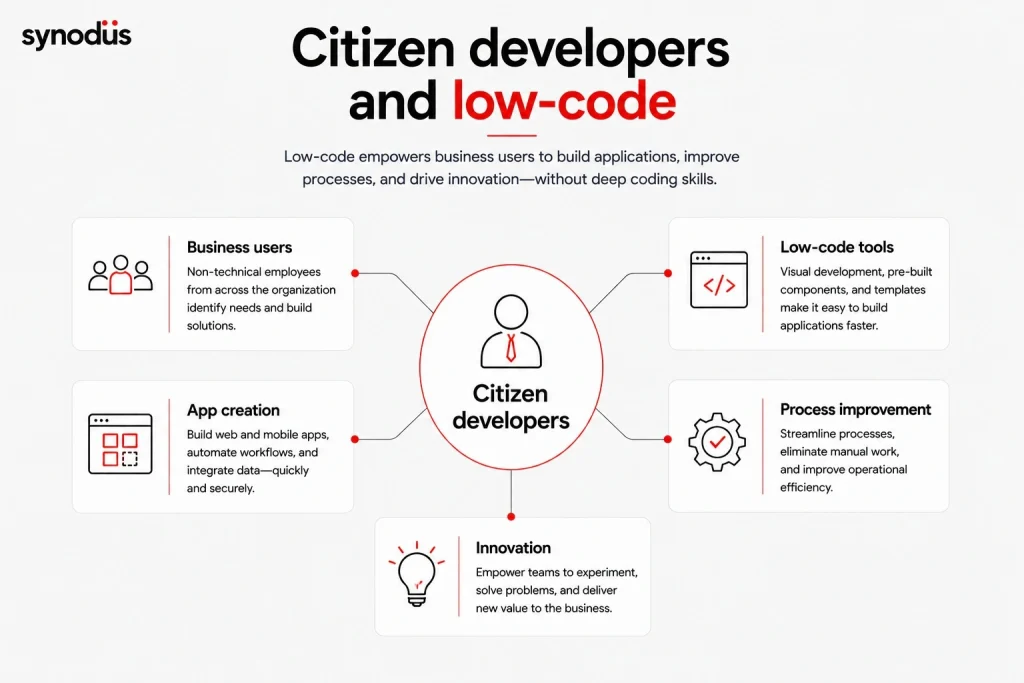
A citizen developer is a non-technical employee who builds applications, with IT’s blessing rather than its direct involvement, to serve their own or their team’s needs. Citizen developer is a persona, not a job title.
They report to a non-IT unit and could be anyone in the company: an account manager, an accountant, or a marketing executive. The key difference from professional developers is that they lack deep coding knowledge and do not sit in IT. Without the right tools, they would have nowhere to start.
All citizen developers are business technologists, but not all business technologists are citizen developers. Citizen developers do not need a specific skill set or time commitment, but they must be employees of the organization.
The demand for citizen developers
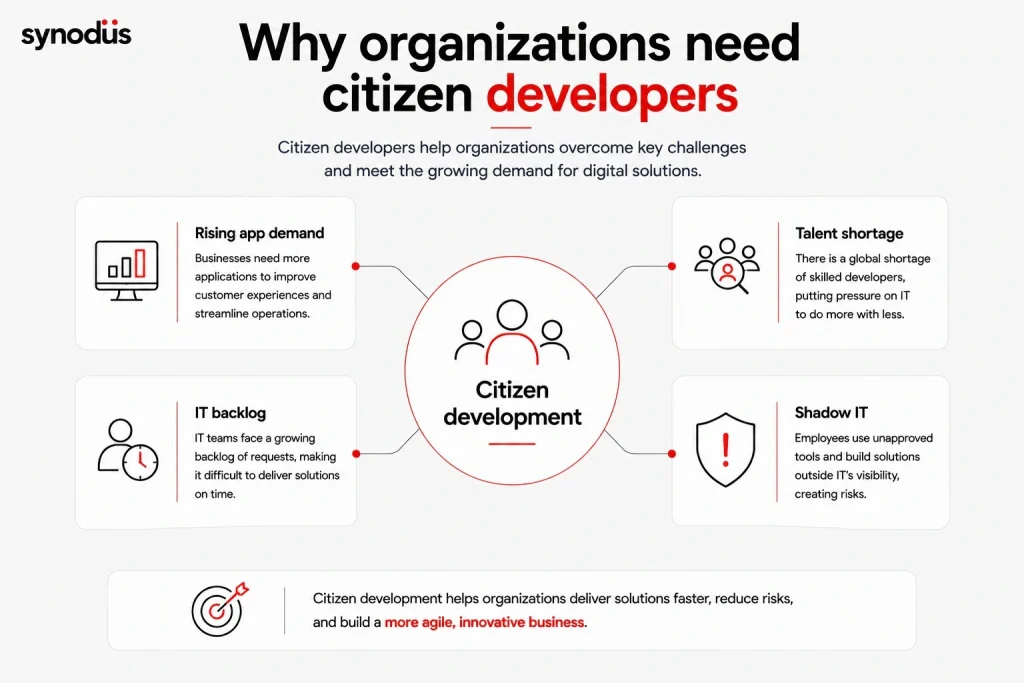
Why do businesses need citizen developers and not just professional coders? There is a clear reason tech giants and leading enterprises encourage employees to take part in tech creation.
The business need
Traditional software usually tackles enterprise-level or department-level problems, while business users solve daily tasks by creating their own spreadsheets, desktop databases, or notes. IT is often unaware of these, which over time leads to disorganized data and lost information when an employee leaves. A unified landscape where anyone can build approved applications is more secure and manageable, so companies should train employees who want to become citizen developers and give them a platform to share ideas.
The IT need
According to a Mendix study, 77% of IT and 71% of business leaders agree that IT faces a large backlog of solution requests, with many more still in development. That pressure keeps IT from meeting demand for business-critical apps.
Worse, many app ideas turn out to be impractical, and you often only learn that by trying to build them. Citizen developers can test an idea by quickly building an MVP, and handle easy, repetitive tasks so IT can focus where it matters most. Learn more about the value of an MVP in software development and how citizen developers use it to test ideas fast.
The benefits of having citizen developers
Meeting demand
Nearly every business is now either a tech company or one that relies on tech tools, which drives huge demand for internal apps. Gartner expects around 75% of new applications to be built with low-code by 2026, and citizen developers to outnumber professional developers four to one at large enterprises. IT alone, with limited resources, cannot build everything on time, which makes citizen development the best way to clear that hurdle.
Addressing the developer shortage
Skilled developers are in short supply, and the global tech talent shortage is projected to reach 85.2 million workers by 2030. That strain falls on IT. Organizations that run a formal citizen development program face the shortage head-on by empowering motivated business users to build the apps that solve their own immediate problems.
Managing shadow IT
Shadow IT, when employees use unapproved tools, can create a technical wild west if left unchecked. The fix is not to ban it but to channel it through a citizen development program. With a recognized program in place, those must-have apps get built on IT-approved platforms, giving IT the visibility and control to maintain quality and security. See our deeper look at shadow IT and how to manage it.
Increasing business and IT productivity
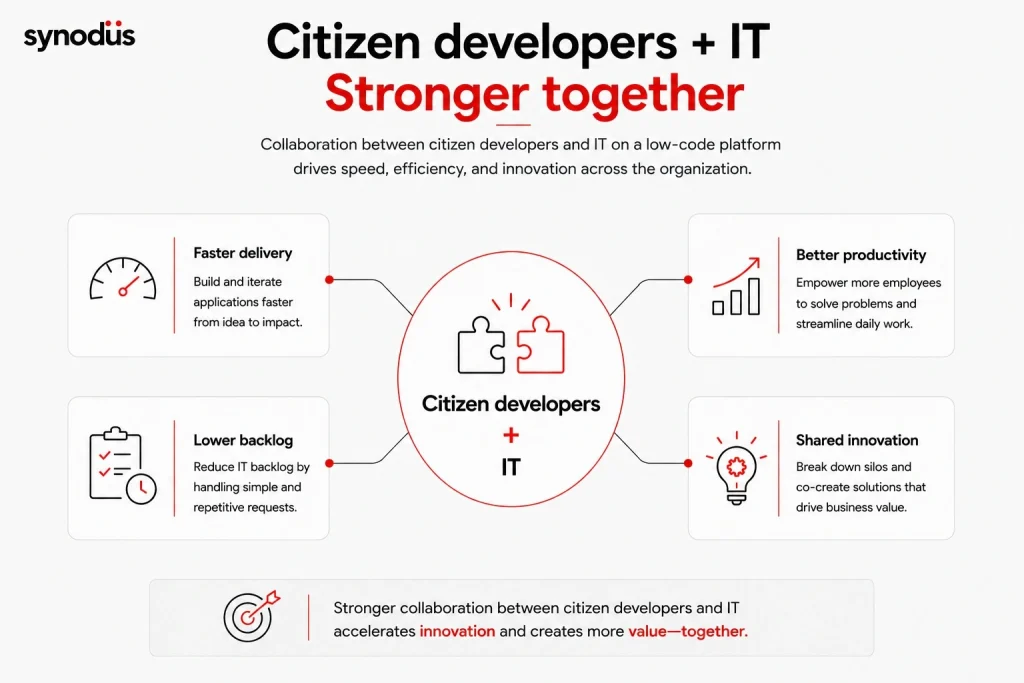
Citizen development gives business users approved technology and IT support to build essential productivity apps. When they do, they work more efficiently, cut operating costs, and reduce the IT backlog. IT is then free to focus on more technically demanding work like legacy modernization, core system extensions, and enterprise-wide applications.
Breaking down silos
As businesses grow, so do organizational silos, and there is often already a divide between IT and the business. Citizen development bridges that gap by giving business users and professional developers a shared space to collaborate. If a citizen developer’s app on an approved tool grows complex, they can invite a skilled developer to build the harder parts in the same platform.
What is low-code?
Low-code is a development approach that contrasts with traditional software development. It focuses on reusing and sharing code to save time, so IT professionals no longer need to write lines of code for a simple change or update.
Thanks to low-code’s core features, drag-and-drop building, pre-built templates, and ready-made design elements, citizen developers with no coding background can jump straight in. For a fuller primer, read our guide to what low-code is and why it matters.
How low-code and citizen developers go hand in hand
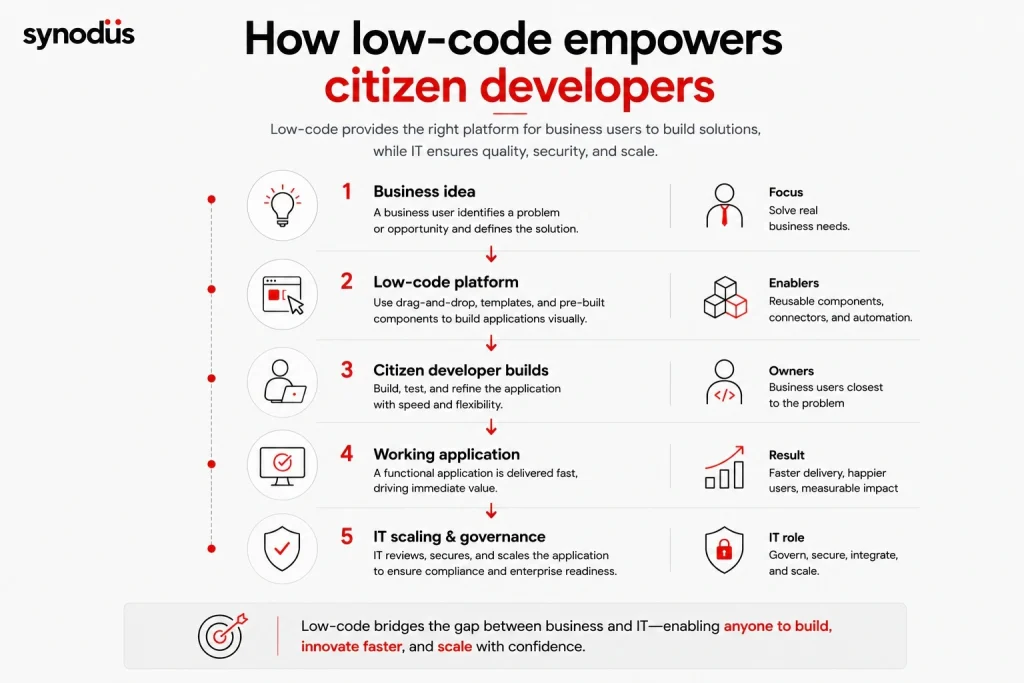
Encouraging citizen developers is good, but giving them a platform to excel is better. They have little coding knowledge, and building apps is not their main job, so you cannot expect results without the right tools.
Low-code is the top way for citizen developers and professionals to work together, because it does not lean heavily on IT to create a basic app. The typical workflow looks like this: a citizen developer builds an app with a few features, it works well until they want something more advanced, then they bring in IT. If the app delivers strong results, the business can plan to scale it for wider use.
Roughly 40% of businesses report a skills gap in development. Low-code helps by letting citizen developers test an idea first before scaling, rather than stalling when IT says it lacks capacity. A good platform gives them everything needed to build, with an interface easy enough to start immediately. To get the most from both, invest in low-code and citizen developers together. For options, explore our roundup of the best low-code platforms.
How AI is supercharging citizen development
The biggest shift in 2026 is AI. Most low-code platforms now include AI copilots that turn a plain-language prompt into a working app, flow, or data model, which lowers the skills barrier even further and widens the citizen developer base. As analysts note, natural-language app generation, AI-assisted data mapping, and agent-driven workflows are becoming standard, and AI is accelerating low-code rather than replacing it.
For citizen developers, this means you can describe what you want and let the platform draft it, then refine visually. For IT, it raises the stakes on governance: AI makes it easier than ever to build, so guardrails, review, and access control matter more than before. The winning model is governed enablement, where AI and citizen developers move fast inside a framework IT defines. See our roundup of low-code AI platforms for where this is heading.
Tips to successfully employ low-code with citizen developers
The low-code trends shaping software development are here to stay, but embracing citizen programming and deploying it well takes effort. Here are three steps for success.
1. Encourage large-scale training
If you train your people well in citizen development, your chances of releasing innovative products at scale and speed rise sharply. Train and empower employees to make their own decisions, and encourage people to learn low-code together, which builds a culture of community.
2. Put knowledge into action
Get the most from low-code by encouraging employees to build solutions for real problems in the organization and add value to live projects. Citizen developers can also play a role in new initiatives that support other departments.
3. Use freedom within a framework
Good low-code tools create a win-win: business professionals gain the freedom to build cutting-edge solutions, but they do so within an IT governance framework that stays compliant with regulations.
Top low-code platforms for citizen developers
Here are strong low-code platforms for citizen development:
- Creatio is a top platform for managing processes of any complexity with pre-built solutions and reusable templates, focused on process automation and mobile app development across advertising, retail, finance, logistics, legal, and pharmaceutical.
- Microsoft Power Apps accelerates development with fewer resources and suits enterprise and professional-grade apps that may be too complex for other platforms.
- OutSystems builds advanced, high-performance applications that are secure, reliable, cloud-ready, and scalable.
- GeneXus is an enterprise platform that uses AI to automate and maintain apps across systems, environments, and devices, with flexibility and high performance.
- UI Bakery offers affordable pricing for unlimited end users, so even small and medium businesses can automate processes without costly in-house or outsourced teams.
- Quickbase streamlines and simplifies business processes, letting users build apps tailored to their needs.
- TrackVia turns paper-based or spreadsheet-based procedures into efficient web and mobile apps, and suits complex enterprise apps and legacy databases.
- Retool builds internal tools and apps for all kinds of businesses, used by companies like NBC, Fox, and Warner Brothers to build workflows on top of their data.
For a fuller comparison sorted by company size, see our guide to the best low-code platforms for startups, SMEs, and enterprises.
Frequently asked questions
A citizen developer is a non-technical employee, such as a marketer, accountant, or operations lead, who builds applications using IT-approved tools to solve their own or their team’s problems. It is a persona rather than a job title, and it does not require formal coding skills.
No. Citizen developers handle straightforward apps and free IT to focus on complex, high-value work. Gartner expects citizen developers to outnumber professional developers four to one at large enterprises, but the model works best when the two collaborate, with IT setting standards and guardrails.
Low-code and no-code platforms, such as Microsoft Power Apps, Creatio, Quickbase, and Retool, which use drag-and-drop building and pre-built templates. In 2026, most of these also include AI assistants that generate apps from a plain-language prompt.
Run a governed program: standardize on IT-approved platforms, set access controls and review processes, and give professional developers a role in defining guardrails. This turns shadow IT into visible, manageable development.
Wrapping up
The success of your citizen development program comes down to the platform you choose, so pick one designed to meet your organization’s needs over the long run. Empowering citizen developers to cut costs, boost productivity, and meet growing app demand is one of the smartest early moves a business can make, especially now that AI is lowering the barrier even further.
If you would rather have experts set it up for you, Synodus builds custom low-code service and governed Power Platform environments that turn your data into apps 10x faster and cut development costs by half, with the guardrails citizen development needs. Book a free consultation to find the right fit for your team.