According to Deloitte, just 23% of blockchain initiatives move beyond proof of concept. The failure is rarely technical. It’s strategic: the wrong use case, the wrong architecture, the wrong sequence of decisions – problems that no amount of good engineering can fix once they’re baked in. The result is wasted budgets, delayed launches, and products that never reach users.
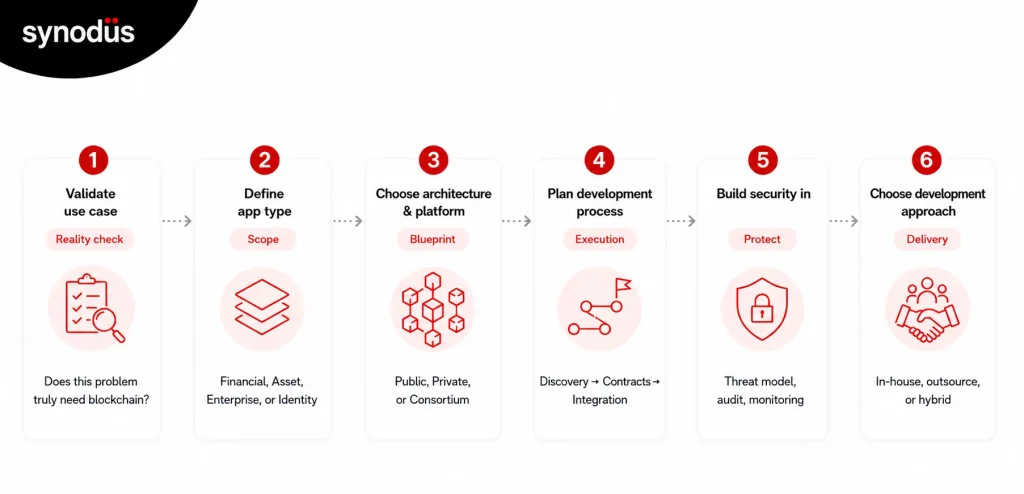
This guide walks you through the decisions that prevent that outcome – in three parts:
- Validate: Whether blockchain is actually the right tool for your problem, and which type of application fits your use case
- Design: How to choose the right architecture, platform, and development process for your specific requirements
- Build: How to handle security, structure your team, and estimate realistic timelines and costs before committing to a build
By the end, you’ll have a clear picture of what your project actually requires and a decision framework that lets you move forward without rebuilding later.
Step 1: Validate your use case – does your problem actually need blockchain?
Before any of the decisions below matter, there’s a more fundamental question: does your use case actually need blockchain?
Blockchain solves one thing well – trust between parties who don’t trust each other, without a middleman. If that’s not the core of your problem, a traditional database will likely serve you faster, cheaper, and with far less complexity.
Run through these three questions before going further:
- Do multiple independent parties need to read or write to the same data?
- Is there a low level of trust between those parties?
- Is transparency or data immutability a core requirement, not just a nice-to-have?
If you answered no to two or more, blockchain is probably overkill for your use case.
| Blockchain | Traditional database | |
|---|---|---|
| Best for | Multiple untrusting parties | Single org or trusted partners |
| Data control | Shared, decentralized | Centralized, easier to manage |
| Cost | Higher build & run cost | Lower across the board |
| Speed | Slower by design | Fast |
| Auditability | Built-in, tamper-proof | Requires extra implementation |
If your situation fits the right column more than the left, stop here and save the budget. If the left column describes your problem, read on.
Step 2: Define what you’re building – app type, legal & compliance
The application type you choose shapes every key decision like platform, cost, timeline, and risk. So, this section will help you clarify your direction early.
Here is a quick decision summary for you
| Your situation | App type | Must-do before you build |
|---|---|---|
| You need to move or manage money without a central intermediary | Financial | Independent security audit + token classification review + KYC/AML roadmap |
| You need to prove or transfer ownership of an asset | Asset & Ownership | Legal structure linking the token to the real asset + token classification review (if you issue a token) |
| You need multiple organizations to share and verify the same data | Enterprise | Governance agreed on paper + jurisdiction review if participants span multiple countries |
| You need people to prove who they are without relying on a central authority | Identity | On-chain/off-chain architecture decided for personal data (GDPR) + core verifiers confirmed to participate |
Financial applications
This includes DeFi protocols, lending platforms, payment apps, and remittance tools.
These apps exist to automate financial rules without human intermediaries. The smart contract is the product. If you remove it, there’s nothing left.
This makes financial apps the riskest category to build in. As of December 2024, hacking incidents in DeFi have accumulated losses of over $9.11 billion, and unlike a bank breach, there’s no insurance or regulator to call, and no way to reverse a transaction.
The decision you need to make
Is an independent security audit in your budget? If not, your project isn’t ready.
A smart contract vulnerability causes permanent, irreversible loss of funds. The Ronin bridge hack lost $625 million and the Wormhole exploit lost $320 million are prime examples. Both were audited projects that still lost hundreds of millions.
So, budget for at least one independent audit before you launch. If your vendor’s proposal doesn’t include this line item, ask why.
Watch out for – Regulatory risk, on two fronts.
First, token classification. If your app creates any kind of token, get a legal opinion on whether it’s a security in every country you operate in. This is judged by how the token works and is marketed, not its label. Get this opinion before launch.
Second, if your app moves money, KYC and AML obligations almost certainly apply, and they affect your onboarding flow and operational structure from the beginning. The cost of getting this wrong is not abstract: regulators issued 139 AML/KYC fines totaling $1.23 billion in the first half of 2025 alone, a 417% jump in value over the same period in 2024. So, map your KYC/AML obligations before your first line of code.
Asset and ownership applications
This includes NFT platforms, real-world asset tokenization, and loyalty programs.
These apps use blockchain as a public record of ownership, not to store assets, but proof of who owns them.
The decision you need to make
Be clear about what your token represents legally. An NFT only proves on-chain ownership of the token, not the asset itself, unless your contracts make that link. Without this, your product may not be legally enforceable.
If you’re tokenizing real-world assets, set up the legal structure before building. You also need a legal opinion early on whether your token is a security, which depends on how it works and is marketed.
Watch out for
Loyalty programs are a special case. If your loyalty program has a single company minting and managing points, that’s a centralized database by definition. You don’t need blockchain for this. Existing platforms handle it for a fraction of the cost.
Blockchain only adds value here if multiple parties need to accept and verify the same points, for example, an airline coalition where several carriers share a rewards ecosystem.
Enterprise applications
This includes supply chain tracking, trade finance, and audit trail systems.
Enterprise blockchains let organizations share data without relying on a single party. These usually run on private or consortium chains like Hyperledger, Corda, or Quorum – speed, privacy, and control take priority over openness.
The decision you need to make
Who governs the network? On a consortium chain, decide up front who joins, validates transactions, and updates rules. If you don’t have agreement on governance before development starts, you’ll have it forced on you during a crisis, which is the worst time to make that decision.
Also consider where each participant operates, as regulations vary by jurisdiction (e.g., MiCA in the EU, SEC/FinCEN in the US, and evolving frameworks elsewhere). Involve legal counsel early, before finalizing your architecture.
Watch out for
Integration with legacy systems is almost always harder than expected. Your blockchain layer needs to connect to ERP systems, databases, and APIs that were built with no awareness of blockchain. In our experience, budgeting for this integration often adds 30 –50% to your timelines.
Identity applications
This includes digital identity systems (like Civic, SelfKey, Polygon ID) and credential verification platforms (like MIT Digital Diplomas, Ethereum Name Service)
These use blockchain to verify data. For example, a university issues a cryptographic proof of your diploma, not the diploma itself.
The decision you need to make
Data privacy laws (like GDPR) give users the right to have their personal data deleted, but blockchains are designed to make data permanent and irreversible – the two are in direct conflict.
The best solution is to keep personal data off the blockchain. Only store hashes or cryptographic proofs on-chain, while keeping personal data in systems you control, where it can be updated or deleted if needed. Make this decision before development starts—not after launch.
Watch out for
User adoption depends on verifiers (employers, institutions, etc.) accepting your credentials. Before building, confirm that at least your core group of verifiers has agreed to participate.
Not sure which category fits your use case, or your project spans more than one?
Step 3: Choose your architecture and platform
The architecture determines how your network operates, while the platform determines the tools, performance, and ecosystem you’ll build with.
Public, private, or consortium blockchain?
Public blockchain is open to all. Anyone can join, read, and transacy, with trust established through decentralization rather than a single owner or governing authority. You should choose public blockchain if you’re building DeFi, tokenized ecosystems, and applications that depend on open participation and interoperability with wallets, exchanges, and other blockchain protocols.
The tradeoff is variable gas fees, transparent transactions, lower throughput than private networks, and greater responsibility for smart contract security. Common platforms include Ethereum (most established, largest developer ecosystem), Solana (high throughput, lower fees), BNB Chain (lower fees, more centralized).
Private blockchain limits access to approved participants only, with trust established through organizational governance rather than decentralization. Access, validation, and data visibility are controlled by a single organization or authorized operator. You should choose private blockchain if you’re digitizing internal business processes, building enterprise audit systems, or operating in regulated industries that require strict control over data access and compliance.
The tradeoff is sacrificing the trustless nature of public blockchains while taking full responsibility for governance and infrastructure. Common platforms include Hyperledger Fabric (enterprise standard, highly configurable), Corda (designed specifically for financial services).
Consortium blockchain is governed by multiple organizations and is not open to the public. Trust is shared across a group of participants rather than relying on a single operator. You should choose consortium blockchain if multiple independent organizations need to share data without any one party controlling the network, such as in trade finance, supply chain collaboration, or interbank settlement.
The tradeoff is more complex governance, as participating organizations must agree on operating rules and decision-making processes. Common platforms include Quorum, Hyperledger Besu, Polygon Edge.
Which platform within that architecture?
Here’s a side-by-side comparison of the most common blockchain platforms
| Ethereum | Solana | Polygon | Hyperledger Fabric | |
|---|---|---|---|---|
| Type | Public | Public | Public (L2) | Private / Consortium |
| Transaction cost | High on mainnet, low on L2 | Very low | Low | No gas fees |
| Speed | ~15 TPS mainnet, high on L2 | ~65,000 TPS | ~7,000 TPS | ~3,500 TPS |
| Ecosystem maturity | Highest | Growing | High | Enterprise-grade |
| Security track record | Most battle-tested | Some network outages | Strong | Strong, different threat model |
| Developer availability | Largest pool | Moderate, Rust-based | Large (Solidity compatible) | Smaller, specialized |
| Compliance-friendliness | Moderate | Moderate | Moderate | High |
| Best for | DeFi, tokens, NFT | High-volume consumer apps | Ethereum apps, lower cost | Enterprise, supply chain |
Ethereum is the default for public blockchain apps because it has the deepest ecosystem, backed by a large developer community, mature toolinh, and well-audited librabries. Gas fees on mainnet can be high, but most teams solve this by deploying on a Layer 2 like Arbitrum or Base.
Best for: DeFi, token issuance, NFT platforms, any application where interoperability with the broader Ethereum ecosystem is a priority.
Not ideal for: High-frequency, low-value transactions where gas costs would exceed transaction value even on L2.
Solana is built for high throughput and low transaction costs, making it a strong choice for applications that require fast, inexpensive transactions. It has gained significant adoption in consumer applications, particularly gaming and NFTs. The tradeoff is a less mature ecosystem than Ethereum and a history of network outages. It also uses Rust instead of Solidity, which limits the available developer pool.
Best for: Consumer apps with high transaction volume, gaming, NFT marketplaces where low fees directly affect user experience.
Not ideal for: Teams that need maximum ecosystem maturity or can’t absorb the risk of occasional network instability.
Polygon is an Ethereum-compatible Layer 2 that offers significantly lower fees and faster transactions while maintaining compatibility with Ethereum tooling and developer knowledge. If your team already knows Solidity and you want lower costs than Ethereum mainnet, Polygon is the most straightforward path. The tradeoff is that Polygon’s security model is different from Ethereum mainnet – it’s not as battle-tested at the same scale.
Best for: Teams migrating from Ethereum, enterprise apps wanting public chain benefits at predictable costs.
Not ideal for: Applications where maximum decentralization and security are the top priority over cost.
Hyperledger Fabric is the enterprise standard for private and consortium chains. No gas fees, full control over who participates and what data they see, strong compliance support. The tradeoff is operational overhead. You’re responsible for running the infrastructure. It also has a steeper learning curve than public chain development, and a smaller developer community.
Best for: Supply chain with multiple enterprise participants, trade finance, regulated industries where data privacy is non-negotiable, internal enterprise audit systems.
Not ideal for: Consumer-facing applications, anything that needs open public participation, teams without enterprise infrastructure experience.
By now you should be able to name two things: the architecture your project belongs on (public, private, or consortium), and the specific platform you’ll build it on. Together with the app type and legal groundwork from Step 2, that’s enough to scope the technical work ahead.
What’s still open is how that work actually gets built – team structure, timeline, and the development approach that fits a blockchain project’s specific risks. That’s what Step 4 covers next.
Step 4: Plan your blockchain development process
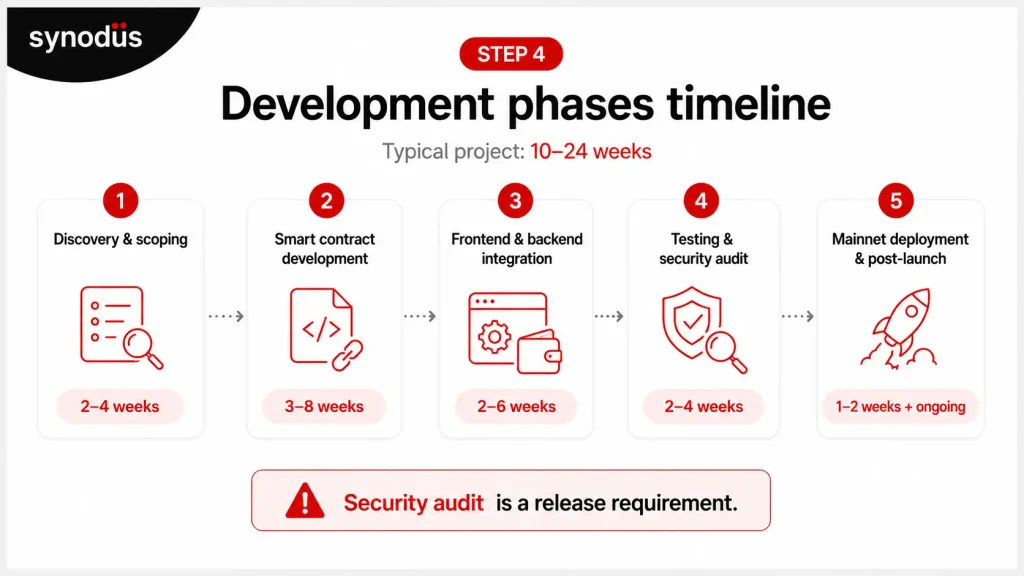
Phase 1 – Discovery & scoping (2–4 weeks)
Define business requirements, user journeys, and which functions belong on-chain versus off-chain. This phase also finalizes the smart contract architecture before development begins. The output is technical specification and system architecture.
Key decision: What will be built, and how the system will be structured.
Phase 2 – Smart contract development (3–8 weeks)
Build the core business logic that runs on the blockchain. Keep contracts as simple as possible to reduce security risks, and decide early whether the contracts need to be upgradeable after deployment.
Key decision: Contract architecture and upgradeability.
Phase 3 – Frontend & backend Integration (2–6 weeks)
Connect the blockchain layer with your application. This includes wallet integration, backend services, and any infrastructure needed to efficiently read blockchain data.
Key decision: How users and backend systems will interact with the blockchain.
Phase 4 – Testing (2–4 weeks)
Test both application logic and smart contracts, deploy to a testnet, and complete an independent security audit before launch. For blockchain applications, a security audit should be treated as a release requirement—not an optional extra.
Key decision: Whether the application is secure enough for mainnet deployment.
Phase 5 – Mainnet Deployment & Post-launch (1–2 weeks, then ongoing)
Deploy to the production network, set up monitoring and alerting, and prepare an incident response plan before going live. Post-launch maintenance is an ongoing responsibility, not the end of the project.
Key decision: Whether the application is operationally ready for launch.
End-to-end, a typical blockchain project runs 10 to 24 weeks across these five phases – not counting the security audit, which should be scheduled as a dedicated block within Phase 4, not compressed into the final week before launch. The cost and timeline estimates in Step 6 are built on this same sequence.
Step 5: Secure your application – From architecture to post-launch
Security should be part of your project from the very start, not just after something goes wrong or right before launch. In blockchain, once code is live, it can’t be quietly fixed, and mistakes are costly and often permanent.
The cost of getting this wrong is not abstract. According to Immunefi’s 2024 report, the Web3 ecosystem suffered nearly $1.5 billion in losses across 232 incidents in 2024 alone. And the damage extends beyond the initial theft – Immunefi CEO Mitchell Amador has warned that nearly 80% of crypto projects that suffer major hacks never fully recover, with operational paralysis and reputational collapse compounding the initial financial damage.
So, security needs to enter the conversation at the beginning.
- Planning: Before any architecture is designed, answer three questions: what are the most valuable assets in your system, who would want to attack them, and how? A DeFi protocol’s answer is obvious – the funds locked in contracts. A supply chain system’s answer is the integrity of the data. A credential platform’s answer is the authority to issue verified credentials.
- Architecture: Keep smart contracts as simple as possible. Every line of code is potential attack surface. Decide early: can contracts be upgraded if a bug is found, and who controls that process? Is there a single admin key, or multi-signature protection? These decisions are very hard to change after deployment.
- Development: Security isn’t a checklist at the end of a sprint. Code reviews, audited libraries, and documented assumptions need to be part of how code is written from day one. If you’re evaluating a development partner, ask how security fits into their process. “We do an audit at the end” is not an acceptable answer.
- Testing: Independent audit is not optional. Budget four to six weeks minimum – teams that schedule it the week before launch either rush it or delay launch, usually both. And audit covers smart contracts only. Penetration testing of your full application – APIs, front end, wallet integration – is a separate requirement.
- Post-launch: Launching is when your system becomes a live target, not when security work ends. Set up on-chain monitoring tools like Forta or OpenZeppelin Defender. Have an incident response plan documented before you need one – who gets called, who can pause the contract, how you communicate with users.
Step 6: Choose your development approach
You’ve defined your use case, chosen your architecture, selected a platform, and mapped out your security requirements. Now comes the question that determines whether any of that planning actually gets executed well: who builds it?
Building an in-house
Building in-house means hiring blockchain developers, architects, and security specialists as permanent or long-term employees dedicated to developing blockchain software exclusively for your product
Works well when: Blockchain is your core product, not a feature. You have at least one senior technical leader who can evaluate and guide the team. You have the runway to absorb six to twelve months of hiring before development begins.
The harder reality: If you don’t already have blockchain expertise in-house, you have no reliable way to evaluate the people you’re hiring. Teams that hire without this calibration often discover the gap only after something goes wrong in production.
Outsourcing blockchain development
Outsourcing means engaging an external development partner – an agency or specialist firm to build some or all of your blockchain application.
Works well when: You need to move fast, validate an idea before committing to a full internal build, or access a complete team – developers, architects, security specialists from the beginning.
The real risks: Vendor selection risk – the market includes firms with very different levels of actual expertise, and the difference isn’t always obvious from a proposal. Knowledge transfer risk – if documentation and handover aren’t contractual deliverables, you’ll end up dependent on the partner long after the engagement ends.
The hybrid model: what most mature companies actually do
The framing of “build vs. outsource” as a binary choice doesn’t reflect how most successful blockchain products are actually built.
The most common pattern in practice: engage a development partner to build the initial version, with an explicit knowledge transfer requirement built into the contract. Use that time to hire one or two internal blockchain developers who work alongside the partner team – learning the codebase, contributing to development, and building the institutional knowledge your company will need long-term. By the time the partner engagement ends, you have an internal team that actually understands what was built.
This approach gets you to market faster than a pure internal build, reduces long-term dependency on the external partner, and gives you real candidates to evaluate for your internal team because you’ve watched them work.
If you decide to outsource: how to evaluate a development partner
Given that vendor selection is where most outsourcing arrangements succeed or fail, here’s how to evaluate a vendor:
- Look for a proven track record with live, production projects.
- Security should be integrated throughout development, not just at the end.
- Expect a discovery phase before a proposal, not a fixed quote up front.
- Get code ownership and documentation in writing.
- Ask for references you can contact directly – especially about how problems were handled.
Choosing the right partner is its own decision. We cover it in detail here:
What will this actually cost you?
Once you know how to choose a partner, it’s time to think about how much all of this will cost you.
Here’s a typical cost range by project type:
| Projecty type | Typical cost range | Estimated timeline |
|---|---|---|
| Simple MVP (1 use case, 1 smart contract) | $30,000 – $80,000 | 10–14 weeks |
| Mid-complexity app (multi-contract, dashboard) | $80,000 – $200,000 | 14–20 weeks |
| Enterprise platform (private chain, integrations) | $200,000 – $500,000+ | 20–24+ weeks |
And here are additional costs beyond development:
- Security audit – $10,000–$50,000 depending on complexity. Non-negotiable.
- Legal and compliance review – varies by jurisdiction, but never zero
- Post-launch maintenance – typically 15–20% of initial build cost per year
- Infrastructure – especially significant for private chain deployments
Cost also shifts significantly depending on whether you build in-house or outsource, which region your development team is based in, and how well-defined your requirements are before development starts. Vague requirements at the start of a project are one of the most reliable predictors of budget overruns.
Get a full breakdown of the expenses involved in our detailed:
Conclusion
Building a blockchain app is not a single decision – it is a sequence of them, and the order matters. Whether you call it how to develop a blockchain app, how to create a blockchain app, or building a blockchain application from scratch, the sequence stays the same: validate before you architect. Architect before you build.
Teams that follow this sequence arrive at development with a clear scope and a realistic plan. Teams that skip steps discover the cost of that shortcut in the middle of a build, when changing course is far more expensive than getting it right from the start.
Done right, this sequence gets you to production faster, with fewer costly rebuilds and a product your users can actually trust.
If you’re ready to move from planning to execution, the next step is finding the right development partner for your project.
Looking for a blockchain development partner?
We’ve put together region-specific guides to help you find and evaluate the right partner for your situation: