What “free” actually means in healthcare software
There are three types of “free” in this space:
Fully open source: The source code is publicly available. You can download, install, modify, and host it yourself at no licensing cost. Examples: OpenMRS, OpenEMR, Bahmni, GNU Health, HospitalRun, OpenClinic GA. The software is free but everything around it is not.
Freemium: A limited version is available at no cost, with full functionality locked behind a paid subscription. Common in SaaS practice management tools. Not covered in this guide.
Free trial: A paid product available for 7-30 days without payment. Not free software.
This guide covers fully open source options only. Before going further: the software license being free does not mean implementation, hosting, training, compliance customization, or ongoing maintenance are free. Those costs are real and are covered in each entry below.
The 6 best free and open source hospital information system options
1. OpenMRS
Website: openmrs.org
License: Mozilla Public License 2.0
Deployment: Self-hosted or cloud
Best for: Public health programs, NGOs, multi-location clinics in low-resource environments
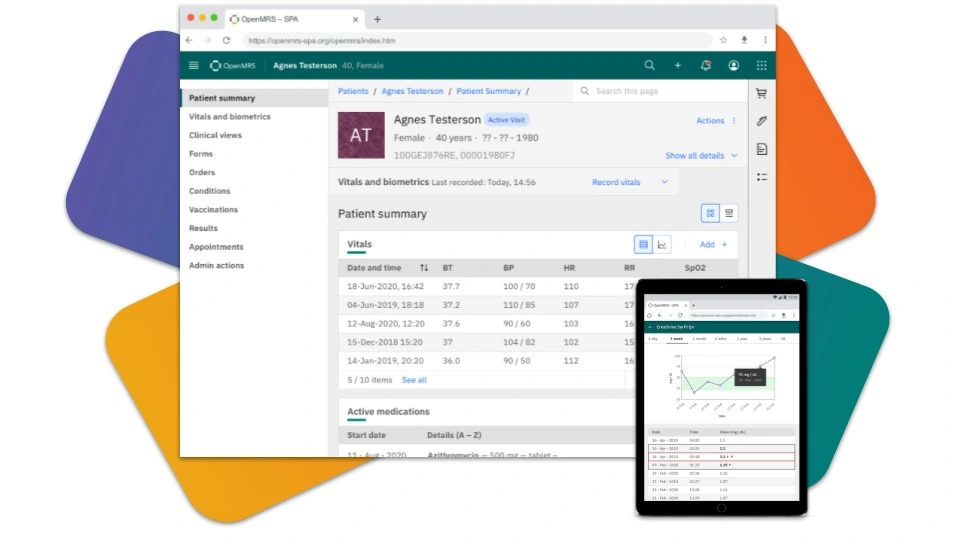
OpenMRS is the most widely deployed open source medical record system in the world. Originally developed by Partners in Health and the Regenstrief Institute, it now runs in over 40 countries with the strongest adoption in sub-Saharan Africa and Southeast Asia. The WHO, PEPFAR, and major global health organizations have funded implementations.
The architecture is modular – you add functionality through a concept dictionary and modules covering everything from patient registration and clinical documentation to lab results, pharmacy management, and appointments. It supports HL7 FHIR interoperability and offline-first operation, which matters in low-connectivity environments.
What it does well:
- Handles high patient volumes in resource-constrained environments
- Strong community of developers and implementers globally
- FHIR-based interoperability for health data exchange
- Customizable to local clinical workflows and languages
- No licensing fees, ever
Where it hits limits:
- Requires technical expertise to install, configure, and maintain – not a system you deploy without developers
- UI is functional but dated in older versions; the newer O3 frontend is an improvement
- Limited built-in administrative and billing modules compared to commercial systems
- Local compliance customization (Vietnam MOH, Philippine DOH, Malaysian PDPA) requires development work
- No commercial support – community forums and paid implementers are the support model
Realistic total cost: Hosting ($200-$2,000/month depending on scale), implementation services ($10,000-$100,000+ depending on customization scope), ongoing maintenance and developer support.
2. OpenEMR
Website: open-emr.org
License: GNU GPL
Deployment: Self-hosted or cloud (OpenEMR Cloud on AWS available)
Best for: Small-to-mid size clinics and hospitals, particularly in the US and markets with HIPAA requirements
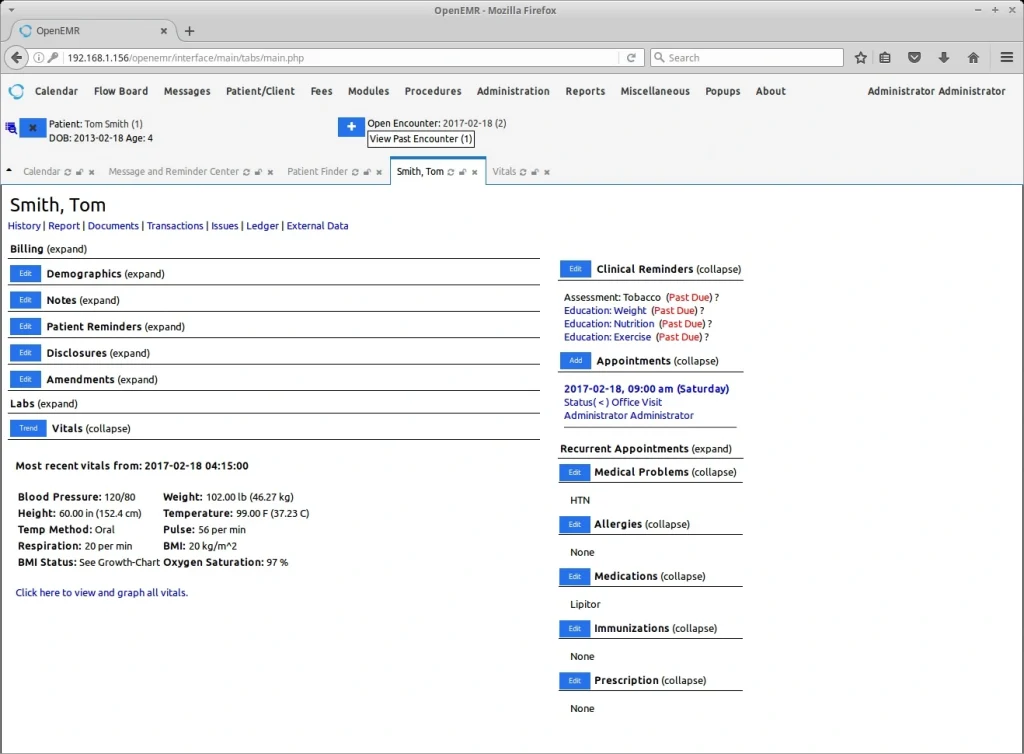
OpenEMR is one of the most feature-complete open source healthcare platforms available. It covers EMR/EHR, practice management, scheduling, billing, e-prescribing, lab integration, patient portal, and reporting in a single system. ONC-certified for meaningful use in the US. Actively maintained with regular releases.
Unlike OpenMRS which is primarily clinical, OpenEMR covers the full administrative and financial side of a practice – making it closer to a full HIS than a pure EMR.
What it does well:
- Comprehensive feature set covering clinical, administrative, and billing functions
- ONC-certified, HIPAA-compliant out of the box for US deployments
- Active development community with regular security patches and feature updates
- OpenEMR Cloud provides managed hosting on AWS, reducing infrastructure burden
- Multi-language support including several Asian languages
Where it hits limits:
- Interface is complex and can be difficult to navigate for non-technical clinical staff
- Implementation without technical support leads to misconfigured systems
- Billing module is US-centric; international billing and insurance workflows require customization
- Local compliance for non-US markets (DOH Philippines, Malaysian MOH, Vietnam BHYT) needs additional development
- Scaling to large hospital environments (500+ concurrent users) can require significant infrastructure investment
Realistic total cost: Hosting ($100-$500/month for cloud), implementation ($5,000-$50,000), training, and ongoing IT support.
3. Bahmni
Website: bahmni.org
License: AGPL v3
Deployment: Self-hosted (Linux); cloud deployment supported
Best for: District hospitals and specialty centers in Asia and Africa; mid-size facilities needing a full HIS
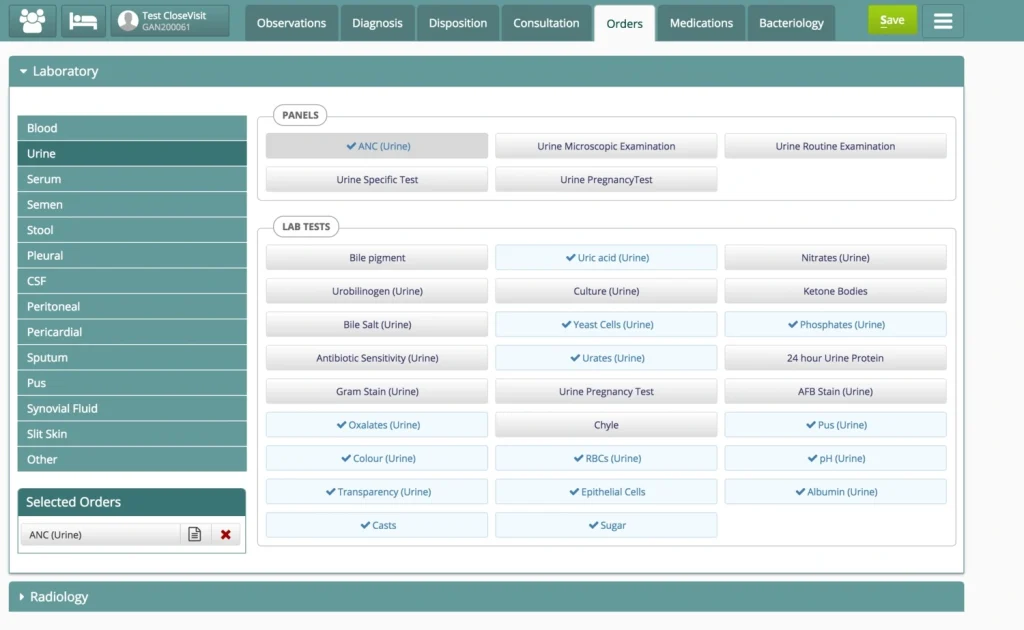
Bahmni is an award-winning free and open source EMR and hospital system designed for low-resource environments, clinics, NGOs, and governments. It has been adopted in over 50 countries worldwide.
Bahmni is built on OpenMRS and extends it significantly – adding modules for diagnostics, pharmacy, radiology, lab management, billing, and patient registration through a more modern interface. Developed by ThoughtWorks and Mylan Laboratories for use in Indian district hospitals, it has since expanded to deployments in Bangladesh, Ethiopia, Haiti, and several other countries.
The architecture combines OpenMRS (clinical), Odoo (ERP/billing), and DCM4CHEE (PACS/radiology) into an integrated platform – giving it more functional coverage than standalone OpenMRS.
What it does well:
- More complete HIS coverage than OpenMRS alone (billing, pharmacy, lab, radiology)
- Modern, usable interface compared to older open source alternatives
- Proven in district hospital environments at meaningful scale
- Active community with strong South/Southeast Asia presence
- FHIR interoperability support
Where it hits limits:
- More complex to install and maintain than simpler options – requires Linux server administration expertise
- Odoo integration (billing/ERP layer) can be technically challenging to configure
- Commercial support is available but not free
- Local regulatory compliance (insurance billing formats, national health registry integration) still requires customization
- Less suited for large multi-site health networks than enterprise commercial systems
Realistic total cost: Hosting and infrastructure ($300-$2,000/month), implementation services ($20,000-$150,000+ for full hospital deployments), ongoing technical support.
4. GNU Health
Website: health.gnu.org
License: GNU GPL v3
Deployment: Self-hosted
Best for: Academic and research hospitals, public health institutions, NGOs; organizations prioritizing open standards and data sovereignty
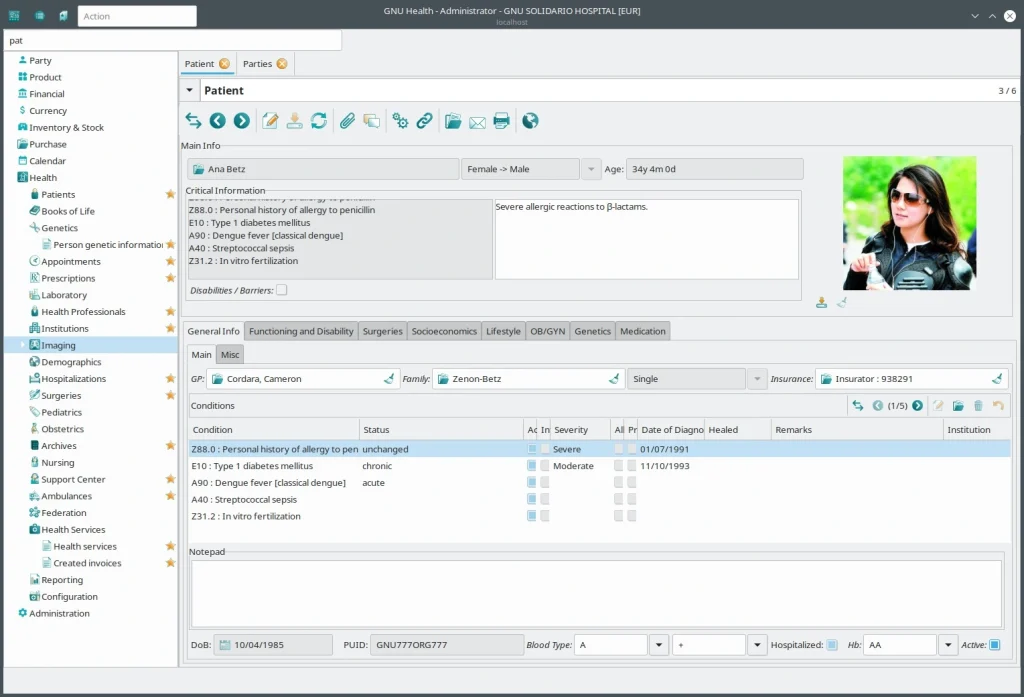
GNU Health is the award-winning Hospital and Health Information System declared a Digital Public Good and adopted by the United Nations. It is used by academic and research institutions globally and has been deployed in the public health systems of Argentina, India, Jamaica, Laos, Cameroon, and Suriname.
GNU Health is an official GNU project maintained by GNU Solidario, a non-profit focused on social medicine. It covers patient management, clinical documentation, lab, pharmacy, inpatient management, and public health surveillance in a single platform built on the Python-based Tryton framework.
Its strongest differentiator is ideological: full data sovereignty, no telemetry, no vendor dependencies, no commercial pressure. For organizations where data control and open standards are non-negotiable, GNU Health is the most principled option on this list.
What it does well:
- Complete data sovereignty – no licensing, no telemetry, no vendor lock-in
- Strong public health and epidemiology modules beyond clinical care
- Recognized by the UN and multiple international health organizations
- Multi-language support including Spanish, Arabic, and several others
- Active global community
Where it hits limits:
- Steeper technical learning curve than most options – built on Tryton, which is less familiar than web frameworks
- Interface is functional but not modern by current standards
- Smaller developer community than OpenMRS or OpenEMR
- Fewer third-party integrations and modules available
- Implementation support harder to find than for more commercially backed platforms
Realistic total cost: Infrastructure, implementation services, and training – similar range to OpenMRS depending on scope.
5. HospitalRun
Website: hospitalrun.io
License: GPL v3
Deployment: Self-hosted; offline-first architecture
Best for: Remote clinics, field hospitals, and facilities in low-connectivity environments
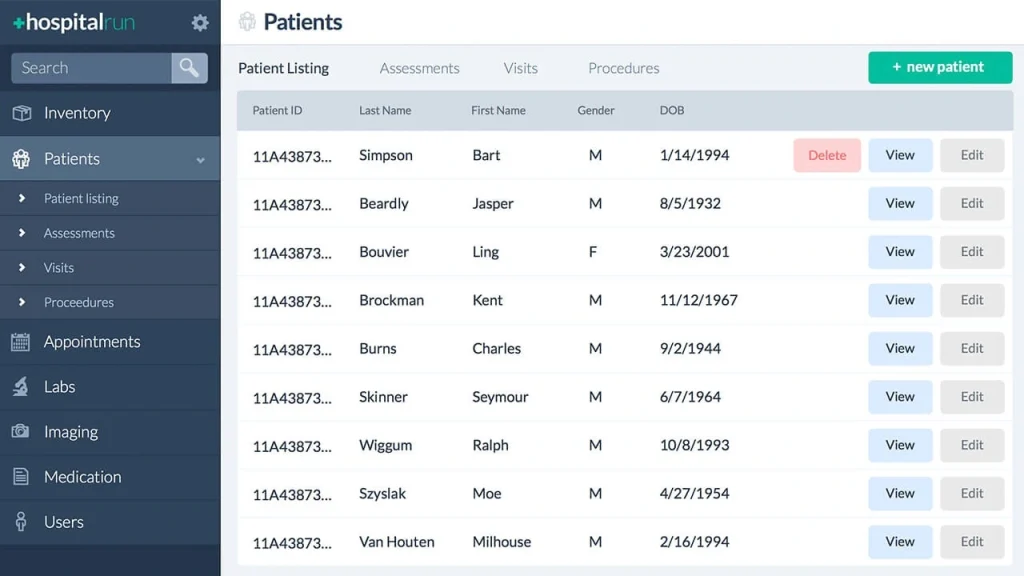
HospitalRun provides free, easy-to-use software for developing world healthcare. Built with React, Node, and PouchDB/CouchDB, it was specifically designed around one constraint: it has to work when there is no internet connection and sync when connectivity returns.
This offline-first architecture makes HospitalRun unique. For facilities in remote areas, disaster response settings, or rural clinics with unreliable connectivity, it is the only open source option designed specifically for that context.
What it does well:
- Works fully offline; syncs automatically when internet is available
- Modern React-based interface – the most contemporary UI on this list
- Designed for usability as the primary requirement, not feature completeness
- Free and open source, actively developed
Where it hits limits:
- Feature set is narrower than Bahmni, OpenEMR, or OpenMRS – focused on core clinical functions
- Not designed for large hospital environments with high concurrent user loads
- Billing and administrative modules are limited
- Smaller community than OpenMRS; fewer implementers available
- Not suited for facilities that need full HIS coverage including finance, HR, and supply chain
Realistic total cost: Lower infrastructure requirements than other options given its lightweight architecture; implementation and training costs still apply.
6. OpenClinic GA
Website: sourceforge.net/projects/open-clinic
License: GPL v2
Deployment: Self-hosted
Best for: District hospitals and clinics in Africa and South Asia; facilities needing integrated billing with local insurance schemes
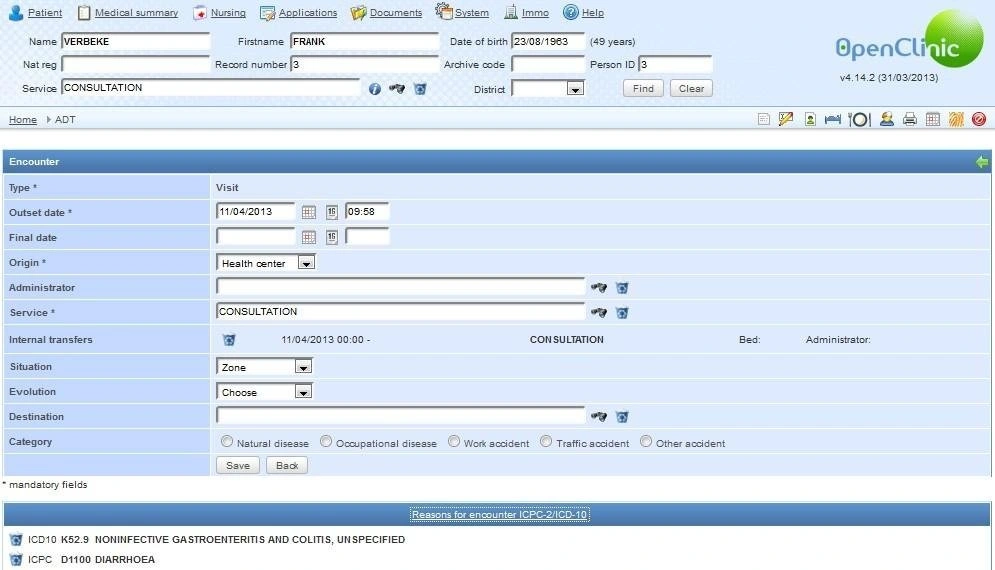
OpenClinic GA is an open source integrated hospital information management system covering management of administrative, financial, clinical, lab, x-ray, pharmacy, meals distribution, and other data, with extensive statistical and reporting capabilities. It has 500+ implementations including 28 in Rwanda, 7 in DRC, 5 in Mali, and 140 in Burundi covering hospitals with 5 to 700 users, with country-specific localizations for Albania, Bangladesh, Belgium, Burundi, and multiple African countries.
OpenClinic GA’s strongest point is its depth of localization for specific markets. If you are deploying in one of its supported countries and your insurance billing matches one of its integrated schemes, it can deliver out-of-the-box coverage that would take months to build in a less localized system.
What it does well:
- Genuinely integrated administrative, financial, and clinical modules
- Deep localization for specific African and Asian markets
- Insurance billing integration for several national health schemes
- Proven at district hospital scale (up to 700 users in single implementations)
- Statistical reporting capabilities beyond most open source alternatives
Where it hits limits:
- Less active development community than OpenMRS or Bahmni
- UI is dated
- Limited deployment outside its core markets
- Less suitable for Southeast Asian markets (Vietnam, Philippines, Malaysia) where localization is absent
Head-to-head comparison
| System | Coverage | Best environment | Technical complexity | Community size | FHIR support |
|---|---|---|---|---|---|
| OpenMRS | Clinical (EMR-focused) | NGO, public health, low-resource | High | Very large | Yes |
| OpenEMR | Clinical + administrative + billing | Clinics, small hospitals | Medium-high | Large | Yes |
| Bahmni | Full HIS (clinical + billing + PACS) | District hospitals, Asia/Africa | High | Medium-large | Yes |
| GNU Health | Clinical + public health | Academic, research, NGO | High | Medium | Partial |
| HospitalRun | Core clinical | Remote, low-connectivity | Low-medium | Small-medium | Limited |
| OpenClinic GA | Full HIS + billing | District hospitals, Africa | Medium | Small | Limited |
The real cost of “free” open source HIS
This is where most evaluations of free HIS software fall short. The licensing cost is zero. Everything else is not.
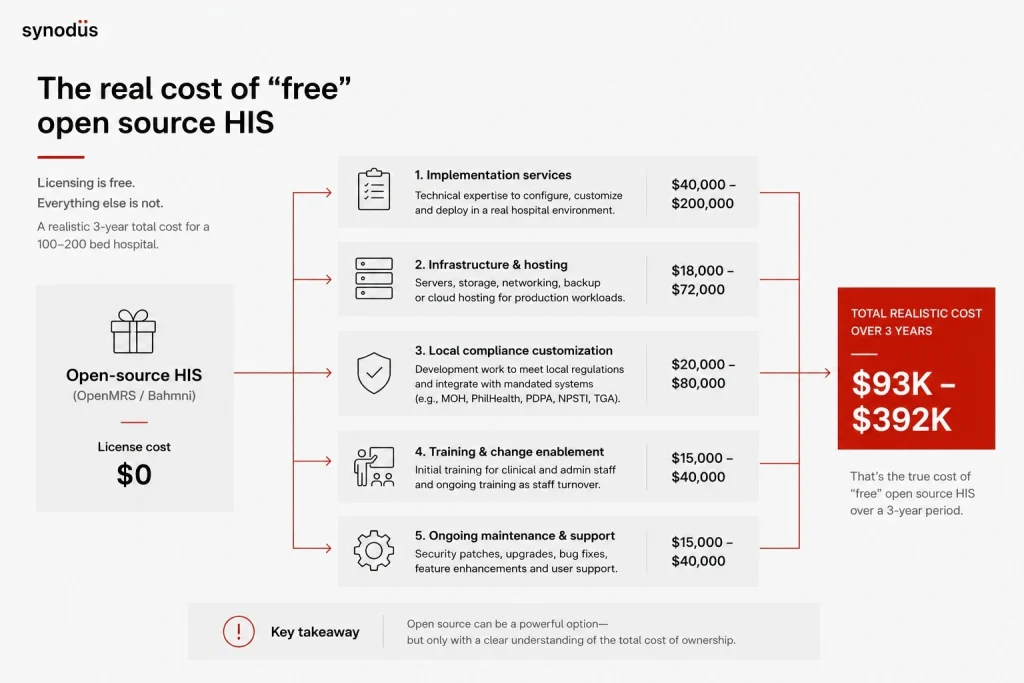
Implementation services: Getting any of these systems running in a real hospital environment requires technical expertise. Bahmni implementations for district hospitals typically cost $20,000-$150,000 in services. OpenMRS implementations for complex deployments run higher. Budget for this before committing to open source.
Infrastructure and hosting: Self-hosted deployments require servers, storage, networking, and backup infrastructure. Cloud hosting reduces this but adds monthly costs. For a 200-bed hospital, expect $500-$2,000/month in infrastructure costs depending on deployment model.
Local compliance customization: This is the most consistently underestimated cost for APAC deployments. Getting an open source system to comply with Vietnam MOH requirements, Philippine PhilHealth eClaims 3.0, Malaysian PDPA and NPSTI standards, or Australian TGA requirements is development work. None of these systems ships with those integrations pre-built. Budget $15,000-$80,000 depending on how many compliance layers are required.
Training: Clinical and administrative staff need training regardless of what system you deploy. Budget for both initial training and ongoing support as staff turn over.
Ongoing maintenance: Security patches, version upgrades, bug fixes, and feature additions all require ongoing technical attention. Either staff IT capacity to handle this or budget for a support contract.
Total realistic cost for a 100-200 bed hospital over 3 years:
- OpenMRS or Bahmni implementation: $40,000-$200,000
- Infrastructure: $18,000-$72,000
- Compliance customization: $20,000-$80,000
- Training and ongoing support: $15,000-$40,000
- Total: $93,000-$392,000 over 3 years
That range overlaps significantly with packaged commercial HIS solutions – without the support guarantees, dedicated account management, or compliance certifications that come with commercial systems. For a detailed breakdown of how these cost ranges compare to OTS and custom builds, see the hospital information system cost guide.
When free open source HIS makes sense
Open source is the right choice in these specific scenarios:
NGOs and public health programs with technical capacity and no commercial budget. OpenMRS and GNU Health were built for this context. For a data-backed overview of what a well-implemented HIS delivers in each scenario, see the hospital information system benefits guide.
Academic and research hospitals that need data sovereignty, full access to source code for research purposes, and the ability to build custom modules for specific research workflows.
Government hospitals in low-resource markets where the alternative is paper records, not a commercial system. Bahmni and OpenClinic GA have proven track records in this context.
Facilities with strong internal IT teams that can handle implementation, maintenance, and compliance work in-house. The software being free is meaningful when you have the technical capacity to deploy and maintain it without external help.
Pilot projects and proofs of concept where you need to demonstrate digital workflows before securing budget for a full implementation.
When free open source HIS stops being enough
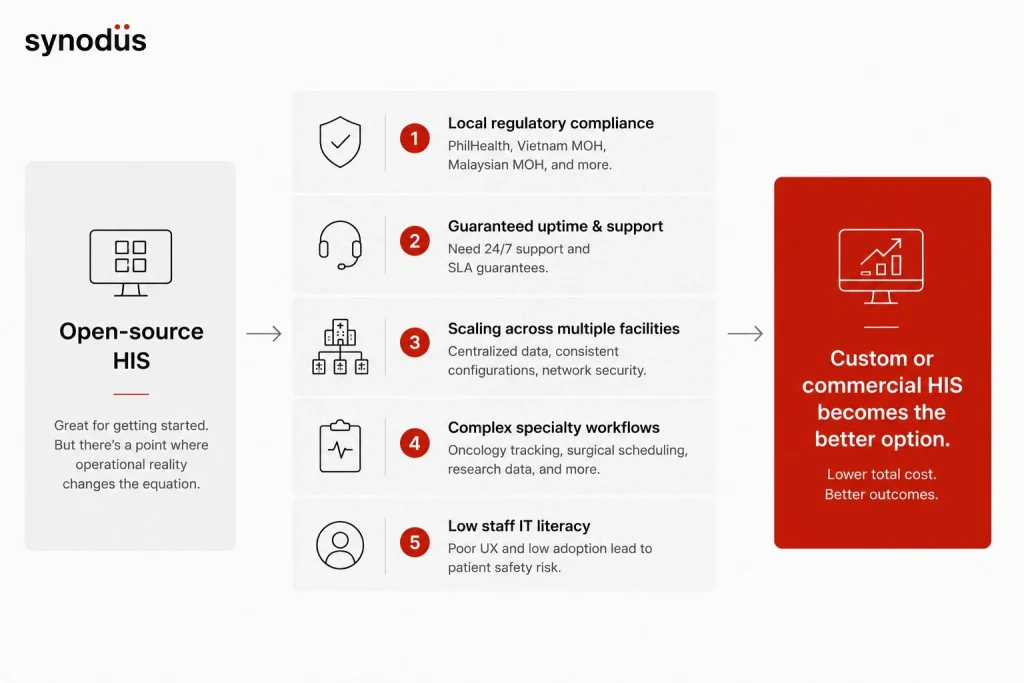
Local regulatory compliance is non-negotiable. If your facility needs to submit PhilHealth eClaims 3.0, integrate with Vietnam’s national health insurance system, or meet Malaysian MOH standards, open source systems require substantial customization to comply. A commercial or custom-built system that ships with those integrations already built will cost less overall than building them on top of open source.
You need guaranteed uptime and support SLAs. Open source community support is forums and goodwill. If your system goes down at 2am during a surgical emergency, there is no support number to call. Commercial systems offer contractual uptime guarantees and 24/7 support. For any facility where system downtime creates patient safety risk, that guarantee has real value. For a comparison of commercial systems by hospital type and budget, see the best hospital information system guide.
You are scaling across multiple facilities. Multi-site deployments require centralized data management, consistent configuration across facilities, and network-level security. These are solvable with open source but require significant engineering investment that quickly exceeds the cost of a commercial solution.
Your workflows are genuinely complex. Open source systems work well for standardized clinical workflows. If your facility has specialty workflows (complex oncology treatment tracking, multi-stage surgical scheduling, integrated research data collection), the customization cost on open source can exceed building a purpose-fit system from scratch.
Staff IT literacy is low. Open source implementations that are not well-configured produce interfaces that clinical staff struggle to use. Low adoption in clinical environments has direct patient safety consequences. Commercial systems with dedicated implementation support and UX research behind them tend to produce better adoption outcomes for facilities that cannot invest in change management.
Build your HIS with Synodus
If you have evaluated free options and concluded that your facility’s compliance requirements, scale, or workflow complexity are beyond what open source can serve without significant investment, a hybrid approach – a pre-built HIS base customized to your context – often delivers better value than either free open source or enterprise commercial systems.

Synodus is a Vietnam-based healthcare software development company with 250+ developers and 30+ implementations across APAC. Their hybrid model starts from a validated HIS base covering core modules (EMR, pharmacy, inventory, billing, scheduling) and extends it with custom compliance layers, local insurance integrations, and workflow-specific modules. This avoids the foundation-building cost of full custom development while preserving the flexibility that OTS products cannot offer.
Recent implementations:
- Vietnam University Hospital – 5,000 outpatients and 1,700 staff daily. Full HIS covering EMR, inventory, analytics dashboard, and patient mobile app. Results: 300% revenue increase, $70,000/month in administrative cost savings, 0.01% insurance claim denial rate.
- Military Hospital 110 – 1,500 outpatients and 500 inpatients daily. Full HIS built in 4 months. Results: 70% efficiency improvement, 90% reduction in incidents, 100% departmental adoption. Read the full HIS case study.
Projects start within 48 hours of scoping completion
FAQs
It depends on implementation quality, not the license. OpenMRS, OpenEMR, and Bahmni all support HIPAA-compliant configurations and HL7/FHIR standards. The risk is not the software itself but misconfigured deployments – role-based access not properly set up, encryption not enabled, audit logging not configured. A poorly implemented open source system is less safe than a well-implemented commercial one. The inverse is also true.
OpenMRS has the largest global deployment footprint, with installations in over 40 countries and backing from major global health organizations. For facilities that need broader administrative and billing coverage, OpenEMR and Bahmni are more complete options.
With development work, yes. None of the systems listed above ship with native integrations for PhilHealth eClaims 3.0, Vietnam BHYT, Malaysian MyHealth, or similar national systems. Integration is achievable but requires a development investment that should be budgeted upfront, not discovered after go-live.
A basic OpenEMR deployment for a small clinic: 2-4 months. A full Bahmni implementation for a district hospital with custom compliance work: 6-18 months. Timeline depends heavily on the scope of customization, data migration complexity, and availability of technical resources. See the hospital information system implementation guide for a phase-by-phase breakdown.
Free open source HIS gives you a working codebase at no licensing cost, which you then customize, host, and maintain. A custom-built HIS is built specifically for your facility’s workflows, compliance requirements, and integration needs. Custom builds cost more upfront but deliver better workflow fit, dedicated support, and compliance coverage for your specific market. A hybrid approach – customizing a pre-built commercial or semi-commercial base – sits between the two in both cost and flexibility. For a comparison of all three approaches, see the hospital information system companies guide.
OpenMRS has been deployed in Southeast Asia and can be configured for local clinical workflows. The challenge is compliance: Vietnamese BHYT integration, Philippine PhilHealth eClaims 3.0, and Malaysian PDPA/NPSTI requirements all require custom development on top of the base system. If your facility needs these integrations, budget for them explicitly. For region-specific HIS guidance, see the Philippines HIS guide and Malaysia HIS guide.