Quick overview: What a well-implemented HIS delivers
| Stakeholder | Primary benefit | Key metric |
|---|---|---|
| Hospital administrators | Revenue cycle improvement, cost reduction | 32-40% fewer coding-related denials |
| Clinical staff | Time savings, medication error reduction | 75 min/provider/day saved post-adaptation |
| Patients | Reduced wait times, improved safety | 22.5 min average reduction in total system time |
| IT teams | Centralized security, simplified integration | Single platform vs. multiple attack surfaces |
Objectives and functions of hospital information system
Before examining the benefits, it helps to understand what an HIS is designed to do. The core objectives of a hospital information system are:
- Centralize patient data across all departments into a single, accessible record
- Automate administrative workflows including scheduling, billing, insurance claims, and inventory
- Support clinical decision-making through real-time alerts, complete medication histories, and lab results at the point of care
- Ensure regulatory compliance with documentation, audit trails, and data security controls
- Improve operational efficiency by reducing paper-based processes and manual data entry
- Enable data-driven management through dashboards, analytics, and performance reporting
The functions of a hospital information system span both clinical and administrative domains: electronic medical records (EMR/EHR), laboratory information management (LIS), radiology information management (RIS/PACS), pharmacy management, billing and insurance processing, appointment scheduling, inventory management, and patient-facing portals.
The purpose of an HIS is not digitalization for its own sake. It is to give every person in a healthcare facility – doctor, nurse, administrator, or patient – accurate information at the moment they need it, without the friction of paper records, disconnected systems, or manual processes.
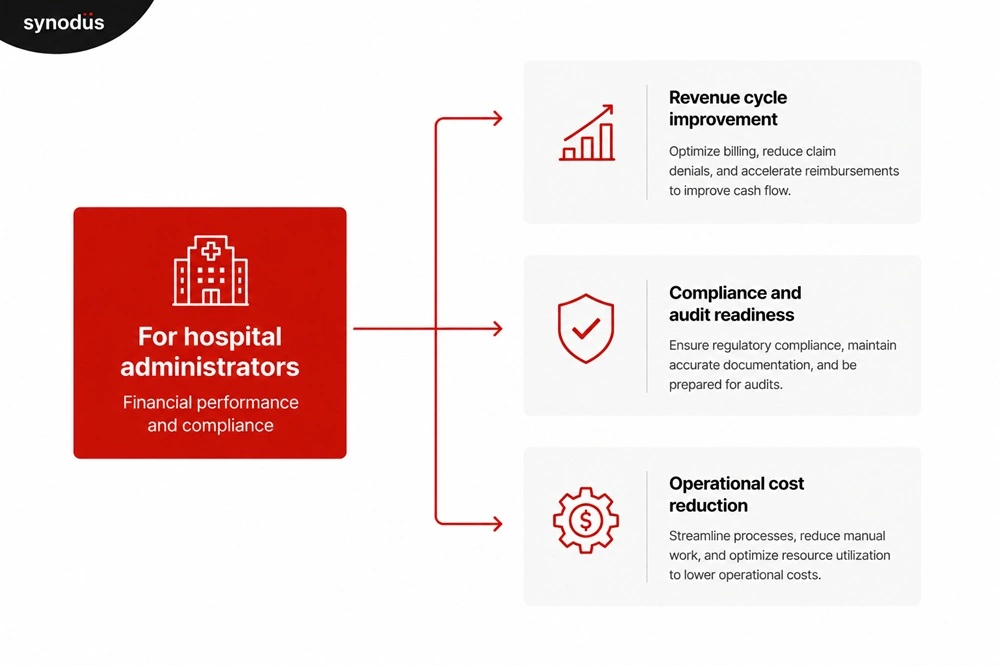
For hospital administrators: Financial performance and compliance
Hospital administrators carry the dual burden of financial sustainability and regulatory compliance. An HIS addresses both, but the mechanisms are specific enough to be worth understanding in detail before any procurement conversation.
Revenue cycle improvement
The financial case for HIS centers on revenue cycle management. Hospitals without integrated HIS rely on manual billing processes prone to coding errors, incomplete charge capture, and slow claims submission.
Industry denial rates now exceed 10%, well above the recommended benchmark of below 5%, and initial claim denials reached 11.8% in 2024. Hospitals spend an estimated $19.7 billion annually attempting to overturn denials, with the cost to rework a single denied claim ranging from $25 to $181. And 35-60% of returned or denied claims are never successfully resubmitted, resulting in permanent revenue loss. Every 1% in denials translates to approximately 2% of lost total revenue for a median-sized hospital.
Integrated HIS addresses this systematically. Automated charge capture reduces missed charges by connecting clinical documentation to billing in real time. Claims scrubbing identifies errors before submission. Electronic remittance processing accelerates payment posting. The results from facilities that have implemented these systems are consistent: organizations implementing HIS automation for coding achieved 32% increased efficiency and 40% fewer coding-related denials. One facility connecting clinical documentation and coding systems saw 40% improvement in productivity, generating over $1 million in ROI. RCM automation can cut administrative costs by up to 30% while improving accuracy, according to an AMA report cited by CPA Medical Billing (2025).
Compliance and audit readiness
Regulatory compliance is not optional in healthcare. HIPAA, local MOH standards, insurance accreditation requirements, and quality reporting programs all demand accurate, auditable records. Manual and paper-based systems make compliance demonstrably harder.
HIS provides the audit trail, access controls, and standardized documentation that compliance frameworks require. When a regulator or accreditation body requests records, an HIS can produce them in minutes rather than days. When a billing audit flags a claim, the clinical documentation supporting that claim is immediately accessible.
For facilities in markets with mandatory digital health requirements (PhilHealth eClaims in the Philippines, Promoting Interoperability in the US, DOH EMR standards in multiple Asian markets), HIS is not a benefit but a prerequisite for continued operation. For a region-specific compliance overview, see the Philippines HIS guide and Malaysia HIS guide.
Operational cost reduction
Beyond billing, HIS reduces costs through automation of high-volume administrative workflows: appointment scheduling, insurance verification, inventory management, and supply chain procurement. Paper, printing, physical storage, and the staff time to manage them are eliminated or significantly reduced.
A 2024 PubMed Central analysis of hospital efficiency improvement programs found cost reductions of 25-50% achievable through systematic digital and process interventions. Administrative expenses already represent 15-30% of total US hospital spending, making this one of the highest-impact areas for HIS to address.
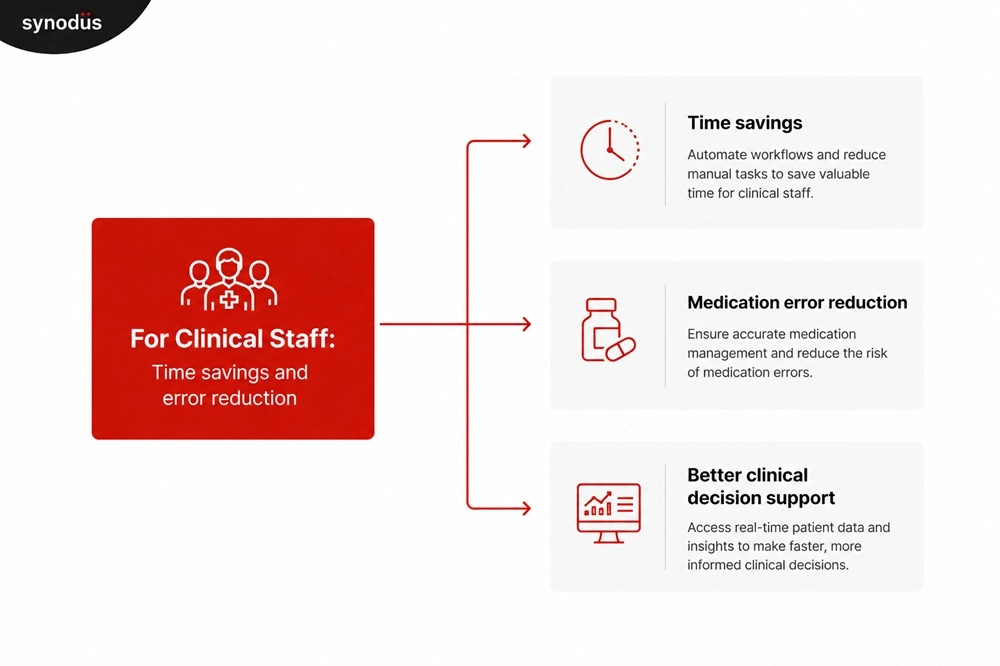
For clinical staff: Time savings and error reduction
Clinical staff are the most important and most resistant group in any HIS implementation. They are important because their adoption determines whether the system delivers clinical benefits. They are resistant because HIS often increases documentation burden in the short term before reducing it in the long term. Understanding both sides of this is essential for any administrator or IT lead planning a rollout.
Time savings
Research published in PubMed Central found savings of approximately 75 minutes per provider per day once clinical staff fully adapted to an EHR/HIS system. That is time returned from administrative tasks to patient care, the core activity clinical staff entered healthcare to perform.
The caveat matters: this productivity gain comes after adaptation, not immediately. The initial implementation period typically involves a productivity dip of 10-20% as staff learn new workflows. The 75-minute daily saving represents the post-adaptation steady state, not the day-one experience. Planning for this transition period (typically 4-8 weeks) with intensive support is essential to reaching the long-term benefit.
Ambient AI documentation, now integrated into major HIS and EHR platforms including Epic and Oracle Health, is accelerating this further. Christopher Maloney, MD, Chief Quality Officer at Children’s Nebraska, noted in Becker’s Hospital Review (2025) that ambient listening technology is “decreasing pajama time and freeing up time for family and friends” by generating templated provider notes automatically from clinical encounters.
Medication error reduction
Clinical staff carry the direct burden of medication errors, both the professional consequences and the clinical harm to patients they care for. HIS addresses this at multiple intervention points.
A study published in npj Digital Medicine (Nature, 2023) tracked a hospital’s transition from paper to fully digital records and found a 38% reduction in voluntarily reported medication incidents, with prescribing errors falling from 52.8% to 15.7% of orders reviewed. A Carnegie Mellon analysis linked full HIS/EHR adoption to approximately a 30% reduction in prescription errors. A separate JAMIA systematic review found computerized order entry systems were associated with roughly half as many preventable adverse drug events compared to paper-based order entry.
Better clinical decision support
HIS clinical decision support (CDS) delivers real-time alerts for drug interactions, allergy conflicts, and preventive care gaps at the moment of prescribing or ordering, not retrospectively during a chart review. EHR alerts and reminders raise screening and vaccination rates by 10-20% compared to paper-based systems, which is meaningful at population scale.
For nursing staff specifically, HIS eliminates the need to hunt through paper files for a patient’s medication history or latest lab results. Everything is accessible from a single interface, reducing the cognitive load of coordinating care across a shift.
HIS in nursing administration
Nursing administration sits at the intersection of clinical care and hospital operations – responsible for staffing, patient assignment, care coordination, quality monitoring, and compliance documentation simultaneously. HIS addresses each of these functions directly.
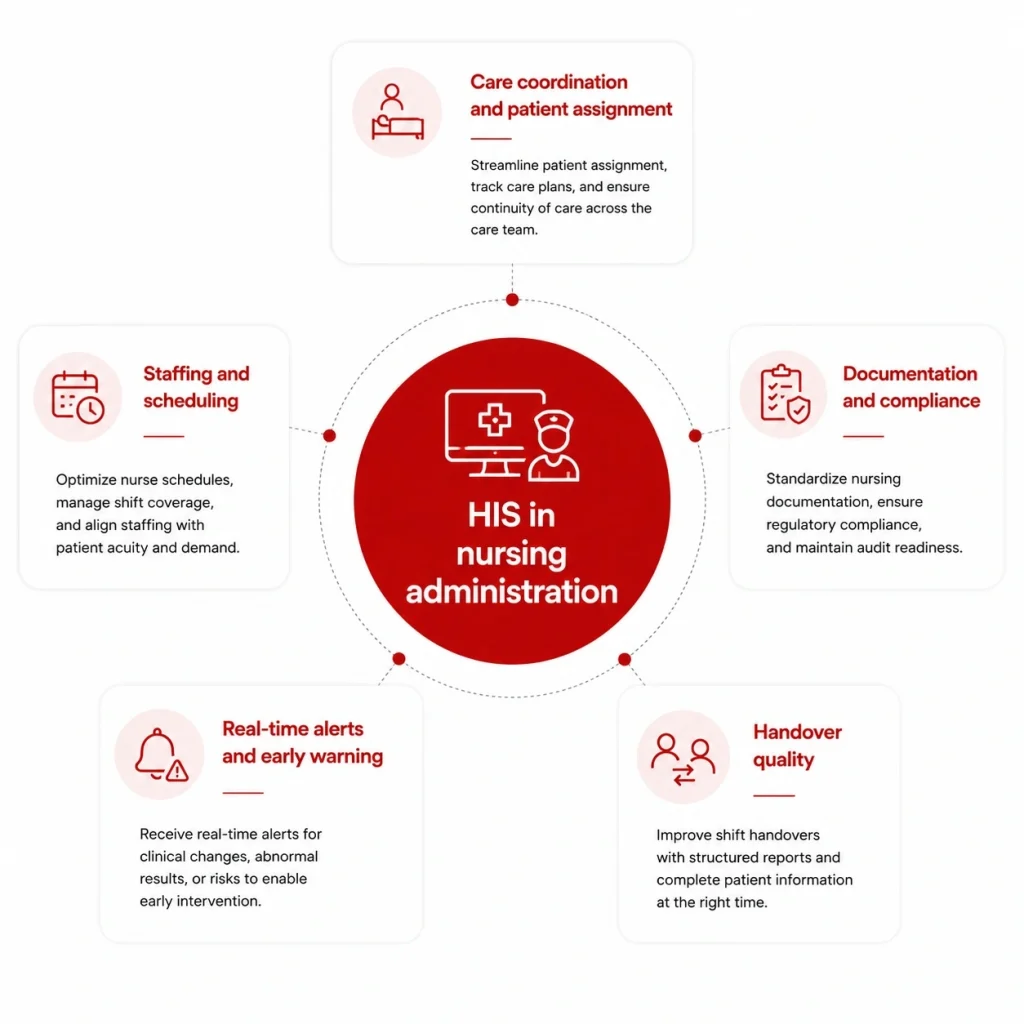
Care coordination and patient assignment
In paper-based environments, nurses spend significant time tracking down patient information across departments: lab results not yet filed, medication orders still in the pharmacy queue, physician notes written but not yet communicated. An integrated HIS puts all of this in a single view, accessible at the ward station or bedside terminal.
Charge nurses managing patient assignments can see real-time bed occupancy, patient acuity scores, and incoming admissions from the emergency department simultaneously – rather than piecing together this picture from phone calls and paper boards. This visibility reduces assignment errors and allows faster response to patient deterioration.
Staffing and scheduling
Nurse staffing is one of the most complex scheduling problems in healthcare: shift coverage requirements, skill mix mandates, overtime limits, leave management, and last-minute absences all interact simultaneously. HIS integrated with an HRM module automates the core scheduling logic, flags coverage gaps before they become critical, and maintains compliance with labor regulations and nursing ratios.
The operational impact is measurable. A PMC study on nurse workload and HIS adoption found that facilities with integrated digital scheduling and patient tracking reduced unplanned overtime by improving shift handover quality and real-time patient status visibility.
Documentation and compliance
Nursing documentation is one of the highest-volume workflows in any hospital. Admission assessments, care plans, medication administration records, vital signs, and shift notes all require accurate, timestamped documentation for both clinical and regulatory purposes.
HIS replaces paper-based nursing documentation with structured digital forms that enforce completeness at the point of entry. Mandatory fields prevent incomplete records from being saved. Timestamps are automatic. Audit trails are generated without additional effort from nursing staff. For accreditation bodies that audit nursing documentation – Joint Commission, DOH, and others – this produces a defensible record with far less preparation effort than paper-based systems require.
Real-time alerts and early warning
HIS clinical decision support extends to nursing workflows through automated alerts for deteriorating patients. Vital sign trends outside normal parameters, missed medication administrations, and overdue assessments generate alerts in the nursing station view, allowing earlier intervention before a patient’s condition becomes critical.
Early warning system (EWS) integration within HIS – where vital signs entered by nursing staff automatically calculate a deterioration risk score – has been associated with faster escalation to physicians and reduced rates of unplanned ICU transfers in facilities that have implemented it.
Handover quality
Shift handover is a high-risk moment in nursing care: incomplete or inaccurate information transfer between incoming and outgoing nurses is a documented contributor to adverse events. HIS supports structured handover by presenting an incoming nurse with a complete, current summary of each patient’s status: active orders, outstanding results, recent vital signs, pending tasks, and any alerts flagged during the previous shift.
This replaces verbal-only or paper-based handover with a system-supported process that reduces the information loss that occurs during shift changes, particularly in high-volume wards.
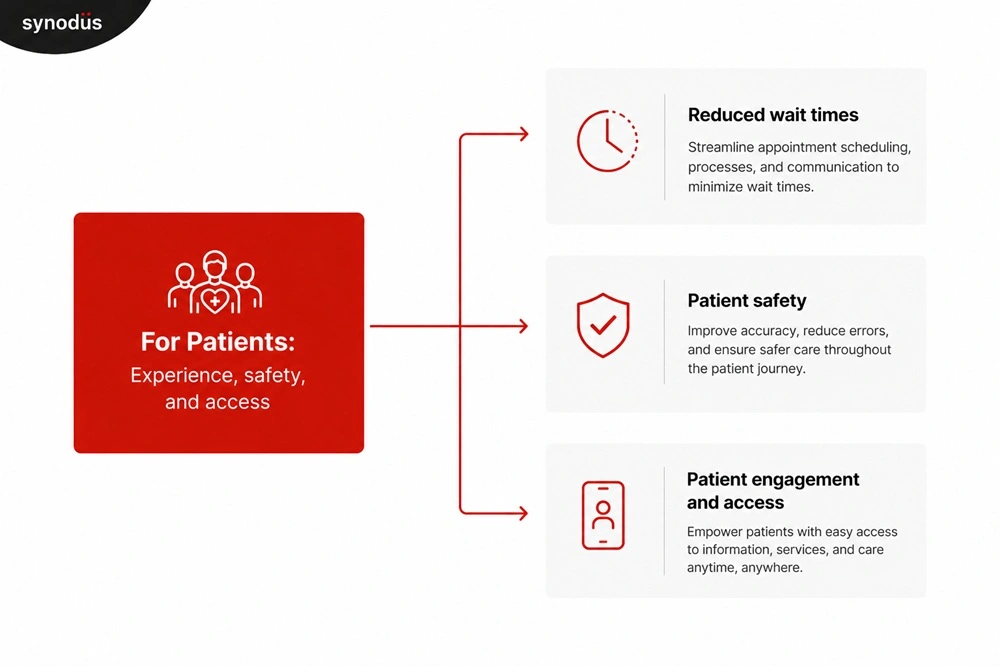
For patients: Experience, safety, and access
Patients experience HIS benefits indirectly, through faster service, fewer errors, and better access to their own health information. The research on these outcomes is consistent.
Reduced wait times
Wait time is the patient experience metric most directly influenced by HIS-enabled process improvement. A 2024 study published in Mathematics (MDPI) implementing a digital process optimization system in hospital outpatient departments found registration wait time decreased by 15%, vital sign recording time by 20%, and doctor consultation wait time by 25%, with an average total reduction of 22.5 minutes in total system time.
A large tertiary hospital in China implementing a patient-centered intelligent guidance system connected to its HIS saw outpatient visits increase from 5,067,958 to 5,456,151 annually while simultaneously reducing consultation wait times by 2.84 minutes and examination wait times by 3.35 minutes per patient. Patient satisfaction increased from 89.99% to 92.72% post-implementation.
A systematic review published in PMC (2025) examining the broader evidence base found that advancing Health Information Management Systems across hospitals showed a significant positive correlation with improvement in inpatient satisfaction scores.
Patient safety
Beyond medication error reduction, which benefits patients most directly, HIS improves patient safety through complete and accessible records. When a patient arrives at an emergency department and clinical staff can immediately see their medication list, allergies, and recent lab results, dangerous clinical decisions based on incomplete information are prevented.
This is the core promise of EHR interoperability within HIS: that a patient’s complete clinical history follows them across care settings, preventing duplicate testing, dangerous drug assumptions, and care gaps that arise when different providers cannot see each other’s records.
Patient engagement and access
Modern HIS platforms include patient-facing portals that give patients online access to their records, test results, prescription refill requests, and appointment scheduling. This is no longer a premium feature: it is an expectation.
Patient portals reduce administrative phone volume, improve adherence to preventive care recommendations (patients who can see their own screening gaps are more likely to act on them), and support the kind of continuous patient-provider communication that chronic disease management requires. For facilities in regions with significant telemedicine adoption, HIS integration with telehealth platforms extends access to patients in rural or underserved areas.
For IT teams: Security, interoperability, and maintainability
IT teams evaluate HIS differently from clinicians and administrators. Their concerns are infrastructure, security, integration complexity, and long-term support burden. These are legitimate and often underweighted in procurement decisions that focus on clinical and financial benefits.
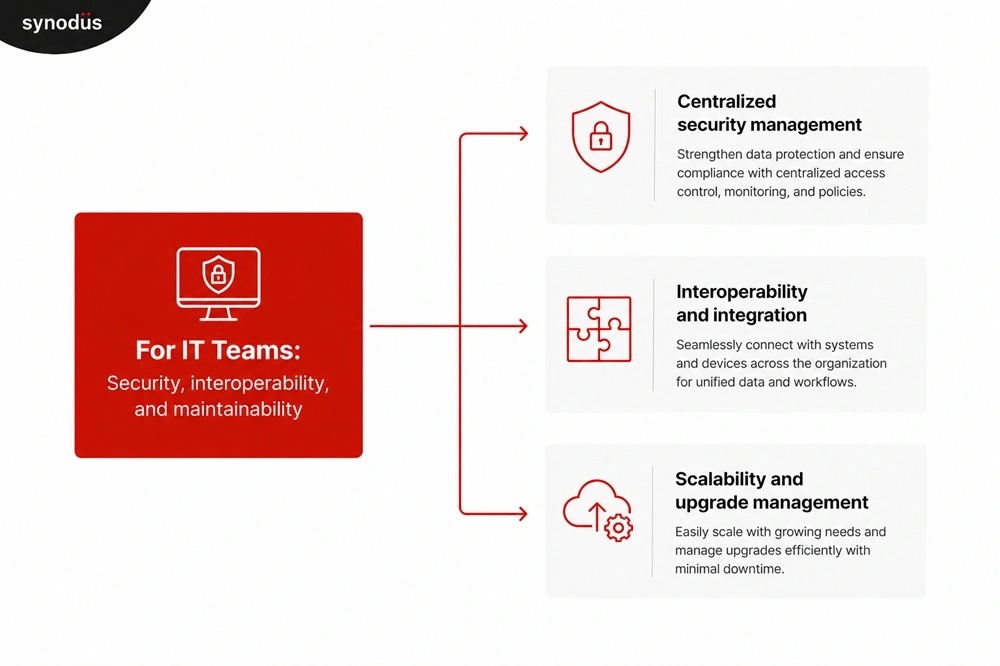
Centralized security management
Healthcare is the most expensive industry for data breaches. The average cost of a healthcare data breach reached $9.8 million per incident in 2024, nearly double the average across all other industries. A fragmented IT environment, where patient data lives in separate systems for billing, clinical records, pharmacy, and lab, creates multiple attack surfaces and makes consistent security policy enforcement difficult.
An integrated HIS consolidates patient data into a single platform with unified access controls, audit logging, encryption standards, and breach detection. For IT teams, managing security for one system is fundamentally simpler than managing it for six. Role-based access control, multi-factor authentication, and automatic session timeout can be enforced consistently across the organization rather than configured separately in each departmental system.
Interoperability and integration
HIS built on standard protocols (HL7 FHIR, DICOM, HL7 v2) simplifies integration with external systems: reference laboratories, imaging centers, insurance payers, regional health information exchanges, and national digital health infrastructure.
Without a standards-based HIS, every external integration is a custom point-to-point project with its own maintenance burden. With one, new integrations follow established patterns and can often leverage existing interfaces. For IT teams responsible for a growing portfolio of healthcare applications, this standardization reduces ongoing maintenance complexity significantly.
Scalability and upgrade management
A well-architected HIS, particularly a cloud-based or hybrid system, scales with the organization without requiring infrastructure replacement. Adding a new department, a new facility, or a new clinical module is a configuration and integration exercise rather than a ground-up build.
Cloud-based HIS platforms handle infrastructure scaling, security patching, and software updates on the vendor’s side, reducing the operational burden on hospital IT staff. This is particularly significant for facilities in markets where healthcare IT talent is scarce and expensive.
Cross-cutting benefit: Data-driven decision making
One benefit that cuts across all stakeholder groups is the shift from intuition-based to data-driven management that a well-implemented HIS enables.
Hospital administrators gain real-time dashboards showing bed occupancy, revenue cycle performance, denial rates, and staff productivity. Rather than waiting for end-of-month reports that describe what happened, they see current performance and can intervene before problems compound.
Clinical leadership gains population health analytics: which patient groups have uncontrolled chronic disease, where care gaps are concentrated, which departments have the highest error rates. These insights support quality improvement programs with specific, measurable targets rather than general aspirations.
Research confirms the value: a Deloitte study found that 80% of healthcare organizations leveraging data analytics improved their revenue cycle performance. A review published in ResearchGate found that EHR-based decision support tools improved documentation efficiency, decreased medication errors, and improved care coordination across facilities.
For hospital administrators specifically, data-driven decision making is the foundation of value-based care participation. As 45% of US healthcare payments now flow through value-based arrangements, the ability to track both clinical quality metrics and financial performance on a single dashboard is no longer optional for facilities seeking to participate in these programs.
Real-world results: What actual implementations show
The data above comes from research and industry analysis. Here is what HIS implementations look like at the facility level.
Vietnam University Medical Hospital
One of Vietnam’s leading university hospitals, serving 5,000 outpatients and 1,700 medical staff daily, implemented a Synodus-built HIS covering integrated EMR, inventory management, analytics dashboard, and patient mobile app.
Results after deployment:
- 300% revenue increase
- $70,000 in monthly administrative cost savings
- 30% improvement in patient satisfaction scores
The system was built to comply with Vietnam MOH regulations and designed around the hospital’s specific operational model rather than a generic template.
Military Hospital 110
A mid-size Vietnamese facility serving 1,500 outpatients and 500 inpatients daily implemented a hybrid HIS (packaged base plus custom modules) covering EMR, scheduling, bed management, billing, inventory, IoT-connected LIS and PACS, and a bilingual patient mobile app. The build was completed in 4 months by a 7-person team.
Results after deployment:
- 70% improvement in operational efficiency
- Full elimination of paper-based workflows across clinical and administrative departments
- Real-time patient data accessible to all departments from a single system
The Military Hospital 110 case demonstrates that the hybrid approach is not only viable for mid-size facilities but often the most practical path to a compliant, cost-effective HIS within a realistic timeline.
Disadvantages and limitations of hospital information system
A balanced view of HIS requires acknowledging where the benefits do not materialize automatically or where the system can actively create new problems if poorly implemented. These are not reasons to avoid HIS adoption, but they are reasons to plan carefully.
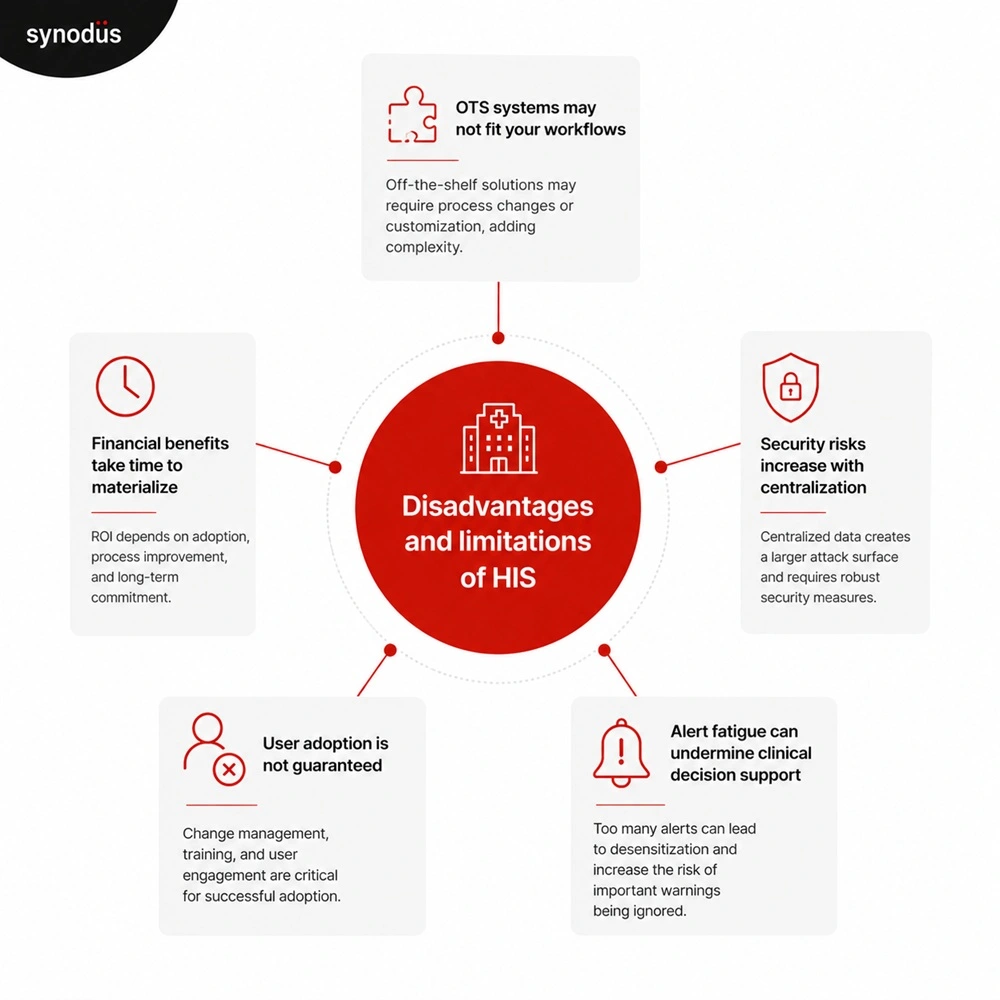
OTS systems may not fit your workflows
Off-the-shelf HIS products are designed around standard clinical workflows. When a facility’s workflows differ significantly from what the system assumes, the result is staff workarounds: paper processes running in parallel with the digital system, defeating the purpose of digitalization. A 2017 PMC study on nurse HIS adoption found that the dual burden of maintaining both electronic and paper records in transition periods significantly increased workload rather than reducing it.
What to do about it: Conduct a thorough workflow analysis before selecting a system. If your workflows differ significantly from what a standard OTS product supports, a hybrid or custom approach will deliver better long-term ROI despite higher initial cost. For a framework for making this decision, see the HIS companies evaluation guide.
Financial benefits take time to materialize
The revenue cycle improvements described above are real, but they do not appear on day one. Most organizations experience net costs in the first 12-18 months: implementation expenses are incurred, productivity temporarily decreases during the transition, and staff spend time on system-specific training rather than clinical or administrative work. Break-even typically occurs 2-4 years post-implementation.
What to do about it: Build a realistic multi-year financial model before presenting the business case internally. Frame the investment as infrastructure with a long payback period, not a quick efficiency fix. Identify the revenue cycle improvements most likely to materialize quickly (automated charge capture and claims scrubbing tend to show results within 6-12 months) and prioritize those modules in the early rollout.
Security risks increase with centralization
The same centralization that makes HIS a security management benefit also creates a higher-value target. A single integrated system containing all patient data is more attractive to attackers than fragmented departmental systems. The Change Healthcare ransomware attack of February 2024, which disrupted claims processing for thousands of US healthcare providers, illustrated what happens when a central health IT platform is compromised.
What to do about it: Centralization requires commensurately stronger security controls, not weaker ones. Any HIS vendor evaluation must include independent verification of SOC 2 Type II or HITRUST certification, not self-reported compliance claims. Conduct penetration testing before go-live and establish a security review cadence post-implementation.
Alert fatigue can undermine clinical decision support
Clinical decision support is one of the most valuable HIS features and one of the most commonly broken in practice. When alert volume is too high or alert relevance is too low, clinicians begin clicking through alerts reflexively. Research in JAMIA found drug interaction alert override rates of 93% in high-alert-volume systems. A separate study found acceptance of the most severe alerts fell from 100% to 8.4% after switching to a commercial EHR that generated six times more alerts.
What to do about it: Configure alert thresholds carefully during implementation. Disable or downgrade low-severity alerts. Review override patterns quarterly post-go-live and reconfigure alerts with high override rates. Modern HIS platforms increasingly use AI to personalize alert thresholds based on patient context, reducing false positives without sacrificing clinically significant warnings.
User adoption is not guaranteed
The clinical staff time savings and error reduction benefits described above are contingent on staff actually using the system as intended. A technically sound HIS that clinical staff resist or work around produces the same outcomes as no system at all.
A PMC study on nurse HIS adoption found that inadequate hardware access, insufficient training, and failure to involve clinical staff in system design decisions were the most common causes of adoption failure. These are organizational failures, not technical ones, and they are entirely preventable with proper change management.
What to do about it: Involve frontline clinical staff in workflow design before the system is configured. Identify physician and nursing champions early and resource them to support peers during go-live. Plan for 4-8 weeks of intensive post-go-live support. Budget for change management as seriously as for the software itself. For a detailed breakdown, see EHR implementation challenges.
How to build an internal business case using this data
The data in this guide is most useful when structured into a stakeholder-specific business case. Here is a practical framework.
Step 1: Identify your primary decision makers and their concerns. A CFO needs revenue cycle ROI and payback period. A CMO needs patient safety and clinical quality data. A CNO needs staff time savings and workload impact. A CIO needs security and interoperability. Build a version of the business case for each audience using the relevant sections above.
Step 2: Baseline your current performance against the benchmarks. What is your current denial rate? How does it compare to the 5% benchmark? What is your current medication error rate? How many hours per week do clinical staff spend on documentation? These gaps represent the quantifiable opportunity your HIS investment addresses.
Step 3: Use conservative estimates for benefit projections. The benefits cited in this guide are from well-implemented systems. Your implementation will face real-world friction: adoption delays, data migration complexity, workflow resistance. Project benefits at 50-70% of the research benchmarks for years 1-2, scaling to full benefit in years 3-4. This produces a credible model rather than an optimistic one that loses credibility when early results underperform.
Step 4: Include a total cost of ownership model. License or development cost is one line item. Implementation services, training, data migration, infrastructure, and ongoing support typically add 50-100% on top. For a detailed cost breakdown, see the HIS cost guide.
Step 5: Identify early wins to demonstrate ROI before full payback. Revenue cycle improvements (automated charge capture, claims scrubbing) tend to show measurable results within 6-12 months. Identifying and tracking 2-3 specific KPIs from day one creates evidence of progress during the period before full ROI is reached.
FAQs
Revenue cycle improvement is consistently the fastest and most measurable financial benefit. Automated charge capture, claims scrubbing, and electronic remittance processing reduce denial rates and accelerate cash flow within the first year of implementation. Facilities implementing RCM automation report 32-40% efficiency gains and significant denial rate reductions. The administrative cost reduction from eliminating paper-based processes is the second most significant financial benefit, though it takes longer to fully materialize.
Revenue cycle improvements typically appear within 6-12 months. Clinical staff time savings reach full effect after 4-8 weeks of adaptation. Patient satisfaction improvements from reduced wait times are measurable within 3-6 months of full deployment. The full financial ROI, accounting for implementation costs, typically takes 2-4 years to achieve. Planning for this timeline in the initial business case is essential to maintaining stakeholder support through the transition period.
The benefit categories apply to all facility sizes, but the magnitude and timeline differ. Large hospitals with high patient volumes see faster revenue cycle ROI because the absolute dollar amounts involved are larger. Small facilities benefit disproportionately from reduced administrative staffing requirements and simplified compliance management. Rural facilities gain particular benefits from telehealth integration and remote monitoring capabilities.
The benefits described in this guide are contingent on implementation quality. A poorly implemented HIS can actively reduce productivity, increase security risk, and lower patient satisfaction. The research benchmarks cited here come from well-implemented systems with proper change management, adequate training, and post-go-live support. Organizations that underinvest in these areas consistently underperform on benefit realization. See EHR implementation challenges for a breakdown of what goes wrong and how to prevent it.
The primary patient safety mechanism is error reduction at the point of care. Computerized order entry with clinical decision support catches drug interactions, allergy conflicts, and dosing errors before they reach the patient. Studies show 30-50% reductions in preventable adverse drug events compared to paper-based systems. Secondary mechanisms include complete and accessible clinical records (preventing decisions based on incomplete information), standardized documentation (reducing variability in care), and population health analytics (identifying patients at elevated risk before they present with acute illness).
An HIS includes EMR functionality as a core module. The question is usually whether to start with a standalone EMR and integrate other systems later, or to implement a full HIS from the start. For single-specialty clinics and small practices, a standalone EMR may be sufficient. For hospitals with multiple departments, billing complexity, and inventory management needs, a full HIS delivers better long-term ROI by eliminating the technical debt of point integrations built over time. See the hospital information system overview for guidance on which approach fits different facility types.