That gap is where most exploits happen. And once a contract is live, there’s no reversing a failure.
This guide walks through three high-risk zones where post-audit risks most commonly hide – and how to test each one before they become a problem.
The mindset shift every developer needs after a smart contract audit
First, you need to change how you think about your system.
Think in behavior, not functions: How attackers chain your code
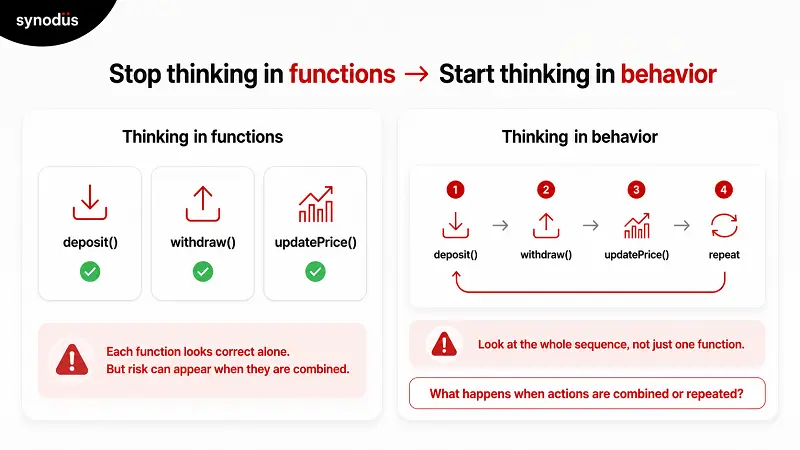
Thinking in functions makes sense when you’re building. Each function has a job, and you verify it does that job correctly. But attackers don’t interact with functions one at a time, they combine them, repeat them, and chain them in ways you didn’t design for. A function that passes every test in isolation can still behave dangerously when used alongside everything else.
The Cream Finance August 2021 exploit illustrates this directly: the AMP token worked exactly as designed, and so did CREAM’s contract in isolation. But the way CREAM integrated AMP created a reentrancy vulnerability that neither audit had tested for.
The risk only existed in the question nobody asked: “What happens when these systems interact inside the same transaction?”
Instead of asking: “Is this function correct?” Ask: “What happens when this function is used repeatedly, or combined with others?”
Why testing single actions misses the real attack surface
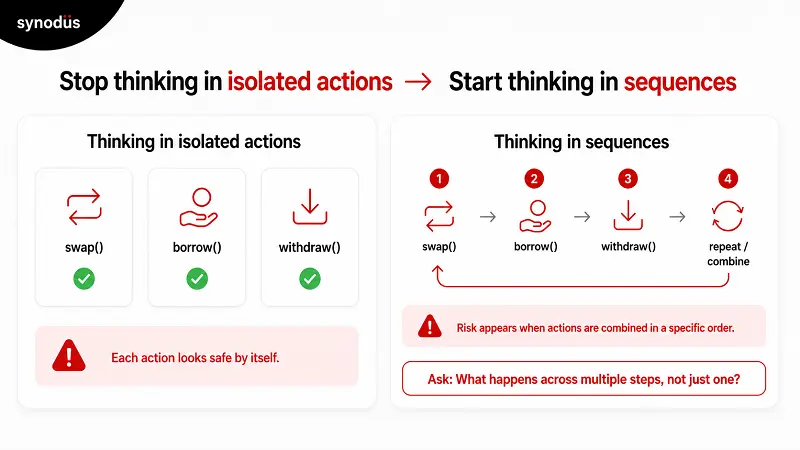
Most smart contract exploits don’t happen in a single call. Attackers use sequences – each step looks harmless, but combined in a specific order, they cause unexpected outcomes. If you only test individual actions, you’ll miss the risk that lives between them.
The bZx attacks in February 2020 followed this exact pattern: interact across multiple protocols, manipulate market conditions, then extract profit. Each step individually would have raised no flags – the risk only appeared when the steps were combined in sequence.
Instead of asking: “Is this action safe?” Ask: “What happens across multiple steps, not just one?”
How attackers exploit incentives your audit didn’t account for
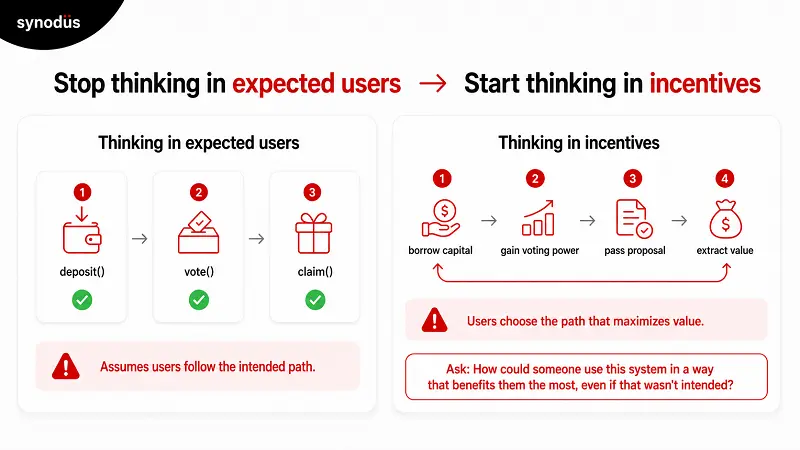
When you design a system, you picture users following the intended path. But in reality, users act in ways that maximize their own value – even if it means using your system in ways you never intended. And when someone can access enough capital, even temporarily, to extract more than your system meant to give, they will.
Beanstalk Farms assumed governance would be used as intended. An attacker looked at the same system and saw a different question: “What if I could acquire enough voting power through a flash loan to pass a malicious proposal – before anyone could respond?”
Instead of asking: “How would a normal user interact with this?” Ask: “How could someone use this system in a way that benefits them the most, even if that wasn’t intended?”
With that lens, here are the three zones where hidden risks most commonly appear.
3 High-risk zones where hidden smart contract vulnerabilities live
Once you’ve made that shift, the next step is knowing where to point it. Here are the three zones where risk most commonly hides.
Logic risks: When your core assumptions break at scale
Focus on the core logic, like reward systems, user-triggered actions, and calculations that grow with usage.
What to check (concretely):
- Does the formula still work correctly at extreme values?
- Can repeating small actions cause big problems?
- Does value build up faster than you expect over time?
How to test:
- Simulate rewards over many cycles
- Test with edge values (like 0, maximum, or near overflow)
- Check for rounding errors and loss of precision
What this looks like in a real project:
On a P2P lending protocol we built on Binance Smart Chain, the token distribution, lending, and repayment logic all looked correct in isolation – but smart contract vulnerabilities in DeFi protocols often only appear when systems interact. The issue only became visible when we simulated rewards across hundreds of cycles. Tiny rounding errors, invisible in single transactions, built up over time and affected rewards. A formula can work perfectly once, but fail when repeated thousands of times. So, if you’re unsure about your own assumptions, that’s usually a warning sign to look closer.
Integration risks: Cross-contract vulnerabilities after deployment
Next, look at how your contract connects to external systems. Focus on external contract calls, dependency on oracles or external data, and multi-step interactions across contracts.
What to check:
- What happens if the external call behaves unexpectedly?
- What if data changes between steps?
- What if execution order is manipulated?
How to test:
- Simulate delayed or stale oracle data
- Change the order of multi-step transactions
- Mock different responses from external contracts (success, failure, unexpected values)
Most exploits don’t happen inside a single contract. They happen between contracts.
What this looks like in a real project:
The same lending protocol integrated with third-party services for pricing data and supported multiple token types, each with its own behavior and decimal handling. Under normal conditions, everything worked as expected. But when we tested delays or stale prices from oracles, the system could use outdated data for collateral calculations. The contract logic was correct, but it couldn’t tell if the data it got was old. .
So, we focused on the boundaries between systems – what happens when an external call returns late, when two tokens interact within the same transaction, and when a multi-step flow doesn’t complete in the order the contract expects.
If your contract relies on anything outside itself to function correctly, those dependencies are worth mapping before you go live.
State risks: How repeated use exposes what one-off tests miss
Finally, look at how your contract behaves over time. Focus on logic that depends on past actions, repeated use, and timing.
What to check:
- Does repeating an action change the results?
- Does the order of operations matter?
- Can state be manipulated gradually?
How to test:
- Run the same function multiple times as the state changes
- Trying actions in different orders
- Test sequences like: deposit → withdraw → re-deposit → claim
What this looks like in a real project:
In our blockchain gaming project, we had a Gacha event system where each individual action worked correctly in isolation. But this kind of setup , where users take actions repeatedly and each action changes the system’s state, often hides state-related bugs.
The risk only appeared when we simulated real usage: the same user making many Gacha calls in a row, lots of users interacting at once, and events happening near the time limit. As calls accumulated, the result became sensitive to transaction order, remaining reward pool, and timing near the event deadline. Most problems in these systems rarely show up in one-off actions, they show up after the system has been used many times.
Post-audit smart contract security: Your next validation steps
If you’ve reached this point and still feel uncertain, that’s not a bad sign. It means you’re looking at the right risks. And if your contract is already live, handling real user funds, or depends on multiple external interactions, this level of validation is no longer optional.
At minimum, your testing should go beyond what users are supposed to do. It should cover how logic behaves under pressure, how interactions play out across systems, and how state evolves over time across sequences.
If you haven’t tested those three things, you haven’t fully tested your system.
If you’re not sure where to start, see how leading smart contract audit firms approach post-deployment security – our breakdown of top smart contract audit companies can help you evaluate your options.