Current state of HIS adoption in SEA and APAC
To understand how a hospital information system is used in APAC and SEA, we dug into many healthcare industry research and regional regulatory studies. Here are some takeaways:
- Developed markets (Singapore, Australia, Japan, Korea, and New Zealand,…) have actively built out comprehensive patient data systems and now focus on extending them with telehealth, AI, blockchain, and predictive analytics.
- Developing markets (Vietnam, Thailand, Malaysia, and the Philippines,…) are still in the adoption phase. Despite understanding the benefits, most facilities remain skeptical due to high costs, limited IT talent, unclear ROI, and difficulty adapting to regional regulations. Major facilities may have implemented HIS, but smaller ones largely have not.
Because of this, their requirements for a good HIS revolve around IoT infrastructure, data management, mobile apps, and telehealth.
In Malaysia, only 3% of healthcare facility use HIS, EHR or both.
Hospital information system case study: An implementation that boosts operation efficiency up to 70%
Project overview
| Services used | Team size | Timeframe | End-users |
|---|---|---|---|
| Custom software development Dedicated team | 7 members | 4 months | For HIS: Doctors, administration staff For mobile app: Patients |
Military Hospital 110 is a long-standing medical institution in Vietnam serving nearly 1,500 outpatients and a maximum of 500 inpatients daily. The facility focuses on treating local and military personnel, and has built a reputation for high-quality care.
As patient volumes grew, the facility ran into operational challenges that its paper-based systems could not handle.
The problem: Late response, slow treatment, long wait times
Despite having 500 healthcare staff, the facility received negative feedback for slow responses to patient requests. Staff constantly lost track of patient information, creating a burden for both staff and patients.
This scenario is still the daily reality in many Vietnamese and SEA hospitals.
Are you having the same problems?
The development process
Coming to us, our client had 2 requests:
- Build a smart HIS with EMR, inventory, and patient-facing modules that digitize the facility into a paperless, fast-paced operation
- Balance quality with cost for a mid-size healthcare facility
The 4-month build was structured around three approaches:
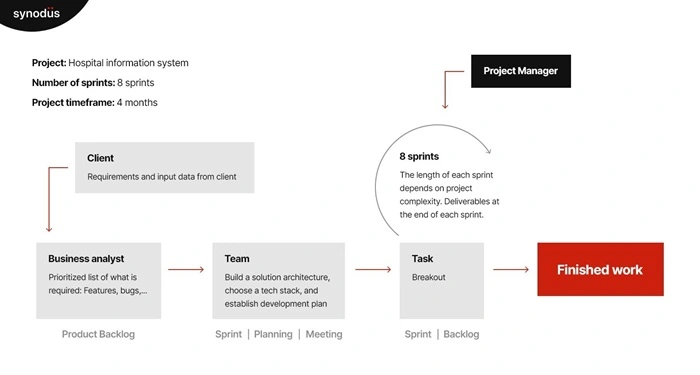
The 4-month build was structured around three approaches:
- Packaged solution as the base. Rather than building from scratch, the team used a pre-built HIS architecture covering standard hospital functions. This compressed development time and reduced cost.
- Customization where it mattered. Custom modules were added to make the HIS fit Vietnamese regulations and the client’s internal processes – not the other way around.
- Agile delivery in 8 sprints. Each sprint was completed before the next began, ensuring quality control and on-time delivery.
What was built
This is one of our many successes of hospital information system case studies. Thanks to a clear development plan and agile-driven methodology, a robust HIS and EMR was built.
Core system
- EMR for storing and retrieving patient records
- Automated appointment scheduling to reduce wait times and eliminate queues
- Bed and ER management with real-time inpatient data
- Billing and insurance management
- Medicine and equipment inventory management with supply tracking
- Separate dashboards for doctors and administration staff
Custom modules
- Patient and doctor mobile app: Bilingual (Vietnamese/English), familiar interface for Vietnamese users. Patients can access medical records, schedule appointments, and consult remotely with hospital experts.
- IoT-connected LIS and PACS: The EMR connects to the laboratory information system and picture archiving system via IoT, giving a complete view of each patient’s data across the facility.
- Vietnamese regulatory compliance: The system stores Citizen ID, social security number, insurance number, and data supporting Level 2 electronic identification, in line with Vietnamese data protection law.
- Training management module: Staff can share knowledge and support career development. The module also supports telemedicine.
- Integrated analytics dashboard: Real-time visibility into facility performance, patient numbers, and operational metrics.
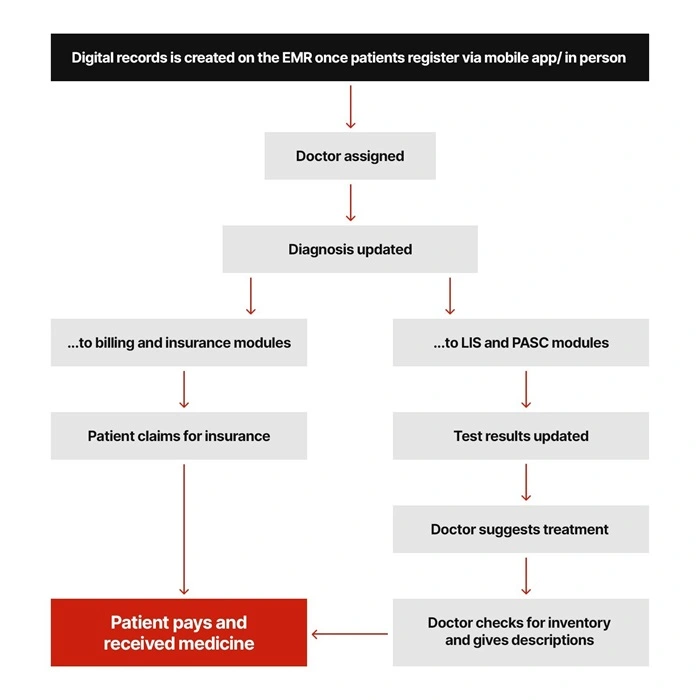
To understand how the hospital information system works in real-life, here’s the visualization:
The results
After deployment, Synodus provided training to all healthcare staff and conducted data transfer testing across departments.
100%
adoption across departments and staff
70%
boost in operational efficiency thanks to automation and centralization
85%
of reports and forms are digitalized, saving tons of money and time on paperwork
< 2
minutes is the average time a patient waits for their medical records to be synchronized
90%
decrease in incidents such as late response, disparate data, wrong diagnosis, and frustrated patients
100%
connectivity with LIS, PACS according to HL7, ISO and HIPPA standard
When Synodus spoke with doctors and staff at Military Hospital 110 after deployment, the consistent feedback was that they could now spend more time with patients instead of managing paperwork. Communication improved because everything was accessible through a single digital record.
We have worked with 30+ facilities and 10,000 healthcare staff
What we can learn from the hospital information system case study
Building an HIS is not straightforward. These are the factors that contributed to a successful outcome:
1. Choosing the right adoption strategy
Off-the-shelf, build from scratch, or packaged solution with customization? One wrong call costs time and money.
| Approach | Best for |
|---|---|
| OTS/SaaS | Small facilities with limited budgets needing basic administrative and data functions |
| Build from scratch | Large facilities with complex requirements incorporating AI, data analytics, blockchain |
| Packaged + customization | Small to mid-size facilities wanting a robust HIS with flexibility at lower cost than a full custom build |
For a detailed comparison of specific products across each category, see the best hospital information system guide.
2. A good HIS needs to serve two audiences
The hospital: scalable, regionally compliant, secure, open to third-party integration. The patient: easy to use for any demographic, supportive of local social standards (supporting Islamic requirements matters for Malaysian users, for example).
3. Developer expertise determines outcomes
Whether building in-house or with a partner, choose developers with proven HIS experience who can balance quality against your budget. For guidance on what to look for, see the hospital information system companies evaluation guide.
4. Post-deployment is not optional
Every staff member needs to understand and use the system. Training courses, maintenance plans, and regular updates are part of what makes an HIS investment pay off over time. For a structured approach to this phase, see the hospital information system implementation plan.
Upcoming trend on using HIS and Healthtech
The HIS of 2030 will look different from today’s. Worth tracking:
- Telehealth and remote healthcare integration: Patients create digital records remotely, consult doctors via mobile app, and have all data stored in real time under their EMR
- AI, ML, and predictive analytics supporting accurate diagnosis and personalized treatment
- National healthcare data systems: Multiple countries are building national health infrastructure; integration readiness matters now
- Wearable health device integration feeding real-time data into HIS
- AR/VR and 3D imaging for remote diagnosis and medical training
- Blockchain in healthcare: Still developing, but worth monitoring for record security and transactions
Synodus actively works with these technologies and applies them where they deliver real clinical or operational value – not as feature additions, but as solutions to specific problems healthcare facilities face.
Wrapping up
This hospital information system case study shows what is possible when an HIS is built around a facility’s actual workflows rather than asking the facility to adapt to generic software. The results at Military Hospital 110 – 70% efficiency improvement, full paper elimination, 100% departmental adoption in 4 months – reflect what happens when implementation is planned and executed correctly.