What “free EMR” actually means
Free EMR software falls into two categories:
Open source: The source code is publicly available. You can download, install, modify, and host it at no licensing cost. The software is free; implementation, hosting, training, and maintenance are not.
Freemium: A limited version at no cost, with full functionality behind a paid tier. Not covered in this guide.
One important security note: free EMRs are typically open source, which means the code is available to anyone to inspect, but that does not mean it has been thoroughly inspected, nor that there is an active community looking at the code to identify security weaknesses. When evaluating any open source EMR, verify that the project has an active development community, regular security patches, and a track record of responsible disclosure.
The 7 best free and open source EMR options for clinics
1. OpenEMR
Website: open-emr.org
License: GNU GPL
Best for: Small-to-mid size clinics, independent practices, community health centers
OpenEMR is an open source medical practice management application featuring fully integrated electronic health records, scheduling, electronic billing, internationalization, and free support with a vibrant community. It is ONC-certified for meaningful use in the US and is one of the most feature-complete free EMR options available.
OpenEMR covers clinical documentation, e-prescribing with drug interaction checking, lab integration, patient portal, scheduling, and billing in a single platform. Multi-language support includes Spanish, French, Arabic, and several Asian languages, making it practical for international deployments.
What it does well:
- Comprehensive feature set covering clinical, administrative, and billing functions in one system
- ONC-certified and HIPAA-compliant out of the box for US deployments
- Active development community with regular security updates
- Cloud hosting available through OpenEMR Cloud on AWS
- Strong international community with deployments across 100+ countries
Where it hits limits:
- Interface complexity – can be difficult to navigate for non-technical clinical staff without proper training
- US-centric billing module – international insurance workflows require customization
- Scaling to high-volume clinic environments (100+ concurrent users) needs significant infrastructure
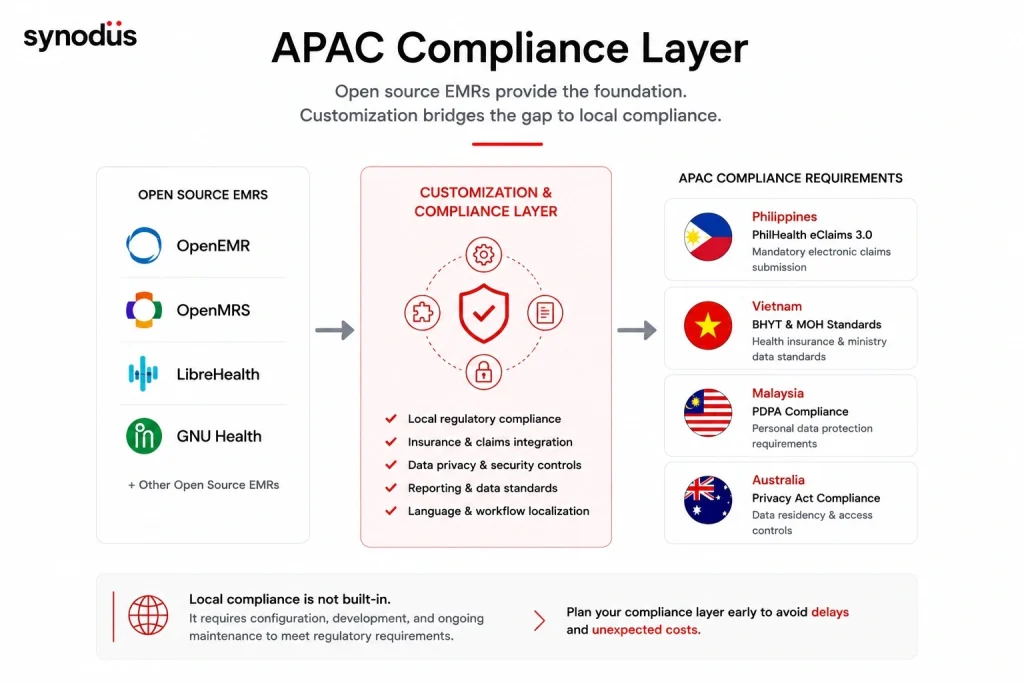
- Local compliance for APAC markets (PhilHealth, Vietnam MOH, Malaysian PDPA) requires custom development
Training resources: OpenEMR has an official wiki with setup guides, a YouTube channel with tutorial videos, and an active community forum. Paid training is available through certified OpenEMR partners.
Realistic total cost for a small clinic: Hosting $50-200/month, initial setup $2,000-$10,000 with developer support, ongoing maintenance $1,000-$5,000/year.
2. OpenMRS
Website: openmrs.org
License: Mozilla Public License 2.0
Best for: Community health clinics, NGOs, public health programs in low-resource settings
OpenMRS is a free, open-source electronic medical record system that tracks and analyzes medical histories, treatments, and results by managing and maintaining patient records. It now powers over 8,000 facilities in more than 70 countries and is free of vendor lock-in and licensing fees.
OpenMRS is primarily a clinical records platform. It handles patient registration, clinical documentation, lab results, medication management, and appointments. Its modular architecture allows adding functionality through a concept dictionary – customizable without programming experience for configuration changes. The newer O3 frontend has significantly improved the interface compared to older versions.
What it does well:
- Proven at scale in community clinic environments across Africa, Asia, and Latin America
- Offline-first capabilities for low-connectivity environments
- FHIR R4 interoperability support
- Backed by WHO, PEPFAR, and major global health organizations
- Highly customizable to local clinical workflows
Where it hits limits:
- Limited built-in billing and practice management modules – primarily a clinical tool
- Requires developer expertise to deploy and maintain properly
- Less suited for private practice billing workflows
- Commercial support available but not free
Training resources: OpenMRS Academy at academy.openmrs.org offers free online courses covering system administration, clinical configuration, and developer training. Community forums and Slack channel provide ongoing support.
Realistic total cost for a community clinic: Hosting $100-500/month depending on patient volume, implementation $5,000-$50,000 depending on customization scope.
3. LibreHealth EHR
Website: librehealth.io
License: Mozilla Public License 2.0
Best for: Small independent practices, free clinics, practices transitioning from paper
LibreHealth EHR was forked from OpenEMR and rebuilt with a modern, more intuitive interface as the primary design goal. It covers patient demographics, clinical documentation, e-prescribing, lab integration, billing, and scheduling – similar scope to OpenEMR but with a cleaner user experience.
The project emphasizes accessibility for clinical staff with varying technical backgrounds, which makes it a more practical choice for practices that cannot invest in extensive training.
What it does well:
- More modern interface than older open source alternatives
- Easier to navigate for non-technical clinical staff
- Active development community
- FHIR support for interoperability
- Free to use, modify, and deploy
Where it hits limits:
- Smaller community than OpenEMR – fewer available implementers and less extensive documentation
- Fewer third-party integrations than larger platforms
- Less proven at high patient volume than OpenMRS
Training resources: LibreHealth has documentation at docs.librehealth.io and a community forum. Training is less structured than OpenEMR – primarily self-directed through documentation.
4. GNU Health
Website: health.gnu.org
License: GNU GPL v3
Best for: Community clinics with strong data sovereignty requirements; public health programs
GNU Health is an official GNU project and a recognized Digital Public Good. It covers patient management, clinical documentation, lab, pharmacy, inpatient management, and public health surveillance. Deployed by national health systems in Argentina, Jamaica, Laos, Cameroon, and Suriname.
Its primary differentiator for clinics: complete data sovereignty with no telemetry, no vendor dependencies, no licensing fees ever. For practices where data control is non-negotiable, GNU Health is the most principled option on this list.
What it does well:
- Full data sovereignty – no licensing, no telemetry, no vendor lock-in
- Strong public health and epidemiology tools beyond basic clinical documentation
- Recognized by the UN and multiple international health organizations
- Multi-language support including Spanish, Arabic, and others
Where it hits limits:
- Built on Tryton framework – steeper learning curve than web-based alternatives
- Smaller developer community than OpenEMR or OpenMRS
- Interface is functional but dated
- Finding trained implementers is harder than for more widely deployed platforms
Training resources: GNU Health Community at community.gnuhealth.org and documentation at the GNU Health wiki. Training courses available through GNU Solidario in Spanish and English.
5. Solismed
Website: solismed.com
License: Open source (free clinic version available)
Best for: Multi-specialty practices and free clinics needing integrated clinic management
Solismed is created for multi-specialty practices and free clinics, working as a clinic management system for independent practices. It provides appointment scheduling, patient encounter management, secured medical records, free e-prescribing, billing, inventory control, and patient portal in one integrated system. Users can manage utilities, bills, and stock from this one integrated system. It is reliable, secure, and browser-based with 100% data ownership.
What it does well:
- Integrated clinic management beyond pure EMR – covers inventory, billing, and patient portal
- Browser-based with no desktop installation required
- Free e-prescribing included
- Customizable to clinic-specific workflows through the interface
Where it hits limits:
- Smaller community than OpenEMR or OpenMRS
- Less extensive documentation for self-guided implementation
- International compliance (APAC, EU) requires additional development
6. OSCAR EMR
Website: oscar-emr.com
License: GNU GPL
Best for: Canadian primary care and family medicine practices; international practices with access to OSCAR-trained implementers
OSCAR (Open Source Clinical Application Resource) was developed at McMaster University in Canada and is widely used by Canadian family physicians. It covers clinical documentation, e-prescribing, lab integration, scheduling, billing (optimized for Canadian provincial billing systems), and patient portal.
OSCAR’s open-source code is used as the basis of EMR software by various organizations, with the “OSCAR McMaster” name used only by those affiliated with McMaster who uphold standards of transparency, collaboration, quality, and ethical data stewardship.
What it does well:
- Proven in Canadian primary care for 20+ years
- Strong billing integration with Canadian provincial health insurance systems
- Active implementer community in Canada
- Solid clinical documentation with encounter-based charting
Where it hits limits:
- Billing module is Canadian-specific – limited value for non-Canadian deployments
- Smaller international community outside Canada
- Interface reflects its age in some modules
Training resources: OSCAR training is available through McMaster and various Canadian OSCAR service providers. Documentation at the OSCAR wiki covers clinical workflows and system administration.
7. FreeMED
Website: freemedsoftware.org
License: GNU GPL
Best for: Free clinics and community health programs with minimal IT resources
FreeMED is one of the oldest open source medical record systems, developed specifically for free clinics and community health programs operating with very limited budgets and IT resources. It covers patient registration, clinical encounters, medication management, scheduling, and basic reporting.
What it does well:
- Designed for free clinics with minimal resources and IT support
- Simple interface accessible to volunteers and non-technical staff
- Active in community health and free clinic networks in the US
Where it hits limits:
- Development activity has slowed compared to more active projects like OpenEMR
- Feature set is more limited than other options on this list
- Less suited for practices with complex clinical workflows or high patient volumes
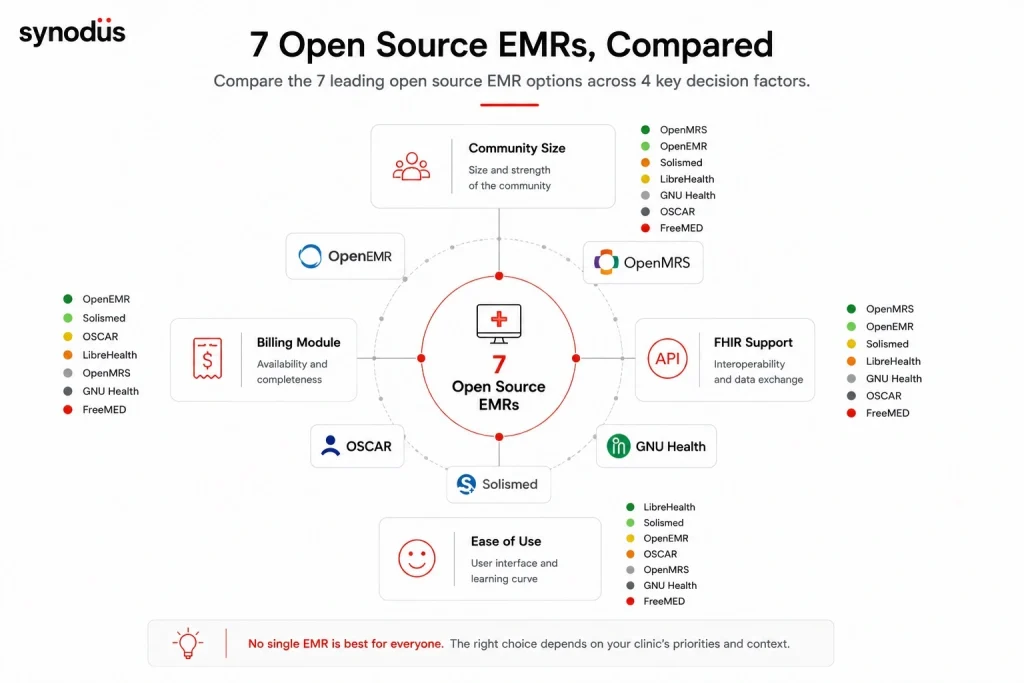
Head-to-head comparison
| System | Best clinic type | Interface | Community size | FHIR support | Billing module |
|---|---|---|---|---|---|
| OpenEMR | Small-mid private practice | Functional, complex | Large | Yes | Full (US-focused) |
| OpenMRS | Community clinic, NGO | Improving (O3) | Very large | Yes (R4) | Limited |
| LibreHealth | Small independent practice | Modern, clean | Medium | Yes | Basic |
| GNU Health | Data sovereignty, public health | Functional, dated | Medium | Partial | Basic |
| Solismed | Multi-specialty, free clinic | Browser-based | Small-medium | Limited | Integrated |
| OSCAR | Canadian primary care | Dated | Medium (Canada) | Partial | Canadian billing |
| FreeMED | Free clinics, minimal resources | Simple | Small | No | Basic |
The real cost of “free” for a small clinic
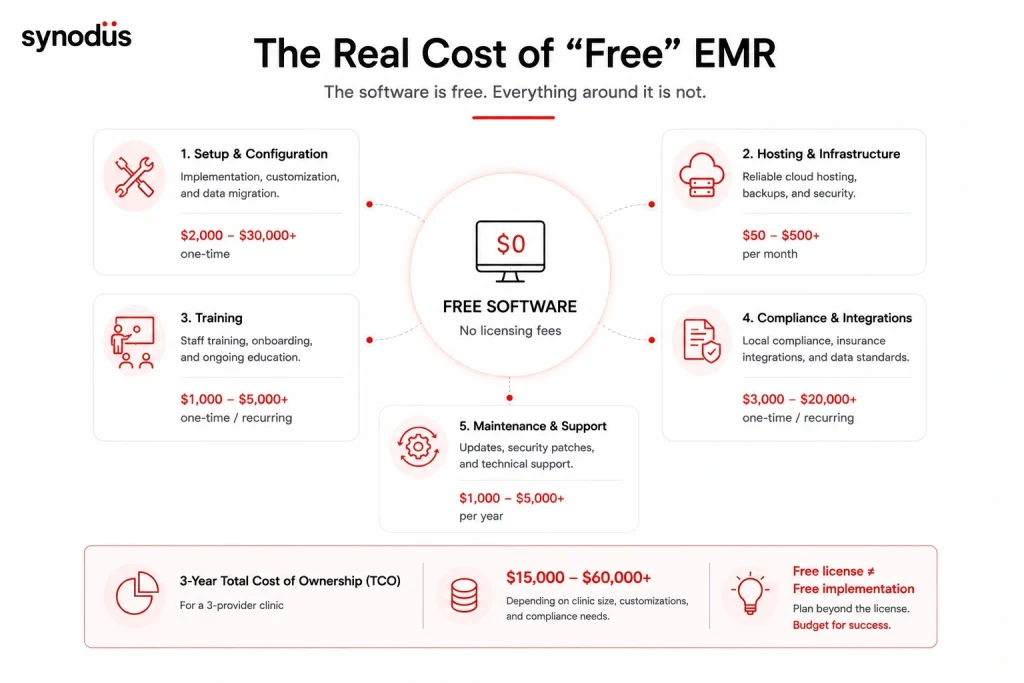
The software is free. Everything around it is not.
Setup and configuration: Getting any of these systems running for a real clinic requires either developer time or a trained implementer. OpenEMR setup for a solo practice can run $2,000-$10,000 in consultant time. For a 5-provider clinic with custom templates and billing configuration, expect $10,000-$30,000.
Hosting: A reliable cloud hosting environment costs $50-$500/month depending on patient volume and backup requirements. Self-hosting reduces this but requires server administration skills.
Training: Clinical staff need to learn the system before go-live and after staff turnover. Plan for at least 8-16 hours of training per clinical role. OpenEMR’s Academy and documentation reduce this cost, but it is not zero.
Local compliance: For clinics in APAC markets, getting an open source EMR to meet local requirements adds development cost:
- Philippine PhilHealth eClaims 3.0: custom integration required
- Vietnam BHYT and MOH data standards: custom development
- Malaysian PDPA: data handling configuration and documentation
- Australian Privacy Act: data residency and access controls
Ongoing maintenance: Security patches, version upgrades, and occasional bug fixes require ongoing technical attention – either internal IT capacity or a support contract.
Realistic 3-year total cost for a 3-provider clinic:
- OpenEMR or LibreHealth: $15,000-$60,000
- OpenMRS (community clinic): $10,000-$40,000
That range is significantly lower than commercial SaaS over the same period for most small practices – which is the primary reason open source remains a practical option at clinic scale. For a full cost comparison between open source, SaaS, and custom builds, see the EMR cost guide for clinics and small practices.
When free open source EMR makes sense for a clinic
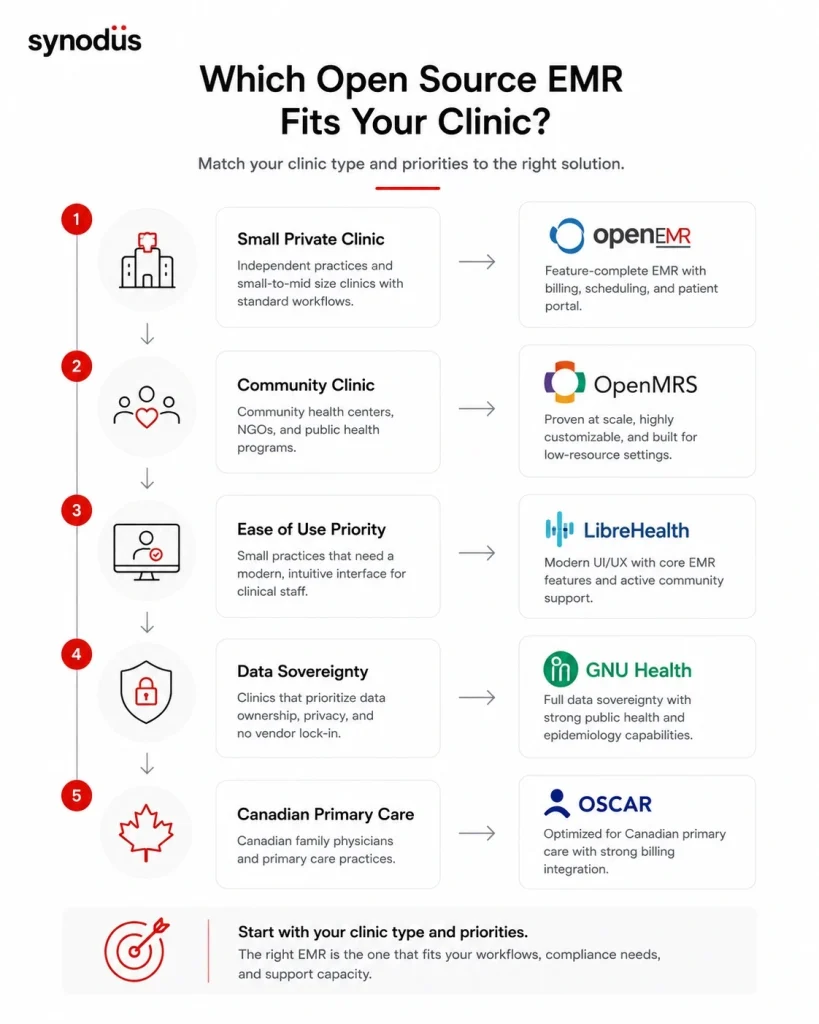
Solo practitioners and small practices with standard workflows who cannot justify $400-$800/month in SaaS fees and have access to developer support for setup.
Community health clinics and free clinics where licensing fees are genuinely prohibitive and the patient population needs are well-served by OpenEMR or OpenMRS.
NGO-run clinics in low-resource settings where OpenMRS or GNU Health have strong local implementer communities.
Practices that prioritize data ownership and want to avoid vendor lock-in or long-term subscription dependencies.
Technically capable practices with an IT-comfortable staff member who can handle ongoing maintenance without external support.
When free open source EMR stops being enough
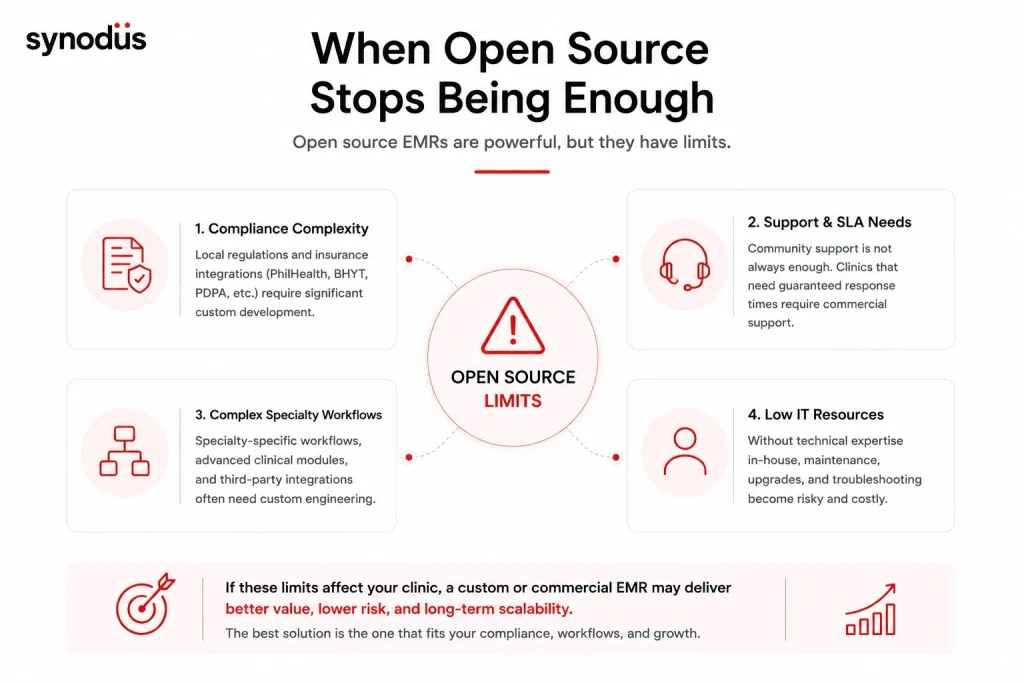
Local compliance is mandatory and complex. If your clinic must submit PhilHealth eClaims, integrate with BHYT, or comply with PDPA/NPSTI, the customization cost on an open source platform can approach the cost of a commercial system built with those integrations already in place.
You need a support SLA. Open source support means community forums and goodwill. For a busy clinic where system downtime directly affects patient care and revenue, a support contract with guaranteed response times has real value. Most open source projects offer paid support tiers – budget for this if downtime is not an option. If you are at this point, it is also worth reviewing commercial options – see the top EMR and EHR companies guide for a comparison by practice type.
Specialty workflows are complex. Open source EMRs are designed around general clinical workflows. Mental health documentation requirements, oncology protocol tracking, and ophthalmology imaging integrations require either a specialty-specific platform or significant customization.
Your staff is not tech-comfortable. An open source system that gets misconfigured or improperly maintained creates clinical risk. If your clinic does not have reliable access to technical support, a well-supported commercial product at $200-$400/month is a more practical path.
Build a custom EMR for your clinic with Synodus
If you have evaluated open source options and concluded that your clinic’s compliance requirements, specialty workflows, or integration needs are beyond what they can serve without significant investment, a hybrid approach – a pre-built clinical base customized to your context – often delivers better value than either open source or commercial SaaS.
Synodus is a healthcare software development company with 250+ developers and 30+ implementations across APAC. Their hybrid model starts from a validated EMR base covering core clinical modules and extends it with custom compliance layers, local insurance integrations, and workflow-specific modules.
Multi-field hospital complex – 700 beds, 2,500 outpatients and 800 staff daily. Custom EMR with cloud-based records, two-layer encryption, e-prescription, document scanning, and full HIS integration. Built in 4 months. Results: 70% improvement in operational efficiency, 90% decrease in incident rates, 3x faster diagnosis, 85% of documents digitalized. Read the full EMR/EHR case study.
Development rates start at $25/hour. Projects start within 48 hours of scoping completion.
FAQs
OpenEMR is the most feature-complete free EMR option for small-to-mid size clinics, with ONC certification, full billing integration, and a large support community. For community health clinics and NGOs in low-resource settings, OpenMRS has the largest global deployment footprint and the strongest support infrastructure. LibreHealth is worth evaluating for practices that prioritize interface usability over feature depth.
Safety depends on implementation quality, not the license. OpenEMR and OpenMRS support HIPAA-compliant configurations with encryption, role-based access control, and audit logging. The risk is misconfigured deployments – improperly set up access controls, encryption not enabled, or outdated versions with known vulnerabilities running in production. A properly implemented open source system is significantly safer than a poorly maintained commercial one.
A solo practice implementing OpenEMR with basic configuration: 4-8 weeks. A 5-provider clinic with custom templates, billing configuration, and data migration from paper: 3-6 months. Community clinic implementations with custom workflows: 6-12 months. For a phase-by-phase implementation framework, see the hospital information system implementation guide – the phases apply to clinic-scale EMR deployments as well.
Yes, with customization. OpenEMR and OpenMRS can be configured for APAC clinical workflows, but local compliance integrations – PhilHealth eClaims 3.0 in the Philippines, BHYT in Vietnam, PDPA in Malaysia – require custom development. None of these systems ships with those integrations built in. Budget explicitly for compliance work before committing to an open source path. For region-specific guidance, see the Philippines HIS guide and the Malaysia HIS guide.
Most free and open source platforms cover both EMR and EHR functions – the distinction is less meaningful in the open source world than in commercial software. OpenEMR, OpenMRS, and LibreHealth all support FHIR-based data exchange, which is the key EHR capability. The practical difference at clinic scale is whether you need cross-provider data sharing (EHR) or primarily within-clinic records management (EMR). For a detailed comparison, see the EMR vs EHR vs PHR guide.
– OpenEMR: OpenEMR Academy (free online courses), official wiki, YouTube tutorials, community forum
– OpenMRS: OpenMRS Academy at academy.openmrs.org (free structured courses), community Slack
– LibreHealth: Documentation at docs.librehealth.io, community forum
– GNU Health: GNU Health community portal, training courses through GNU Solidario
– OSCAR: McMaster training materials, Canadian OSCAR service provider courses
All five projects have active community forums where clinical staff can ask implementation and workflow questions at no cost.