Current challenges in digital transformation of financial services
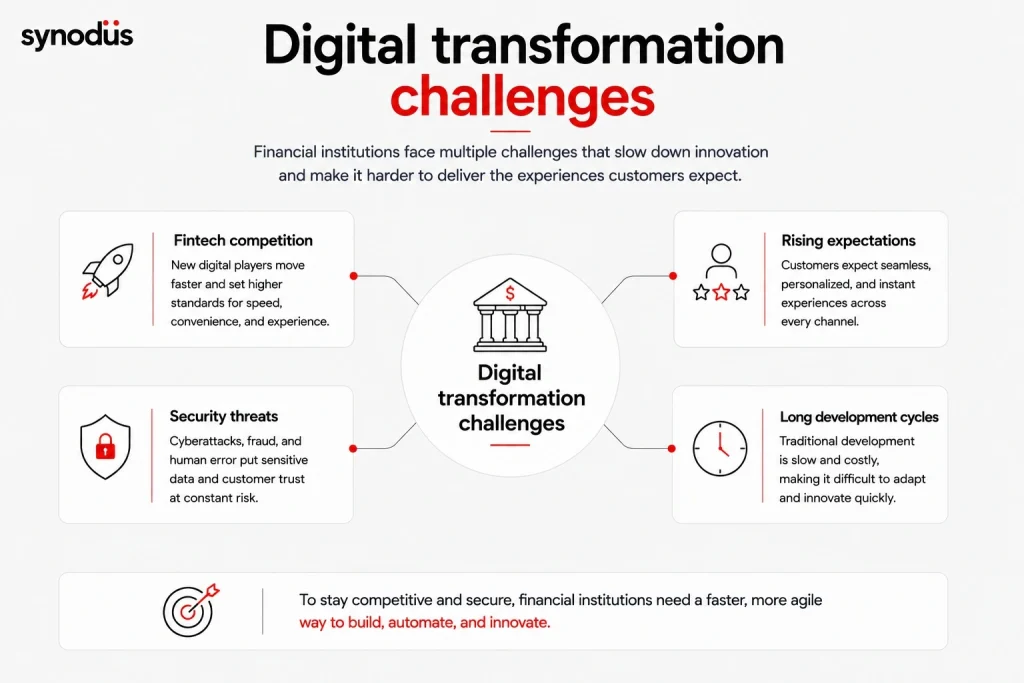
1. Competition against fintech
Competition from new entrants, especially fintech giants, is fiercer than it is between established banks and credit unions. Fintech offer customer service that is online, fast, convenient, and time-saving, so traditional institutions are racing to use technology to keep up. Many well-known banks have spent millions building custom digital interfaces, yet they started well behind fintech. The question is how to close that gap.
2. Rising customer expectations
Customers now expect to be served, informed, and involved on their own terms. Instead of visiting a branch for a credit card application, they want to do it online themselves. Institutions that deliver fast processes and personalized service see better retention and lower churn.
Because digital solutions evolve so quickly, applications can become obsolete fast, which pushes businesses to add features like voice-enabled support, live chat, and autonomous chatbots. As the experience improves, expectations rise with it, so companies must keep improving response times, accuracy, and ease of use. Firms that adapt slowly risk falling behind.
3. Security in the digital era
Protecting clients’ money and personal data is fundamental, and it is also one of the hardest challenges banks face. Attempts to breach financial systems happen constantly. According to the 2025 Verizon Data Breach Investigations Report, around 60% of breaches involved the human element, such as errors, social engineering, or misuse, which underlines why centralized, governed systems matter.
4. Long development cycles with the traditional approach
Depending on complexity, a typical software project can take up to 18 months. That is far too long for a financial organization that needs to automate and improve operations now.
Key takeaway: the threat from fintech, high demand for digital experiences, and the risk of security gaps have pushed financial institutions to find something better than a slow, traditional development process. Because low-code can cut development time by 50 to 90%, it has become the go-to alternative for both conventional finance and fintech looking to drive innovation through automation.
What is low-code?
Low-code makes rapid application development possible by relying on visual building blocks, point-and-click configuration, and pre-built code to automate the build. This lets developers cut manual coding and repetitive tasks so they can focus on what makes their product unique.
By helping IT, citizen developers, and business experts collaborate, low-code speeds up delivery and reduces coding effort. In short, it saves digital teams their two most valuable resources: time and energy. For a deeper primer, explore our full guide to what low-code is.
What is good about low-code?
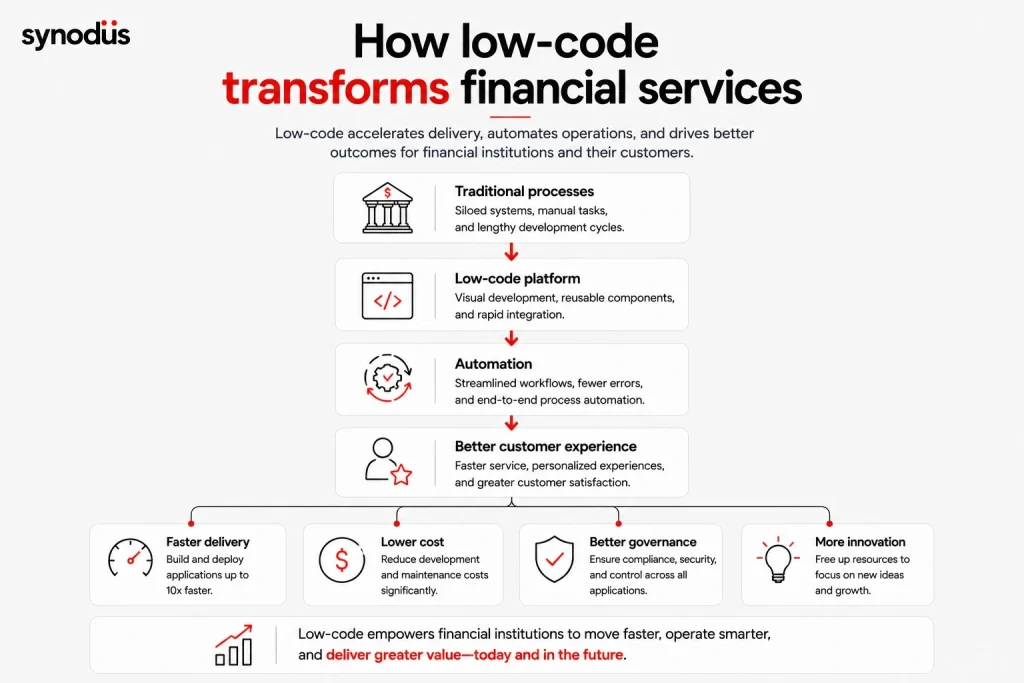
- Cost-effective: save on your development budget and on hiring developers. The average ROI of a low-code platform runs from 150% to 300% or more.
- Faster deployment: low-code is said to speed development up to 10 times. You skip the tedious, time-consuming parts and get straight to customization.
- Automation built in: with low-code BPM and RPA features, you can automate processes from departmental to cross-department.
- Better teamwork: low-code unites IT professionals and business users. One side shares and prototypes the idea while the other executes, which removes misunderstanding and clears IT backlogs. You can also set up access management and governance to keep usage under control.
- Low maintenance: standardized, pre-tested, ready-made components mean fewer bugs and integration issues.
- More room for innovation: less time on lengthy development plans means more flexibility for your IT team to pursue other innovations.
Is low-code really that good? See the full picture in our breakdown of the pros and cons of low-code.
How to leverage low-code for financial services
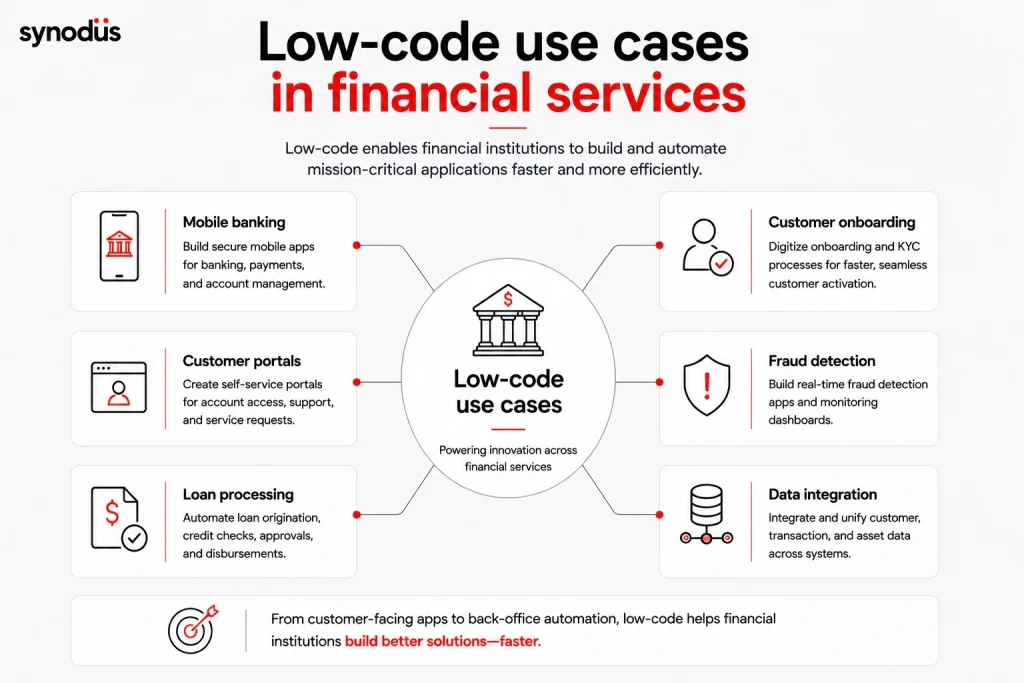
| Use case | What you can build |
|---|---|
| Rapid application development | MVPs, prototypes, new digital products |
| Better digital experience | Mobile banking, customer portals, chatbots |
| Operational automation | Onboarding, account closure, loan processing |
| Risk reduction | Anti-fraud apps, centralized governed systems |
| Data integration | Unified customer and asset data platforms |
1. Rapid application development
Low-code can dramatically shorten the time to build new software, giving programmers a toolkit to prototype, develop, and deploy with minimal code. IT departments and fintech startups can use it to build a minimum viable product (MVP) to test functionality and market fit before scaling, which is valuable in a sector that must constantly adapt to market change.
2. Deliver better digital user experiences
Customers now expect digital banking, and that trend keeps growing. Online channels already dominate new account openings, deposits, consumer loans, and credit card applications across much of the market. Low-code lets customer service teams craft seamless, personalized experiences quickly. For example, you can build:
- A low-code portal with chatbots to answer common questions.
- A finance mobile app for digital transactions.
- A data application to store and analyze client information.
3. Transform operations with automation
Low-code is not only for web and mobile apps. You can also build business automation tools, since most platforms include robotic process automation (RPA) features with agents trained to handle tedious manual tasks. Examples in finance include:
- Customer onboarding.
- Account closure.
- Bank reconciliation.
- Loan and credit card application processing.
- Automated daily reports.
- Trade finance operations.
4. Reducing internal risks
When IT resources grow slower than demand, low-code helps meet urgent needs without a large IT team. Many financial firms still rely on Excel spreadsheets, which are convenient but lack governance, data lineage, and security, putting sensitive client data at risk. A centralized, governed system reduces that exposure, and low-code can build and maintain one.
For example, you can build an app with anti-fraud rules that uses machine learning to flag risky users and alert you to suspicious transactions, which builds customer confidence. Read more in our guide to low-code databases for management and analytics.
5. Data integration into one platform
Customer identification and banking operations, from know-your-customer checks and fraud detection to transaction records and loan history, are often handled in siloed systems that struggle to communicate. Employees then switch between platforms to find information, which makes investigations slow and complex.
Businesses use low-code to consolidate this data into a complete picture, merging records from many accounts and third-party sources, sometimes adding machine learning and business intelligence to surface trends and opportunities. See our roundup of low-code data integration tools.
The AI shift in financial services low-code
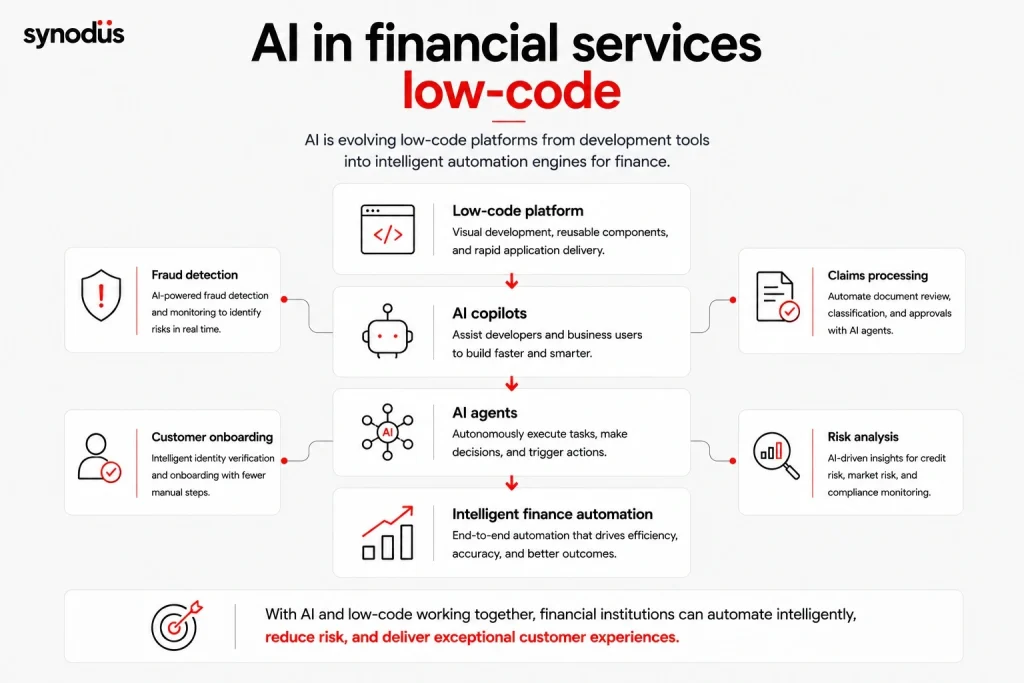
In 2026, AI has moved to the center of financial services low-code. Anti-fraud tools have evolved from rule-based alerts into AI models that detect anomalies in real time, onboarding and claims now run through AI agents that verify documents and complete steps end to end, and developers use AI copilots to generate apps from a plain-language prompt. Allianz, for example, launched an AI agent in 2025 to automate low-complexity claims with a human-in-the-loop model. When planning a finance build today, it is worth asking where an low-code AI agent could go beyond a static workflow, while keeping the governance that regulated industries require.
Real-life use cases of low-code in financial services
- RBC Wealth Management used low-code to speed up its bank account registration and smooth data transfer across RBC’s platforms.
- Academy Bank built an app to monitor PPP loans with low-code, and ING Bank uses a low-code suite to handle credit and political risk insurance.
- Standard Bank, headquartered in South Africa, set up a center of excellence to let employees lead their own digital transformation. One early success was a low-code ATM inspection solution, prototyped as a mobile app in just 24 hours. Over 300 employees now use it to produce more than 5,000 inspection reports a month.
- Yorkshire Building Society Group, the third-largest building society in the UK, updated its self-service software for around three million customers. Its new online mortgage calculator and savings account application were built with low-code, after which mortgages closed rose 54% and the pace of new savings account openings rose 40%.
These figures come from each institution’s published case studies, so treat them as point-in-time results.
Top low-code platforms for financial services
Choosing a low-code platform for finance takes more care than in other industries, for two reasons:
- Financial data is highly sensitive and needs a secure platform to protect it.
- Most financial tasks demand caution and precision, so the platform must be flexible and stable enough to handle multi-step processes and advanced automation. An enterprise-grade tool is usually the better fit.
With those requirements in mind, here are strong options. Need more choices? See our detailed review of the top low-code platforms.
- Microsoft Power Apps: a strong choice for professional-grade apps trusted across the financial industry. If you already use Microsoft 365, Power Apps integrates easily for basic to complex builds and process automation, with SharePoint as an option for intranet development. See how Power Apps transformed a Rabobank process.
- OutSystems: focused on high performance, it uses AI and cloud technology to build advanced apps, full process automation, and customer service tools.
- Pega: an easy-to-use interface with advanced features for enterprise-ready CRM, case management, and RPA.
- Sitecore: robust functions to customize customer management, asset management, websites, and content management.
- Salesforce Lightning: among the top choices for scalable cloud apps and complex mobile apps in financial services, now with built-in AI agents.
- GeneXus: like OutSystems, it uses AI for a flexible, scalable, high-performance coding environment across cloud and on-premises, suitable for individuals, startups, and enterprises.
As a Microsoft Power Platform specialist, Synodus builds and customizes secure low-code solutions for finance and banking, from customer-facing apps to process automation, often delivering in a matter of weeks. If you want consultation and support, our experts are ready to build robust applications and optimized automation for your finance business. Explore our low-code services.
Frequently asked questions
Banks adopt low-code to compete with fast-moving fintechs, meet rising customer expectations for digital service, and ship software far faster than traditional development allows, all while keeping costs down. Around half of financial services firms are already among the top low-code adopters.
It can be, but security depends on the platform and your governance. Finance teams should choose enterprise-grade platforms with strong security certifications, centralize app building under IT oversight, and apply access controls, rather than assuming any platform is safe by default.
Common builds include mobile banking apps, customer portals and chatbots, onboarding and loan processing automation, anti-fraud tools, ATM and branch operations apps, and unified data platforms that pull together siloed customer information.
No. AI is being built into low-code platforms, not replacing them. AI agents and copilots speed up fraud detection, onboarding, and app generation, but you still need the platform’s governance, security, and integration layer to run them safely in a regulated environment.
Wrapping up
Low-code is a strong alternative to time-consuming traditional coding in financial services. To get the most from it, use it with customization, encourage professional coders to work alongside citizen developers and business users, and treat low-code as a tool rather than a replacement for traditional development. Done well, it delivers fast application development and smooth process automation.
If you would rather have experts build it for you, Synodus delivers custom low-code development for finance and banking that turn your data into apps 10x faster and cut development costs by half, with the security and governance the sector demands. Book a free consultation to find the right fit for your business.