How this list of Web3 development companies was made
Here’s how we selected the Web3 companies on this list.
Expertise
We start by looking at expertise. That means evaluating their experience, technical know-how, and mastery of relevant Web3 tech stacks through their portfolio, case studies, GitHub repositories, and client testimonials. We prioritize companies with transparent, impressive portfolios that showcase their real-world projects.
Areas of inspection:
- Team of experts: The top Web3 companies must have a team with a proven track record in Web3 development. Hands-on experience with blockchain technology, smart contracts, and decentralized applications (DApps) is preferred.
- Verifiable projects: Well-documented portfolios showcasing past projects and achievements are valuable evidence of competence. By assessing the company’s previous work, we can confidently measure the company’s capability and reliability.
- Security protocols: We also pay close attention to the Web3 development firm’s security approach, particularly in smart contract development and data privacy. Selected companies must strictly follow standard safety protocols and have no history of breaches.
- Tech stacks: We investigate the Web3 technology stacks to make sure they are comprehensive and up-to-date.
These capabilities should cover the full product lifecycle, from use-case validation and architecture design to development, testing, deployment, and maintenance. Our guide on how to build a blockchain app explains the key stages and technical capabilities a development partner should be able to support.
Cost-effectiveness
Next, we look at whether a company can deliver strong outcomes at a reasonable cost. Pricing structure and resource allocation matter, but the clearest signal is whether a company can point to real, documented results from past work. That is why we prioritize companies with case studies backed by specific, verifiable numbers, not general claims of success.
Areas of inspection:
- Pricing transparency: We look at how clearly each company communicates its hourly rates, project minimums, and pricing model (fixed cost vs hourly). Companies that keep pricing vague or hidden behind a sales call are ranked lower on this criterion.
- Documented project outcomes: Instead of relying on self-reported ROI figures we cannot verify, we prioritize companies that publish case studies with concrete, checkable numbers, for example user growth, cost reduction, or time to market. A claim only counts if it is tied to a specific project we can point to.
- Note: we did not evaluate ROI directly, since project financials are rarely public information. What we can verify is whether a company has a track record of delivering results it is willing to document.
Client testimonials
Our Web3 companies list value insightful reviews. Shortlisted companies must have positive feedback from past clients, scoring 4.5 stars minimum on Clutch. We also value authentic testimonials that provide insights into the company’s capabilities, work ethics, and customer service.
Areas of inspection:
- Reviews from reputable platforms: Selected companies should be listed in credible sources like Clutch.co, G2, and Good Firms. We only qualify companies with authentic reviews and positive scores.
- Handling negative feedback: We heavily emphasize how the company addresses negative feedback. It’s a testament to their professionalism & communication in troubled times.
Before comparing individual vendors, use this framework to evaluate a blockchain development company based on your project stage, budget, technical requirements, and risk profile.
World’s best 10 web3 development companies in 2026
Let’s take a closer look at the top 10 Web 3.0 development companies according to the criteria mentioned above.
| Company name | Founded | Team size | Clutch rating | Best for |
|---|---|---|---|---|
| Synodus | 2019 | 250 – 999 | 5/5 | High-stakes fintech and blockchain products where security, scalability, and production reliability are critical |
| Peiko | 2017 | 50 – 249 | 5/5 | Fintech and crypto exchange platforms needing fast, agile delivery |
| NetSet Software Solutions | 2011 | 50 – 249 | 4.9/5 | Cost-conscious startups and mid-market businesses building DeFi platforms from a $10K budget. |
| Systango Technologies | 2007 | 250 – 999 | 4.9/5 | Enterprises seeking a publicly listed blockchain partner with stronger governance and financial transparency |
| 4soft | 2015 | 50 – 249 | 5/5 | Blockchain analytics and compliance platforms requiring complex multi-chain data engineering |
| EvaCodes | 2019 | 50 – 249 | 5/5 | Startups needing a fast MVP, typically within two months |
| SpaceDev | 2017 | 10 – 49 | 5/5 | North American teams needing nearshore blockchain delivery with security embedded from day one |
| Aetsoft | 2014 | 50 – 249 | 5/5 | Regulated tokenization and digital asset platforms requiring built-in compliance workflows |
| Tech Alchemy | 2016 | 50 – 249 | 5/5 | Web3 startups needing product strategy and an investor-ready MVP, with AI integration where it adds value |
| Vention | 2002 | 1,000 – 9,999 | 4.9/5 | Enterprises needing flexible blockchain specialists backed by a large, multidisciplinary engineering team. |
Synodus
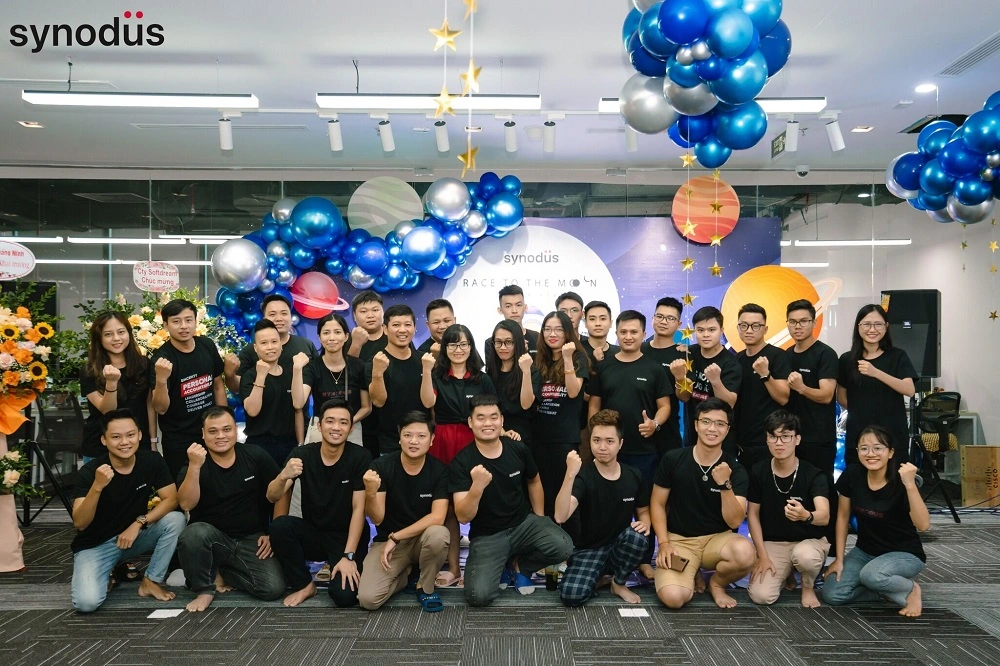
Synodus brings seven years of blockchain delivery experience to businesses operating financial systems and handling sensitive production data.
Its portfolio includes rescuing an underperforming e-wallet project for a fintech startup. Synodus rebuilt the platform on a microservices architecture within four months, creating an infrastructure capable of supporting up to 3 million users.
The company’s capabilities cover several areas relevant to production-grade financial blockchain systems:
- Information security practices aligned with ISO 27001 requirements
- Custodial and non-custodial wallet architecture
- Smart contract development, security review, audit-ready testing, and coordination with independent auditors
Synodus primarily operates at the application layer, building wallets, exchanges, and financial platforms on top of established blockchain infrastructure. Its work focuses less on developing new protocols, consensus mechanisms, or Layer 1 networks.
This makes the company particularly suitable for fintech businesses and established organizations whose blockchain products involve real-value transactions, sensitive user data, complex integrations, or demanding security requirements.
Synodus is less differentiated in research-heavy protocol engineering and highly experimental, token-first launches where speed, community growth, and crypto-native market execution matter more than enterprise delivery processes.
For companies whose blockchain projects sit close to real money movement, Synodus’s combination of production experience, application-layer expertise, and structured security practices makes it a credible vendor to include in a shortlist.
Got a Web3 idea? Let’s turn it into reality
Peiko
Peiko is a full-cycle Web3 development company focused on helping crypto-native startups move from product concepts to working platforms through fast, iterative delivery.
Its portfolio is concentrated around cryptocurrency exchanges, crypto wallets, dApps, and blockchain-enabled fintech products. The company covers the full product lifecycle, including discovery, UX/UI design, web and mobile development, blockchain integration, testing, deployment, and post-launch support.
Its core capabilities include:
- Centralized and decentralized exchange development
- Custodial and non-custodial crypto wallets
- Smart contract and dApp development using technologies such as Solidity, Rust, Web3.js, and Ethers.js
- Agile MVP development through short, iterative delivery cycles
Peiko primarily works at the application layer, building user-facing products on established blockchain networks rather than developing new protocols or consensus mechanisms.
Its delivery model is particularly relevant for startups that need to validate a crypto product quickly, launch an initial version, and improve it based on early market feedback. Client reviews also frequently highlight the team’s communication, responsiveness, and ability to maintain delivery momentum.
Peiko is less differentiated in research-heavy protocol engineering and large enterprise transformation programs where legacy modernization, complex governance, or extensive regulatory requirements form the majority of the engagement.
NetSet Software Solutions

NetSet Software Solutions is a blockchain and custom software development company positioned around cost-effective delivery for startups and mid-market businesses.
The company reports delivering more than 100 blockchain and Web3 projects, with services spanning DeFi platforms, smart contracts, crypto exchanges, tokenization, NFT marketplaces, and blockchain applications for industries such as finance and real estate.
Its core capabilities include:
- DeFi platform and smart contract development
- Crypto exchange and digital asset solutions
- Tokenization and NFT marketplace development
- Web and mobile application development around blockchain products
NetSet primarily works at the application layer, combining blockchain functionality with customer-facing platforms rather than developing new Layer 1 networks or consensus mechanisms. Its $10,000 minimum project size and hourly rates of $25–$49 place it among the more accessible vendors in this list. Client reviews frequently highlight timely delivery, responsiveness, flexibility, and strong value for cost.
The company is particularly relevant for teams that need a broad blockchain feature set while working within a controlled budget. However, its publicly available portfolio provides less evidence of research-intensive protocol engineering or large institutional DeFi programs requiring extensive regulatory and compliance specialization.
Systango Technologies
Systango Technologies is an award-winning digital engineering company. The London-based Web3 development agency was recognized as one of the first 17 Google Cloud partners to receive the Gen AI specialization certificate. Systango Technologies is a publicly listed digital engineering company combining blockchain delivery with broader expertise in cloud, AI, data, and custom software development.
Its blockchain offering covers centralized and decentralized exchanges, DeFi infrastructure, crypto wallets, smart contracts, NFT marketplaces, multi-chain deployment, blockchain indexing, and oracle integration. This gives the company a broader engineering scope than Web3 studios focused primarily on smart contracts or token launches.
Its core capabilities include:
- Centralized and decentralized exchange development
- DeFi infrastructure and AI-enabled trading solutions
- Custom and white-label wallets, including Fireblocks integration
- Smart contracts, NFT marketplaces, multi-chain deployment, indexers, and oracles
Systango works mainly across the application and supporting infrastructure layers, building production systems on established blockchain networks rather than developing new Layer 1 protocols or consensus mechanisms.
Its public listing and structured corporate governance make it particularly relevant for established businesses that place greater emphasis on vendor accountability, financial visibility, information security, and long-term operational continuity.
The company is less differentiated for low-budget MVPs and highly experimental token-first launches where a smaller crypto-native studio may offer a leaner and faster engagement model.
4soft

4soft is a blockchain-focused software development company with particular strength in the data infrastructure behind digital asset, analytics, and compliance platforms.
Beyond building smart contracts, dApps, exchanges, and tokenization products, the company develops systems that collect, index, normalize, and process high-volume data from multiple blockchain networks. This makes its capabilities relevant to products that depend on accurate, auditable on-chain information rather than blockchain functionality alone.
Its core capabilities include:
- Multi-chain data connectors, indexers, and ingestion pipelines
- Blockchain analytics and accounting-ready data processing
- Smart contract, dApp, and decentralized exchange development
- Private blockchain integrations and data verification systems
4soft works across both the application and supporting data infrastructure layers. Its projects include transforming raw blockchain transactions into standardized datasets for financial reporting, asset reconciliation, compliance workflows, and blockchain investigations.
This combination of blockchain engineering and data processing differentiates 4soft from vendors focused mainly on user-facing wallets, marketplaces, or token launches. Client reviews also frequently highlight its technical expertise, proactive problem-solving, flexibility, and ability to integrate with existing engineering teams.
The company is less differentiated for simple, design-led Web3 MVPs where the primary requirement is launching a basic customer-facing product as quickly and cheaply as possible.
EvaCodes
EvaCodes is a blockchain and Web3 development company focused on helping startups validate product ideas and bring an initial version to market quickly.
Its portfolio covers dApps, DeFi products, crypto exchanges, wallets, NFT platforms, GameFi, and tokenization solutions. EvaCodes states that it can deliver a Web3 MVP within approximately two months by limiting the initial scope and using an iterative development process.
Its core capabilities include:
- Web3 product discovery and MVP development
- DeFi, dApp, wallet, and crypto exchange development
- Smart contract development and blockchain integration
- Multi-chain deployment across networks such as Ethereum, BNB Chain, Solana, and TRON
EvaCodes primarily works at the application layer, building customer-facing products on established blockchain networks rather than developing new consensus mechanisms or Layer 1 protocols.
Its delivery model is most relevant for founders who need to test market demand, demonstrate a working product to investors, and refine the platform through short development cycles. The company also supports NDA-protected engagements and third-party security audits, including coordination with specialist blockchain security providers such as Hacken.
EvaCodes is less differentiated for research-intensive protocol engineering and large enterprise transformation programs involving extensive legacy-system integration, organizational governance, or multi-year modernization.
SpaceDev
SpaceDev is a Latin American blockchain development company that combines nearshore delivery with dedicated Web3 security capabilities.
The company builds dApps, DeFi platforms, smart contracts, token infrastructure, wallets, and Web2 applications that integrate with blockchain systems. It supports established networks such as Ethereum, EVM-compatible chains, Solana, and Layer 2 ecosystems, while also offering protocol and custom Layer 1 development for more technically demanding projects.
Its core capabilities include:
- dApp, DeFi, wallet, and smart contract development
- Token infrastructure and blockchain integrations
- Custom protocol and Layer 1/Layer 2 engineering
- Embedded security reviews, threat modeling, and audit preparation
Unlike agencies focused exclusively on customer-facing Web3 applications, SpaceDev works across the application, infrastructure, and protocol layers. Its internal BlockAudit security practice is integrated into development engagements rather than being introduced only before launch.
With delivery teams across Latin America, SpaceDev is particularly relevant for North American businesses that want closer time-zone alignment, faster collaboration, and access to blockchain specialists without hiring a full internal team. Engineers for staff augmentation can typically begin within one to two weeks, while most production-ready MVPs are delivered within eight to twelve weeks.
The company is less suitable for very small or loosely defined experimental projects, particularly those without a clear product roadmap or sufficient budget for structured discovery and security work.
Aetsoft
Aetsoft is a blockchain product engineering company with particular strength in regulated asset tokenization and security token offering platforms.
The company combines blockchain development with the operational components required to issue and manage tokenized assets, including investor onboarding, KYC/KYB and AML checks, document management, ownership records, and auditable transaction workflows. Its portfolio covers real estate, financial instruments, commodities, funds, and other real-world assets.
Its core capabilities include:
- Asset tokenization and security token offering platforms
- Compliance workflows for KYC/KYB, AML, and investor verification
- Custom, audit-ready smart contracts for asset issuance and transfer
- Public, private, and custom Layer 1 and Layer 2 blockchain development
Aetsoft works across the application and blockchain infrastructure layers. It can build investor portals and asset-management platforms on established networks while also supporting private chains, protocol customization, API integrations, and connections with existing financial systems.
Its main differentiator is the ability to connect technical delivery with a broader ecosystem of legal, compliance, financial, and infrastructure partners. This makes Aetsoft relevant to businesses that need regulatory requirements reflected in the product architecture rather than added as a separate process near launch.
The company is less differentiated for simple consumer-facing Web3 MVPs and projects seeking standalone legal or regulatory advice without a substantial blockchain engineering component.
Tech Alchemy
Tech Alchemy is a London-based product development studio that combines Web3 engineering with product strategy, UX/UI design, custom software, and practical AI integration.
The company works with founders from early discovery through product launch, helping them validate technical feasibility, define user journeys, design the architecture, and turn an initial concept into an investor-ready MVP. Its blockchain portfolio includes smart contracts, dApps, tokenization platforms, NFT products, DeFi systems, and blockchain-enabled web and mobile applications.
Its core capabilities include:
- Product discovery, prototyping, and MVP development
- Smart contracts, dApps, tokenization, and DeFi products
- Web and mobile platforms integrating on-chain components
- AI-powered workflows, personalization, and predictive features
Tech Alchemy primarily works at the product and application layers, combining blockchain functionality with conventional software and user-facing experiences. Rather than applying AI or blockchain by default, its approach focuses on identifying where each technology creates a practical product or operational advantage.
This makes the company particularly relevant for founders who need more than development capacity and want strategic input on product scope, architecture, user experience, and launch planning. Client reviews frequently highlight its Web3 knowledge, proactive guidance, communication, and ability to translate early-stage concepts into functional products.
Tech Alchemy is less differentiated in research-intensive protocol engineering and narrowly scoped staff augmentation engagements where the client already has a complete product roadmap and only requires additional developers.
Vention
Vention is a large software engineering company that gives businesses flexible access to blockchain specialists alongside broader expertise in cloud, fintech, mobile, QA, DevOps, and data engineering.
Its blockchain services cover custom applications, smart contracts, dApps, DeFi products, crypto wallets, exchanges, NFTs, and integrations with existing enterprise systems. Clients can engage Vention through staff augmentation, dedicated teams, or full-cycle product development, depending on how much internal ownership they want to retain.
Its core capabilities include:
- Custom blockchain applications and enterprise integrations
- Smart contract development, optimization, and security audits
- Crypto wallet, exchange, DeFi, and dApp development
- Public and permissioned blockchain solutions using technologies such as Ethereum, Solana, Hyperledger, and Chainlink
Vention primarily works across the application and integration layers, helping businesses introduce blockchain functionality into new or existing software. Its broader engineering bench also allows clients to add complementary roles as requirements evolve rather than sourcing separate vendors for frontend, cloud infrastructure, testing, and post-launch support.
This delivery model is particularly relevant for established companies that already have product or engineering leadership but need to expand capacity, fill specific blockchain skill gaps, or assemble a cross-functional team for a larger digital product.
Vention is less differentiated for small, token-first startups seeking a boutique crypto-native team focused primarily on community launches, experimental tokenomics, or highly specialized protocol research.
Wrapping up
The Web3 space will keep changing, but the fit between a vendor’s strengths and your project’s risk profile does not.
For speed and experimentation, look at EvaCodes or SpaceDev. For projects touching real financial infrastructure, Synodus and Aetsoft bring production track records and audited security practices.
Before signing with anyone, ask for a named, verifiable case study, and confirm whether smart contract audits are done in-house or by an independent third party.
Want to talk through your project with a team that has shipped blockchain systems handling real money and 3 million users? Book a free consultation with Synodus.
FAQs
A Web3 development company builds products such as dApps, smart contracts, crypto wallets, exchanges, DeFi platforms, and tokenization systems.
Look for relevant case studies, technical expertise, security processes, client reviews, team structure, and post-launch support.yperledger or Quorum.
A basic MVP may start from $25,000–$50,000, while production-grade platforms require larger budgets. See our blockchain app development cost breakdown for estimates by product type.
It should use code reviews, automated and manual testing, threat modeling, testnet deployment, and independent audits for high-value contracts.
Many provide monitoring, maintenance, bug fixes, smart contract upgrades, security support, and ongoing feature development.