How to evaluate a blockchain development vendor in Singapore (before you look at any list)
Most teams shortlist blockchain vendors based on what’s easiest to compare – pricing, team size, or portfolio logos.
In Singapore, that approach breaks down quickly.
Since the Monetary Authority of Singapore tightened its regulatory framework, the real risk is no longer “can this team build it?” – but “can this system pass compliance, handle custody correctly, and survive production load?”
From our experience auditing and rebuilding failed implementations, four factors consistently determine whether a vendor can take a product to launch:
- Compliance shapes architecture – not something you add later
- Production experience means handling failure, not just shipping MVPs
- Custody design defines your risk model, not just your security layer
- Team structure determines delivery speed, not sprint promises
If a vendor cannot go deep on these areas, they are unlikely to get you past launch – regardless of how strong they look on paper.
For a complete framework on how to evaluate any blockchain vendor before you sign – covering project stage, budget signals, and the questions that separate real experience from a polished pitch, see How to choose a blockchain development company without getting it wrong.
Quick comparison: top 10 blockchain companies in Singapore
This list was compiled and is maintained by Synodus, a Singapore blockchain company, based on publicly available data, delivery history, and a set of criteria explained below (technical stack, pricing model, industry focus, and client scale). Where relevant, Synodus’s own capabilities are included for comparison, clearly marked as such.
The table below is a starting filter, not a ranking. Use it to identify which vendors match your project type and eliminate obvious mismatches before going deeper into the assessments below.
| Vendor | Primary fit | Best for | Not ideal for |
|---|---|---|---|
| Accubits | Enterprise / Gov – Compliance-first | Regulated systems, large organizations | Speed-critical MVPs |
| AuroBlocks | Web3-native (DeFi / dApp) | Smart contracts, DeFi protocols | Regulated fintech systems |
| Synodus | Wallet / Fintech – Speed + strong architecture | Fast MVP → scalable systems | Large enterprise rollouts |
| LeewayHertz | Enterprise – Scale & reliability | Large, complex implementations | Budget-sensitive startups |
| Vinova | General blockchain – Balanced delivery | End-to-end product builds | Deep custody-heavy systems |
| SoluLab | Multi-tech blockchain – Flexibility | Cross-tech projects (AI + blockchain) | Security-critical wallets |
| Vegavid | Startup blockchain – Speed-first | Rapid MVP development | Complex enterprise systems |
| Saola Labs | Lean Web3 builds – Lightweight | Quick dApp development | Large-scale infrastructure |
| RedDuck | Engineering-heavy builds | Custom blockchain & smart contracts | Strategy-heavy engagements |
| Pixelette | Complex systems – Enterprise builds | Cross-platform blockchain platforms | Fast MVP timelines |
1. LeewayHertz (multi-chain enterprise platforms)
LeewayHertz operates across Hyperledger Fabric, Ethereum, Substrate, Avalanche, and XDC – with verifiable partnerships with Polygon and XDC Foundation. For Singapore-market projects involving trade finance DLT or cross-border payment rails, this multi-chain breadth matters more than it might elsewhere.
The more practical differentiator is AI + blockchain in a single engagement. Fraud detection on payment rails, AI-driven compliance monitoring on permissioned networks – use cases that would otherwise require coordinating two separate vendors.
Siemens, 3M, McKinsey as reference clients signals capacity to navigate enterprise procurement cycles and multi-stakeholder compliance reviews – the organizational friction that breaks smaller vendors before code is written.
One flag before engaging: LeewayHertz was acquired by The Hackett Group in September 2024. Confirm which team owns delivery, whether blockchain engineering leads are still in place, and whether pricing has shifted. Pre-2024 case studies describe a different entity.
2. Accubits (AI + blockchain combined, enterprise systems)
Accubits positions its blockchain practice around a narrower but increasingly relevant problem: systems where blockchain and AI must operate as a single architecture, rather than two loosely integrated layers. For Singapore-market projects in regulated sectors – supply chain provenance with ML-driven anomaly detection, trade finance platforms with automated compliance screening – this approach aligns well with real operational requirements.
Their technical stack spans Hyperledger Fabric and EVM-compatible networks, with a stated focus on government and financial services engagements. The Dubai Land Department land registry system is the most verifiable production deployment on record – a government-grade build requiring tamper-proof ownership records and multi-party access control. For Singapore buyers, this is the type of reference to ask for in the first call: a named client, a specific system, and what happened after launch.
The practical friction point is not capability – it’s project ownership. With US-headquartered leadership and India-based engineering teams, Singapore engagements can sit several organizational layers from the people writing the code. For projects where architecture decisions need to move fast, confirm upfront who has direct authority to make those calls and what the timezone overlap looks like for a Singapore engagement.
3. Synodus (enterprise blockchain integration, SEA delivery)
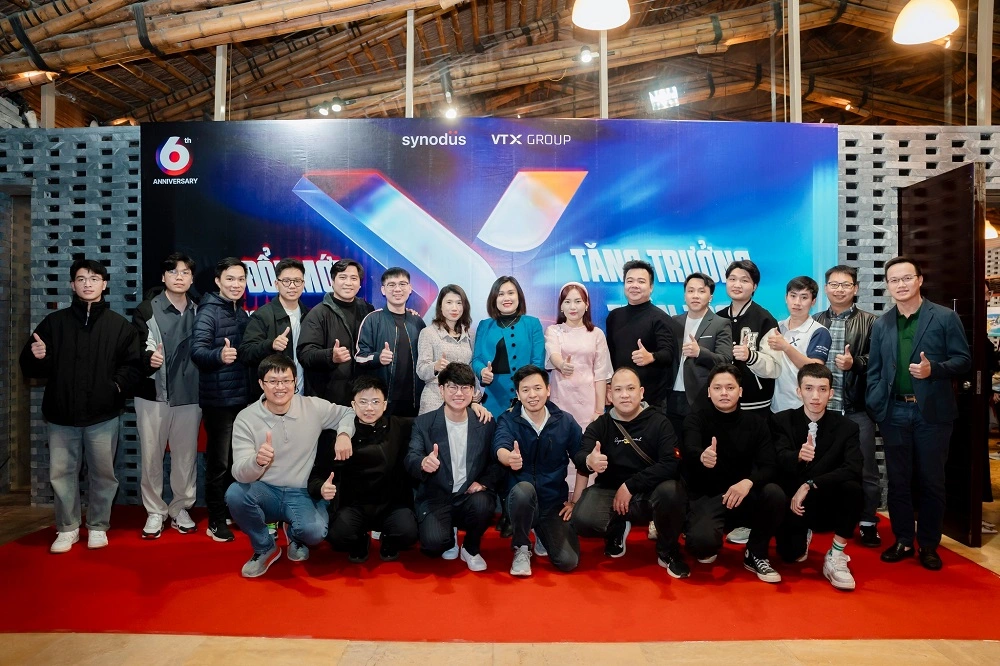
Synodus sits at a less common intersection for Southeast Asian vendors: enterprise-grade delivery combined with the cost structure of a Vietnam-based engineering team. BOC Aviation – a Singapore-headquartered, Hong Kong-listed aircraft leasing company – is a strong signal of the team’s ability to operate under formal governance and compliance requirements.
On the blockchain side, the DeFi For You platform provides a clearer execution reference: a production system on BNB Chain combining lending, NFTs, and wallet infrastructure, with 120,000 transactions and 28,700 wallet holders post-launch. This indicates capability beyond prototypes, at both the backend transaction layer and the user-facing product layer.
Where Synodus differentiates is in its execution model. Rather than acting as a staffing layer, the team operates as a single delivery unit across architecture, development, and post-launch support – reducing the coordination overhead that often appears when multiple vendors are involved.
The limitation is primarily at the protocol layer. Projects requiring custom L1 development, advanced cryptographic design, or research-heavy areas like MEV are outside their core focus.
4. Vinova (full-service builds, Singapore track record)
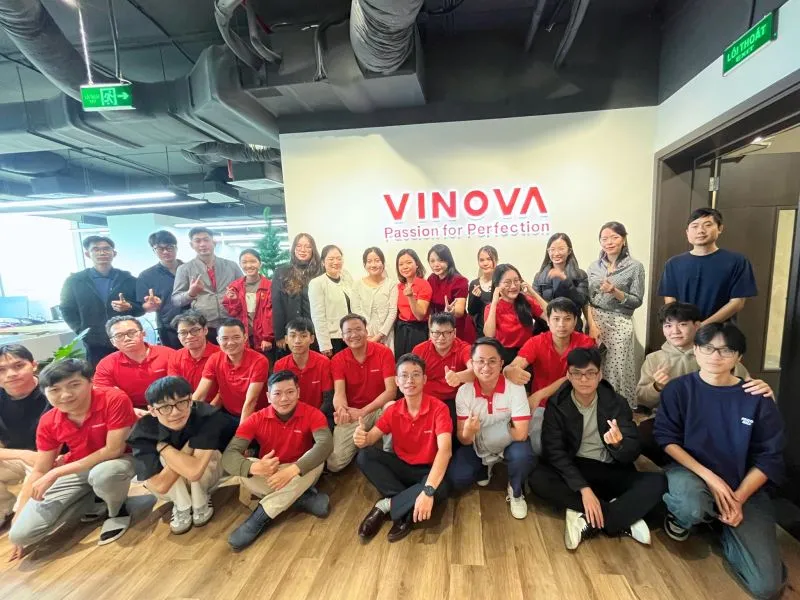
Vinova‘s client base – Samsung, OCBC, AIA, Prudential, Changi Airport Group – signals more than delivery competence. These are organizations where failed deployments trigger formal vendor reviews, so long-term relationships here are a strong indicator of execution reliability.
On the blockchain side, their strength is integration architecture: connecting smart contracts to core banking or healthcare systems, syncing on-chain events with off-chain data, and embedding blockchain beneath existing mobile interfaces. For Singapore BFSI and healthcare projects – where blockchain must coexist with legacy infrastructure – this is often what determines whether a system reaches production.
The tradeoff is clear: Vinova is a delivery partner, not a protocol specialist. Projects involving DeFi architecture, tokenomics, or advanced smart contract security require deeper specialization.
For Singapore buyers: client management is based locally, while engineering runs from Vietnam. Ask specifically who owns architecture decisions – the Singapore account team or the Vietnam engineering lead and what happens when the two disagree mid-sprint.
5. AuroBlocks (on-chain specialist, DeFi protocols)
Auroblocks is a Singapore-native Web3 development studio, active since 2018, with founding team experience in dApp development, exchange architecture, and blockchain protocols. In a market where protocol depth is often claimed but rarely demonstrated, this kind of hands-on background is a more meaningful starting signal than company size or award listings.
Their scope is intentionally focused: token systems, decentralized exchanges, staking mechanisms, lending protocols, smart contract development, and custom blockchain builds. This is a specialist team rather than a full-service delivery partner – best suited for clients who already own product strategy, design, and go-to-market, and need deep execution at the on-chain layer.
Compared to larger vendors in this list, publicly available project-level proof is more limited, so validation happens during the evaluation process rather than through published case studies. For Singapore buyers, ask directly about deployed systems – which chain, post-launch transaction volume, and whether contracts have undergone third-party security audits. Also confirm scope boundaries upfront: product ownership and off-chain delivery need to be covered elsewhere, as this is where gaps typically emerge.
6. Solulab (broad Web3 scope, multi-market delivery)
SoluLab covers a broad Web3 stack – Ethereum, Solana, Polygon, Hyperledger, Cosmos – with portfolio spanning DeFi, tokenization, and enterprise blockchain across multiple markets. Enterprise references like The Walt Disney Company and Mercedes-Benz indicate capacity to engage large organizations, though the relevant question for Singapore buyers is what the blockchain scope actually was – a proof-of-concept looks very different from a production system under compliance scrutiny.
The tradeoff is delivery coordination. Distributed teams across geographies, combined with client reviews pointing to early-phase delays around scope alignment, makes upfront ownership clarity critical – especially for projects with fixed MAS licensing or exchange compliance deadlines.
Before engaging, clarify which team owns delivery and what the escalation path is when timelines slip.
7. Vegavid (DeFi and dApp, rapid MVP)
Vegavid focuses on rapid Web3 product delivery, building DeFi platforms and dApps across Ethereum, Solana, and Polygon. Their 5-star Clutch rating reflects consistent execution in projects where requirements are well-defined and the client already understands the domain.
This makes them a practical fit for Singapore-based startups or protocol teams that need to move from concept to MVP quickly without building an in-house team – the model works best when scope is clear and speed is the priority.
The limitation appears in regulated or enterprise-adjacent contexts. Vegavid’s strength is in Web3-native delivery, not in compliance-heavy architecture – access control design, audit trails, or regulatory documentation required in MAS-linked environments.
For Singapore buyers with any exposure to financial infrastructure, confirm upfront whether compliance requirements are handled internally or require an additional partner.
8. Saola Labs (DeFi backend, API-intensive systems)
Saola Labs is a Singapore–Vietnam team focused on backend-heavy Web3 systems: DeFi infrastructure, tokenization, and API-driven payment layers. Their positioning is narrow by design, centered on high-performance backend engineering rather than full product delivery.
While publicly available blockchain case studies are limited, telecom-related projects — eSIM, GoHub — provide a useful proxy signal. These systems require high-frequency transaction handling, real-time state management, and API reliability: capabilities directly transferable to DeFi and payment rails. Consistent on-time delivery feedback reinforces execution reliability for a team of this size.
The main constraint is capacity. Saola Labs works best as a focused backend partner, not a multi-stream delivery vendor. Projects requiring parallel execution across frontend, product design, smart contracts, and go-to-market will need additional teams.
For Singapore buyers, validate current workload early: how many concurrent projects the team is running, who leads backend architecture, and how delivery timelines are protected when priorities shift.
9. RedDuck (full-stack DeFi and tokenization)
RedDuck operates as a full-stack Web3 team, covering smart contracts, backend systems, and user-facing applications within a single delivery unit. For Singapore-market projects that want to avoid splitting ownership across multiple vendors, this model simplifies coordination and accountability – particularly in DeFi and tokenization products.
Technical credibility is reinforced by recognition within the Web3 ecosystem, including hackathon performance across networks like NEAR – a stronger signal of protocol-level depth than Clutch ratings for this type of specialist team.
The key distinction to evaluate is protocol skill versus production maturity. Hackathon performance demonstrates implementation depth under time pressure; it says less about system stability under sustained real-user load, incident response, or contract upgrade management.
The evaluation question is simple: ask for a deployed system that has been live for at least six months – transaction volumes, any incidents, and how they were handled. Hackathon wins don’t answer that question. Production history does.
10. Pixelette (ISO-certified, compliance-sensitive builds)
Pixelette‘s clearest differentiator in this list is dual ISO certification – ISO 27001 for information security and ISO 9001 for quality management. For Singapore enterprise buyers where ISO compliance is a procurement requirement rather than a preference, this removes an onboarding barrier that most vendors in this list cannot shortcut.
Their blockchain scope covers smart contracts, DeFi, tokenization, and custom distributed ledger systems. The most concrete public reference is a legaltech blockchain platform that supported a £2M fundraising outcome – a useful signal of production readiness, even if the regulatory context differs from Singapore.
The gap worth pressure-testing is regulatory alignment. Pixelette’s track record is primarily UK and US-oriented, and RWA tokenization experience – while directly relevant to Singapore’s Project Guardian direction – does not automatically translate to MAS regulatory familiarity. Ask specifically for a deployment that had to satisfy a financial regulator’s technical risk requirements, not just one built to ISO standards.
Eager to discover the top blockchain companies around the world?
Blockchain development cost in Singapore vs other countries
The cost of hiring a blockchain company in Singapore ranges from $80 – $180 per hour, depending on project scope, technology stack, and the team’s expertise. While the rates are higher than in most Asian countries, they reflect Singapore’s world-class infrastructure, strong data regulations, and highly skilled blockchain professionals.
Compared to global markets:
| Region | Average hourly rate (USD) | Key highlights |
|---|---|---|
| Singapore | $80 – $180 | Balanced option with enterprise reliability and strong legal compliance |
| Vietnam/India | $30 – $70 | Cost-effective with growing blockchain talent, ideal for startups |
| Estern Europe | $50 – $100 | Strong in cryptography and security-focused development |
| USA/Western Europe | $150 – $300 | Premium pricing driven by high labor costs and regulatory complexity |
Despite higher rates, Singapore remains a strategic choice for blockchain projects that demand security, scalability, and compliance. Its government-backed support under MAS and PSA regulations ensures every blockchain initiative can scale safely and legally.
Many enterprises today adopt a hybrid development model – combining Singapore-based consulting and compliance expertise with offshore technical execution (e.g., in Vietnam or India). This approach can cut overall costs by 40-60% while maintaining product quality and regulatory assurance.
Final thoughts
Most blockchain company in Singapore shortlisting processes in Singapore are still catching up with two realities: MAS’s revised DPT framework has quietly disqualified some vendors that remain on popular lists, and many firms repositioned as “enterprise blockchain” partners after the NFT and DeFi boom without meaningfully upgrading their compliance capability.
ISO certification is not regulatory experience. A hackathon win is not a production track record. The vendors worth engaging are the ones who can answer with specifics: which systems are live today, what incidents have they handled, and how is compliance documented. Most cannot.
FAQs
Because Singapore offers clear regulations (MAS, PSA), strong government support, and a thriving tech ecosystem that encourages blockchain innovation.
Look for proven experience, regulatory compliance, transparent pricing, and post-launch support.
Absolutely. Many offer flexible engagement models and MVP development, making them ideal for early-stage Web3 projects.