When the founder looked back, the failure didn’t start with bad development. It started with bad vendor selection. The warning signs were there before a line of code was written: the vendor agreed to everything without pushing back on scope, the proposal had no specific deliverables, and security audit was never mentioned. He had read enthusiasm as competence, and a low quote as efficiency.
The mistakes weren’t technical. They were decisions made before the project started – choosing the wrong vendor for his stage, misreading what his budget actually signaled, and having no way to tell real experience from a polished pitch.
Most guides to hiring a blockchain development company start with a vendor list or a company ranking. This one starts earlier: with the decisions that determine whether any vendor evaluation is worth running at all. The vendor shortlist comes last, because it should.
If you’re about to hire a blockchain development company, start with Step 1.
Step 1: What stage is your project at?
The most expensive mistake in hiring a blockchain vendor isn’t choosing a bad company. It’s choosing the right company for the wrong stage.
A studio built for speed will cut corners that cost you later. A firm built for enterprise will spend three months on process before writing a line of code. Neither is wrong – they’re just optimized for different problems. Matching your vendor to your stage isn’t a nice-to-have. It’s the decision everything else depends on.
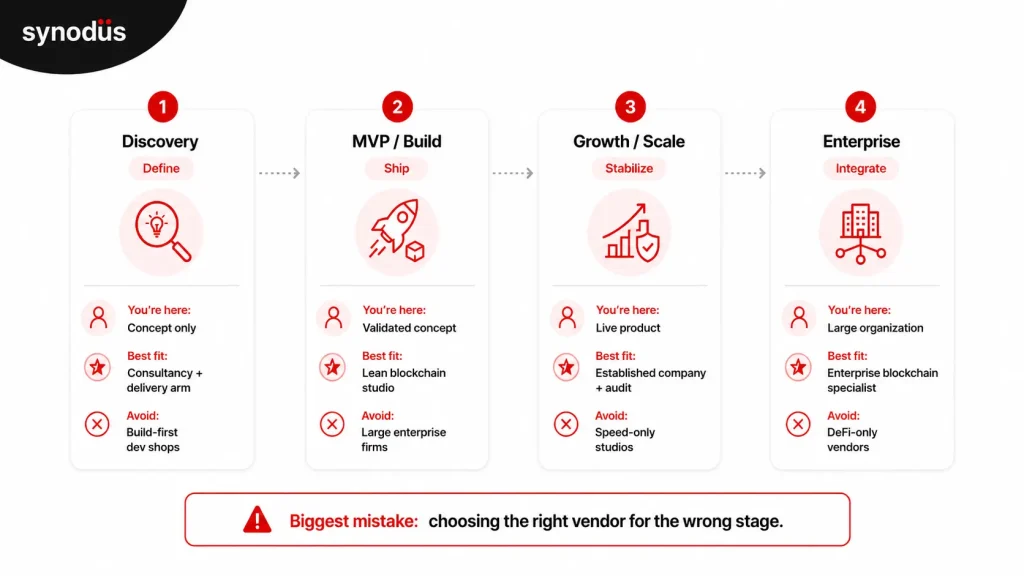
Use the table below to identify where you are before you look at a single vendor.
| Stage | You’re here if… | Right vendor type | Avoid |
|---|---|---|---|
| Discovery/pre-MVP | You have a concept but haven’t confirmed blockchain is the right solution, or you’re still defining what you’re building | Consultancy with a delivery arm – someone who can advise before they build | Dev shops. Most will default to saying blockchain is necessary. That’s not always advice – sometimes it’s sales. |
| MVP / Build | You know what you’re building and need to ship a working version fast, within a real budget constraint | Specialized blockchain studio (5–15 people), lean and focused | Large enterprise firms. You’ll likely spend months in scoping meetings before anything gets built. |
| Growth / Scale | Your product is live with real users. You need to improve performance, security, compliance, or scalability | Established company with a production track record, paired with an independent audit firm | Studios built for speed. Most aren’t set up for the complexity that comes after launch. |
| Enterprise | You’re a large organization integrating blockchain into existing operations or infrastructure | Enterprise blockchain specialist with proven experience on Hyperledger, Corda, or Quorum | Web3 / DeFi vendors. The tech stack and domain assumptions are different enough that the overlap is usually limited. |
A note on each stage:
- Discovery: The clearest way to confirm you’re here is that you’re still asking whether blockchain is the right solution, not just how to build it. If a vendor never raises that question, you’re likely not working with an advisor.
- MVP: You’re here if you have a validated concept and a defined scope – not a wishlist. If your feature list keeps growing every time you talk to a vendor, you’re probably still in Discovery.
- Growth: You’re here if real users are depending on your product. The priority has shifted from shipping to stability – performance, security, and compliance start mattering in ways they didn’t before.
- Enterprise: You’re here if blockchain needs to fit into existing systems, processes, and governance – not replace them. The question is integration, not greenfield development.
Step 2: How to read your budget range honestly
Once you know your project stage, budget is the next filter and it works differently than most buyers expect.
Your budget doesn’t just define what you can build. It tells you who’s realistically in play, what kind of vendor you’re likely to attract, and when a quote feels wrong, it usually deserves a closer review. The more useful way to read it is as a filter: each range has a different market, different risk profile, and different signals worth watching.
These ranges are directional rather than absolute. Complexity, security requirements, integrations, and compliance obligations can move a project significantly outside its expected band. For a detailed breakdown of what drives blockchain development costs, see blockchain app development cost.
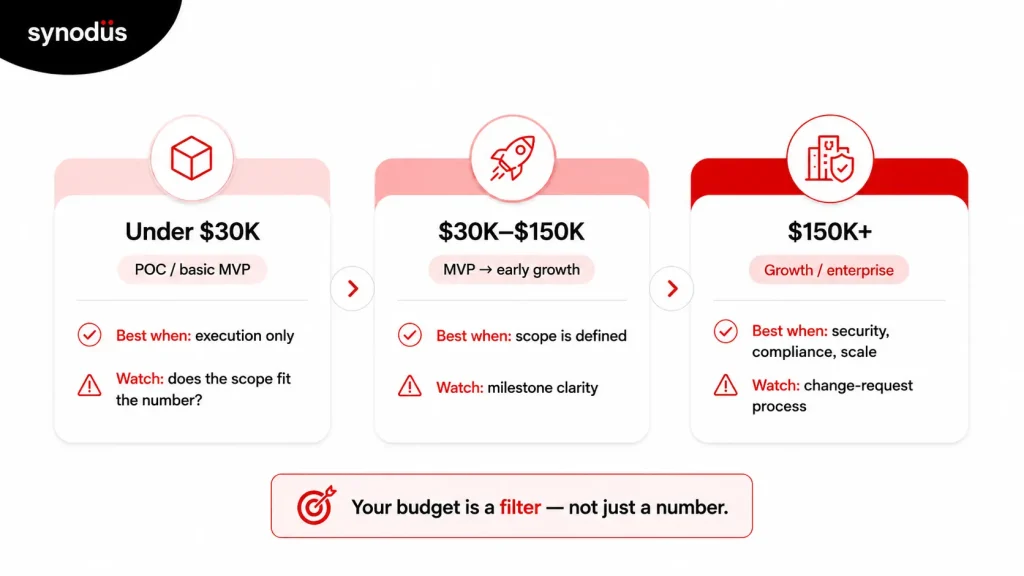
Under $30k
What this budget typically buys: a proof of concept, a single smart contract, or a basic MVP with limited functionality.
Most vendors here are lean offshore studios or freelancer teams built primarily for execution rather than strategic discovery. They work well when the project is well-defined going in.
The signal to watch: whether the scope in front of you actually fits the number. A vendor who quotes $25k for a complex project isn’t giving you a deal. They’re either leaving work out, or they’ll add it back later as a change request.
Works best for: proofs of concept, single-function smart contracts, or early MVPs where you already have technical leadership in-house and need execution support only. If you’re still working out what your project needs to include, our guide on scoping a blockchain app covers the full decision sequence before you commit to a budget range.
$30k–$150k
This range is kept as a single band intentionally. The vendor types and delivery dynamics shift as the number grows, but the core evaluation logic stays the same: the number tells you little, the structure of the quote tells you everything.
The signal to watch: whether milestones are tied to specific deliverables or just to time periods. “Month 1: development phase” is not a commitment. “Milestone 2: smart contract deployed to testnet, reviewed and signed off before next phase begins” is. If a proposal can’t describe what done looks like at each stage, that ambiguity will most likely show up later as a dispute.
Works best for: MVP through early growth stage, but only when scope is defined. If you’re still refining requirements, you’re likely still in Discovery, and a $30k–$150k build budget won’t fix that.
$150k and above
What this budget typically buys: structured delivery, deeper technical specialization, and support for compliance, security, and scalability requirements.
At this level you’re working with established firms with real production track records. Technical capability is less often the primary failure mode here. Scope expansion and governance issues become more common sources of overruns and delays.
The signal to watch: whether the contract defines a clear change request process, with milestone sign-offs that gate the next payment. Before signing, ask directly: “What happens if we need to change a core feature two months into the build?” How they answer tells you more than the contract language will.
Works best for: growth-stage projects, enterprise blockchain integration, and anything with serious compliance or regulatory requirements.
Step 3: Region is an output, not a starting point
Most buyers pick a region first, then look for vendors inside it. The more useful sequence is the opposite: define what you actually need from a vendor’s location, then let region follow from that.
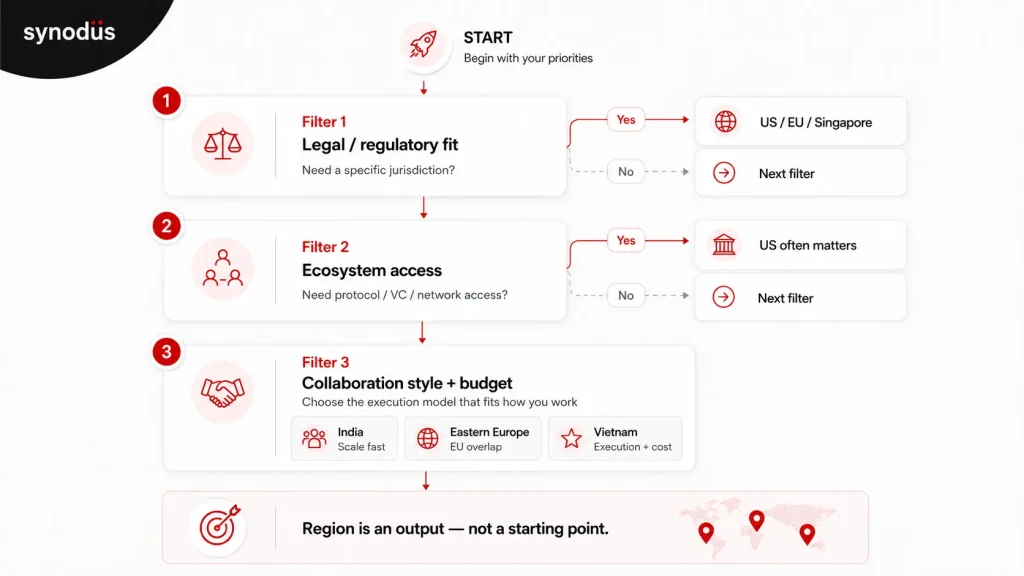
Location affects three things: your legal and compliance exposure, the ecosystem your vendor can connect you to, and the practical realities of working together. Work through each in order.
Filter 1: Do you have legal or regulatory requirements tied to a specific jurisdiction?
This is the only filter that can be a hard constraint. If it applies to you, it narrows the field before anything else.
- US regulatory exposure or institutional investor credibility → US-based vendor familiarity matters. [See blockchain development companies in the US]
- EU regulation – MiCA, GDPR, regulated financial services → Eastern Europe has a structural advantage.
- Fintech or digital assets targeting Asian markets with a credible legal framework → Singapore. [See blockchain development companies in Singapore]
If none of these apply, this filter doesn’t constrain your decision. Move to Filter 2.
Filter 2: Does your project need ecosystem access that only a specific region can provide?
Ecosystem access means connections to protocol teams, VC networks, and the core Web3 community. For most projects, this filter matters less than buyers assume.
US-based vendors have ecosystem access that other regions can’t reliably replicate. This is worth paying for only if your project genuinely depends on it – fundraising credibility with institutional investors, or direct relationships with major protocol teams.
For everything else, a vendor’s network rarely transfers to the client in the way buyers expect. If ecosystem access isn’t a specific, named requirement for your project, this filter is unlikely to change your decision. Move to Filter 3.
Filter 3: What does your collaboration style and budget actually require?
Most projects land here. What they have is a budget, a working style, and a need for execution quality. Three regions serve this filter distinctly.
India
Best when: you need to scale a large team quickly, require specialist expertise across multiple domains, or need to staff up fast.
Tradeoff: quality variance is wider here than in any other region. A strong Indian firm and a weak one can look very similar on paper. Verifiable live portfolio links and direct client references matter more here than anywhere else. [See blockchain development companies in India]
Eastern Europe
Best when: you’re a European buyer who values timezone overlap, frequent collaboration, and reduced communication friction across product and delivery teams.
Tradeoff: the talent pool is smaller than India, which makes it harder to scale large or fast-growing teams. Capacity constraints are real at the higher end.
Vietnam
Best when: your project is execution-focused, cost efficiency matters, and you’re in the MVP through early growth stage – particularly for buyers targeting Asian markets. For execution-focused projects, the quality gap is significantly smaller than many international buyers assume.
Tradeoff: ecosystem depth remains lower than in the US or Singapore. Access to protocol teams, institutional investors, and global Web3 networks is improving, but not yet at the same level. Explore Vietnam-based blockchain firms!
The mistake most buyers make
They choose a region before they’ve defined what they need from it – paying US overhead for a project that doesn’t require US ecosystem access, or Singapore rates for a project with no Asian market component.
Region is an output. If a vendor’s location doesn’t clearly serve any of the criteria above, it probably shouldn’t be a deciding factor.
Step 4: How to evaluate a vendor without being technical
The goal isn’t to find the best vendor. It’s to make weak vendors reveal themselves before you sign.
You don’t need to understand blockchain to know if a vendor is good. You need questions that make the difference between real experience and a polished sales pitch visible and you need to know what a weak answer sounds like before you hear one.
Part 1: Questions to ask in the first meeting
On security and risk:
Ask: “If our smart contract has a bug after deployment, what’s your process?”
Strong signal: they can explain how issues are detected, contained, fixed, and communicated after deployment. This may include audits, upgrade mechanisms, or emergency controls.
Weak signal: “We test very thoroughly” – outcome language with no process underneath.
Follow up with: “Tell me about a project where something went wrong in production and how you handled it.” A vendor who claims they’ve never had a problem isn’t being honest. That’s not the same as being careful.
On timeline and delivery:
Ask: “Which milestone in a project like ours carries the most risk of delay, and why?”
Strong signal: immediate and specific – a vendor who’s done this before knows exactly where the risk lives.
Weak signal: “We always deliver on time.” No project always delivers on time. That answer tells you they’re not willing to be honest about risk before the contract is signed.
Follow up with: “If we need to change a core feature two months into the build, what happens?” This reveals both their process and how their contract actually works.
On the actual team:
Ask: “Who specifically will work on this project, and how many other projects are they running simultaneously?”
Strong signal: names, roles, and availability. Willingness to introduce the tech lead before signing.
Weak signal: “Our senior team will handle this” with no specifics. Ask to meet the tech lead before signing, and notice whether they hesitate. Hesitation here is an answer.
Part 2: How to read a proposal
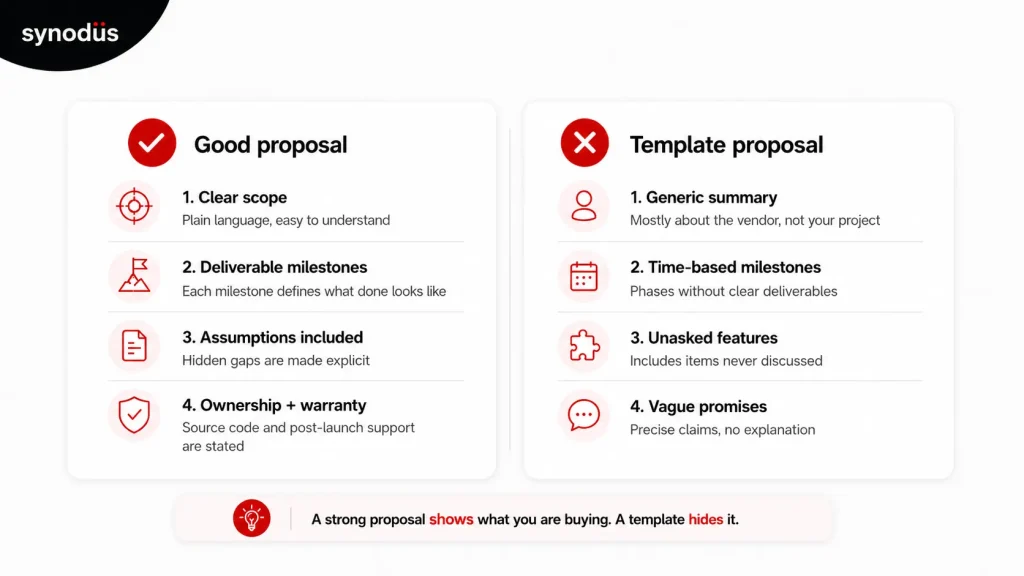
What a good proposal must have:
Scope in language you can understand. If a proposal relies on jargon you can’t follow, that’s not because the project is complex — it’s because they don’t want you to know exactly what you’re buying.
Milestones tied to deliverables, not time periods. “Week 4: smart contract deployed to testnet and demoed” is a commitment. “Month 1: development phase” is not.
A section on assumptions. If this doesn’t exist, everything left unspoken becomes a future dispute.
Signs you’re looking at a template:
Features, technologies, or requirements appear that were never discussed in your brief. The section describing your project is only a few generic paragraphs inside a much longer document. Outcomes are presented with precise percentages but no explanation of how they would be measured.
What to negotiate before signing:
Payment structure: be cautious of contracts that require large upfront payments without corresponding milestone accountability.
Source code ownership: must be explicit in the contract, not implied by the proposal.
Warranty period: every product has bugs after launch. A vendor who won’t commit to a post-launch fix period in writing is telling you something about how they view accountability once the money has cleared.
Part 3: Red flags by category
The one that’s easiest to miss:
Infrastructure lock-in. After the project ends, if the vendor is the only one with access to your server, repository, or admin panel, you don’t own your product – you rent it from them. Ask directly before signing: “If we want to manage this ourselves after handover, or move to a different vendor, what does that process look like?” A good vendor answers this without hesitation. A bad one changes the subject.
A vendor worth working with won’t be offended by these questions. They’ll recognize them as the sign of a serious buyer.
By now, most weak vendors will have eliminated themselves. What’s left is a shortlist worth comparing seriously.
When no vendor checks every box
Step 4 helps you eliminate vendors who can’t deliver. This section is for what comes after: when you have two or three credible options and none of them is perfect.
The question was never “who meets every criterion?” It was always “which gaps can I live with, and which ones will cost me later?” These are the four trade-offs that come up most often, and how to think through each one.
Technical strength, but no experience in your industry
This is the most common tension, especially in niche sectors like healthcare, logistics, or trade finance. The instinct is to see it as a dealbreaker. It often isn’t – but it depends on one thing: who on your side will bridge that gap.
Strong blockchain engineers can usually learn a domain faster than domain experts can learn blockchain architecture. If you or someone on your team understands the domain well enough to guide the vendor through the business logic, strong technical execution is the right thing to optimize for. If you’re expecting the vendor to figure out the domain on their own, that gap will show up in every decision they make.
Verdict: Acceptable if you have internal domain expertise to lead with. Not acceptable if you’re expecting the vendor to bring both.
Impressive portfolio, but you’ll be a small client
A vendor with a strong track record and recognizable client logos is easy to trust. The problem is that the work in that portfolio was done by people who may have nothing to do with your project.
Most large vendors assign teams by client size and revenue potential. If your project is significantly smaller than their typical engagement, you will likely get a junior team while the seniors stay on the accounts that matter more to the business. The portfolio you evaluated was built by people you’ll never work with.
Ask directly: “Which team will be assigned to our project, and is this a priority engagement for you right now?” Watch how they answer, not just what they say.
Verdict: A smaller vendor where your project is genuinely important to them will often outperform a larger vendor where you’re a minor account. Size of portfolio is not a proxy for quality of delivery on your specific project.
Significantly cheaper, but the timezone gap is real
Timezone difference isn’t automatically a problem. Whether it becomes one depends entirely on how you work.
If your project has a well-defined scope, an async-friendly workflow, and minimal need for real-time decision-making, a significant timezone difference is manageable – many successful projects are built this way. But if your requirements shift frequently, or your stakeholders expect rapid turnaround on changes, timezone gaps compound every delay. What takes one day to resolve in the same timezone can take three when each round of communication costs a day.
Verdict: This depends on your collaboration style, not the cost savings. Be honest about which kind of client you actually are, not the kind you intend to be.
Strong technical team, but weak visibility
A vendor can be genuinely capable and still leave you in the dark. This trade-off shows up when a team delivers good work but communicates poorly – updating only when asked, using technical language that doesn’t translate to business decisions, and giving you no way to know whether the project is on track until something goes wrong.
For a non-technical founder, this is more dangerous than it sounds. If you can’t tell the difference between “we’re behind but recovering” and “we’re behind and hiding it,” you lose the ability to intervene early. By the time the problem becomes visible, it’s usually too late to course-correct without significant cost.
Before signing, test communication style directly: ask the vendor to walk you through how they’d handle a situation where a milestone is at risk. A strong team explains the problem clearly, outlines options, and tells you what they need from you. A weak communicator describes what happened technically without giving you anything to act on.
Verdict: Technical output matters. So does your ability to understand it. A vendor who can’t keep you informed in plain language will cost you more than their hourly rate suggests.
No framework makes this easy. What it does is make the decision more honest. Once you’ve worked through these trade-offs, one question remains and no checklist can answer it for you. That’s where this guide ends.
Conclusion
The founder in the introduction didn’t lose eight months and $120,000 because he couldn’t evaluate smart contract architecture. He failed because he trusted signals that looked convincing and had no framework to catch the ones that actually mattered.
Everything in this guide is designed to make those signals visible earlier.
If you’re still choosing between two or three options at this point, the final question isn’t technical. It’s this: which of these vendors do you trust enough to call when something goes wrong?
Because something will go wrong. The vendor relationship that survives those moments isn’t the one with the best portfolio or the lowest quote – it’s the one where both sides feel safe enough to say what’s actually happening.
That’s not something any checklist measures. But it’s what the $120,000 lesson was really about.