| App type | Development cost | 3-year total* |
|---|---|---|
| Crypto wallet | $40K–$120K | $70K–$200K |
| NFT marketplace | $20K–$185K+ | $38K–$371K+ |
| DeFi platform | $150K–$500K | $260K–$800K+ |
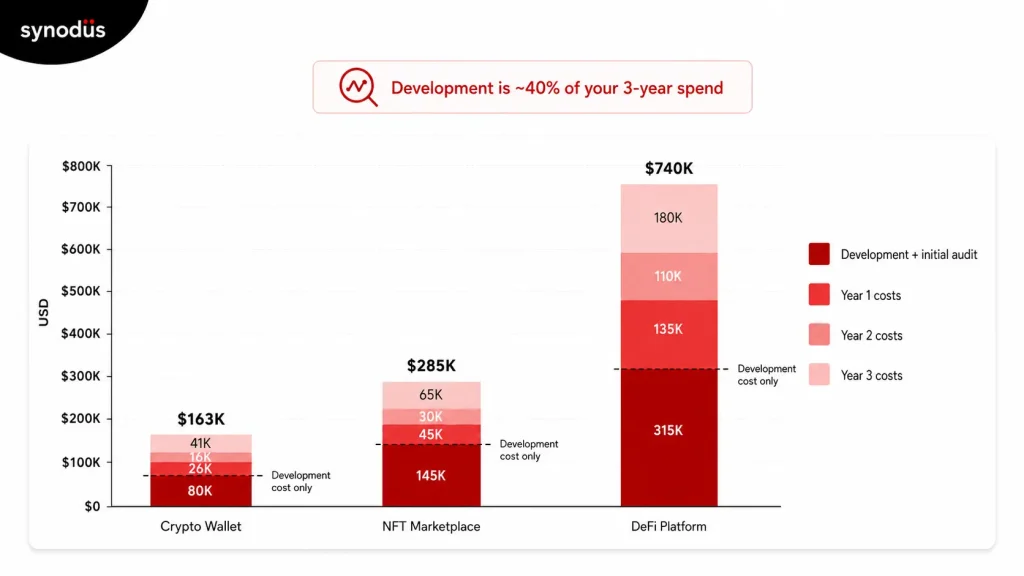
*3-year total includes maintenance, security re-audits, gas fees, and infrastructure – not development cost alone. On average, development accounts for roughly 40% of what you’ll spend over three years.
These ranges give you a starting point. What determines whether your project is a $25,000 decision or a $500,000 one is the technical decisions you make – chain choice, smart contract complexity, integrations, and how seriously you treat security from day one. This guide walks through each of those variables so you can size your project accurately before you talk to a vendor.
Jump to the section that matches where you are:
- Not sure if you need blockchain → Section 1
- Already decided, need a budget → Section 2
- Have a quote, need to evaluate it → Section 5
Do you actually need blockchain? 4 signs it’s the wrong choice
The fastest way to answer that is to check whether your use case matches any of the four scenarios where blockchain genuinely earns its cost. If it doesn’t, a simpler solution will do the same job for a fraction of the price.
4 cases where a blockchain app genuinely earns its cost
- Multi-party supply chain tracking: When multiple independent parties like manufacturers, logistics providers, retailers, regulators need to verify the same data, and none of them want to trust another party to run the database, blockchain solves a real coordination problem. Example: Walmart’s food traceability system on Hyperledger reduced the time to trace food origin from 7 days to 2.2 seconds.
- DeFi and financial producs: When the core value proposition is that rules execute automatically without a human intermediary – lending, trading, yield – smart contracts aren’t optional. The trustless execution is the product. Example: Uniswap processes billions in trading volume monthly with no central party controlling funds.
- Cross-border settlement: When correspondent banking adds days and 3–5% in fees to international transfers, and your users are the ones absorbing that cost, blockchain provides a legitimate alternative. Example: Stellar-based payment apps have reduced cross-border settlement from 3–5 days to under 5 seconds for corridors like USD–PHP.
- Public credential and certificate checks: For credentials that anyone should be able to verify forever, like degrees or licenses, and where no single group should control verification, blockchain offers a secure public record. Example: MIT has issued blockchain-verified diplomas since 2017, allowing graduates to share verifiable credentials without contacting the registrar.
Not sure if your use case fits here? The line isn’t always obvious. Talk to our team before you commit to a budget.
4 cases where blockchain is the wrong choice, and what to build instead
If your use case doesn’t match any of the above, read through these before going further. Each one describes a real project type where teams have spent $80K–$150K on a blockchain solution that a $5K–$15K alternative would have handled.
- Internal data management: If you want a more secure, auditable record of internal transactions or documents, you don’t need a blockchain app. PostgreSQL with proper access controls and an audit log costs $5K–$15K to set up. A blockchain version of the same use case runs $80K–$150K. Saving: $70K–$135K.
- Loyalty and reward points for a single brand: A single-brand loyalty program has one party minting and managing points, that’s a centralized database by definition. Existing platforms like Yotpo or Smile.io handle this for $500–$2K per year. A blockchain version costs $60K–$120K to build, plus ongoing. Saving: $58K–$118K in year one alone.
- Payment processing: Stripe and PayPal already solve 95% of payment use cases, including cross-border. Integrating either costs $3K–$8K. A custom blockchain payment app costs $80K+. Unless you have a specific reason why existing payment rails won’t work, and most teams don’t, this is the wrong use of blockchain. Saving: $72K+.
- One scenario that belongs in its own category: Adding crypto or NFT features to an unvalidated product isn’t really a “wrong use of blockchain” – it’s a sequencing problem. If you haven’t confirmed users want the core product, building the blockchain layer first puts $100K+ at risk on an assumption. Mock the blockchain experience first, validate demand, then build. This applies regardless of whether your use case is technically a good fit for blockchain.
If your use case is clearly in the “right” category, the next step is figuring out what your specific project actually costs to build.
What blockchain app development actually costs
The summary table at the introduction gives you a baseline by app type. But within each range, what actually moves the number is the technical decisions you make.
The decisions that actually drive cost
Smart contract complexity is usually the biggest variable.
- A single standard contract using OpenZeppelin’s ERC-721 adds $5K–$10K to your build.
- Custom logic like auction mechanisms or royalty splits, pushes that to $25K–$40K.
- If your app needs multiple contracts interacting with each other (marketplace + token + governance), add $40K–$80K on top.
Chain choice affects both your build cost and what you pay every month after launch.
- Polygon keeps ongoing gas costs low ($200–$500/month) and is the default for most consumer apps.
- Ethereum mainnet adds $500–$5K+ per month in gas at moderate usage, but gives you access to a larger ecosystem.
- Going multi-chain adds $30K–$60K to the build and compounds complexity across everything else.
Integrations each come with their own cost line.
- A fiat on-ramp (MoonPay, Stripe) adds $10K–$20K.
- Chainlink oracle integration adds $8K–$15K upfront plus $500–$5K per month ongoing.
- AKYC/AML layer adds $10K–$25K, and if your app handles regulated assets, this isn’t optional.
Security audit is the line item most vendors understate.
- Skipping it entirely is an option only if you’re not handling real money, and even then, it’s a risk most teams regret.
- A standard audit from CertiK or OpenZeppelin runs $10K–$30K.
- A comprehensive audit for complex DeFi protocols starts at $30K and can reach $80K.
To see how these decisions play out in practice, here’s what they look like across the most common app types.
| App type | Tier | Configuration | Cost |
|---|---|---|---|
| NFT marketplace | Base | Polygon, fixed-price listing, OpenZeppelin ERC-721, standard audit | $80K |
| Mid | + Auction mechanism, lazy minting, basic analytics, Ethereum mainnet | $130K | |
| Full | + Multi-chain, royalty splits, fiat on-ramp, custom contracts, comprehensive audit | $185K+ | |
| DeFi Lending Platform | Base | Single asset pool, Ethereum/Polygon, standard audit | $150K |
| Mid | + Multi-asset, liquidation engine, governance token, oracle, comprehensive audit | $280K | |
| Full | + Cross-chain, institutional-grade security, multiple audits, compliance layer | $500K+ | |
| Crypto wallet | Base | Single chain, send/receive/history, standard security | $40K |
| Mid | + Multi-chain, swap integration, push notifications, biometric auth | $70K | |
| Full | + Hardware wallet support, multi-sig, institutional features, fiat on/off ramp | $120K+ |
Bonus section: If you are building something other than an app, here’s 2 quick references:
1. Building a blockchain protocol from scratch
| What you’re building | Cost |
|---|---|
| AppChain on existing frameworks (Cosmos SDK, Substrate, Avalanche Subnets) | $300K+ |
| Custom Layer 2 (OP Stack, Arbitrum Orbit) with bridge and custom gas token | $600K+ |
| New Layer 1 with custom consensus, custom VM, multiple audits | $1.5M+ |
2. Integrating blockchain into an existing system
| Scope | Cost |
|---|---|
| One-way integration with a single ERP via API/Webhook | $100K+ |
| Two-way real-time sync, role-based access control, 2–3 external partners | $250K+ |
| Multi-org governance, IoT integration, ISO/GDPR/HIPAA compliance | $500K+ |
These cost ranges assume a well-scoped project with clear requirements. If you’re still working out what your app needs to include, our guide on how to build a blockchain app walks through the full decision sequence – from use case validation to development planning – before you commit to a budget.
These are development costs only. The next section covers what the full picture looks like once your app is live – because for most blockchain projects, what you spend after launch matches or exceeds what you spent to build.
Blockchain app total cost of ownership: 3-year budget breakdown
Why development cost is only 40% of what you’ll spend
Most vendors quote you a development number and stop there. But development is only the beginning and this isn’t a blockchain-specific problem.
This isn’t a blockchain-specific problem. O’Reilly’s software engineering benchmark found that fully 60% of the lifecycle costs of software systems come from maintenance, with only 40% coming from development. Blockchain apps compound this further because they carry ongoing costs that rarely appear in vendor proposals – gas fees, oracle services, security re-audits and the accumulation of these expenses typically matches or exceeds what you paid to build.
Here’s what those costs look like in practice:
- Maintenance: 15–20% of your development cost per year – bug fixes, dependency updates, minor feature work
- Security re-audit: $10K–$30K each time you ship a major upgrade
- Gas fees: $200–$500/month on Polygon, $3K–$8K/month on Ethereum mainnet at moderate usage
- Oracle services: $500–$5K/month if your app uses Chainlink or similar
- Monitoring and incident response tooling: $200–$500/month
3-year total cost of ownership by app type
NFT Marketplace – $130K build scenario
| Cost | |
|---|---|
| Development + initial audit | $130K |
| Year 1: maintenance $20K + gas/infra $8K + re-audit $10K | $38K |
| Year 2: maintenance $20K + gas/infra $8K | $28K |
| Year 3: maintenance $20K + gas/infra $8K + major upgrade $5K + re-audit $10K | $43K |
| 3-year total | $239K |
DeFi Lending Platform – $280K build scenario
| Cost | |
|---|---|
| Development + initial audit | $315K |
| Year 1: maintenance $50K + oracle $36K + gas $24K + re-audit $25K | $135K |
| Year 2: maintenance $50K + oracle $36K + gas $24K | $110K |
| Year 3: maintenance $50K + oracle $36K + gas $24K + major upgrade $40K + re-audit $30K | $180K |
| 3-year total | $740K |
Crypto wallet – $70K build scenario
| Cost | |
|---|---|
| Development + initial audit | $80K |
| Year 1: maintenance $12K + gas/infra $4K + re-audit $10K | $26K |
| Year 2: maintenance $12K + gas/infra $4K | $16K |
| Year 3: maintenance $12K + gas/infra $4K + major upgrade $15K + re-audit $10K | $41K |
| 3-year total | $163K |
What this means for your budget conversation
Vendors quote the development cost. You need to plan for the total.
Quick rule of thumb: take the development cost you’ve been quoted and multiply by 2-2.5x. That’s a realistic 3-year budget for most blockchain apps. If that number doesn’t fit your business case, that’s important to know before you sign a contract.
Now that you have a realistic total number, the next question is where to build it, because the same project can cost very differently depending on where your team is located.
Blockchain development cost by region: US vs Europe vs Vietnam vs India
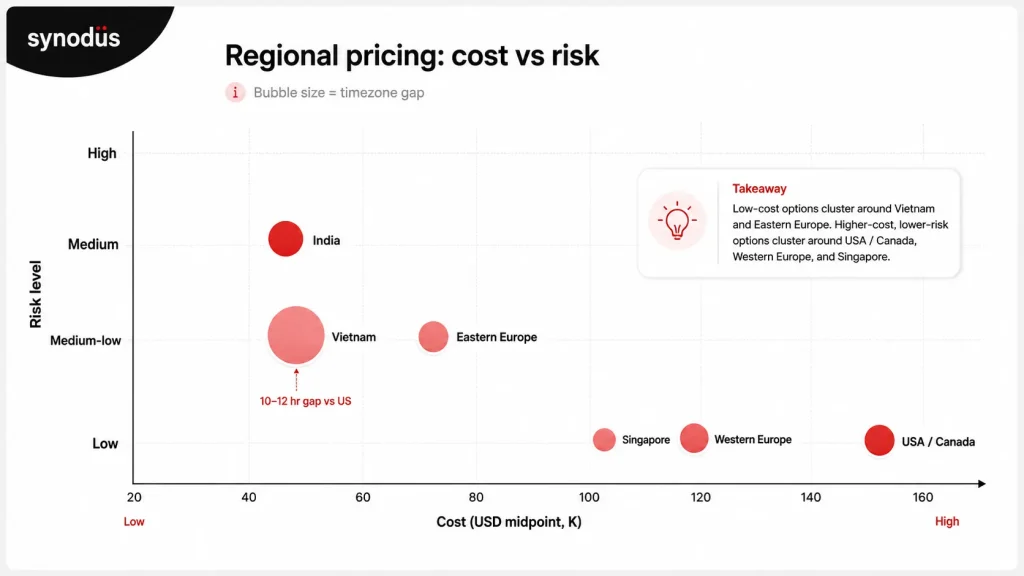
To make regional pricing actually useful, we’re not comparing hourly rates in the abstract, we use one fixed project and compare what it costs to build in different regions.
Benchmark project: Crypto wallet app – send/receive, multi-token support (ETH + ERC-20), transaction history, biometric auth, Ethereum + Polygon, no fiat on-ramp, standard security audit.
| Region | Dev cost | Hourly rate | Timezone (vs US ET) | Risk profile |
|---|---|---|---|---|
| USA/Canada | $120K–$180K | $120–$250/hr | Same / +1–3hr | Lowest risk, highest accountability |
| Western Europe | $90K–$140K | $80–$150/hr | +6hr | Low risk, strong IP protection |
| Eastern Europe | $55K–$90K | $45–$90/hr | +7–8hr | Low-medium risk, strong technical quality |
| Singapore | $80K–$130K | $70–$130/hr | +13hr | Low risk, good for regulated industries |
| India | $30K–$65K | $25–$75/hr | +9–10hr | Medium risk, requires careful vetting |
| Vietnam | $35K–$70K | $30–$80/hr | +11–12hr | Low-medium risk, strong technical output – requires portfolio verification |
How to choose the right region for your project
- If you’re building a regulated financial product, USA or Singapore offer the strongest combination of compliance familiarity and accountability structure. Teams in these regions have worked within financial regulatory frameworks and understand what KYC/AML implementation, audit trails, and data residency requirements actually mean in practice. That familiarity is worth the premium.
- If you’re building an MVP to validate demand, Eastern Europe or Vietnam can deliver the same technical quality at 50–60% of the cost. For either region, ask for references from similar blockchain projects and treat the first milestone as a paid trial before committing to the full scope. For Vietnam specifically, verify the team’s delivered project portfolio – not just their tech stack claims – before signing.
- If you need a long-term maintenance partner, timezone overlap matters more than hourly rate. A team that’s 11–12 hours ahead with limited async communication discipline creates coordination overhead that quietly erodes your cost savings over time. Before committing, test their response time and documentation quality during the scoping phase – both are reliable proxies for how they’ll operate post-launch.
- If you need both cost efficiency and senior oversight, a hybrid model is worth considering. Keep a tech lead or project manager in USA or Singapore for client-facing accountability and compliance review, and place the core development team in Vietnam or Eastern Europe. In practice this saves 40–50% compared to a fully US-based team while maintaining the oversight structure most enterprises require.
If you are looking for vetted blockchain development teams by region, explore our lists below:
- Top blockchain development companies in Vietnam
- Top blockchain development companies in the USA
- Top blockchain development companies in Singapore
- Top blockchain development companies in India
Once you know what it costs and where to build it, the last piece is making sure the quote you receive actually reflects the project you think you’re getting.
How to read a blockchain development quote
If you’ve made it this far, you have a realistic sense of what your project should cost and where to build it. Before you sign anything, run through this checklist.
Before looking for red flags, establish what a complete proposal looks like:
- Development cost broken down by component – not a single lump sum
- Smart contract audit – whether it’s included or billed separately, and by which firm
- Ongoing cost estimate – maintenance, infrastructure, gas fees
- Milestone and payment schedule
- IP ownership clause
- Change order policy
If any of these are missing, you’re not looking at an incomplete proposal – you’re looking at an incomplete project plan.
5 red flags to watch out for
1. No audit line item
2. No ongoing cost breakdown
3. No questions about your compliance requirements
4. A price that’s significantly below market without explanation
5. No contingency buffer
Three questions worth asking before you sign:
- Is the smart contract audit included, and which independent firm is conducting it?
- If there’s a security incident after launch, what’s your response process?
- How are change orders handled – fixed price or hourly?
Evaluating a vendor goes deeper than reading their quote. How they scope the project, handle IP ownership, and structure accountability matters as much as the number itself. For a full breakdown of what to look for – and what most teams miss – read our guide: How to choose a blockchain development vendor
How to reduce costs without cutting corners
Now that you have a realistic picture of what blockchain development costs, here’s where you can legitimately bring that number down.
What you can cut
Use OpenZeppelin contracts for standard functionality: If your app uses standard contract types – ERC-20 tokens, ERC-721 NFTs – OpenZeppelin’s audited libraries are production-ready and eliminate the need to build from scratch. As noted in Section 2, custom smart contract logic adds $25K–$40K to your build. Staying within standard OpenZeppelin implementations keeps you at $5K–$10K and reduces your audit scope at the same time – auditors charge less to review code they already know.
Build on Layer 2 instead of Ethereum mainnet: If your app doesn’t specifically require Ethereum mainnet, Polygon or Arbitrum will handle the same functionality at 90%+ lower gas costs. For an app with moderate transaction volume, that’s a difference of $2K–$7K per month in ongoing costs – every month, indefinitely. This is one of the few decisions that reduces both your build cost and your operating cost simultaneously.
Use managed blockchain services for private chains: If you’re building a private chain, AWS Managed Blockchain or Azure Blockchain eliminates the need to self-host and manage nodes. That saves $3K–$8K per month in infrastructure costs without sacrificing control over your application layer.
Start with MVP scope: One core user flow, one or two smart contracts, deployed and validated before building the rest. A focused MVP typically costs 40–60% less than a full build and if your assumptions about user behavior turn out to be wrong, you find out before you’ve spent the full budget.
What you should never cut
Security audit: If your app handles real money or assets, an independent audit is non-negotiable. A single exploit can drain your entire contract. Skipping the audit to save $10K–$30K upfront is how teams lose everything post-launch.
Testnet deployment before mainnet: Bugs on testnet cost nothing to fix. Bugs on mainnet cost gas fees to address and depending on the bug, potentially much more. This step is not optional.
Smart contract documentation: Six months after launch, when you need to upgrade or modify a contract, undocumented code will cost you more in developer time than the documentation would have. This is consistently one of the most expensive shortcuts teams take.
Legal review if your project involves a token: If your token could be classified as a security, a $20K–$40K legal review upfront is a fraction of what regulatory action costs later. This applies more broadly than most teams assume, get the review before you launch, not after.
Final thought
Blockchain development cost is the result of a series of decisions: what you’re building, which platform you use, where your team is located, and how seriously you treat security from day one. Understand your blockchain development costs before you sign a contract, not after. That’s the difference between a $25K project and a $500K one.
If you’ve worked through this guide, you’re in a better position than most teams that sign blockchain development contracts. You know what drives the number up, what can legitimately bring it down, and what a fair proposal looks like.
If you’re ready to scope your project or want a second opinion on a quote you’ve received, explore our blockchain development services