This guide does both. It shortlists the vendors worth evaluating in 2026, explains the criteria that actually matter for different project types, and tells you what to ask before you sign with anyone – including us.
Vietnam for blockchain development – what international buyers need to know
Vietnam has emerged as one of Southeast Asia’s stronger blockchain development markets, particularly for Ethereum-compatible applications. Vietnam has remained one of the world’s highest-ranked crypto adoption markets for multiple years, reaching #4 globally in Chainalysis’ 2025 Global Crypto Adoption Index. That level of real-world usage has helped create a developer ecosystem with hands-on experience in wallets, smart contracts, DeFi systems, NFT infrastructure, and Web3 integrations – not just enterprise blockchain pilots that never reach production.
Most blockchain vendors are concentrated in Ho Chi Minh City and Hanoi, with technical expertise centered around Ethereum, BNB Chain, and Polygon. Compared with US and Western European firms, Vietnamese vendors typically offer 30–40% lower rates than comparable Eastern European teams and 60–70% lower than US-based equivalents, while maintaining established offshore delivery experience and functional English across senior teams.
The market is strongest for application-layer blockchain development rather than deep protocol engineering or advanced cryptographic research. On the regulatory side, 2025 marked a meaningful shift: crypto assets were formally recognized under the Law on Digital Technology Industry, and Resolution No. 05/2025/NQ-CP launched a five-year pilot programmer for digital asset markets. Vendors operating in Vietnam are now doing so within a formalizing regulatory framework — which reduces certain long-term partnership risks, though it does not yet provide the in-country compliance infrastructure that EU or US-regulated projects require.
For international buyers looking to build EVM-based products with experienced teams, Vietnam is a credible outsourcing destination. The vendors in this guide operate in that space. None of them are the right answer if your requirements fall outside it.
Comparison Table: Top 9 blockchain development companies in Vietnam
Synodus is both the publisher of this article and one of the vendors reviewed in this comparison. To keep the evaluation balanced, all companies were assessed using the same public criteria, including case-study depth, technical scope, blockchain specialization, and third-party review signals. Buyers should validate final vendor fit based on their own technical and business requirements.
| Company | Blockchain orientation | Best-fit buyer | Scope signal |
|---|---|---|---|
| Sotatek | AI + blockchain major pillar | Enterprise / scale-up Web3 teams | dApp, DeFi, NFT, exchange, wallet |
| Ekotek | Web3 + software development | Startup / SME product teams | Smart contract, dApp, exchange, wallet, tokenization |
| Synodus | Software product firm + blockchain line | Fintech / Web3 product teams | Smart contract development, DeFi, dApp, wallet, exchange, RWA tokenization |
| Twendee | Blockchain + AI positioned | Innovation-led Web3 teams | DeFi protocol, NFT tools, AI/Web3 |
| Sphinx JSC | IT outsourcing + Web3 vertical | NFT / GameFi / DeFi builders | NFT game, DeFi, marketplace, Web3 |
| Hola Tech | Software-to-blockchain delivery | Fast Web3 MVP buyers | NFT, DEX/CEX, wallet, launchpad, game |
| Savvycom | Enterprise software + blockchain | Enterprise innovation teams | Wallet, exchange, supply chain, consulting |
| AgileTech | Software outsourcing + blockchain | Custom blockchain buyers | Smart contract, dApp, tokenization, custom chain |
| AMELA Technology | IT outsourcing + blockchain service | Dedicated blockchain team buyers | Smart contract, dApp, DeFi, L1/L2, launchpad |
Blockchain development company reviews: Strengths, proof points, and limitations
The comparison table provides a high-level snapshot, but blockchain vendor selection is highly context-dependent. A team that performs well on NFT marketplaces may not be the right fit for DeFi infrastructure, custody-heavy systems, or enterprise tokenization projects. The reviews below focus on the public evidence behind each vendor’s positioning, including case-study depth, technical specialization, delivery patterns, and the areas buyers should validate before shortlisting.
1. Sotatek (Hanoi, HCMC)
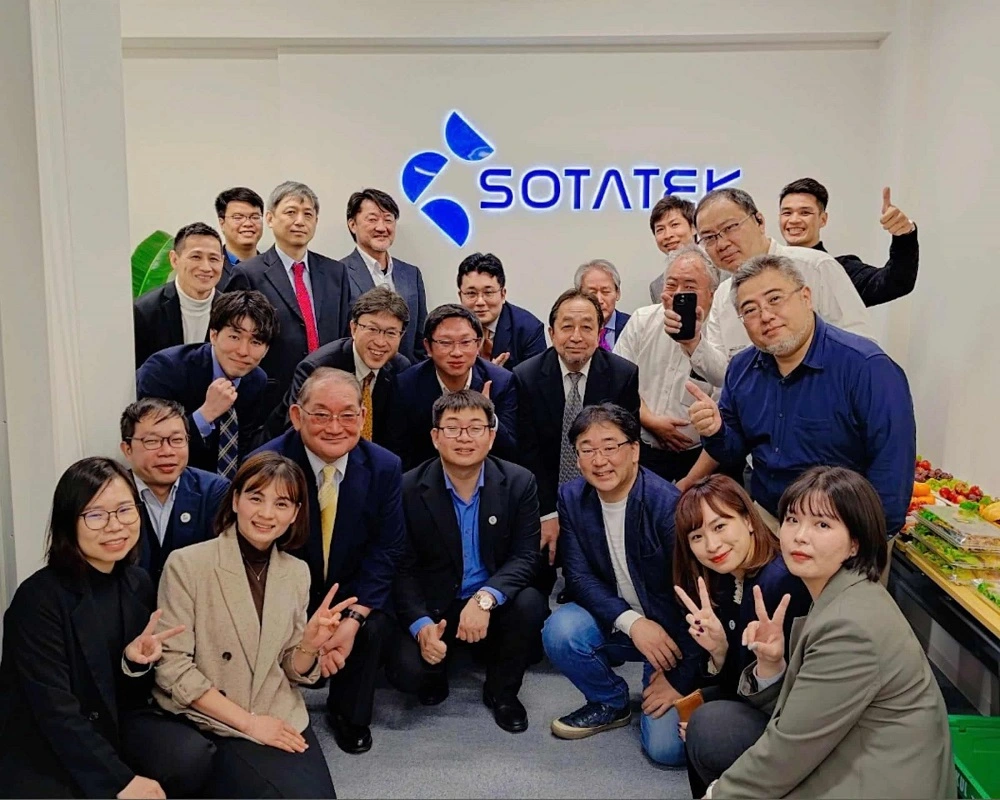
Core thesis: SotaTek is strongest for multi-component Web3 platforms, especially where token flow, backend logic, user app, and smart contracts need to work together.
Its public blockchain proof is clearest in launchpad-style products. For example, the Fellaz IDO Platform involved Ethereum and Arbitrum support, ICO/INO launchpad logic, FLZ-token-based transactions, whitelist/community sale stages, backend infrastructure, and Solidity smart contracts. This suggests SotaTek has experience beyond isolated smart contract tasks, particularly in Web3 platforms where token mechanics must connect with user journeys and backend systems.
Its Solstarter / Multichain Launchpad case also points to launchpad ecosystem experience, including DEX, NFT auctions, vesting contracts, bridge functionality, and OTC token flows.
Capability boundary: Strong public signals around launchpads, token distribution, NFT/GameFi-style platforms, and Web3 app delivery. Buyers should still validate smart contract audit process, custody architecture, and protocol-level expertise.
2. Ekotek (Hanoi)
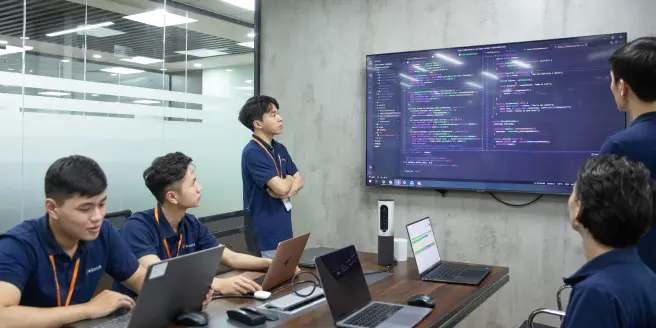
Core thesis: Ekotek looks strongest in turning blockchain features into usable Web3 product experiences – especially where users need to claim tokens, access wallets, trade assets, buy NFTs, or interact with marketplace flows.
What makes Ekotek worth considering is the amount of public blockchain portfolio evidence available. Its listed work includes the Age of Gods token vesting portal, A Multichain Wallet, A Gasless Marketplace, NFTify, Bullet Chain, a crypto launchpad, blockchain-enabled travel booking, and Myanmar Gold Coin tokenization. That breadth does not automatically prove deep protocol expertise, but it does show repeated exposure to practical Web3 product delivery.
The pattern across these cases is fairly clear: Ekotek seems more proven at the application layer than the infrastructure layer. For example, its Solana trading dApp case involved token creation, Jupiter-based swap integration, transaction history, user profiles, and referral mechanics. Those are not just blockchain keywords; they are product workflows that real users need to understand and use.
That makes Ekotek easier to evaluate for wallets, NFT marketplaces, vesting portals, token trading apps, and other user-facing Web3 products. For buyers with more sensitive requirements – such as institutional-grade smart contract security, protocol-level R&D, or regulated financial infrastructure – the main questions should be around audit ownership, security review depth, and post-launch support.
3. Synodus (Hanoi, HCMC)
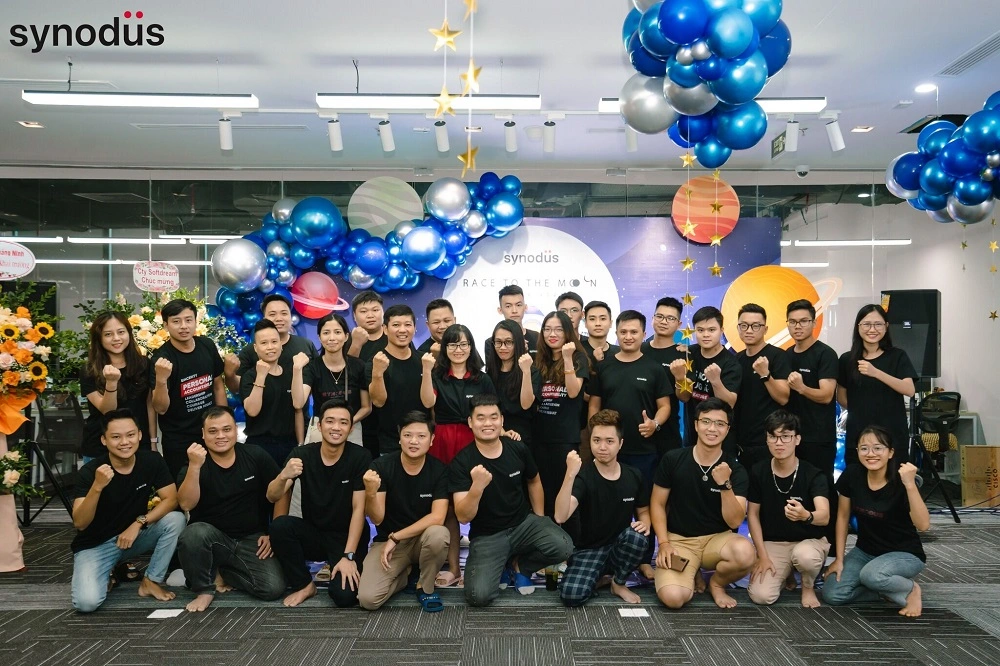
Core thesis: Synodus is strongest when blockchain is not a standalone module, but part of a broader fintech or Web3 product that needs smart contract development, backend logic, user workflows, and business operations to work together.
The best public proof point is DeFi For You, a P2P lending platform where blockchain is tied directly to asset-backed lending, NFT collateral, liquidity pools, and an OTC trading layer. This case is useful because it shows Synodus working on the surrounding product logic, not only the token or contract layer. For buyers, that matters when the hard part is not “can someone code a smart contract?”, but “can the blockchain layer support a real financial workflow?
Another useful signal is Synodus’ ICP crowdfunding platform case, which involved ReactJS, NodeJS, ICP blockchain, AWS, Motoko, and React Native over a 6-month delivery window. This points to experience outside standard EVM-only delivery, although buyers should still validate how deep the team’s chain-specific expertise is today.
Synodus also has public GameFi/NFT evidence through Cyberium, where the scope included a 3D pool game and a bespoke NFT marketplace for in-game assets. This supports the “product + blockchain” positioning, but it should not be stretched into a claim that Synodus is a pure GameFi specialist.
Capability boundary: Stronger proof around fintech/Web3 product delivery, DeFi workflows, NFT marketplaces, and smart contract development connected to backend systems. Buyers should still validate audit process, chain-specific depth, and production metrics.
4. Twendee (Hanoi)
Core thesis: Twendee is more credible as a Blockchain + AI innovation partner than as a deeply proven enterprise blockchain infrastructure vendor.
Twendee’s public positioning is clear: it presents itself around Blockchain and AI, with stated signals such as 70+ launched projects, 50+ clients, 10+ served countries, and 100+ experienced developers. This helps establish blockchain as part of its core public identity, not just a small add-on service.
But the public evidence is thinner than some other vendors in this list. The available materials show thought leadership and broad Blockchain/NFT/Web3 positioning, but fewer detailed case studies with named clients, architecture, chain environment, transaction flow, or production metrics. That does not mean Twendee lacks capability; it means the buyer should treat the public proof as directional, not conclusive.
Capability boundary: Good candidate for exploratory Web3, AI x Blockchain, NFT, or innovation-heavy ideas. For regulated fintech, custody-heavy systems, or high-value smart contracts, buyers should ask for private case studies, audit examples, and senior technical walkthroughs before shortlisting.
5. Sphinx JSC (Hanoi)
Core thesis: Sphinx JSC looks more like a Web3 application development vendor than a protocol-level blockchain engineering firm.
Its blockchain page focuses on practical Web3 delivery: NFT marketplace development, Web3 development, smart contract development, dApp creation, deployment, and consulting. That positioning is useful for buyers building application-layer products such as marketplaces, dApps, or smart-contract-enabled platforms.
The key reading here is that Sphinx appears to compete in the “build the Web3 product” category, not the “invent new blockchain infrastructure” category. This is not a weakness if the buyer needs a usable application, admin flows, marketplace logic, wallet connection, or smart contract integration. It becomes a risk only if the project requires deep protocol design, advanced DeFi mechanics, or institutional-grade security.
Capability boundary: Public evidence supports Web3 app delivery and NFT/dApp-related scopes. Buyers should validate smart contract audit ownership, mainnet experience, and whether the blockchain team is a dedicated practice or a general software team covering Web3 projects.
6. Hola Tech (Hanoi)
Core thesis: Hola Tech is best interpreted as a software-to-blockchain execution team for common Web3 product types, especially where speed and practical delivery matter more than advanced protocol depth.
Hola’s blockchain page frames the company as moving “from software to Blockchain” and offering end-to-end IT solutions for businesses of different sizes. The page lists common blockchain scopes such as public/private blockchain, NFT marketplace, DEX/CEX, games, wallet, POS, and launchpad.
This gives Hola a clear service-market fit: buyers who already know the type of Web3 product they want and need a team to execute quickly. The public signal is strongest around familiar product patterns — marketplace, exchange, launchpad, wallet, or blockchain game — rather than highly specialized blockchain infrastructure.
Capability boundary: Hola’s public materials are service-rich but case-detail-light. Buyers should ask for demos, delivered product references, smart contract examples, and security review process. Without that, it is hard to judge whether the team is better for MVP execution or production-grade financial systems.
7. Savvycom (Hanoi)
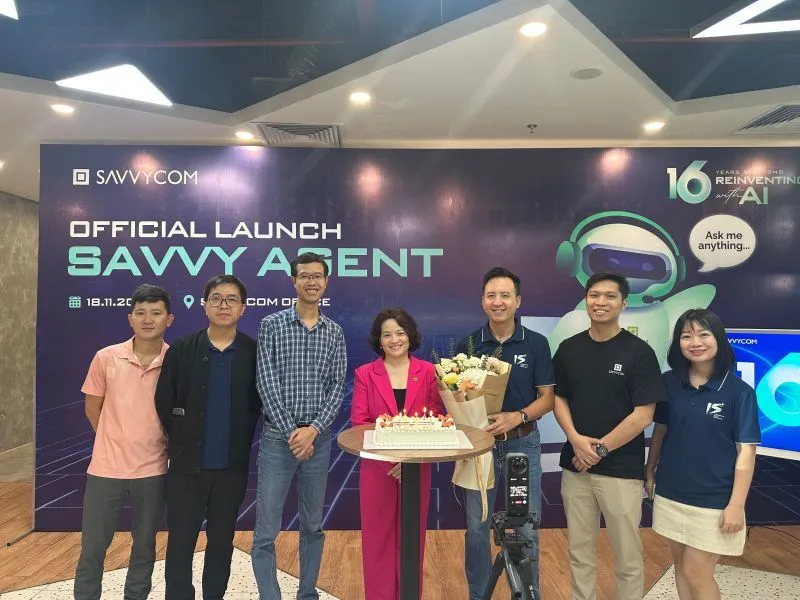
Core thesis: Savvycom is more relevant when blockchain is part of enterprise digital transformation, not when the buyer is looking for a crypto-native protocol studio.
Savvycom’s blockchain positioning is business-led. Its service page discusses blockchain solutions for fintech, real estate, and supply chain, and frames blockchain consulting as a way to support projects such as cryptocurrency exchange, wallet development, mobile app development, and other application initiatives.
That context matters. Savvycom is not primarily presenting itself like a Web3-native lab. It is a broader technology partner with blockchain as one solution line inside enterprise software, consulting, and digital transformation. This can be valuable for traditional companies exploring blockchain in operational workflows, traceability, finance, or asset-related use cases.
Capability boundary: Stronger fit for enterprise application contexts where blockchain is one layer of a larger system. Buyers building DeFi protocols, tokenomics-heavy platforms, or high-risk smart contract products should validate whether Savvycom has a dedicated blockchain team and comparable production references.
8. AgileTech Vietnam (Hanoi)
Core thesis: AgileTech sits in the middle ground: broader software outsourcing capability, with enough blockchain-specific messaging to be relevant for custom blockchain applications.
Its public site positions blockchain alongside software development and AI, with blockchain services covering smart contracts and decentralized applications. Its blockchain guide also mentions custom blockchain development for both private and public solutions.
The stronger proof signal is its blockchain portfolio category. AgileTech describes end-to-end delivery that includes smart contract development, node integration, UI, automation, and system security. That is more useful than a generic service list because it suggests experience across both blockchain components and product/application layers.
Capability boundary: AgileTech looks credible for custom blockchain applications and product builds that need web/mobile engineering around the chain layer. Buyers should still validate chain-specific depth, audit process, and whether the team has handled similar production load or transaction complexity.
9. AMELA Technology (Hanoi)
Core thesis: AMELA is best read as a scalable blockchain engineering resource partner, especially for buyers who already have a defined scope and need execution capacity.
AMELA’s blockchain page is quite explicit on technical service coverage: smart contract development and auditing, dApp development, custom blockchain development, DeFi and trading bot solutions. It mentions Solidity, Rust, and Move for smart contracts, plus Layer-1, Layer-2, private/public blockchains, and chains such as Ethereum, BNB Chain, Solana, and TON.
This breadth is useful, but it should be interpreted carefully. It signals availability of blockchain engineering services, not automatically proven ownership of complex product strategy, token economics, or regulated financial architecture. AMELA also has a public partnership announcement with Pando Infinity around blockchain development, which supports blockchain as a real service direction rather than only a website category.
Capability boundary: Better fit when the buyer needs dedicated blockchain developers, smart contract implementation, dApp development, or defined engineering workstreams. For projects needing architecture leadership, protocol design, custody, or compliance-heavy fintech flows, buyers should validate senior blockchain leadership and project governance upfront.
Excited to learn about top blockchain companies globally?
How to evaluate blockchain development companies for your project
Choosing a blockchain development company requires more than comparing portfolios or pricing. The right decision depends on how well a vendor’s technical capabilities align with your specific blockchain use case, delivery expectations, and long-term goals.
Start with your blockchain use case, not the vendor
Before shortlisting any company, clearly define what you are building. DeFi platforms, NFT marketplaces, and enterprise systems each require different technical depth and delivery models, which is why understanding the scope of blockchain development services involved is critical from the start. If you haven’t worked through that scope yet, our guide on planning your blockchain app covers the full decision sequence before you start comparing vendors.
Determine whether blockchain is a core capability or an add-on
Not all development companies treat blockchain as a core focus. Some offer blockchain services as an extension of general software development. Review how prominently blockchain appears in a company’s offerings, case studies, and technical discussions to assess whether it is a primary specialization.
Evaluate delivery maturity beyond proof-of-concept
Many blockchain projects reach MVP but struggle in production. Ask how a company approaches security reviews, smart contract upgrades, and post-launch support. These factors often determine whether a blockchain system remains viable after launch.
Assess scalability and long-term maintainability
A reliable blockchain partner should be able to explain how your system will handle growth. This includes transaction volume increases, feature expansion, and changes in underlying blockchain infrastructure. Long-term maintainability matters more than initial development speed.
Align expectations on scope, budget, and delivery model
Successful blockchain projects depend on realistic planning. Instead of focusing solely on cost, evaluate how a company helps define scope, manage trade-offs, and structure delivery in a way that fits your timeline and resources.
Final thoughts
Vietnam has become a strong destination for blockchain development, with companies offering varied strengths in delivery speed, technical depth, and product scalability. This list highlights providers that have demonstrated real execution capability across DeFi, NFT, and Web3 use cases – not just experimental builds.
There is no one-size-fits-all choice. The right blockchain partner depends on your project scope, required technical complexity, and long-term product goals. By focusing on proven delivery experience, clear execution models, and production-ready capabilities, businesses can significantly reduce risk and improve outcomes when building blockchain solutions in Vietnam.
FAQs
Yes. Many Vietnamese blockchain firms work with US, European, and APAC clients, offering mature outsourcing processes, English communication, and cross-timezone delivery experience.
Hourly rates typically range from $25–$60, depending on project complexity and team seniority, making Vietnam a cost-efficient alternative to Western markets.
Leading firms in Vietnam build production-ready blockchain platforms, including DeFi protocols, NFT marketplaces, and enterprise integrations – not just proof-of-concept projects.