Top gaming NFT marketplaces by use case
Gaming NFT marketplaces follow different models, so there is no single platform that fits every use case. The platforms below are selected to illustrate distinct approaches, from marketplaces built around one game ecosystem to multi-game platforms and marketplace infrastructure for game studios.
| Marketplace | Best for | Model | Ecosystem | What stands out |
|---|---|---|---|---|
| App.Axie | Axie Infinity assets | Game ecosystem marketplace | Ronin | Deep integration with Axie assets and games |
| Sphere | Gaming assets across Beam | Multi-game gaming marketplace | Beam | Gaming-focused trading plus in-game marketplace infrastructure |
| Altura | Assets across multiple Web3 games | Multi-game marketplace | Multi-chain | Public marketplace plus custom game storefronts |
| The Sandbox marketplace | The Sandbox assets | Game ecosystem marketplace | The Sandbox | LAND, avatars, equipment, props, and ecosystem collections |
App.Axie
App.Axie is the marketplace hub for the Axie Infinity ecosystem. Its marketplace currently covers Axies, accessories, land, land items, runes, charms, materials, and consumables, while the wider App.Axie platform connects users with Axie Infinity games and ecosystem activities.
Rather than aggregating unrelated gaming collections, the marketplace is organized around assets that already have context within Axie Infinity, letting users evaluate an item alongside the game ecosystem where it has value.
For someone already participating in Axie Infinity, that specialization can be more useful than browsing a broader NFT marketplace. The marketplace can organize assets around concepts and categories relevant to Axie players instead of treating every item as a generic NFT.
Sphere
Sphere describes itself specifically as a marketplace for gaming assets. Players can use it to discover and trade game-related NFTs, including characters, weapons, cosmetics, and other assets, with the marketplace built around the needs of gamers rather than a broad range of NFT categories.
Sphere also follows a different marketplace model from App.Axie. Connected to the Beam ecosystem, it provides infrastructure that game developers can use to create an in-game marketplace based on the same marketplace contracts.
For users, Sphere sits between a traditional external marketplace and infrastructure that can bring trading closer to the gameplay experience, making it a useful example of how a gaming marketplace can serve several games rather than being tied to one title.
Altura
Altura operates a gaming-focused marketplace where users can explore games, collections, and recently listed assets. Its current marketplace is multi-chain, while the broader Altura platform also provides tools for game developers to launch branded marketplaces and manage Web3 game assets.
Players can use the public marketplace to discover gaming collections, while game teams can create a separate storefront with their own branding rather than sending users to a generic third-party platform.
Altura sits closer to a multi-game marketplace and marketplace infrastructure platform than a marketplace designed around one game economy. See its white-label marketplace offering for the developer-facing side of the product.
The Sandbox Marketplace
The Sandbox Marketplace is closely tied to The Sandbox ecosystem. Its current shop includes collections, avatars, equipment, characters, props, LAND, and estates, giving users a marketplace focused on assets associated with creating and participating in The Sandbox experiences.
Like App.Axie, its value comes partly from ecosystem context. Users are not simply browsing isolated NFTs because the marketplace organizes assets around how they relate to the wider virtual world and its experiences.
The Sandbox Marketplace follows the same game ecosystem model as App.Axie, though the types of assets and user activities differ substantially between the two.
How to choose a gaming nft marketplace
Choosing a gaming NFT marketplace should start with the game or assets you actually want to trade, not with the size of the platform. A marketplace with thousands of collections may still be a poor choice if the game you care about has little activity or incomplete asset information. The following factors are more useful when comparing platforms.
Check the games and assets it supports
Start by finding out whether the marketplace supports the specific game, collection, and asset type you want.
A game-specific marketplace such as App.Axie can provide deep coverage of one ecosystem, while a multi-game marketplace such as Sphere or Altura can make it easier to browse assets across different projects. Neither model is automatically better because the useful choice depends on whether you want ecosystem depth or wider discovery.
You should also look at the types of assets available. Characters, equipment, land, cosmetics, collectibles, and crafting-related assets can require very different information for a buyer to evaluate them properly.
Look at liquidity and trading activity
A large catalog does not automatically mean an active marketplace.
For the game or collection you care about, look at whether there are active listings, recent transactions, offers, and enough buyers and sellers to support trading. A smaller marketplace with consistent activity around one game may be more useful than a large platform where the same assets rarely change hands.
Liquidity also varies from collection to collection. Marketplace-wide volume can tell you less than the activity around the specific assets you intend to buy or sell.
Compare the total trading cost
Marketplace fees are only one part of the cost of trading an NFT.
Depending on the marketplace, blockchain, and transaction, the total cost can include a marketplace fee, blockchain network fee, creator royalty, and potentially payment or currency-conversion costs. These charges go to different recipients and should not be treated as the same fee.
For example, Sphere currently states that trades on its marketplace carry a 2% marketplace fee. That does not mean the user’s complete transaction cost will always be exactly 2%, because network or other transaction-specific costs can still depend on how the trade is settled.
For more detail on how these charges differ, see our NFT marketplace business model guide.
Check search and asset information
Gaming assets often require more context than a collection name, floor price, and rarity rank.
If you are buying a character, you may want to search by class, attributes, abilities, or other game-specific properties. For equipment, the relevant information could instead include item type, rarity, compatibility, or gameplay effects.
A useful gaming marketplace should make the information that matters for the underlying game easy to find. App.Axie, for example, separates assets into game-specific categories such as Axies, land, runes, charms, materials, and consumables instead of presenting them as one undifferentiated NFT catalog.
Evaluate the wallet and account experience
A marketplace also needs to fit the level of blockchain knowledge you are comfortable with.
Some platforms rely heavily on external wallets, while gaming platforms can also use embedded accounts, social login, or other onboarding methods that reduce the amount of blockchain interaction visible to the player. The important question is not whether a marketplace uses a wallet, since blockchain ownership ultimately requires one, but how much of that complexity the user has to manage directly.
Check whether transactions require manual network switching, native gas tokens, repeated wallet approvals, or other steps that could make frequent trading inconvenient.
Check how well it connects with the game
Buying an NFT and being able to use it in a game are not the same thing.
Before purchasing an asset for gameplay, check whether the relevant game actually supports it and what the NFT represents inside that game. Blockchain ownership can confirm which address holds a token, but the game still determines whether the asset is usable, cosmetic, collectible, access-based, or tied to some other function.
Pay particular attention when browsing assets outside an official game ecosystem. Do not assume that an NFT is usable in a particular game simply because its artwork or description is related to that game.
What is a gaming NFT marketplace and how does it work?
What is a gaming NFT marketplace?
A gaming NFT marketplace, also called a game NFT marketplace or NFT gaming marketplace, is a platform where users can discover, buy, sell, or otherwise trade blockchain-based assets associated with games.
These assets can include characters, weapons, skins, equipment, land, collectibles, access items, and other digital objects. OpenSea broadly defines gaming NFTs as blockchain-based items associated with gaming environments, including in-game items, characters, skins, maps, tickets, and collectibles.
The value of a gaming NFT does not necessarily come from one source. Gameplay utility and item attributes may matter, but rarity, visual appeal, collectibility, supply and demand, and the popularity of the underlying game can also influence how buyers evaluate an asset.
A rare cosmetic skin, for instance, may have limited effect on gameplay but still attract demand because of its appearance or scarcity. A functional game asset might instead be valued primarily for what it allows a player to do.
How does a gaming NFT marketplace work?
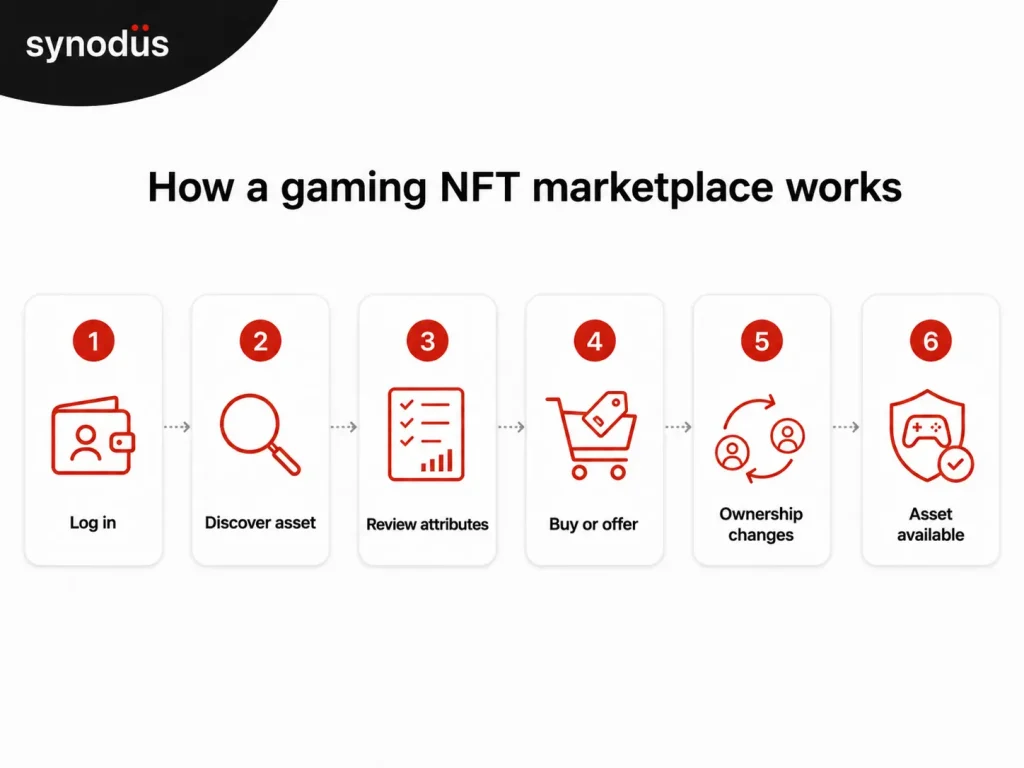
The player first uses an account or wallet associated with a blockchain address, then browses assets and evaluates the information provided by the marketplace. Depending on the platform, the transaction may use a fixed-price listing, an offer, an auction, or another trading mechanism.
Once the transaction settles, blockchain ownership of the NFT changes. If the NFT represents an asset usable inside a game, the game must then recognize the new owner before the player can use or manage it as intended.
The blockchain records token ownership, but the game’s own rules determine what owning that token actually allows the player to do.
How is it different from a general NFT marketplace?
Gaming and general NFT marketplaces share many basic functions, including asset listings, wallet interactions, search, and blockchain settlement. The main difference is how much game-specific context the marketplace needs to provide.
| Gaming NFT marketplace | General marketplace | |
|---|---|---|
| Asset focus | Game-related assets | Broad NFT categories |
| Discovery | Game attributes, item types, and gameplay context | Collections, categories, traits, and price |
| Game integration | Often relevant | Usually not required |
| Account experience | Often benefits from game-linked or simplified wallet UX | External wallets remain common |
| Main context | How the asset relates to a game | Broader collection or asset context |
The distinction is not absolute. General marketplaces can list gaming NFTs, while gaming marketplaces may contain collectible assets with little or no gameplay utility.
A dedicated gaming marketplace can organize discovery, asset information, and user experience around what players need to understand a game asset rather than around a broad catalog of unrelated NFTs.
In-game vs External gaming marketplaces
Gaming NFT marketplaces can also differ in where the trading experience takes place. Some are integrated directly into a game or its account system, while others operate as separate platforms that players visit outside the game.
Neither approach is automatically superior, and each solves different discovery and user-experience problems.
In-game marketplace
An in-game marketplace allows users to browse or trade assets without leaving the game experience, or through an interface closely connected to it.
Reducing context switching is one practical benefit. A player might open a marketplace from the game, purchase an item, and then see that asset reflected in the same account or inventory without moving between several independent products.
In-game marketplaces can also hide more of the blockchain complexity. Game accounts, embedded wallets, sponsored transactions, or simplified signing flows can make trading feel closer to a conventional digital game purchase.
The model suits games where trading happens frequently as part of the game economy. The marketplace becomes one component of the gameplay experience rather than a separate destination users visit occasionally.
External gaming marketplace
An external gaming marketplace exists as a separate website or application.
Users leave the game environment to browse collections, compare assets, view market activity, and execute trades. The platform may focus on one game, as App.Axie does, or aggregate assets across several gaming projects.
External marketplaces have more room for broader discovery. They can provide collection pages, marketplace-wide search, trading information, and navigation across several games without having to fit those functions inside the game interface.
Sphere demonstrates how the two approaches can overlap. It operates an external marketplace for gaming assets while also providing infrastructure that game developers can use to bring marketplace functionality inside their own games
| In-game marketplace | External marketplace | |
|---|---|---|
| wherre trading happens | Inside or closely integrated with the game | Separate platform |
| Asset scope | Usually focused on one game or ecosystem | Can support one or multiple games |
| Discovery | Highly game-specific | Can support broader browsing |
| Account experience | Often more abstracted | Varies by marketplace |
| Best suited for | Frequent trading within the game experience | Broader asset discovery and comparison |
These models are not mutually exclusive. A game ecosystem can provide an in-game marketplace for convenient trading while maintaining an external marketplace for users who want deeper discovery or market information.
Planning your own gaming NFT marketplace?
For teams planning their own gaming marketplace, the first question should be how the marketplace fits the game economy rather than which blockchain or technology stack to use. The games, assets, users, and trading behavior should define the product model before technical architecture is selected.
Define the games and assets first
Start by deciding whether the marketplace supports one game or several games and what users will actually trade. A character marketplace may need very different asset information and discovery tools from a marketplace focused on cosmetics, land, or collectible cards.
Asset decisions also affect how users evaluate items. The marketplace should be designed around the attributes that matter to the relevant players rather than starting with a generic NFT catalog.
Decide where trading should happen
Determine whether trading belongs inside the game, on an external platform, or in both places.
An in-game model can reduce friction for existing players, while an external marketplace can provide more room for discovery and potentially serve several games. A hybrid approach is also possible when the same trading infrastructure supports both experiences. If you need a development partner for a gaming-focused project, working with NFT game development companies can help turn these marketplace requirements into a game and blockchain architecture.
Map ownership to actual game use
The complete user journey does not end when the NFT changes wallets. For assets with in-game utility, map the full flow:

Mapping this flow early reveals dependencies between marketplace transactions, player accounts, ownership data, and game inventory before development begins.
A build we’ve done: connecting ownership to in-game use for Cyber8
When Synodus built the NFT marketplace for Cyberium, a 3D sports gaming project for game studio Cyber8, the project required more than the marketplace itself. It also needed an interoperability layer: a bridge meant to connect blockchain NFTs, tokens, and in-game assets, so that ownership recorded on-chain could translate into something usable inside the game rather than staying siloed in a wallet. That is the same dependency the mapping exercise above is meant to surface early, before development starts.
Model transaction economics before choosing a blockchain
The network should fit the way users will trade.
Consider the typical value of an asset, expected trade frequency, acceptable transaction cost, confirmation requirements, and wallet experience. A network that works well for occasional high-value transactions may be less suitable when players repeatedly trade low-value game items.
Common mistakes include starting from a generic NFT marketplace template, selecting a blockchain before modeling trading behavior, requiring every player to use crypto-native onboarding, and treating game integration as something that can be added after the marketplace is complete.
For the broader implementation process, see our guide to building an NFT marketplace. If you are budgeting the project, the NFT marketplace development cost guide covers how scope and technical requirements affect the estimate.
Final thoughts
Gaming NFT marketplaces differ in far more than the number of NFTs available. Supported games, liquidity within specific collections, total trading costs, asset information, account experience, and connection with the underlying game can all determine whether a marketplace is useful for a particular player.
For teams creating their own marketplace, these same differences should define the product before technical implementation begins. The marketplace model should follow how players discover, value, trade, and use game assets, rather than starting with blockchain architecture and trying to fit the game around it.
FAQ about gaming NFT marketplaces
App.Axie, Sphere, Altura, and The Sandbox Marketplace are worth comparing. The right option depends on the game or collections you want to trade, not on one platform being universally best.
Start with supported games and collections, then evaluate trading activity, total transaction costs, asset information, search functionality, wallet experience, and whether purchased assets are actually supported by the relevant game.
A blockchain NFT needs a wallet address, but you do not always have to manage an external wallet directly. Some platforms integrate wallet functionality into a broader account or login experience.
Marketplace fees, blockchain network fees, creator royalties, and payment costs can all apply depending on the transaction. Evaluate them separately rather than treating them as one combined fee.
Yes. Sphere and Altura are multi-game examples, while App.Axie and The Sandbox focus closely on their own ecosystems.