Top hospital information system companies: Custom development
Custom or hybrid HIS development is the right path when your workflows are complex, your compliance environment is local and specific, or your facility is scaling in ways that OTS products cannot accommodate. The vendors below have proven track records in healthcare software delivery.
Synodus
Hourly rate: $25-$50/hr
Clutch rating: 5.0
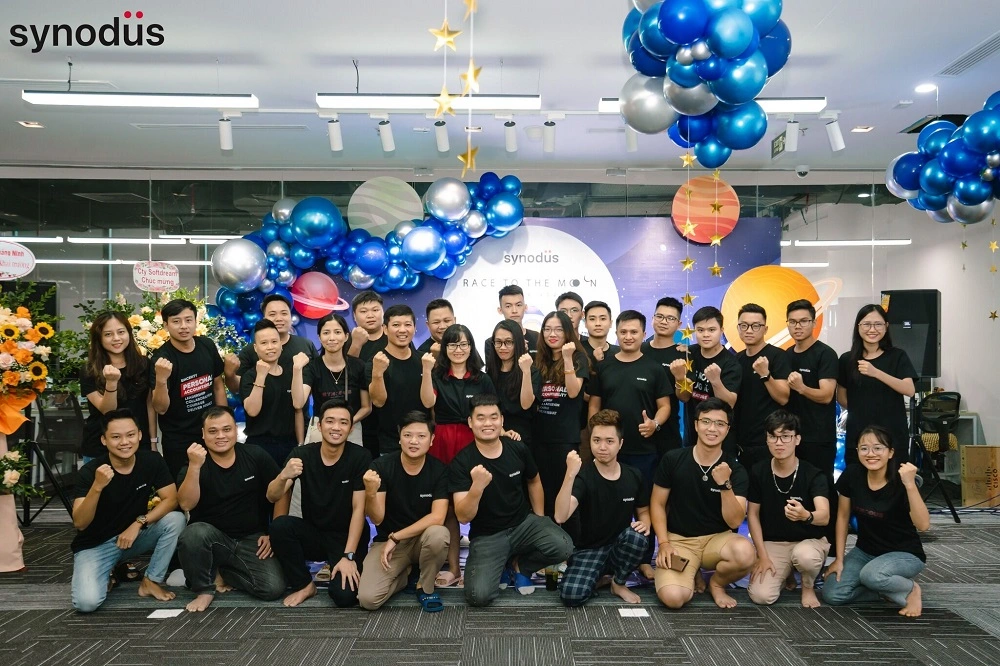
Synodus is a Vietnam-based healthcare software development company with over 250 developers serving hospitals and healthcare facilities across Vietnam, the Philippines, Malaysia, and Australia. What sets them apart from most custom vendors is their hybrid model: rather than building every project from scratch, they start from a validated HIS base that already covers core modules (EMR, EHR, pharmacy, inventory, billing, scheduling), then custom-build the workflows, integrations, and compliance layers specific to each facility. This compresses timelines significantly without sacrificing the flexibility that custom development is supposed to deliver.
Their compliance coverage spans HIPAA, HL7, ISO standards, and local MOH/DOH regulations across Vietnam, Australia, and the Philippines, which makes them a practical choice for APAC hospitals where international vendors often fall short on local regulatory fit.
What they do differently: They deploy in hybrid mode, reducing the time-to-go-live gap that makes fully custom builds risky for hospitals with urgent digitalization timelines. Most projects include a patient-facing mobile app and analytics dashboard as standard components, not add-ons.
Best for: Mid-to-large APAC hospitals with complex, multi-department workflows or local compliance requirements that OTS products are not built for. Also suits facilities that want a single vendor for build, compliance, and long-term support rather than managing multiple contractors.
Worth knowing: Their primary market is APAC. If your facility is in North America or Europe with stable compliance requirements and standard workflows, an OTS system will likely be faster and cheaper.
Comarch
Compliance standards: HL7 CDA, IHE profiles (CDS.b, XCA)
Hourly rate: $50-$100/hr
Comarch is a large international technology company with healthcare as a dedicated vertical, currently supporting 80 hospitals, 200 outpatient clinics, and 2.5 million patients annually. Their differentiator is the depth of AI and machine learning integration: rather than adding AI as a layer on top of existing workflows, Comarch builds intelligence into core clinical processes, including remote diagnosis, cardiac monitoring, and laboratory data interpretation.
What they do differently: AI capabilities are embedded at the system architecture level, not bolted on later. This makes them a strong option when the clinical goal goes beyond standard HIS digitalization into active decision support and predictive monitoring.
Best for: Hospitals that need AI-assisted diagnostics, remote patient monitoring, or specialty clinical intelligence (cardiac, oncology) built into the foundation rather than integrated after the fact.
Worth knowing: Their team size (1,000+) and international scale means project management complexity is higher than with a smaller, more focused vendor. They work best when the client has a dedicated IT team to interface with their delivery process.
TCA Healthcare
Services: Packaged and custom HIS, IT staff augmentation, health IT consulting
Hourly rate: $50/hr
TCA Healthcare brings 40 years of healthcare IT experience and a deployment record of 2,000 implementations serving 30,000 healthcare users. That longevity is their most distinctive attribute. Most software companies pivot, rebrand, or get acquired; TCA has operated as a specialized healthcare IT firm through multiple technology generations, which means their architecture decisions reflect hard-won lessons that newer vendors are still learning.
What they do differently: Their implementation methodology is heavily shaped by clinical process design, not just technical delivery. They build around how clinical staff actually work, which tends to produce higher user adoption rates than technically superior systems that ignore workflow fit.
Best for: Public and private sector hospitals that prioritize implementation risk reduction and long-term vendor stability over cutting-edge features. A particularly good fit for organizations that have had a painful experience with a vendor that over-promised and under-delivered.
Worth knowing: Their 40-year legacy means their product roadmap moves more conservatively than agile-first competitors. If your priority is rapid iteration, modern DevOps practices, or bleeding-edge AI features, a younger vendor will likely move faster.
Chetu
Hourly rate: $50/hr

Chetu operates at scale, with 2,800+ developers and a compliance credential list that covers the widest range of any vendor on this list: HL7, ICD-10, CPT, LOINC, SNOMED-CT, and CQM tracking. Their strength is handling regulatory-heavy builds where non-compliance is not just a legal risk but a patient safety risk.
What they do differently: They treat compliance as a technical architecture concern rather than a documentation exercise. Their development process maps clinical requirements directly to specific standards, which reduces the compliance remediation work that often surfaces late in less structured builds.
Best for: Hospitals that need a system certified against multiple overlapping regulatory frameworks simultaneously, or facilities building AI-powered diagnostic tools where FDA software classification and clinical safety standards apply alongside standard HIS compliance.
Worth knowing: Chetu’s breadth means they work across many industries beyond healthcare. Verify that the specific team assigned to your project has deep healthcare domain experience, not just general compliance expertise repurposed from another vertical.
Fortunesoft
Services: Project-based outsourcing, staff augmentation
Hourly rate: $50/hr
Fortunesoft approaches HIS delivery with a modern engineering philosophy: DevOps pipelines, CI/CD deployment, cloud-native architecture, and sprint-based development cycles. For hospitals that have experienced the frustration of waterfall-style builds where they only see the product at go-live, Fortunesoft’s agile delivery model means earlier visibility, faster course correction, and a tighter feedback loop between clinical staff and developers during the build.
What they do differently: Their delivery model is structured for hospitals that want to be actively involved in shaping the system during development, not just reviewing a finished product. Regular sprint reviews and iterative testing cycles reduce the gap between what was specified and what was actually built.
Best for: Hospital chains and clinic networks looking for competitive pricing with modern engineering standards. A good fit for facilities with an internal IT team that wants to stay close to the development process rather than handing off to a black-box build.
Worth knowing: Their module coverage is solid for core HIS functions but narrower than larger vendors. Complex specialty integrations (advanced imaging, high-volume LIS, multi-site enterprise rollouts) may require supplemental development capacity.
Top hospital information system companies: Off-the-shelf
OTS products suit facilities that need fast deployment, standard workflows, and lower upfront investment. The major vendors in this category are covered in depth in the top hospital information system guide, including strengths, real limitations, and which hospital type each is actually suited for. Here is a quick orientation to help you decide which to look at more closely.
Epic dominates the large hospital segment with 42.3% US acute care market share. If your facility has 500+ beds and the IT budget to match, it belongs on your shortlist. If not, it does not. Full Epic breakdown
Oracle Health (formerly Cerner) is the second-largest at 22.9% market share, now cloud-native with AI-assisted documentation. A credible alternative to Epic for large systems, though its post-acquisition transition has been uneven. Full Oracle Health breakdown
MEDITECH Expanse is the consistent top performer for mid-size community hospitals (151-400 beds), with a MaaS cloud model that removes the infrastructure burden. It has ranked in the KLAS top two for this segment for five consecutive years. Full MEDITECH breakdown
Veradigm (formerly Allscripts) focuses on ambulatory care and revenue cycle management. Strong on clinical insights and medication management, but better suited to outpatient-heavy environments than full inpatient HIS deployment.
Athenahealth is a network-enabled platform for outpatient and ambulatory settings. Its compliance credentials are solid and it is designed to reduce administrative burden for clinical teams, but like Veradigm, it is not a full inpatient HIS solution.
Trubridge (formerly CPSI) targets community hospitals operating on tight margins, with focused products for patient access, revenue cycle, and AR management. A practical option for smaller facilities that do not need enterprise-scale feature depth.
For a side-by-side comparison of all six OTS vendors by deployment model, pricing range, interoperability standards, and independent ratings, see the full comparison table.
The vendor evaluation framework
A vendor shortlist is only the starting point. The real work is vetting each vendor against criteria that a demo will not reveal. Here is a structured framework built around the six areas that most commonly determine whether an HIS implementation succeeds or fails.
Understanding what benefits a well-implemented HIS should deliver helps you hold vendors accountable. See hospital information system benefits and limitations for the research benchmarks to use in vendor evaluation.

1. Compliance and certification verification
This is where many procurement teams take a vendor’s word at face value and pay for it later. “HIPAA compliant” means different things to different vendors. Ask for specifics.
What to verify:
For OTS vendors, request documentation of ONC certification (for EHR in the US), HITRUST or SOC 2 Type II certification for security, and any relevant local accreditations (DOH in the Philippines, TGA in Australia, local MOH standards in Southeast Asia). Despite the stakes involved, healthcare procurement teams frequently take vendor compliance claims at face value: a 2025 analysis of healthcare IT procurement practices found that manual, unstructured evaluation processes remain common, leaving compliance verification gaps that only surface after contracts are signed.
For custom development vendors, verify their process for embedding compliance into architecture decisions, not just reviewing at the end. Ask how they handled a specific compliance challenge in a past project in your regulatory environment..
Questions to ask:
- Which specific certification bodies have validated your security controls?
- Can you share your last penetration test summary?
- How do you handle regulatory updates? Do we pay for compliance updates, or are they included?
- Have you deployed in our specific regulatory environment (country/region) before?
2. Interoperability and integration depth
Poor interoperability is one of the most cited causes of failed HIS implementations. A system that cannot exchange data with your lab, imaging, billing, or insurance systems creates digital silos as damaging as paper-based records.
What to verify:
Minimum acceptable standards are HL7 FHIR for data exchange and DICOM for imaging. In the US, USCDI v3 compliance is increasingly a procurement requirement for government-affiliated facilities. Ask which specific version of HL7 FHIR the system supports, not just whether it “supports HL7.”
Beyond standards, ask for a live integration demonstration with systems similar to what you are running. A vendor who claims broad interoperability but cannot demonstrate it with your specific stack should raise concerns.
Questions to ask:
- Which version of HL7 FHIR do you support?
- Have you integrated with [your specific LIS/RIS/billing system] before?
- Do you have an open API? What are the rate limits and access controls?
- What does integration with a new third-party system typically cost and take?
3. Implementation track record in comparable facilities
A vendor’s overall client count tells you very little. What matters is whether they have successfully deployed a system similar to what you need, at a facility similar to yours, in the last three years.
What to verify:
Ask for three references from hospitals with comparable bed count, patient volume, and specialty mix to yours. Then actually call those references, not just read testimonials. Prepared questions matter here: ask about what went wrong during implementation, not just what went well. Every implementation has problems; how the vendor responded to those problems is the real signal.
For custom development vendors, ask to speak directly with the project manager or technical lead who handled a comparable healthcare project, not just a sales representative. If you want to see what a well-documented EMR implementation looks like before your vendor calls, the EMR case study for a multi-field hospital complex is a useful reference point for what good transparency looks like.
Questions to ask:
- Can you provide three references from hospitals with a similar profile to ours?
- What were the two biggest implementation challenges in your last comparable project, and how were they resolved?
- What was the actual go-live date relative to the planned date? What caused any delays?
- What does your post-go-live support look like in the first 90 days?
4. Total cost of ownership, not just licensing
Vendors quote licensing or development fees. The actual cost of an HIS over five years includes implementation services, training, data migration, integration development, customization, ongoing support, and upgrade fees. These can easily double or triple the quoted license cost for OTS systems.
What to verify:
Request a fully itemized five-year total cost of ownership estimate, not just annual licensing. For OTS systems, clarify which features are included in the base license versus charged as add-ons. For custom development, clarify the billing model for change requests, bug fixes post-launch, and compliance updates. Note that EHR costs within an HIS implementation often carry their own pricing variables worth understanding separately; the EHR cost and ROI breakdown covers what to budget for that layer specifically.
Healthcare data breaches cost an average of $10.93 million per incident in 2024. Data security is not a place to optimize for cost in vendor selection.
Questions to ask:
- What is the total five-year cost including implementation, training, support, and upgrades?
- Which features or modules cost extra beyond the base license?
- How are pricing increases handled at renewal? Is there a cap?
- What does data migration from our current system cost, and who bears that cost if the migration fails?
5. Scalability and product roadmap
A system that fits today may be a bottleneck in three years. Healthcare organizations grow, merge, add specialties, and expand to new locations. The HIS must be able to grow with them.
What to verify:
Ask for the vendor’s product roadmap for the next 18-24 months. Reputable vendors publish this; evasiveness about future development direction is a warning sign. For OTS vendors, clarify how new features are delivered and whether you have any input into development priorities as a paying customer.
For custom vendors, clarify the architecture approach: modular systems that can be extended independently are significantly lower risk than monolithic builds that require core system changes for every new feature.
Vendor lock-in is a serious risk in healthcare IT. As Paubox notes in their 2025 analysis, EHR systems that make data migration difficult trap organizations in costly relationships even when better alternatives exist. Once a business is dependent on a vendor, that vendor may raise prices knowing that switching is prohibitively expensive.
Questions to ask:
- What is your product roadmap for the next 18-24 months?
- How do customers submit and track feature requests?
- What happens to our data if we decide to migrate to a different system in the future?
- Can you demonstrate a customer who has successfully added a major new module or facility to the system after initial deployment?
6. Long-term support model and organizational stability
Healthcare systems are not decommissioned after go-live. You are entering a relationship that will last 5-10 years minimum. The vendor needs to still exist and be responsive at year eight.
What to verify:
For smaller or newer vendors, ask about their financial stability, ownership structure, and whether they have had significant staff turnover in recent years. A vendor acquired by a larger company mid-contract is not unusual in healthcare IT, and the service quality change that follows is often dramatic.
For any vendor, clarify exactly what “support” means: response time SLAs, escalation paths, whether support is in-house or outsourced, and what happens during critical incidents outside business hours. Vague SLAs with phrases like “reasonable efforts” or “industry standards” offer little legal protection when things go wrong.
Questions to ask:
- What are your uptime guarantees, and what are the penalties if you miss them?
- How many of your current support staff have been with the company for more than three years?
- What is your critical incident response time outside business hours?
- Have you been acquired or had significant ownership changes in the last five years?
How to run an effective demo

A standard vendor demo is designed to show the system at its best. To get useful signal, you need to control the process.
Prepare “day in the life” scenarios. Rather than letting the vendor walk through their standard feature tour, give them three to five concrete scenarios based on your actual workflows. For example: admit an emergency patient who already has records in your legacy system; process an insurance claim for a complex multi-department case; generate a compliance report for a DOH audit. A vendor who can demo these scenarios fluently has likely actually deployed in environments like yours. A vendor who struggles or deflects is telling you something important.
Bring end users to the demo. IT and procurement staff will evaluate the demo differently from the nurses, doctors, and administrative staff who will use the system daily. End user resistance is one of the most common causes of HIS adoption failure. Involving them at the demo stage surfaces usability concerns early, when they can still influence vendor selection, rather than after go-live when they cannot.
Score each vendor on the same criteria. Create a structured scoring sheet before the first demo and use it consistently across all vendor evaluations. Categories should mirror the six framework areas above: compliance, interoperability, track record, cost, scalability, and support. Subjective impressions are unreliable when you are comparing four or five vendors across two months of demos. If your internal team lacks the bandwidth or healthcare IT expertise to run this process rigorously, bringing in an independent healthcare IT consulting firm to facilitate vendor evaluation is worth considering, particularly for large or high-risk implementations.
Ask what the vendor will not do. Every vendor has product limitations they prefer not to lead with. Ask directly: “What are the top three things customers most commonly ask for that your system cannot currently do?” A vendor who cannot answer this question has not thought carefully about their own product limitations.
Contract red flags to watch for
By the time you reach contract negotiation, you have already done significant evaluation work. Do not undo it by signing an unfavorable agreement. These are the clauses that most commonly cause problems for healthcare organizations post-signature.
Data ownership provisions. Some vendor contracts claim partial or full ownership of patient or operational data processed through their systems. This is unacceptable. Your patient data is yours. Verify explicitly that the contract states your organization retains full ownership of all data, and that the vendor’s access is limited to what is necessary to provide the contracted service.
One-sided termination clauses. Contracts that allow the vendor to cancel with minimal notice while imposing heavy penalties on you for early exit create an imbalanced relationship. Negotiate for symmetric termination rights and clear definitions of what constitutes a breach that entitles you to exit without penalty.
Automatic renewal with long notice periods. A contract that auto-renews for another year unless you provide 90 or 120 days’ written notice is designed to trap inattentive procurement teams in another contract cycle. Know your renewal dates and put them in your calendar the day you sign.
Vague SLA language. Phrases like “commercially reasonable efforts” or “industry-standard response times” are not enforceable. Your contract should specify uptime percentages (99.9% is standard for cloud-based systems), maximum response times for critical incidents (typically 1-4 hours), and specific remedies (service credits, right to terminate) if those benchmarks are missed.
Unilateral amendment rights. Some contracts allow the vendor to modify terms by updating a website or sending an email with insufficient notice. Negotiate for mutual written consent to any material contract changes.
Lock-in through proprietary data formats. If your data is stored in a proprietary format that cannot be exported in standard formats (HL7 FHIR, CSV, or similar), you are locked in regardless of what the contract says about data ownership. Verify the export format and test it before signing.
For a more detailed breakdown of implementation risks and how to avoid them, see EHR implementation challenges.
FAQs
Off-the-shelf vendors sell a pre-built product that you configure for your facility. Custom vendors build a system around your specific workflows, often starting from a base platform and extending it. The choice depends primarily on how standard your workflows are, your budget, and your compliance requirements. For a full breakdown, see hospital information system companies: custom vs OTS.
Ask for documentation, not assurances. For security compliance, request the vendor’s most recent third-party audit report (SOC 2 Type II or HITRUST). For clinical compliance (ONC certification in the US, DOH accreditation in the Philippines), ask for the certification number and verify it directly with the issuing body. Vendors who resist sharing audit documentation are a red flag.
Request a fully itemized five-year total cost of ownership estimate covering licensing, implementation services, data migration, integration development, training, ongoing support, and upgrade fees. Then add 20-30% as a contingency for scope changes, delays, and unforeseen integration work. For reference pricing by system type, see the HIS cost guide.
Data migration complexity, staff retraining, and workflow disruption are the three primary risks. Data migration is particularly high risk: some HIS store data in proprietary formats that are difficult to export cleanly, and poorly migrated data can create patient safety issues. Run a full data audit before migration begins, and include data validation testing as a go-live criterion, not an afterthought.
Both have trade-offs. International vendors bring proven systems and scale but may have limited familiarity with local regulations, billing systems, and workflows. Local vendors understand regional context but may have a smaller feature set or less proven deployment track record. The ideal is a vendor with regional implementation experience and international technical depth. For region-specific vendor landscapes, see the guides for Malaysia and the Philippines.
Three to five is the practical range. Fewer than three means insufficient comparison; more than five makes the evaluation process unmanageably time-consuming for your clinical and IT staff. Use the framework in this guide to screen your initial long list down to three to five before investing in demos and reference calls.
Walk away. Any vendor with a genuine track record of successful healthcare deployments will have clients willing to speak on their behalf. A vendor who cannot provide references is either too new to have them or has clients who are not satisfied. Neither is a foundation for a five-to-ten-year technology partnership.