This article explains what real estate tokenization is, how it works, what it takes to develop a tokenization platform, and what the market looks like heading into 2026. It covers the blockchain technology behind it, the different tokenization models in use today, and the benefits and risks that come with each.
What is real estate tokenization?
Imagine owning a piece of a fancy apartment building. That’s real estate tokenization in a nutshell. Instead of buying the whole thing (super expensive!), this lets you buy a digital token, like a mini-certificate, that represents a share of the property. These tokens come with rights and responsibilities, just like owning a regular slice of real estate.
Smart contracts act as automatic managers for these tokens. They are computer programs that follow instructions, such as transferring ownership when a share is sold, and this all happens on a blockchain, which keeps track of everything transparently.
So, real estate tokenization basically cuts up properties into digital shares using blockchain technology.
Blockchain: the technology behind real estate tokenization
Tokenization of real estate involves leveraging blockchain technology, which utilizes a distributed ledger to ensure immutability, security, and transparency by recording transactions across a network of computers.
Smart contracts, which are self-executing agreements that have the provisions of the contract explicitly encoded into the code, also play a vital role in the blockchain ecosystem as they automate and execute the conditions of tokenized real estate transactions. They automatically distribute rental revenue, enforce ownership rights, and make it easier for tokens to be transferred between properties when they are purchased or sold in the context of real estate tokenization. Because these contracts cannot be altered, there is less chance of fraud, and participant confidence is maintained.
Tokenization platforms are purpose-built to turn real estate assets into digital tokens representing fractional ownership. Property owners or developers typically collaborate with a tokenization provider to run this process.
The real estate tokenization process: from asset to token
Turning a property into tradable digital shares follows a defined sequence, from selecting the right asset through to letting investors trade their stake on a secondary market. Here’s how a property typically moves through that journey.
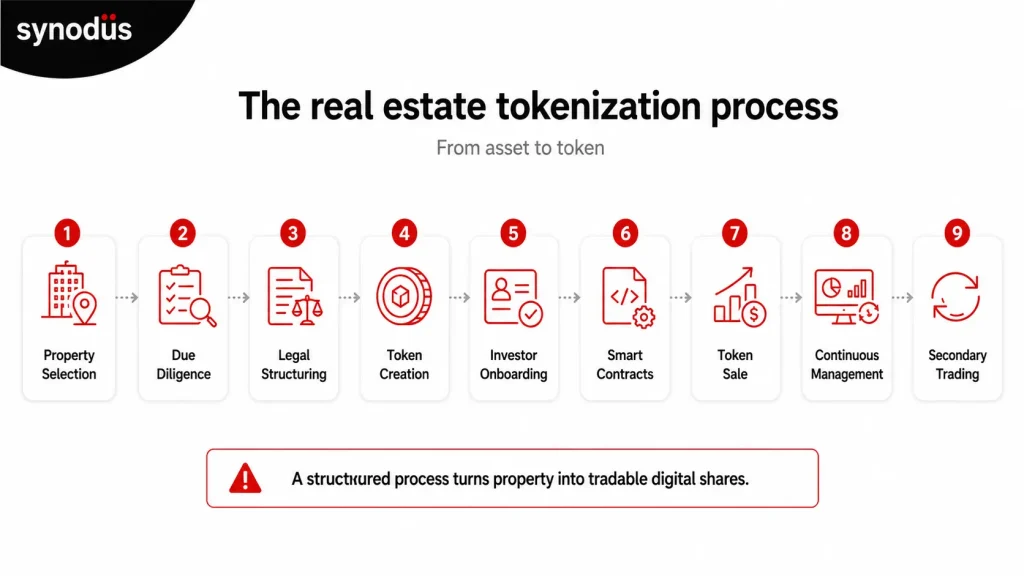
- Property selection: Developers or property owners evaluate the prospective asset by considering variables such as market demand, value, and location.
- Due diligence: Extensive due diligence confirms the property’s financial and legal affairs are in order, reducing risk before tokenization begins.
- Legal structuring: Legal professionals draft the agreements and contracts needed to establish the legal basis for tokenization, in compliance with domestic and applicable international frameworks.
- Token creation: Digital tokens are created to represent ownership shares once the legal framework is in place, with each token representing a defined proportion of ownership.
- Investor onboarding: Interested investors go through a verification process, including identification checks and, where applicable, accreditation checks, to meet regulatory requirements.
- Smart contracts: Smart contracts are built and deployed on the chosen blockchain to manage the tokenized asset, automatically handling token transfers and revenue distributions.
- Token sale: Investors purchase tokens representing ownership shares, offered through a private or public offering depending on the project.
- Continuous management: The blockchain automates financial processes tied to property bills, rental income, and other recurring obligations, in line with the parameters set in the smart contracts.
- Secondary market trades: Tokenized assets may be exchanged on secondary markets, letting investors buy or sell their stake without waiting for the underlying property to sell.
How does tokenization of real estate work?
Ownership of a property gets represented as tokens on a blockchain, with a smart contract handling the mechanics. The contract records who holds which tokens, executes transfers when tokens change hands, and can trigger payments, such as rental income, directly to token holders on a set schedule. The property itself doesn’t move onto the blockchain, only the rights tied to it do: ownership shares, income claims, or both, depending on how the deal is structured.
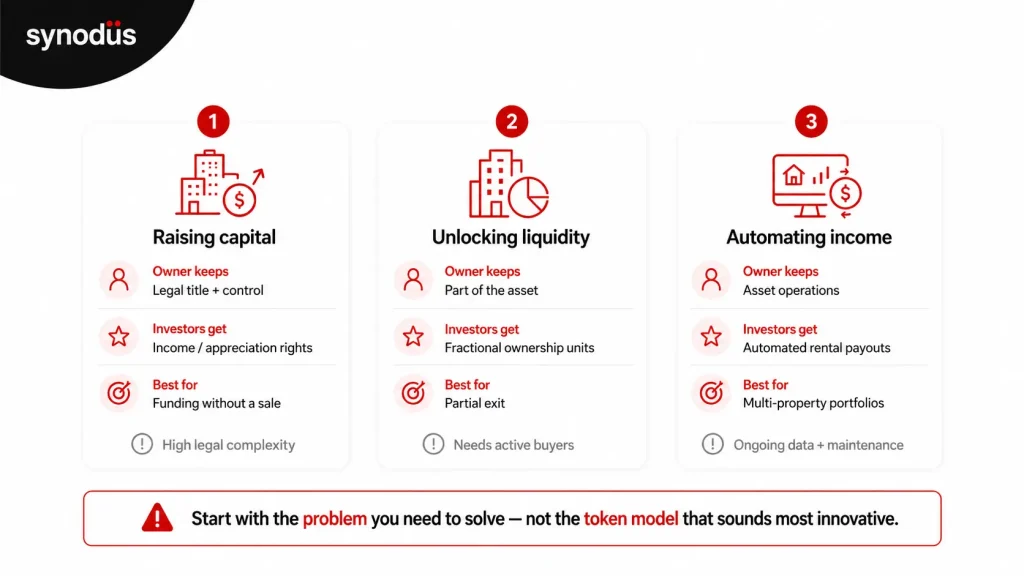
What varies from project to project is which rights get tokenized and why. The specific model an owner chooses depends on the business problem they’re solving.
Raising capital without giving up control
Owners who need funding but don’t want to sell or take on traditional debt use tokenization to sell economic rights, mainly rental income and future appreciation, while keeping legal title. This is closer to a structured loan than a property sale. Blocksquare’s notarized framework in Luxembourg works this way: the property owner borrows against a lien on the title, and investors hold tokens tied to that lien rather than the deed itself. This model requires the heaviest legal lift, since it has to satisfy both securities law and local property law at once.
Unlocking liquidity for existing owners
Some owners already hold appreciating property and want partial exit without a full sale. This is where fractional ownership tokens come in: the property is split into equal, interchangeable units, and the owner can sell a portion while retaining the rest. This model is closer to selling shares of a company than borrowing against it. The main obstacle isn’t legal structuring, it’s finding enough buyers to create real trading volume, which is why most fractional platforms still struggle with thin secondary markets.
Automating income distribution at scale
Owners managing multiple properties face an operational problem more than a financing one: manually tracking and distributing rental income across many token holders doesn’t scale. Here the token itself matters less than the automation layer behind it, usually an oracle service that pulls rent payment data and triggers payouts on a schedule.
RealT runs this model at scale on Ethereum, having tokenized more than 500 US residential properties. Its distribution contract calculates each holder’s share and pays out in stablecoins daily, with every transaction recorded on-chain. This is a maintenance-heavy model rather than a one-time legal build, since it depends on ongoing data feeds and monthly infrastructure costs rather than a single structuring event.
Note: property owners evaluating tokenization should start from which of these three problems they actually have, not from which token model sounds most innovative. The legal and operational costs differ significantly between them, and mixing models without a clear reason is the most common way projects overrun budget.
Real estate tokenization development: process, cost, and timeline
The steps above describe what happens to the asset. This section covers what it takes to build the software behind it, which is the question most teams evaluating a project actually need answered.
What a development team actually builds
A tokenization platform is built in three layers:
- Smart contract layer: token logic, ownership records, transfer rules, and (where applicable) automated income distribution.
- Platform layer: the investor-facing dashboard, KYC/onboarding flow, and admin panel for the property owner or issuer.
- Infrastructure layer: custody and multisig controls for fund security, plus oracle infrastructure if the model requires automated payouts (as with the RealT-style approach above).
Understanding these three layers matters because “tokenization” is sometimes sold as a single smart contract deployment, when in practice the platform and infrastructure layers are where most of the development effort, and cost, actually goes.
Development timeline, by phase
A tokenization build typically runs through eight phases. The order matters: skipping ahead to smart contract work before the legal and asset groundwork is settled is one of the most common ways projects run into rework later.
- Regulatory and market research. Map the securities and property law requirements across every jurisdiction the offering will touch, and determine how the tokens will be classified (security, utility, or otherwise) in each. This classification decision shapes almost every downstream choice, so it happens first.
- Asset selection and due diligence. Confirm title, valuation, and income history for the property before committing engineering resources to it. Usually the shortest phase of the eight, assuming the asset itself is already identified.
- Legal and entity structuring. Set up the entity (commonly a special-purpose vehicle per asset) and define investor entitlements: dividend schedules, voting rights, and transfer rules. This tends to be the longest phase overall, and it scales directly with how many jurisdictions the offering spans; a single-market deal moves markedly faster than one structured for cross-border investors.
- Technology and token standard selection. Choose the blockchain (public versus permissioned) and token standard based on the liquidity, privacy, and compliance needs identified in phase one. A comparatively quick decision once the legal structure is settled, since it’s constrained by what phase three already ruled in or out.
- Smart contract development and audit. Build the token logic, ownership records, and any automated distribution rules, then get the contracts independently audited before funds touch them. Audit turnaround is often the bottleneck here, not the development itself.
- Platform development. Build the investor-facing dashboard, KYC/onboarding flow, and admin tools, alongside the back-end systems handling custody integration and transaction records. This phase can run in parallel with smart contract development rather than after it, which is where an experienced team saves the most calendar time.
- Security testing and compliance automation. The highest-risk phase given the smart contract vulnerabilities discussed below. Skipping or shortening this step is the most common source of post-launch incidents, and it’s the one phase teams should resist compressing under deadline pressure.
- MVP launch and post-launch lifecycle management. Most projects treat the first release as a starting point, not a finished product, continuing to refine onboarding, valuations, and reporting based on investor feedback after launch. This phase doesn’t really end; it continues for as long as the platform is live.
Cost factors
There’s no single price tag for a tokenization build, and you’ll find wildly different numbers depending on who you ask. As a rough point of reference, published market estimates range from $15,000 for a basic minimum viable product (MVP) to over $250,000 for fully custom enterprise platforms. Use that as a sense of scale, not a quote. What actually moves your number is the variables below.
- Legal complexity is usually the biggest swing factor, not the code. If you’re structuring for multiple jurisdictions, expect compliance, securities filings, and legal counsel to outweigh your development spend, not the other way around.
- Blockchain choice matters, but less than legal complexity does. Public chains (Ethereum, BSC) versus permissioned chains carry different cost and compliance trade-offs worth weighing early.
- Secondary market support adds real scope. Building exchange or resale functionality is closer to building a second product than bolting on a feature.
- Audit depth should scale with how much investor capital is on the line. A higher-value or higher-volume offering justifies a deeper, more expensive audit than a small single-asset pilot, and cutting corners here is the wrong place to save money.
Every project’s actual number comes down to your specific jurisdictions, asset type, and feature scope. If you want a cost breakdown for your project instead of a market range, talk to our team.
Tech stack considerations
- Blockchain: public chains offer liquidity and composability but less control over compliance. Permissioned chains offer more control but a smaller investor pool.
- Custody: multisig setups (e.g., Gnosis Safe) split transaction approval across multiple parties, reducing single-point-of-failure risk versus a custodial model held by one party.
- Oracles: only needed if the model automates income distribution, as in the RealT example above. This adds an ongoing infrastructure dependency, not just a one-time build cost.
Choosing a development partner
- Combined experience in blockchain development and local real estate regulation. The two rarely sit under one roof, which is often the actual bottleneck in vendor selection.
- A track record of independent security audits on delivered smart contracts, not just internal testing.
- Capacity to support the platform post-MVP, since oracle-dependent models in particular require ongoing maintenance rather than a one-time handoff.
For a closer look at how different vendors approach this, see our real estate tokenization companies comparison.
Benefits of real estate tokenization
The tokenization of real estate is a desirable alternative for investors and property owners alike because of its many advantages.
Enhanced liquidity
One of tokenization’s most important benefits is heightened liquidity. Property transactions in traditional real estate investing sometimes take months or even years, making them illiquid assets. Conversely, tokenized real estate facilitates quicker and more straightforward transactions, making ownership share purchases and sales easier.
Fractional ownership possibility
Tokenization lets investors buy as much or as little real estate as they choose. This makes real estate investing more accessible by lowering the entry-level financial barrier.
Potential for small-scale investors
Real estate investing, once reserved for the elite, is now accessible to smaller investors through tokenization. This process divides large assets into smaller portions, making them more affordable and available to retail and small-scale investors.
Security and transparency
Blockchain technology records every transaction on an unchangeable ledger, which guarantees transparency. By being transparent, participants’ confidence increases, while the chance of fraud decreases.
Counterparty risk reduction
In the pre-tokenized real estate era, tracing longer transaction chains was challenging due to the involvement of third parties. Smart contracts in blockchain-based transactions improve this by keeping the chain of transactions short and minimizing human involvement, leading to a considerable decrease in counterparty risk.
International market accessibility
Tokenization opens up real estate markets that were previously closed to investors from other countries because of geographical restrictions. The pool of possible investors is expanded by this accessibility on a worldwide scale.
Cost-effectiveness
Conventional real estate transactions entail a number of costs, including title insurance, attorney fees, and agent commissions. Both buyers and sellers generally experience less financial strain from tokenized transactions since they frequently have reduced related expenses.
It is obvious that the benefits of real estate tokenization have improved the sector tremendously, especially in terms of increased liquidity, transparency, security, and effective management. Tokenization is showing promise as a game-changing solution for a number of industries outside of real estate that require upheaval and change.
Challenges & risks of real estate tokenization
Much like any emerging technology, there must be real estate tokenization challenges that any investor might face. Let’s look at a few of the restrictions below.
Security gaps in smart contracts
The network of blockchains is generally secure, but there are still vulnerabilities in smart contracts that need to be addressed. Hackers are persistent in their attempts to exploit smart contract programming and steal funds. It’s crucial to conduct a thorough audit of smart contracts to ensure the safety of the funds. Real estate investors face the risk of losing their investments due to hacks or system errors. The inability to recover lost assets worsens the situation.
Regulatory matters
It appears that many employees at real estate firms and regulatory agencies lack an understanding of how blockchain technology works and how it can address industry challenges. This lack of knowledge creates a poor regulatory environment, leading to obstacles for all involved parties. Regulatory uncertainty undermines investor confidence, resulting in below-par growth.
Complicated licensing requirements
Real estate assets need to be tokenized through licensed platforms that enable regulated STO (security token offering) operations and maintenance. Getting the license is a challenging process. To be successful, you must go through multiple stages of trial and error as well as ongoing testing before reaching the licensing step.
Complexities in taxes
Many tax systems do not have clear laws regarding cryptocurrency taxes, causing problems for those involved. While the advantages of tokenization are widely recognized, there is no sensible tax system in place to go along with it. This lack of a unified tax system leaves everyone involved uncertain.
The current situation & future outlooks on real estate tokenization
From pilot to production
Tokenized real world assets on-chain grew from $21B to $27.5B in Q1 2026, according to Investax’s Q1 2026 RWA report. That’s a 30% jump in three months, driven by institutional activity rather than a single headline. Hong Kong’s SFC approved its first tokenized real estate offerings. Dubai’s Land Department opened secondary market resale for tokenized property. Nasdaq, NYSE, and DTCC are all integrating tokenized securities into existing market infrastructure, a sign that tokenization is entering the mainstream financial system.
Regulation is clarifying
On January 28, 2026, the SEC issued a joint staff statement confirming that tokenized securities are regulated based on their economic substance, not the technology used to issue them. It didn’t create new rules, but it gave the industry real clarity. Since then, the SEC has favored guidance over enforcement, including setting up a dedicated Crypto Task Force. In India, fractional real estate platforms are now required to register as SM REITs. Other markets are moving toward similar frameworks.
Institutions are in, cautiously
76% of firms surveyed by EY-Parthenon and Coinbase plan to hold tokenized assets in 2026. Forecasts for the 2030 market size vary widely, from $1 to 4 trillion (McKinsey) to $3 trillion (ScienceSoft), which shows how unsettled the sizing still is. Institutions currently treat tokenized real estate as an addition to existing portfolios, not a replacement, and are prioritizing compliance over speed.
What’s still unresolved
Secondary market liquidity remains thin. Most US offerings are still limited to accredited investors under Reg D or Reg CF. Title verification and closing still rely on manual processes. Broader US market structure legislation had stalled as of Q1 2026.
Real estate tokenization projects & use cases for reference
Real estate tokenization is already running in production across a range of models. Blocksquare’s Luxembourg framework and RealT’s oracle-driven rental distribution model, both detailed above, are two of the clearer examples of tokenization solving distinct business problems at scale.
Work with Synodus
Synodus has worked in blockchain development since the company’s early years, with a team spanning digital transformation, blockchain implementation, and software development, and more than 30 completed projects to date. Services relevant to real estate tokenization include:
- Security token offerings for real estate assets
- Real estate tokenization platform development
- Secondary market exchange development
One project we’re able to speak to is an MVP built for a real estate company in Vietnam, covering the business model, legal structuring, and platform build for one of the country’s earlier real estate tokenization efforts.
If you’re evaluating a development partner, see our in-depth case study for a closer look at how one such project was scoped and delivered. Ready to talk through your own project?
FAQs?
REITs are similar to company shares but represent real estate, while tokenization allows for direct property ownership in smaller units. Tokens may currently have lower liquidity.
Token owners typically earn through rental income, property appreciation, and, where a secondary market exists, trading their tokens. As with any new investment approach, it’s worth researching a platform thoroughly before investing.
The legal considerations to be addressed include security regulations, property ownership structure, and compliance with traditional real estate laws.