What is a white label NFT marketplace?
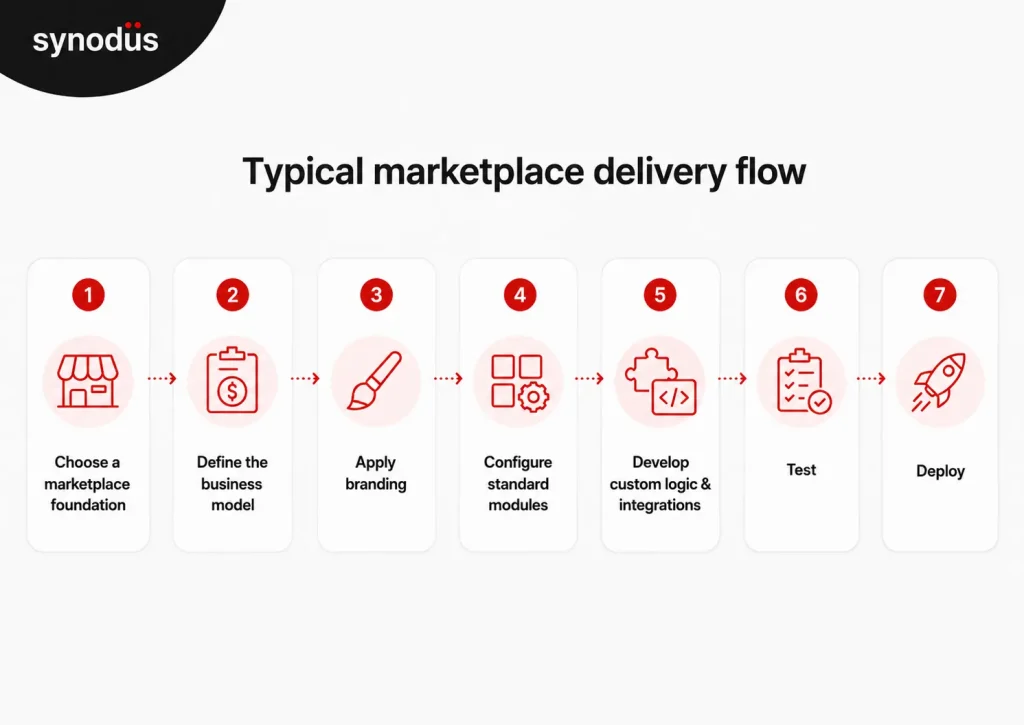
A white label NFT marketplace is a reusable marketplace foundation that another business can launch under its own brand. Instead of starting with an empty codebase, the project begins with existing marketplace components such as asset listings, trading flows, wallet connectivity, administration tools, and smart contract integrations, then adapts them to the target business.
White label does not mean no-code or zero development. Branding may be straightforward, while custom wallet flows, new blockchains, unusual trading rules, compliance requirements, payment integrations, or industry-specific data can still require substantial product and engineering work.
It is also useful to separate a white label platform from an NFT marketplace clone. A white label foundation is intended to be configured and branded for different clients, while a clone usually tries to reproduce the experience or feature set of an existing marketplace. The two can overlap in marketing language, but they are not the same delivery model.
Typical flow:
What is pre-built and what still needs development?
Knowing what comes ready and what still requires engineering is the most practical way to evaluate a white label NFT platform. The value comes from reusing components that do not differentiate the business, while reserving engineering effort for the parts that do.
The exact split varies by provider, so the table below should be read as a common pattern rather than a guaranteed package. ND Labs’ current white label marketplace description, for example, lists minting, listings, auctions, offers, wallets, payments, admin tools, smart contract support, multi-chain support, and discovery tools as part of its reusable foundation, while advanced modules can be added separately.
| Area | Open pre-built | Wht may still need development or confluration |
|---|---|---|
| Marketplace UI | Core storefront, collection, asset, profile, and trading screens | Brand-specific UX, custom journeys, new page types, design system changes |
| Listings and sales | Fixed-price listings, offers, auctions, order management | Custom sale mechanics, eligibility rules, bundles, gated trading, industry-specific flows |
| Wallet and account layer | Common wallet connectors and sign-in flows | Embedded wallets, custody model, account abstraction, game or enterprise identity integration |
| Smart contracts | Standard NFT and marketplace contract integrations | Custom fee logic, asset logic, settlement rules, upgrade model, bespoke contracts |
| Search and discovery | Collection browsing, basic search, filters, sorting | Domain-specific metadata, advanced search, recommendations, custom ranking |
| Admin | User, listing, collection, fee, and marketplace management | Custom roles, approval workflows, moderation, operational dashboards |
| Payments | Crypto settlement and selected payment connectors | Fiat on-ramp, local payment rails, treasury flows, accounting integration |
| Blockchain support | A defined set of supported networks | Additional chain integrations, bridging, chain-specific contract work |
| Compliance | Sometimes identity or KYC connectors | Jurisdiction-specific KYC/AML, investor eligibility, reporting, legal workflows |
| Analytics | Basic marketplace activity and sales views | Business-specific KPIs, BI integration, cohort or seller analytics |
The more your requirements stay inside the provider’s standard model, the more time a white label foundation can save. Once the project requires many new contracts, unusual trading mechanics, deep integrations, or a completely redesigned product flow, the implementation begins to resemble custom development even if it still starts from reusable code.
Before deciding on a white label route, it helps to have a clear feature set for your marketplace type so you can map your requirements against what each provider’s standard foundation actually covers.
Top white label NFT marketplace solutions and development providers
The providers below represent different ways to launch a white-label NFT marketplace. Some offer productized marketplace infrastructure, while others provide development services that combine reusable blockchain components with project-specific customization. We compare them by delivery model rather than treating every provider as the same type of white-label solution.
| Provider/solution | Best for | Delivery model | What stands out |
|---|---|---|---|
| RaribleX | L1/L2 ecosystems, consumer brands, Web3 communities | Productized marketplace infrastructure with self-serve and enterprise options | Branded storefronts, custom fees, custom domain, marketplace insights, integrations, shared or private liquidity |
| ND Labs | Businesses wanting a configurable marketplace foundation with modular add-ons | Ready-made platform plus customization and development services | Broad core module set, multi-chain support, fiat/KYC add-ons, custom royalty and seller logic |
| PixelPlex | Projects that expect significant custom engineering around a white label base | Service-led white label marketplace development | End-to-end customization, smart contracts, infrastructure integration, design, QA, deployment |
| Synodus | Businesses needing a heavily customized marketplace around existing blockchain capabilities | Service-led NFT marketplace development / white-label delivery | Gaming and RWA marketplace delivery, custom smart contracts, blockchain-to-game integration, real estate tokenization |
| SoluLab | Businesses seeking a service-led white label rollout with implementation support | White label development service with configurable marketplace features | Branding, on-premise deployment support, integrations, multi-chain positioning, audit-related services |
| INORU | Buyers who want packaged marketplace tiers and visible starting configurations | Pre-built white label solution plus customization services | Published standard/advanced packages, multi-chain options, wallet, auction, admin, fiat and API add-ons |
RaribleX
RaribleX is one of the clearest examples of a productized white label marketplace rather than a general NFT development service. Its current offering targets L1s, L2s, consumer brands, Web3 ecosystems, creators, and other organizations that want a branded onchain storefront without building the marketplace layer from zero.
The platform supports branded front-end design, custom domains, marketplace fees, primary drops, marketplace insights, integrations, and dedicated enterprise support. Its secondary-marketplace product also emphasizes discovery, wallet flexibility, and the ability to aggregate liquidity from other marketplaces on supported networks.
RaribleX is especially relevant when the marketplace itself is not the core differentiating technology. A chain or brand can use existing marketplace infrastructure while focusing internal resources on the ecosystem, community, products, or assets that make the marketplace worth using.
ND Labs
ND Labs positions its offering as a ready-made marketplace foundation that can be configured around a client’s business model. The current public product page lists branding, minting, listings, auctions, offers, multi-seller support, wallet integration, crypto and fiat payment options, admin tooling, smart contract support, multi-chain support, and discovery features.
Its approach is modular rather than purely template-based. Additional options include KYC/AML integrations, fiat on/off-ramp, custom royalty logic, lazy minting, token-gated access, rewards, analytics, mobile apps, and other extensions, so it fits buyers who want to reuse a broad marketplace core while still customizing important business rules.
The trade-off to verify during procurement is where configuration ends and custom development begins. Buyers should ask which modules are part of the standard license, which require new engineering, and what happens to ownership and maintenance of any client-specific additions.
PixelPlex
PixelPlex approaches white label NFT marketplace development more as a full-cycle engineering engagement. Its service covers planning, architecture, marketplace development, branding, smart contracts, integrations, QA, deployment, and ongoing support.
PixelPlex is a stronger fit for teams that want to start from reusable marketplace knowledge or components but expect meaningful custom work around the final product. Its public case studies also show experience with specialized NFT products rather than only generic art-marketplace templates.
For buyers, the key question is how much of the proposed solution is genuinely reusable and how much will be built specifically for the project. That distinction affects timeline, cost, maintainability, and whether the engagement behaves like a white label rollout or a custom build with some reusable components.
Synodus
Synodus is better positioned as a development partner than an off-the-shelf white-label marketplace vendor. Its blockchain services include custom NFT marketplace development, allowing businesses to tailor marketplace functionality, smart contracts, integrations, and the wider product experience around their requirements.
The company also has documented experience delivering a white-label cryptocurrency exchange, where an existing trading foundation was customized around the client’s branding and operating requirements. While this is not an NFT marketplace case, it provides relevant evidence of Synodus working with a reusable white-label blockchain platform rather than only building products from scratch.
For businesses comparing white-label NFT marketplace development companies, Synodus is more relevant when the project requires significant customization around a reusable foundation, rather than when the goal is to purchase a standardized marketplace package with fixed modules and pricing.
SoluLab
SoluLab offers a service-led white label NFT marketplace model with multi-chain positioning and customization for different asset categories. Its current page highlights branding, on-premise deployment support, minting, royalty options, support-system integration, smart contract audit reports, wallet integration, and broader marketplace implementation.
This model suits businesses that want a provider to handle more of the implementation rather than operating a self-serve product. Because the service can include both standard modules and project-specific work, scope definition is particularly important before comparing a SoluLab proposal with a more productized white label platform.
Buyers should also separate provider marketing claims from contractual deliverables. Features such as supported chains, audit scope, infrastructure ownership, maintenance, and support levels should be confirmed in the proposal rather than inferred from a general service page.
INORU
INORU markets a pre-built white label NFT marketplace with configurable modules such as minting, multi-chain compatibility, wallet support, auctions, royalties, lazy minting, fiat support, admin analytics, and API integrations. It also publishes standard and advanced marketplace packages, which makes it easier for buyers to see how a provider can productize a baseline configuration.
The useful part of this model is pricing and scope visibility at the starting point. The limitation is that packaged features do not tell you whether the platform fits your long-term architecture, so source-code access, smart contract ownership, upgrade responsibility, supported infrastructure, and the cost of non-standard integrations still need separate review.
How much can a white label NFT marketplace be customized?
White label is not one standardized level of customization. Two vendors can both use the term while offering very different amounts of control over the interface, business rules, smart contracts, infrastructure, and source code.
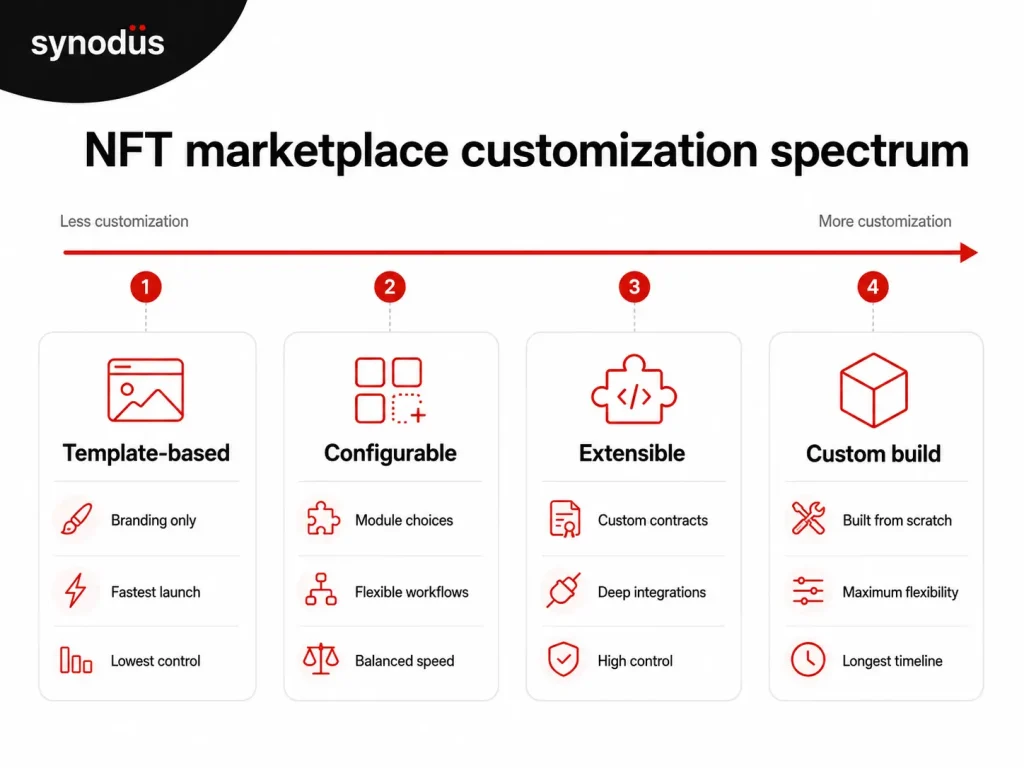
A more useful way to compare solutions is to place them on a customization spectrum. The labels below describe the delivery model, not formal industry categories.
Template-based
A template-based marketplace keeps most product behavior fixed and focuses customization on branding and basic configuration. Typical changes include the logo, colors, domain, navigation labels, supported collections, fees, and other settings already exposed by the platform.
The fastest model when the business is comfortable with standard marketplace mechanics. It becomes restrictive when competitive differentiation depends on custom trading rules, proprietary data, unusual user roles, or deep third-party integrations.
Configurable
A configurable solution exposes more product choices without requiring the entire marketplace to be rebuilt. Businesses may be able to choose modules, sale types, supported networks, wallet connectors, fee rules, royalty logic, payment providers, KYC integrations, and selected workflow variations.
This model fits many MVP and mid-complexity marketplace projects because the business can change meaningful behavior while still reusing a large core. The main procurement task is to understand which options are truly configurable and which require custom engineering.
Extensible white label foundation
An extensible foundation reuses the marketplace core but allows substantial client-specific engineering on top. The provider may redesign the UX, add custom smart contracts, connect proprietary systems, build new data models, or introduce workflows that are not part of the standard product.
More flexibility comes with a trade-off: the time and cost advantage of white label decreases as customization increases. At some point, a business should compare the cost of extending the foundation with the cost and long-term control of a custom marketplace.
White label vs custom NFT marketplace development
The decision is less about which approach is objectively better and more about how much of your product can reuse an existing marketplace model. White label works best when standard marketplace infrastructure covers most requirements; custom development becomes more attractive as unique business logic becomes central to the product.
| Decision factor | White label NFT marketplace | Custom NFT marketplace |
|---|---|---|
| Starting point | Existing marketplace foundation | Business-specific requirements and architecture |
| Time to launch | Usually faster when customization stays near the standard product | Usually longer because more components are designed and built for the project |
| Initial engineering effort | Lower for reusable modules | Higher because core marketplace capabilities are built or assembled for the project |
| Customization | Limited by the underlying platform and extension model | Broader control over UX, business logic, contracts, data, and infrastructure |
| Unique trading logic | Possible if the platform is extensible, but may become expensive | Can be designed as a first-class part of the architecture |
| Source code and IP | Depends on license and vendor agreement | Typically easier to negotiate for project-specific ownership |
| Vendor dependency | Can be significant if updates and infrastructure remain provider-controlled | Depends on architecture, documentation, deployment, and engagement model |
| Best fit | Standard or moderately differentiated marketplaces | Products where differentiation depends on custom workflows, contracts, compliance, or integrations |
A white label option can be a poor choice even when it is cheaper at the start. If the roadmap already requires major contract changes, several proprietary integrations, strict infrastructure control, and a substantially different user journey, forcing those requirements into an existing foundation can create more complexity than it removes.
For a deeper breakdown of how development approach affects scope and cost, see our guide to building an NFT marketplace.
When does a white label NFT marketplace make sense?
A white label marketplace is most useful when the business problem is not to invent a new trading engine, but to launch a branded marketplace around a known transaction model. In that situation, reusing the marketplace foundation lets the team spend more effort on the asset supply, users, distribution, partnerships, community, and integrations that actually differentiate the business.
A white label approach is usually a good fit when
- Most requirements map to standard marketplace mechanics such as listings, offers, auctions, wallets, collections, fees, and admin workflows.
- Faster market validation matters more than owning every component from day one.
- The internal team has limited blockchain engineering capacity or does not want to maintain the marketplace core.
- Differentiation comes mainly from brand, assets, community, data, or business integrations rather than a unique trading protocol.
- The provider’s supported chains, wallet model, security approach, and deployment model already match the target product.
In these cases, white label can reduce duplicated engineering effort without materially constraining the product. The business still needs technical due diligence, but it is evaluating a foundation rather than designing every layer from scratch.
Consider custom development when
- The marketplace uses unusual trading, settlement, custody, or revenue logic.
- Compliance or investor eligibility requires complex jurisdiction-specific workflows.
- Custom smart contracts are a core source of differentiation.
- The platform must integrate deeply with proprietary systems, game infrastructure, enterprise data, or existing financial workflows.
- The business requires strict control over source code, infrastructure, admin keys, upgradeability, or deployment.
- The expected customization would replace large parts of the white label foundation anyway.
The decision should be made against the product roadmap, not just the launch version. A solution that is convenient for an MVP can become expensive to extend if the next stages require capabilities that the provider’s architecture was not designed to support.
How to choose a white label NFT marketplace development company
A provider comparison should go beyond feature checklists. Many vendors can show the same words on a landing page, but the commercial and technical terms behind those features determine whether the marketplace remains flexible after launch.
Understand what you actually own
Ask for a clear ownership matrix covering source code, custom modules, smart contracts, deployment configuration, marketplace data, analytics data, admin access, domains, and intellectual property. A branded marketplace can still leave the client highly dependent on the provider if critical components remain inaccessible.
Source-code ownership does not always need to mean full source-code transfer, but the commercial model should match your risk tolerance. If the provider hosts the core platform, confirm export options, termination terms, and what happens to client data and custom work if the relationship ends.
Check customization limits
Request examples of changes that are configuration, paid extensions, and full custom development. A common procurement mistake is comparing one vendor’s standard package with another vendor’s custom proposal as if they were equivalent.
A useful test is to take the three most differentiated requirements in your roadmap and ask the provider to explain exactly how each would be implemented. The answer usually reveals whether the platform is a strong fit or whether the project will spend most of its budget working around the foundation.
Review smart contract ownership and upgradeability
Confirm who deploys the contracts, who controls administrator or upgrade keys, whether contracts are upgradeable, and who is responsible for changes after launch. If marketplace fees, royalties, settlement rules, or asset behavior depend on custom contracts, these details directly affect operational control.
Also ask what has already been audited and what needs to be reviewed again after customization. An audit of the standard contract set does not automatically cover newly added logic or a different deployment configuration.
Verify supported chains and wallet architecture
Do not choose a provider because its website shows a long list of chain logos. Verify support for the exact network, token standard, wallet model, gas strategy, and transaction flow your target users need.
For mainstream users, embedded wallets or account abstraction may matter more than supporting several external wallets. For crypto-native audiences, direct wallet control, multi-chain access, and interoperability may be more important.
Evaluate security and audit responsibility
White label does not guarantee security. Review the provider’s development practices, dependency management, access controls, infrastructure hardening, smart contract review process, incident handling, and responsibility for post-launch patches.
Security scope should also follow customization scope. The more code or contract logic changes, the less useful it is to rely on the security status of the original baseline without reviewing the modified implementation.
Check integration capability
Map every external dependency before signing: payment providers, fiat on-ramp, KYC/AML, analytics, CRM, game backend, storage, notification services, custody, tax reporting, or enterprise identity. An integration that is technically possible may still require significant custom work if the platform has no existing adapter or API surface for it.
RWA, gaming, and enterprise marketplaces in particular need this check, since the blockchain transaction may be only one part of a larger operational workflow.
Understand licensing and ongoing fees
Ask whether pricing is based on a one-time license, setup fee, subscription, transaction share, infrastructure usage, maintenance retainer, or a combination of these. A low initial implementation quote can still produce a higher total cost of ownership if core modules, support, or transaction volume carry recurring charges.
Also check whether upgrades are included, whether the business can delay them, and whether custom modules remain compatible with future platform versions.
Review post-launch support
The marketplace will continue to depend on wallets, chains, RPC providers, third-party APIs, libraries, and security updates after launch. Confirm who monitors these dependencies, how incidents are handled, what support hours apply, and how quickly critical fixes can be deployed.
For a long-lived product, post-launch responsibility can matter as much as the initial feature set. A provider that offers a strong launch package but weak operational support may shift maintenance risk back to the client.
White label NFT marketplace cost and timeline
There is no reliable universal price or launch timeline for a white label NFT marketplace because vendors package the product differently. The cost depends on licensing, customization, supported networks, smart contract changes, wallet and account architecture, payments, KYC, integrations, infrastructure, security review, and ongoing support.
Current public pricing shows how wide the delivery models can be. RaribleX’s pricing page lists a free self-serve marketplace option for a simpler setup and a branded enterprise tier with custom design, integrations, insights, and product improvements. ND Labs states that its basic white label setup starts from $10,000 and that selected configurations can launch in as little as two weeks, while INORU publishes standard and advanced packages at $15,000 and $25,000 respectively.
These figures are vendor-specific offers, not a market average. A project that stays close to a standard template can be priced very differently from one that adds custom contracts, new chains, fiat payments, compliance flows, bespoke UX, and proprietary integrations.
A better budget process is to separate the standard foundation from the extension scope. Price the license or baseline implementation first, then estimate custom modules, integrations, security work, deployment, and recurring support so the team can compare total ownership cost with a custom build on the same assumptions.
For a broader breakdown of NFT marketplace budgets and cost drivers, see our NFT marketplace development cost guide.
Final thoughts
A white label NFT marketplace is most valuable when the reusable foundation already covers most of the product you need. In that case, the business can avoid rebuilding standard marketplace infrastructure and focus resources on the assets, users, integrations, and operating model that create differentiation.
The more your roadmap depends on unique trading logic, compliance workflows, proprietary systems, custom contracts, or strict ownership requirements, the more carefully white label should be compared with custom development. If you are evaluating that trade-off, Synodus’ blockchain development team can help assess product scope, architecture, and the level of customization required before implementation.
FAQ
Not necessarily. A white label platform is designed to be reused and configured for multiple businesses, while a clone generally aims to reproduce the appearance or functionality of an existing marketplace. A provider may market both approaches, so the underlying code, licensing, and customization model should be checked.
Customization depends on the platform. Some solutions mainly support branding and configuration, while extensible foundations can add custom smart contracts, workflows, integrations, data models, and UX. The more the project departs from the standard product, the closer the engagement becomes to custom development.
Many providers advertise multi-chain support, but support should be verified for the exact network and transaction model you need. Adding a new chain may require contract work, wallet changes, indexing changes, infrastructure, testing, and security review even when the platform is already multi-chain.
A standard configuration can launch much faster than a heavily customized platform, but there is no universal timeline. Branding and basic configuration may be quick, while custom contracts, new chains, KYC, fiat payments, complex integrations, and security work can add weeks or months.
White label is a delivery model, not a security guarantee. Security depends on the codebase, contracts, deployment, configuration, infrastructure, third-party integrations, access controls, review process, and how changes are maintained after launch.