Key takeaway
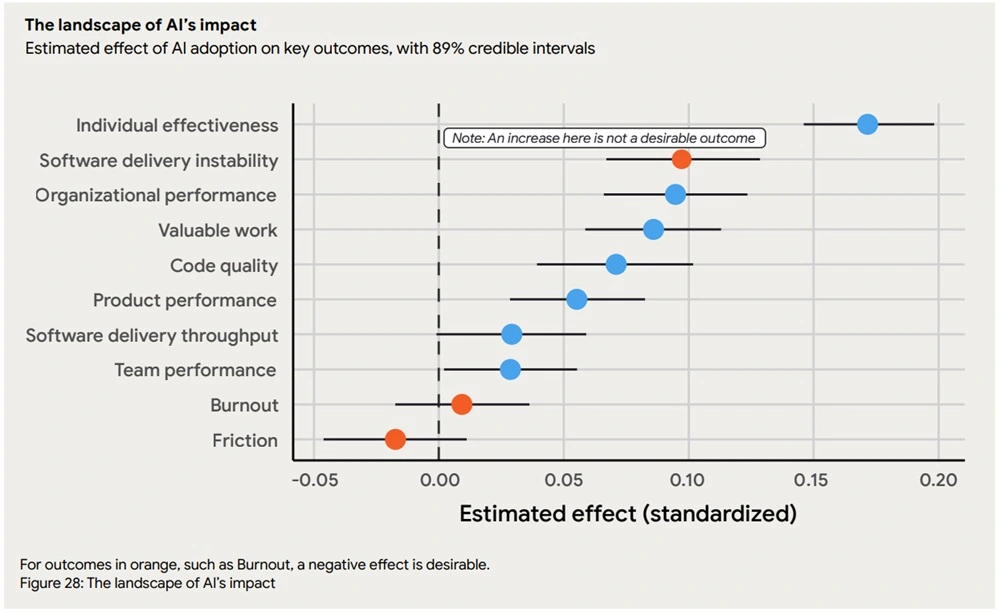
- Gartner predicts that by 2028, 90% of enterprise software engineers will use AI coding assistants, up from less than 14% in early 2024. The developer’s role is shifting from writing code to solving business problems and making architectural decisions
- Organizations that adopt product-centric delivery report measurable improvements across eight business dimensions including accelerated feature delivery, higher quality, and closer alignment between IT and business goals (Gartner, 2018)
- Senior technology leaders agree measuring developer productivity by lines of code or completed tasks is the wrong approach. Real productivity is measured by the value a team delivers to the market
- 65% of organizations fail to achieve stated IT outsourcing goals. The most cited reasons are lack of clear goals (41%), wrong tools (45%), and lack of expertise (53%) (Fujifilm / Deloitte research)
- Fixed-price contracts structurally prevent product mindset from taking hold. Dedicated team and time-and-materials models are required to support the flexibility that product development demands
The problem that keeps repeating
A VP of Engineering described this pattern clearly in a recent industry discussion:
“Business outcomes are what matter most, but those outcomes will depend as much on the strategy and design of the software as they do on the productivity of the developers.”
That observation points directly to the core problem with traditional IT outsourcing. When a vendor’s responsibility ends at delivery, they have no stake in whether the strategy and design were right. Their incentive is to finish the work, not to ensure the work produces results.
A CTO in banking put the measurement problem in equally direct terms:
“One of the biggest misconceptions is measuring the worker rather than measuring the work. It’s more important to think about outcomes and values. While capturing this can be complex, shifting the mindset towards outcomes is crucial.”
These are practitioners describing the gap between what the outsourcing model currently rewards, such as completed tasks, delivered code, and what the business needs: software that works for users and improves over time.
Why AI makes this gap impossible to ignore
The shift from project thinking to product thinking has been necessary for years. AI has made it urgent.
Gartner’s analysis of strategic trends in software engineering states that AI is now embedded into every phase of the development lifecycle from design to deployment. By 2028, 90% of enterprise software engineers will use AI code assistants, up from less than 14% in early 2024.
The implication is specific: if an IT outsourcing team’s primary value is writing standard code according to clear instructions, they are now competing directly with AI tools that do this faster and at lower cost. A development team that operates with a project mindset (receive instructions, write code, deliver) is operating in the part of the market that AI is absorbing most quickly.
The part of the market AI cannot absorb is the part that requires genuine understanding of the business, the user, and the long-term consequences of each technical decision. A VP of Engineering described exactly this distinction:
“There’s no common understanding of productivity, and it’s often about hours of output and lines of code. Another misconception is thinking tools like GitHub Copilot can improve productivity by a certain percentage without considering the overall outcome. This is a significant gap that needs to be addressed.”
The gap he is describing is the gap between project thinking and product thinking.
Project mindset vs. Product mindset: what each one produces
These two approaches are not different at the speed of the same process. They produce structurally different outcomes.
Project mindset in practice:
- The vendor focuses on completing the defined scope within the agreed time
- Engineers ask, “what do I need to build?”, not “why does this need to be built?”
- Technical decisions are optimized for delivery speed rather than long-term maintainability
- After delivery, accumulated technical debt makes future updates expensive
- The business must write increasingly detailed requirements because the vendor does not carry knowledge of the product between engagements
Product mindset in practice:
- The team treats the software as something they are responsible for, not something they are building for someone else
- Engineers ask why before they code if a requested feature does not serve the user’s actual need, they raise it
- Technical decisions account for scalability, maintainability, and how the system will need to evolve
- After release, the team monitors performance data, user feedback, and errors as inputs to the next cycle of improvement
- Knowledge accumulates inside the team, reducing the overhead required to maintain and extend the product
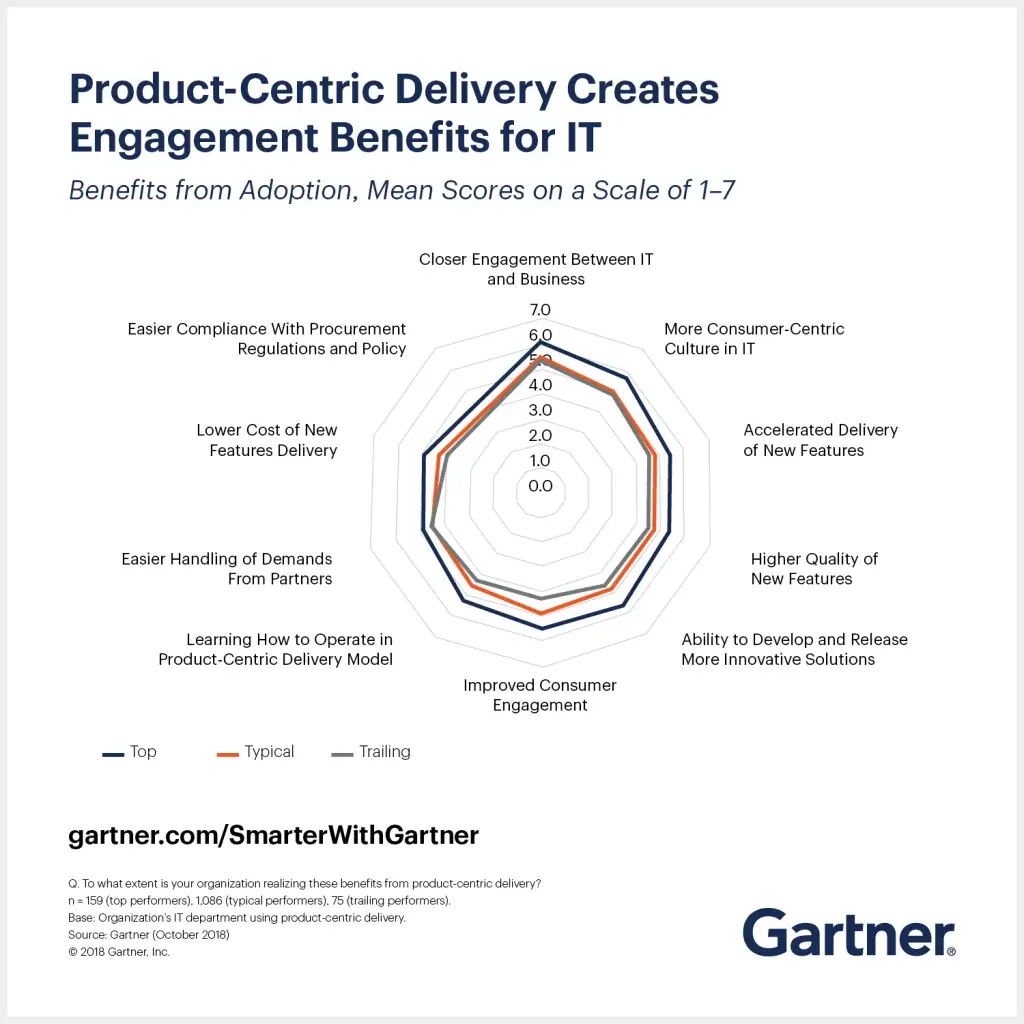
Gartner’s research on product-centric IT delivery quantifies what this difference produces in practice. Organizations that have adopted product-centric delivery report measurable benefits across eight dimensions: closer alignment between IT and business teams, stronger consumer-centric culture, accelerated delivery of new features, higher feature quality, greater ability to develop innovative solutions, improved consumer engagement, easier handling of partner demands, and lower cost of new feature delivery. Top-performing organizations score consistently higher across all eight dimensions than typical or trailing performers.
The shift is not philosophical. It has documented business outcomes.
Where the current model breaks down
The Fujifilm research on IT outsourcing pitfalls documents what happens when organizations outsource without making this mindset shift.
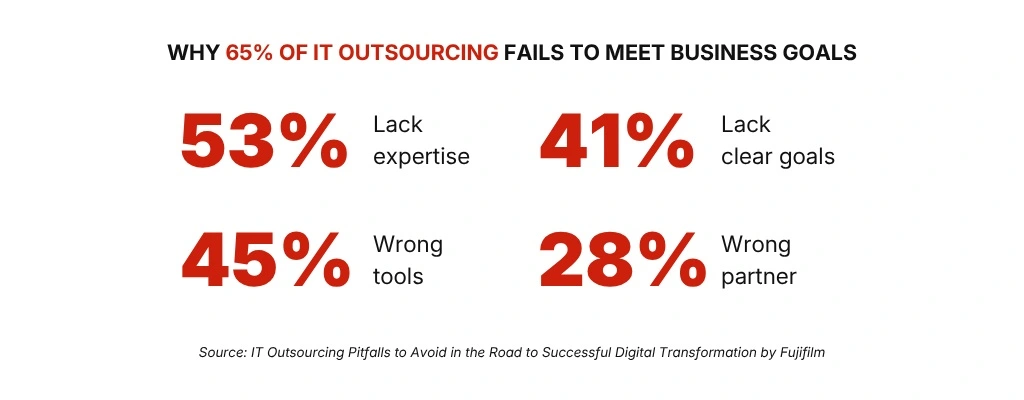
What the research makes clear is that these are not independent problems. An outsourcing partner operating with a project mindset will not help a client define clear goals – that is outside their contract. They will not flag when tools are wrong for the context – that is outside their scope. They will not bring the domain expertise required to navigate regulatory or architectural constraints – that is someone else’s responsibility.
A vendor with a product mindset behaves differently at each of these points. They define success criteria before development begins. They challenge tools and technology choices when the context requires it. They carry the domain knowledge that prevents the same problems from recurring across engagements.
What this looks like in practice: a two-year digital transformation
The clearest way to show the difference between a project vendor and a product partner is to look at how an engagement evolves over time.
Our client manages one of Singapore’s most iconic nature destinations, operating at the scale of millions of visitors annually. When they came to Synodus, they were not asking for a new mobile app. They were asking us to rebuild the entire digital backbone of a multi-park operation that was actively costing them revenue.
The problem was not a single broken system. It was three connected failures that could only be solved together.
High-volume fragmentation: Each park ran on its own separate ticketing infrastructure. During peak periods like school holidays and public events, the legacy systems could not handle the surge in concurrent users, producing system lag and abandoned transactions at exactly the moment when revenue was highest.
The logic gap: Managing cross-park ticket bundles and memberships requires manual configuration in the old system. Every promotional change required developer intervention. The marketing team could not respond to market opportunities without queuing work through engineering, which meant every campaign took longer and cost more than it should.
Zero tolerance for downtime: This was a revenue-critical system for a national attraction. Any migration had to be executed without interrupting daily park operations. There was no acceptable window for service disruption.
We committed a dedicated team of seven (one Scrum Master, one PM, one DevOps engineer, two backend engineers, one mobile engineer, and one QC) to a partnership of over two years. We did not scope a project and deliver it. We treated the full operational environment as the problem we were responsible for solving.
What we built:
- A unified booking engine consolidated multi-park ticketing, bundling, and add-ons into a single transaction flow – replacing the fragmented systems that required separate management across parks.
- A dynamic rule engine gave the marketing team direct control over promotional configuration through a dashboard. Complex seasonal promotions, membership rules, and cross-park bundles can now be set up and launched without any developer involvement.
- A cross-platform application built in React Native delivers consistent performance and fast physical check-ins at the park gates across all visitor devices.
- A cloud-native architecture on AWS using EKS, ECS, and Lambda gives the platform auto-elasticity — it expands computing capacity instantly during traffic spikes and scales down when demand drops. The system is always fast and never carries unnecessary costs.
The outcomes:
The marketing team is now fully independent from engineering campaign configuration, reducing their time-to-market from day to hour. The system handles high-traffic events with consistent uptime and dramatically reduced defect leakage. The simplified booking journey produced higher transaction success rates and faster physical entry at the gates.
What happened after delivery is where the product mindset becomes visible:
Two years in, we are not winding down the engagement. We are deepening it. The next phase of work includes a dynamic pricing engine to implement demand-driven pricing across park offerings, AI-driven personalization for behavior-based cross-selling, and a smart crowd control system using heatmaps to optimize visitor flow across the reserve.
This is what product ownership looks like in practice. The relationship did not end when the system was delivered. The system we built became the foundation for capabilities the client could not have pursued with their previous infrastructure. Each phase of work opens the next one.
A vendor operating with a project mindset delivers the system and closes the contract. A product partner uses the delivered system as the starting point for what the business can do next.
How contract structure determines which mindset you get
The contract model you use with an outsourcing vendor is not a procurement detail. It determines which mindset the vendor is structurally incentivized to bring.
A fixed-price contract creates a project mindset by design. When the scope is fixed and the price is fixed, the vendor’s interest is to deliver the agreed scope as efficiently as possible. Any change to requirements represents a risk to their margin. They will minimize scope changes, not embrace them. The software that results reflects what the business thought it needed at the start of the contract, not what the business discovered it needed as development progressed.
To work with a team that carries a product mindset, the contract structure must accommodate how products actually evolve.
Dedicated team model: A fixed team of mid-level and senior engineers works exclusively on your product for ongoing engagement. You direct the daily priorities. The team accumulates deep knowledge of your product, your users, and your technical environment over time. This model is appropriate when requirements will naturally change as the product develops, which is true of most enterprise software.
Time and materials model: You pay for the actual time and resources used, with no fixed scope. This model gives the team freedom to respond to what users and data reveal during development rather than executing a plan that was made before any user feedback existed. It is the appropriate structure when detailed technical requirements do not yet exist at the start of the engagement.
Neither model removes the need for clear objectives and governance. What they remove is the structural incentive for the vendor to resist change.
What to look for when evaluating an IT partner
The shift from project to product mindset is not something a vendor can claim in a proposal. It is visible in how they work.
They ask why before they build: A team with a product mindset wants to understand the business goal behind a feature request. If the feature as described will not achieve that goal, they say so before the work begins. A team with a project mindset asks for more detailed specifications.
They track outcomes after delivery: A team with product mindset monitors what happens when the software reaches real users (adoption rates, performance data, error frequency) and treats that data as input to the next cycle. A team with project mindset considers the engagement complete at handover.
They staff senior engineers on your product: An SVP of Technology in insurance described the structural problem with treating all engineers as interchangeable: senior engineers spend their time on architecture and mentoring, not on output volume. A vendor who allocates junior engineers to your product and senior engineers to sales is not building product ownership into your engagement. Verify who specifically will work on your product, not the vendor’s overall team composition.
Their case studies describe business outcomes, not technical deliverables: The difference between “we built a cloud-native booking platform” and “the marketing team became independent from engineering, and the system handled peak traffic without delays” is the difference between a project vendor and a product partner.
The practical shift
In the AI era, the ability to write code to specification is no longer a premium service. AI tools perform this function faster and at lower cost with every product cycle.
The capability that remains genuinely scarce is the ability to understand what needs to be built, why it matters to the user, and how to make technical decisions that hold up over time. These are product capabilities, not project capabilities.
Organizations that continue purchasing development as a project service (defined scope, fixed price, complete and hand over) will keep producing software that works as specified and fails in practice. The pattern is well documented, and the cost of rebuilding is consistently higher than the cost of building correctly from the start.
The organizations that avoid this outcome make one different decision: they choose partners who take responsibility for outcomes, not just delivery. That is what a product mindset requires an IT outsourcing relationship, and it is the standard by which engineering partners should now be evaluated.
Synodus works with enterprise companies in banking, healthcare, retail, and the public sector as a long-term engineering partner, not a project vendor. If you are evaluating how to structure your next IT outsourcing engagement around product outcomes rather than project delivery, visit synodus.com.