When it comes to AI in software development, there is a massive gap between what executives expect and what engineering teams actually experience.
Leadership teams read industry reports and expect faster releases. However, engineering teams face a different reality. The 2026 data is clear. AI tools help developers generate code faster, but actual software release cycles are slowing down.
According to the 2025 DORA Report, higher AI adoption is currently associated with an increase in software delivery instability. Why does this happen? The core constraint in software development did not disappear. It shifted from writing code to verifying code.
For engineering leaders, the hype cycle creates a real operational problem. You do not need broad predictions. You need a delivery pipeline that actually works under the pressure of AI generated volume.
In this article, our Synodus engineering leadership team shares exactly how we encountered this problem directly. We identified the root causes and built a structured framework to address it across the full delivery pipeline.
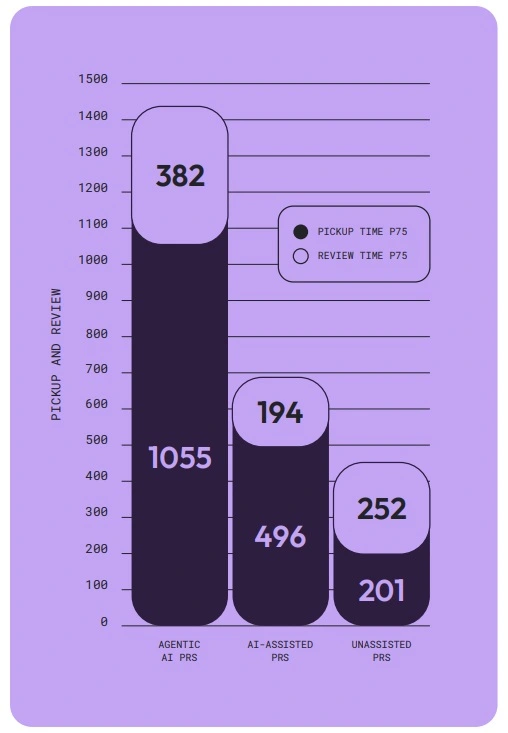
The reality: faster coding, slower releases
When our team first applied AI to the development process, we saw a sudden surge in output. But we also saw the immediate consequences on our senior engineers.
“The volume of Pull Requests (PRs) and the number of files inside each PR increased by two to three times,” explains Hiep Tran, Technical Lead. “The problem is that AI-generated code often looks perfectly logical. It compiles correctly. But because the AI lacks deeper system context, it invents its own logic. This leads to hidden, structural errors.”
This is the core issue that traditional Agile methodologies are failing to handle. Reading and verifying machine-generated code requires immense cognitive effort. A human reviewer cannot easily reverse-engineer why an AI made a specific architectural decision. Giving developers AI tools without changing the pipeline around them does not accelerate delivery. It moves the delay downstream to where it is harder to detect and more expensive to fix.
The Synodus AI-verified delivery framework
To solve this, we realized we could not just change how we write code. We had to change the system.
We built the AI-verified delivery framework. This framework forces engineering teams to stop relying on end-of-pipeline testing. Instead, it breaks the delivery process into three strict operational layers: machine-readable input, autonomous gatekeeping, and business logic auditing.
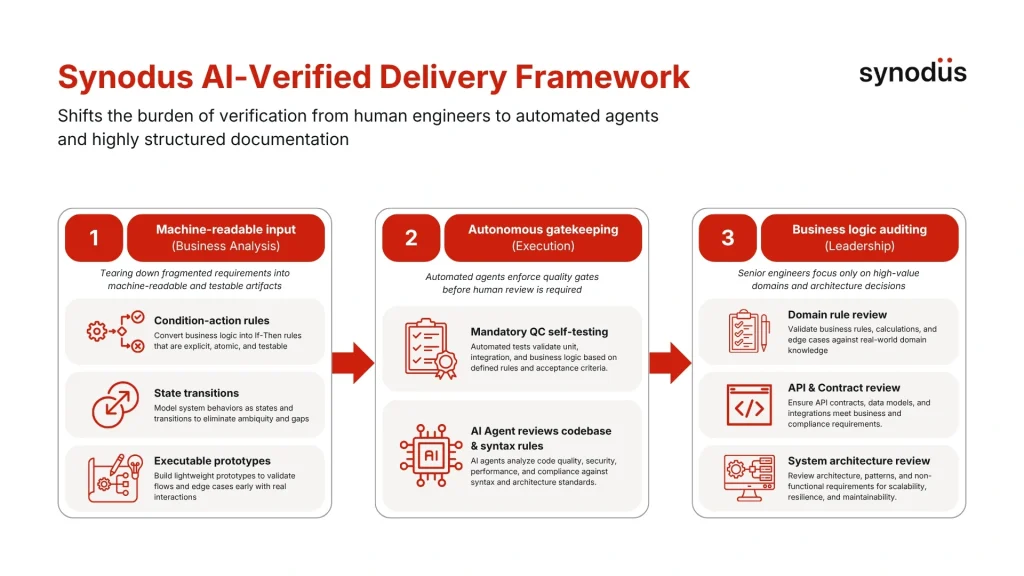
Here is a deep dive into how we apply this framework in practice, and why it is the only way to scale AI effectively.
Layer 1: Machine-readable input (Business Analysis)
The most common assumption about bad AI code is that the AI is the problem. In practice, bad AI code usually starts with bad requirements.
In a traditional pipeline, business rules are often scattered. The user flow is in a slide deck, the business rule is in a meeting note, the API endpoint is in Jira, and the exception case is in a chat message. A human developer can connect these fragmented pieces to write the correct logic. An AI cannot. If the input is unstructured, the AI will guess the missing information.
“If a requirement is vague, the AI will scale that vagueness with incredible speed,” says Nguyet Nguyen, BA Lead. “We had to look at our entire Business Analysis process. AI does not reduce the role of the BA; it forces the BA to design knowledge structures. Two years ago, we wrote manual documents. Today, our BA team uses AI throughout the lifecycle to generate working prototype code, sequence flows, and exact business rules.”
To prevent the AI from generating incorrect logic, our requirements are now broken down explicitly:
- Clear separation of the “happy path” and the “exception path.”
- Business rules written in strict condition-action formats.
- Clear state transitions and defined sources of truth.
- Strict data mapping traceability from the requirement directly to the API and the database.
Furthermore, we shifted the alignment process. The BA Lead and the Tech Lead must completely align on the domain terminology, API contracts, and exception handling before any coding begins. The AI is only as powerful as the structure it receives.
Layer 2: Autonomous gatekeeping (Execution)
Even with well-structured requirements, generating a massive amount of code still requires review. We could not expect our senior engineers to read three times the normal amount of code every day without causing a severe delay.
We had to build an automated gate. We stopped relying on humans for the first round of review.
Now, before a developer can send a PR for human review at Synodus, they must pass two strict automated checkpoints:
- Mandatory self-testing: Developers are required to run their AI-generated code against exact test cases provided by the Quality Control (QC) team. If the code does not pass the self-test, it cannot be submitted for review. This single requirement eliminates a significant portion of defects before they ever enter the review queue.
- The AI review agent: A dedicated AI agent – configured with the specific rules, architecture patterns, and codebase standards of each project – reviews the code for structural compliance, internal rule violations, and syntax errors before a human sees it.
By forcing developers to use an AI agent to review the code generated by their AI coding tools, we eliminate the tedious work. By the time the code reaches a human reviewer, the basic errors have already been stripped away.
Layer 3: Business logic auditing (Leadership)
With the automated gate handling syntax, structure, and formatting, the Technical Lead’s review function changes entirely.
Human review at Synodus is not about coding quality. It is about three specific concerns that AI cannot evaluate on its own: business logic correctness, security risk, and fit within the broader enterprise architecture.
This strict separation of duties prevents senior developer burnout and fundamentally changes the economics of software delivery.
“This structured pipeline delivers measurable business results,” explains Quan Nguyen, Director of Solutions & Services. “On a recent project, our team completed a full Minimum Viable Product (MVP) including requirement analysis, development, and testing in exactly three weeks. Our actual delivery time decreased by two to three times. More importantly, because we set up strict QC and AI review gates beforehand, the code achieved an 85% to 90% pass rate in the very first round of System Integration Testing (SIT).”
A high first round pass rate means defects are caught at the automated layer. They are not discovered during final testing when the cost to fix them is highest.
What this means for engineering leaders in 2026
In 2026, writing code quickly is no longer a competitive advantage for an IT vendor. It is a basic expectation. Every team with access to AI tools can generate code faster than they could two years ago.
The organizations that will build a durable delivery advantage are the ones that govern AI output with the same discipline they apply to any other production system. That means structured requirements that give AI the context it needs to generate correct logic. It means automated gates that absorb the volume problem before it reaches human reviewers. And it means senior engineers whose judgment is reserved for the decisions that only they can make.
If your team is generating code faster but releases are still stalling, the bottleneck is not the technology. It is the pipeline around it. At Synodus, we document what we learn from building and running these systems across banking, healthcare, retail, and the public sector. The Performance-led AI Log is where that learning becomes public. If you are working through the same delivery challenges, visit HERE.