Key takeaways
- The old plan does not work: Many foreign technology companies lose millions of dollars in Southeast Asia because they use the exact same strategy they use in their home countries.
- Payment methods are completely different: Foreign software that requires a credit card will fail. In Vietnam, QR code payments recently grew by 150%, and most consumers do not use credit cards for daily purchases.
- The laws are now very strict: Under the new Personal Data Protection Law (PDPL), foreign software that sends local data to servers outside of Vietnam faces strict government checks and massive fines.
- Success requires a co-delivery alliance: Global companies must stop trying to sell from 5,000 miles away. They must partner with a local expert, like Synodus, who takes full responsibility for actual software installation and legal safety.
The difference between winning and leaving
In recent years, several major foreign technology companies quietly closed their offices in Vietnam and left. Some of them lasted less than a year. At the exact same time, other global companies continued to grow rapidly and secure large contracts.
Why do some foreign software companies lose money here while others succeed?
The difference is rarely the technology. The difference is how they enter the market. Many foreign companies prepare their software, set their prices, and translate their application into the Vietnamese language. They assume that if their product worked in Europe or the United States, it will naturally work here.
This is the most common mistake in global business. To win in Vietnam today, you cannot just translate your words. You must change the mechanics of your software.
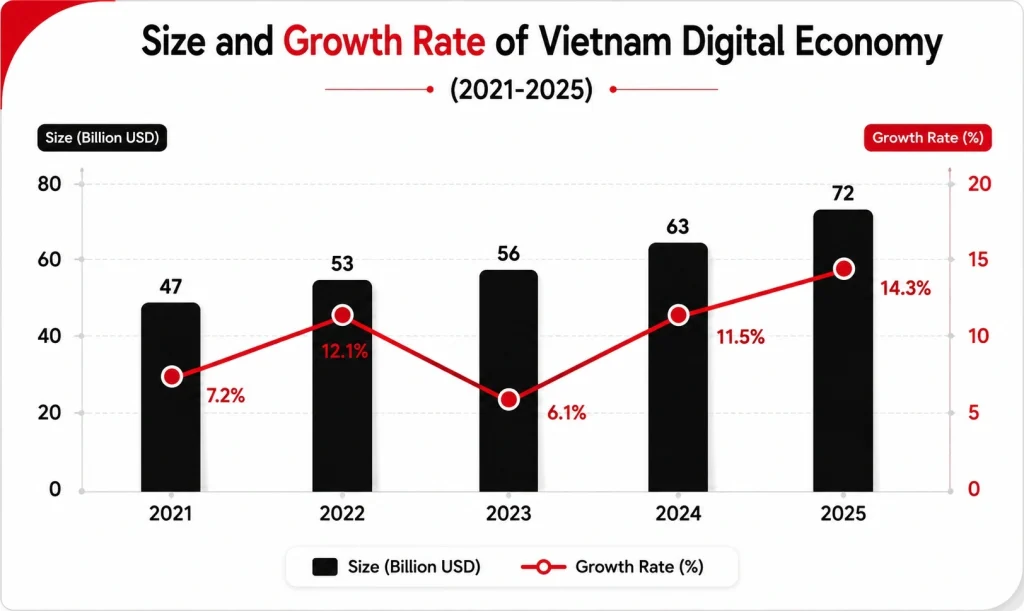
Vietnam is no longer a cheap place to hire coders. As the chart shows, the digital economy has scaled past $72 billion. It is a high-value market with strict data rules and advanced payment habits.
The mechanics of payment failure
When a foreign company launches a mobile application in Vietnam, the software often works perfectly. But when the user tries to buy something, the sales stop completely.
The problem is the checkout screen. Many Western software products ask the user to type in a credit card number. But in Vietnam, most people do not use credit cards for daily purchases. Recent reports from the State Bank of Vietnam show that QR code payments grew by more than 150% in value over the last year. Today, 70% of Vietnamese consumers prefer to use QR codes, digital wallets, or physical cash when their item is delivered.
If your software only accepts credit cards, the Vietnamese user will simply close the application. You make zero money.
To fix this, the foreign company must rewrite their software to connect with local payment systems like MoMo, ZaloPay, or the national VietQR network. This requires deep technical knowledge of local banking systems.
The enterprise spending shift
A few years ago, foreign companies came to Vietnam to find cheap teams of developers to write simple code. Today, reality has completely changed.
The Vietnamese government recently created a National Data Development Fund with $38.4 billion to build local digital systems. Companies are building huge local server centers, including a new $1.5 billion data center in Southern Vietnam and a massive National Data Center by the Ministry of Public Security. Enterprises are spending billions to keep their technology inside the country.
When a foreign company tries to sell a simple software tool to a Vietnamese hospital or bank, they fail. These large buyers do not want simple tools. They want to buy highly secure systems that can safely serve millions of people. They will not buy from a foreign company that only offers a product. They will only buy from a company that has a strong local engineering team ready to build and protect the system locally.
The new legal wall for data and AI
When a European software company sells an artificial intelligence tool to a Vietnamese bank, the software often looks great during the presentation. But when the bank tries to install it, the project is canceled.
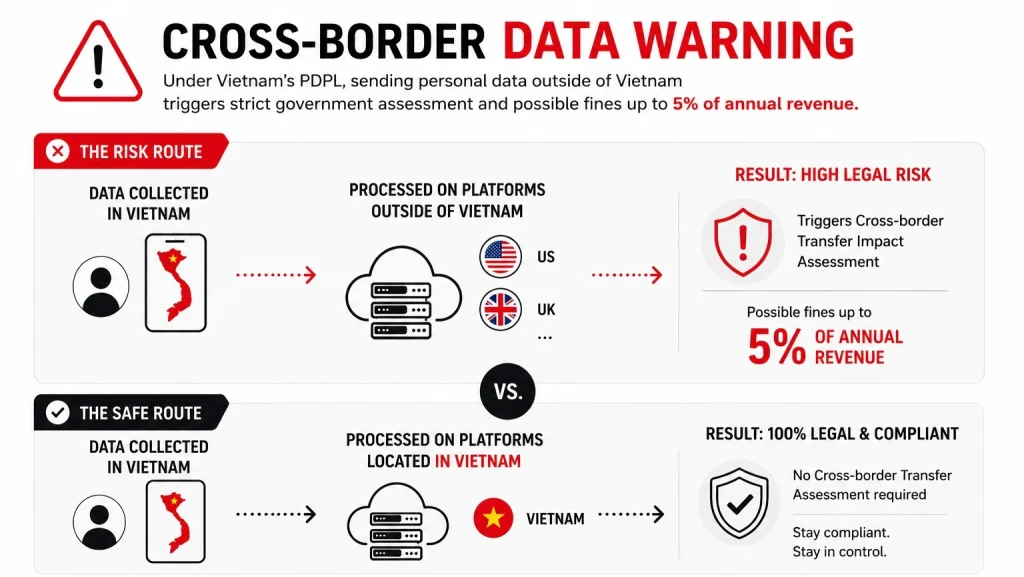
The problem is the data location. On June 26, 2025, Vietnam enacted the Personal Data Protection Law (PDPL). Under this strict law, if your software collects information in Vietnam but processes it on a computer outside of Vietnam, you must pass a Cross-Border Transfer Impact Assessment.
If your system is built to send customer data to a server in London or New York, your project will stop immediately. The government can fine you up to 5% of your total revenue for breaking this rule. Plus, Vietnam started its new Law on Artificial Intelligence on March 1, 2026.
The foreign company must then rewrite their entire software base to keep all data inside Vietnam. This delay costs months of time and destroys the profit of the deal.
The performance divide: outsiders versus insiders
There is a clear separation between the foreign companies that fail in Vietnam and the ones that grow. The companies that fail to act as outsiders. The companies that win do the hard work to become insiders.
If you act as an outsider – a foreign company just looking to sell software from far away – local buyers will give you very polite meetings. They will smile. But they will not buy your enterprise software.
To become an insider, you must prove you are here for the long term. You must respect that local business decisions often happen after the formal presentation is over. You cannot build this trust from 5,000 miles away. You must partner with local leaders who already know the specific market rules and have engineering skills to make your software work legally.
How to choose a local execution partner
When global companies look for a local partner, they often make the mistake of looking for the cheapest hourly rate. If a local programming company only cares about selling you cheap hours, they are just renting your desks. They will not protect your business.
To expand safely, you need a partner who shares the business risk with you. At Synodus, we call this the co-delivery model. We stopped acting like a cheap vendor. We act as your strategic partner.
If you want to guarantee long-term success, you must look for four exact traits in your local partner:
- They invest time to build trust: A signed contract does not create trust. Trust creates the contract. A good partner does not rush to close a deal. They invest time to understand your exact software and how they must change it to fit the local user.
- They provide senior local leaders: You do not just need junior developers who take orders. You need senior human intelligence. You need local experts who are brave enough to tell you the hard truth when your expansion plan is wrong for the market.
- They focus on practical execution: Forget fancy sales presentations. You need a partner focused on what actually works on the ground. A co-delivery partner takes hands-on responsibility to integrate local payment methods and make sure the software remains stable.
- They protect your company from risk: Global enterprises do not just buy software features; they buy risk reduction. Your local partner must handle the complex local data laws, privacy rules, and cybersecurity. They build the local server systems so you do not break the law or fail government audits.
Conclusion
The era of expanding alone is over. A great software product will get you a meeting, but it will not secure a long-term contract in Southeast Asia.
To win in Vietnam, you do not need more cheap coders. You need a strategic alliance. You need a local execution partner who sits at the same table, understands the strict local data laws, and adapts your software to solve actual local problems.
This is exactly how Synodus works with global technology companies. You bring your core software technology. We bring the local data systems, the legal knowledge, and the senior engineering team to actually install it. When we combine your technology with our local execution, we win the market together.