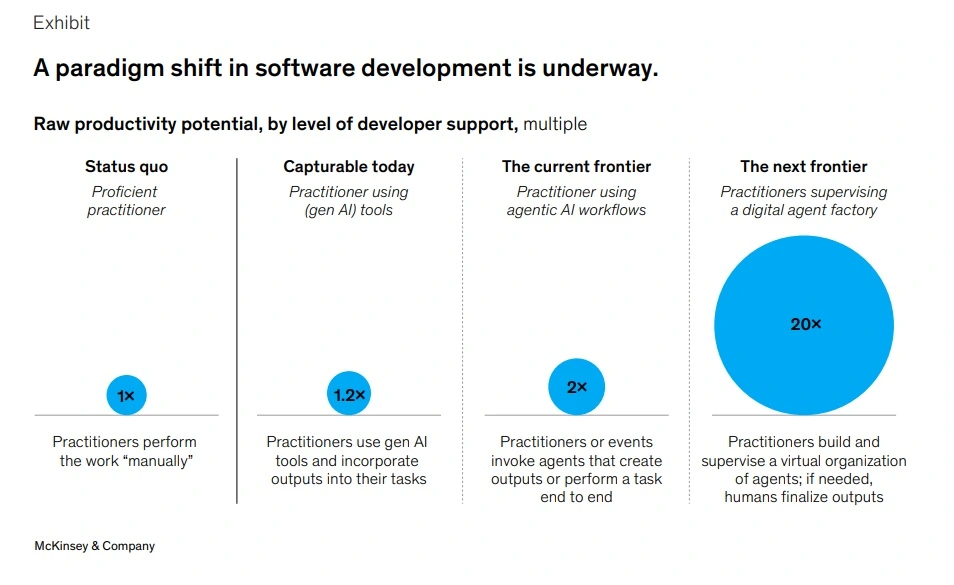
In the software industry, project failures are rarely caused by a lack of coding skills. According to the 2022 Deloitte Global Outsourcing Survey, 65% of IT projects fail to reach their goals. Look closer, and you will see that 41% of these failures happen simply because the requirements are unclear.
When organizations use AI to speed up software delivery, this problem multiplies. A vague requirement used to delay one human developer. Today, a vague requirement confuses an AI agent, causing it to write thousands of lines of incorrect code in seconds.
At Synodus, we learned that preventing AI errors requires changing the first step of the Software Development Life Cycle. The role of BA must evolve. Business Analysts can no longer just write documents. They must design strict knowledge structures.
Three types of “bad requirements”
Many companies assume that if AI generates the wrong business logic, the model needs to be replaced. In practice, the root cause is almost always the requirement analysis process.
Nguyet Duong, BA Lead at Synodus, identifies three specific reasons why requirements fail in an AI assisted environment:
1. The BA lacks deep business context
Sometimes, the requirement is wrong from the start. The analyst might not fully understand the end-to-end user flow, industry regulations, or exception cases. This usually happens when tasks are assigned to the wrong domain expert, when there is not enough mentoring, or when a rushed timeline forces the analyst to make blind assumptions.
2. The specification lacks exact details.
The business goal might be correct, but the design is not detailed enough for an AI agent to execute. For example, it might be missing core business rules, edge cases, or clear state transitions. The acceptance criteria might be too high-level.
“In the past, a senior human developer could fill these knowledge gaps using their own experience,” Nguyet explains. “But when you use an AI coding assistant, the AI tries to guess the missing information. It generates logic that looks technically correct but is entirely wrong for the business.”
3. Fragmented information sources
In traditional teams, requirements are scattered. The user flow is in a slide presentation, the logic rule is in a meeting note, the API detail is in Jira, and the exception case is in a chat message. A human can connect these fragments. An AI cannot. If the input is not highly structured, the engineering review process will face severe delays as developers try to debug the logic and trace the requirements backward.
The new anatomy of a machine-readable specification
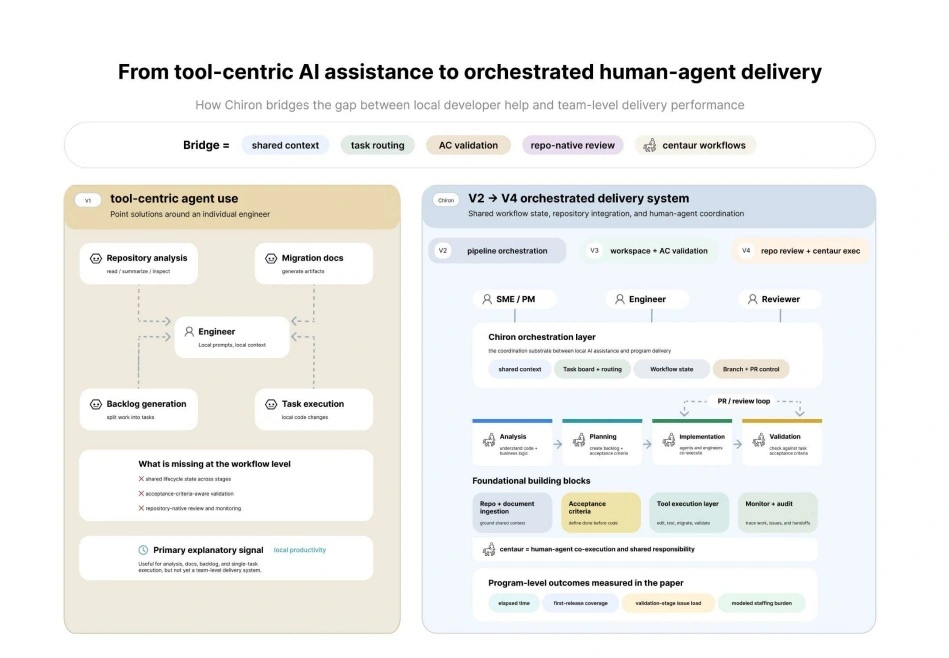
To solve this, our team completely changed traditional BA methods. We stopped writing manual documents and drawing static wireframes. Instead, we use AI throughout the lifecycle to analyze requirements, assist with database diagrams (ERD), and build sequence flows.
Today, UI elements are presented as runnable prototypes, completely generated by AI. Instead of a static mockup, the developer receives the interaction flow, the validation behavior, the component logic, and the prototype source code to understand the expected behavior instantly.
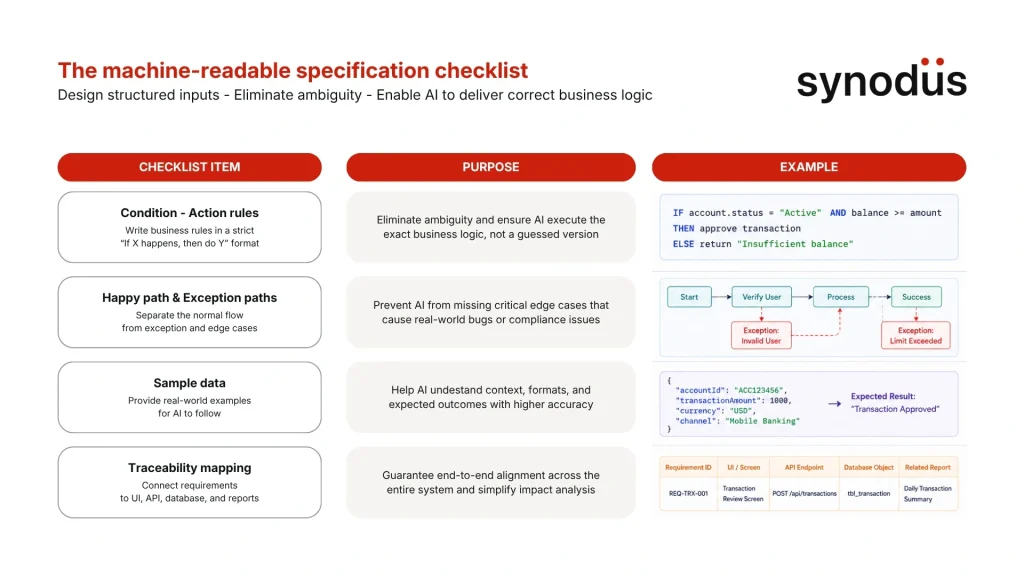
However, AI only accelerates the work. It does not replace the control process. Therefore, our team writes requirements with explicit, machine-readable structures.
To ensure the AI understands the task perfectly, our specifications now include:
Furthermore, we established a strict review process for the artifacts that AI helps create. Before handing anything over to developers, the team reviews the prototype flow, business rule coverage, naming consistency, data mapping, and the AI generated prototype code.
How developers use the single source of truth
Creating this level of detail requires more upfront work. But it drastically reduces wasted time during the coding phase.
The 2024 IBM Research report titled Exploring Prompt Engineering Practices in the Enterprise shows that developers waste an average of 43.4 minutes per session just fixing the background information they give to AI tools. By delivering a perfect document with strict rules, we eliminate this waste.
“The time we save depends entirely on the detail of the document from the BA team,” says Hiep Nguyen, Technical Lead. “To prevent the AI from inventing its own logic, the first step is always clarifying the context. We do not just command the AI to code. We ask the AI to read the detailed specification document. Then, the developer and the AI brainstorm together. The developer asks questions to check if the AI truly understands the business rules.”
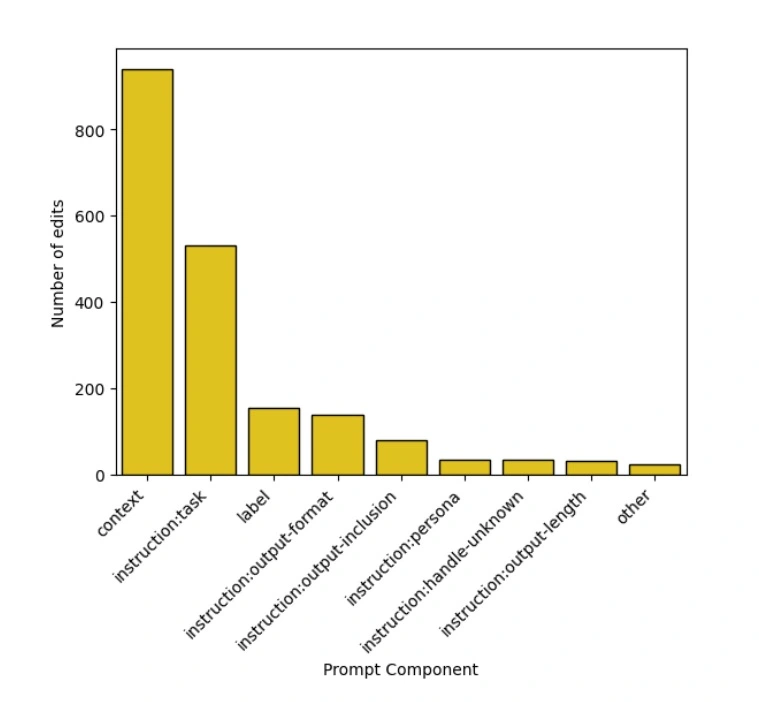
Because the document is highly detailed, the AI has all the information it needs. The developer spends far less time forcing the AI to fix mistakes.
Why enterprise clients demand this process
For many teams, slowing down to build deep knowledge structures feels counterintuitive when AI offers so much speed. But for enterprise software, it is the only way to guarantee stability.
The 2026 MIT Technology Review Insights report titled Establishing AI and data sovereignty in the age of autonomous systems notes that establishing safe operating boundaries is a strict requirement for forging safe autonomous systems. In software development, those boundaries are the business rules.
Quan Nguyen, Director of Solutions and Services, explains why this upfront work protects clients.
“We use a spec-driven development approach,” Quan says. “The Software Requirement Specification (SRS) and the design documents become the single source of truth throughout the entire development lifecycle. This upfront work ensures that business requirements, user flows, edge cases, and system behaviors are clearly defined and aligned before development starts.”
When developers, testers, designers, and clients all work from the same validated specification, misunderstandings disappear. Costly production failures are avoided.
“This exact process is one of the key reasons why banks, hospitals, and other high-trust industries work with us,” Quan adds. “In these environments, system correctness, traceability, predictability, and compliance are critical. A spec-driven process creates a controlled and auditable development flow, ensuring the final system behaves exactly as expected.”
Conclusion
In the age of AI, Business Analysts are no longer just document writers. They are knowledge architects.
By building machine-readable requirements and aligning the business context early, engineering teams can use AI to accelerate delivery safely.
At Synodus, we document our operational frameworks across banking, healthcare, retail, and the public sector. Continue following The Performance-led AI Log to see how we rebuild software delivery systems for the future.